Cervical Dysplasia and Cervical Cancer Qu Quanxin [email_address] Tianjin First Central Hospital
New Cases of Cervical Cancer per Year (Parkin D.M,et al Bulletin of the WHO.1984,62:163-183) 459400 Total 15700 44000 47200 31300 36900 131500 71600 9700 70300 1200 105100 354300 North America Latin America Europe Soviet Union Africa China Indea Japan Asia ( Other Areas ) Australia/New Zealand Advanced Areas Developing Aeras New Cases Area
Etiology and Epidemiology HPV infection   High risk factors   Young age at first coitus(<20yr) Multiple sexual partners Sexual partner with multiple sexual partners Young age at first pregnancy High parity Lower socioeconomic status Smoking
 
LCR E6 E7 E1 E2 E4 E5 L2 L1
HPV HPV infection via wounds in epithelium
Infection From Time of First  Sexual Intercourse From Winer RL, Lee S-K, Hughes JP, Adam DE, Kiviat NB, Koutsky LA. Genital human papillomavirus infection: incidence and risk factors in a cohort of female university students.  Am J Epidemiol.  2003;157:218–226. Reprinted with the permission of Oxford University Press. 0 0.2 0.4 0.6 0.8 1 Months Since First Intercourse Cumulative Incidence of  HPV Infection
*Mantle-Haenszel estimates adjusted for age only 1. La Vecchia C, Franceschi S, DeCarli A, et al.  Cancer . 1986;58:935 – 941.  Age at First Intercourse (Years) (n=206)  (n=327)
Cervical Intraepithelial Neoplasia
9,710 new cases of cervical cancer 1 330,000 new cases of high-grade cervical dysplasia (CIN 2/3) 2 1.4 million new cases of low-grade cervical dysplasia (CIN 1) 2 1 million new cases of genital warts 3 Incidence of HPV infection, CIN and Cervical Cancer in USA
Several Conceptions Cervical intraepithelial neoplasia(CIN)   the condition that different degree of  abnormal epithelial proliferation and maturation above the basement membrane.  Transformation zone   the area of metaplastic squamous epithelial located between the original squamocolumnar junction and new squamocolumnar junction. Original squamocolumnar junction   The junction between the embryologic squamous and columnar epithelia at or near the external cervical os is called the original squamocolumnar junction.
Before puberty After puberty and reproductive period child-bearing period Peri-menopausal period menopausal period
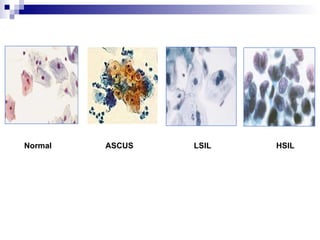
Classification of an abnormal papanicolaou smear (According to the standard of the 2001 Bethesda classification of cytologic abnormalities ) Atypical glandular cells(AGC)(specify endocervical, endometrial, or not otherwise specified) Atypical glandular cells, favor neoplastic (specify endocervical,  or not otherwise specified) Endocervical adenocarcinoma in situ(AIS) Adenocarcinoma Atypical squamous cells of undetermined significance (ASCUS) cannot exclude HSIL(ASC-H) Low-grade squamous intraepithelial lesion(LSIL) encompassing:human papillomavirus/mild High-grade squamous intraepithelial lesion(HSIL) encompassing:moderate and server dysplasia, carcinoma in situ; CIN2 and CIN3 Squamous cell carcinoma glandular epithelial cell abnormalities squamous epithelial cell abnormalities
Normal  ASCUS  LSIL  HSIL
Conventional Pap Smear Decrease Sensitivity
Liquid-based Cytology HPV infection  and endocrine change
The Liquid-based Cytology
CIN 1 CIN2 CIN3 LSIL HSIL Normal or benign disease Carcinoma in situ Early  invasive carcinoma CIN   Pathology Cytology
Colposcopy   At colposcopy, the original or native squamous epithelium appears gray and homogeneous. The columnar epithelium appears red and grapelike. The transformation zone can be identified by the presence of gland openings that are not covered by the squamous metaplasia and by the paler color of the metaplastic epithelium compared with the original squamous epithelium.Normal blood vessels branch like a tree.
 
Squamous epithelial  Columnar epithelial Squamous epithelial  Columnar epithelial (iodine test)
Biopsy and endocervical Curettage A diagnostic cone biopsy of the cervix is indicated if :  Colposcopic examination is unsatisfactory Endocervical curettings show a high-grade lesion Papanicolaou smear shows a high-grade lesion that is not confirmed on punch biopsy Papanicolaou smear indicates adenocarcioma in situ Microinvasive is present on the punch biopsy
Pathology of CIN CIN I  CIN 2  CIN 3  carcinoma in situ
Treatment of intraepithelial neoplasia Loop excision of the transformation   LEEP,loop electrodiathermy excision procedure  Laser   Cryosurgery   Electrocoagulation   Cervical conization   Hysterectomy
Cervical carcinoma
Incidence of Cervical Cancer  in China New Cases  130,000/year Died from CC  20,000~30,000/year Incidence of CC has increased tends to occur in younger
Incidence:  138.75/100,000 (8 million samples, 25 provinces)  High incidence of Age:    ≤ 35  4.8% (80’s)   34.1% (2000) Mortality: 10.28/100,000 (70’s)   3.25/100,000 (90’s)   69% dropped
The presence of  HPV   in virtually all  cervical cancer  implies the highest worldwide attributabe fraction so far reported for a specific  cause  of any major human cancer
Normal  Pre-Invasive Cancer  Invasive Cancer Pre-Invasive Cancer Invasive  Cancer
Natural History of Cerical Carcinogenesis
Signs and Symptoms   Abnormal vaginal bleeding  presents with postcoital, intermenstrual, or postmenopausal vaginal bleeding.   Abnormal vaginal discharge Advanced symptomes   such as, pelvic pain, leg swelling, and urinary frequency.
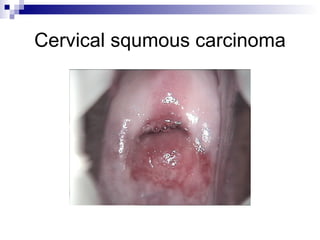
Physical finding General physical examination  such as weight loss, enlarged inguinal lymph nodes, edema of the legs, ascites, pleural effusion, or hepatomegaly. Pelvic examination   I n early cervical cancer may reveal a cervix that appears normal, especially if the lesion is endocervical. Visible disease may take several forms:  ulcerative, exophytic, granular, or necrotic . The lesion may involve the upper potion of the vagina. The cervix may be distorted or completely replaced by tumor.   Rectovaginal examination   E ssential to determine the extent of involvement. The degree of cervical expansion and spread to the parametria are much more easily deteced with a finger in the rectum, as is extension into the uterosacral ligaments.  Laboratory test
Cervical squmous carcinoma
Three Steps Diagnosis for Cervical Carcinoma Cytologic test Colposcopic test Cervical biopsy and Endocervical Curettage
Pathologic features Squamous carcinoma  Adenocarcinoma Adenosquamous carcinomas  Melanomas  Sarcomas
Cervical squmous carcinoma
Cervical adenocarcinoma
Patterns of spread Direct invasion  cervical stroma, vagina, and parametrium.  Lymphatic spread  pelvic and then paraaortic lymph nodes  Hematogenous spread   such as lungs, liver, and bone
The International Federation of Gynecology and Obstetrics(FIGO) staging of cervical carcinoma Spread to distant organs. IVb Spread of the growth to adjacent organs. IVa The carcinoma has extended beyond the true pelvis or has clinically involved the mucosa of the bladder or rectum. A bullous edema, as such, does not permit a case to be allotted to stage IV IV Extension onto the pelvic wall and /or hydronephrosis or nonfunctioning kidney. IIIb Tumor involves lower third of the vagina with no extension to the pelvic wall. IIIa The carcinoma has extended to the pelvic wall. On rectal examination there is no cancer-free space between the tumor and the pelvic wall. The tumor involves the lower third of the vagina. All cases with hydroeprosis or nonfunctioning kidney should be included, unless they are known to be due to another cause. III Obvious parametrial involvement. IIb No obvious parametrial involvement. IIa The carcinoma extends beyond the cervix but has not extended to the pelvic wall or to the lower third of the vagina. II Clinical lesions greater than 4 cm in size Ib2 Clinical lesions not greater than 4 cm in size Ib1 Clinical lesions confined to the cervix or preclinical lesions greater than stage Ia Ib Measured invasion of stroma greater than 3 mm and not greater than 5 mm and width not greater than 7 mm Ia2 Measured invasion of stroma not greater than 3 mm in depth and 7 mm in width Ia1 Invasive cancer is identified only microscopically. All grossslesions even with superficial invasion are Ib cancer. Invasion is limited to a measured stromal invasion, with a maximal depth 5 mm and a horizontal extension of not more than 7 mm Ia The carcinoma is strictly confined to the cervix I Carcinoma in situ, intraepithelial carcinoma  0 Range Stage
 
Preoperative investigations Biopsies, cystoscopy, sigmoidoscopy, chest and skeletal radiographs, and liver function tests.  For patients with advanced disease, an abdominal and pelvic computed tomographic scan is helpful in planning management,  but the results do not influence the FIGO stage.
Treatment of cervical cancer Stage Ia (microinvasive cervical carcinoma ) Operation   radical hysterectomy and bilateral pelvic lymphadenectomy   Radiation therapy  intracavitary and external radiation. chemoradiation, using weekly cisplatin as the radiation sensitizer improve survival
Treatment of cervical cancer Stage II   Stage IIa   radical surgery or chemoradiation therapy   Stage IIb  No operation.   C ombination of external beam chemoradiation and intracavitary therapy .   Stage III Stage IIIa and IIIb  C hemoradiation therapy, usually external beam followed by intracavity brachytherapy. Stage IV Stage IVa   Pelvic chemoradiation therapy.   Stage IVb   S ome pelvic radiation therapy to control bleeding from the vagina, and chemotherapy is for distant metastases .
Prognosis for cervical cancer   Clinical stage Pathologocal type   Adenocarcinoma and adenosquamous carcinoma have a somewhat lower 5-year survival rate than squamous carcinoma, stage for stage.
Key points Main cause for cervical carcinoma What is CIN, transformation zone How to differentiate CIN I, CIN II, CIN III? Diagnosis? Pathologic type? Patterns of spread in cervical carcinoma.
Questions 1 Which examination is the first step in cervical lesion A. Cervical conization B. Endocervical curettage C. Cervical pap smear D. Colposcopy E. Biopsy
Questions 2 Which patient should be treated by operation? A. Stage IIIa B. Stage IVa C. Stage IIa D. Stage IIb E. Stage IIIb

18.Cervical Cancer

  • 1.
    Cervical Dysplasia andCervical Cancer Qu Quanxin [email_address] Tianjin First Central Hospital
  • 2.
    New Cases ofCervical Cancer per Year (Parkin D.M,et al Bulletin of the WHO.1984,62:163-183) 459400 Total 15700 44000 47200 31300 36900 131500 71600 9700 70300 1200 105100 354300 North America Latin America Europe Soviet Union Africa China Indea Japan Asia ( Other Areas ) Australia/New Zealand Advanced Areas Developing Aeras New Cases Area
  • 3.
    Etiology and EpidemiologyHPV infection High risk factors Young age at first coitus(<20yr) Multiple sexual partners Sexual partner with multiple sexual partners Young age at first pregnancy High parity Lower socioeconomic status Smoking
  • 4.
  • 5.
    LCR E6 E7E1 E2 E4 E5 L2 L1
  • 6.
    HPV HPV infectionvia wounds in epithelium
  • 7.
    Infection From Timeof First Sexual Intercourse From Winer RL, Lee S-K, Hughes JP, Adam DE, Kiviat NB, Koutsky LA. Genital human papillomavirus infection: incidence and risk factors in a cohort of female university students. Am J Epidemiol. 2003;157:218–226. Reprinted with the permission of Oxford University Press. 0 0.2 0.4 0.6 0.8 1 Months Since First Intercourse Cumulative Incidence of HPV Infection
  • 8.
    *Mantle-Haenszel estimates adjustedfor age only 1. La Vecchia C, Franceschi S, DeCarli A, et al. Cancer . 1986;58:935 – 941. Age at First Intercourse (Years) (n=206) (n=327)
  • 9.
  • 10.
    9,710 new casesof cervical cancer 1 330,000 new cases of high-grade cervical dysplasia (CIN 2/3) 2 1.4 million new cases of low-grade cervical dysplasia (CIN 1) 2 1 million new cases of genital warts 3 Incidence of HPV infection, CIN and Cervical Cancer in USA
  • 11.
    Several Conceptions Cervicalintraepithelial neoplasia(CIN) the condition that different degree of abnormal epithelial proliferation and maturation above the basement membrane. Transformation zone the area of metaplastic squamous epithelial located between the original squamocolumnar junction and new squamocolumnar junction. Original squamocolumnar junction The junction between the embryologic squamous and columnar epithelia at or near the external cervical os is called the original squamocolumnar junction.
  • 12.
    Before puberty Afterpuberty and reproductive period child-bearing period Peri-menopausal period menopausal period
  • 13.
    Classification of anabnormal papanicolaou smear (According to the standard of the 2001 Bethesda classification of cytologic abnormalities ) Atypical glandular cells(AGC)(specify endocervical, endometrial, or not otherwise specified) Atypical glandular cells, favor neoplastic (specify endocervical, or not otherwise specified) Endocervical adenocarcinoma in situ(AIS) Adenocarcinoma Atypical squamous cells of undetermined significance (ASCUS) cannot exclude HSIL(ASC-H) Low-grade squamous intraepithelial lesion(LSIL) encompassing:human papillomavirus/mild High-grade squamous intraepithelial lesion(HSIL) encompassing:moderate and server dysplasia, carcinoma in situ; CIN2 and CIN3 Squamous cell carcinoma glandular epithelial cell abnormalities squamous epithelial cell abnormalities
  • 14.
    Normal ASCUS LSIL HSIL
  • 15.
    Conventional Pap SmearDecrease Sensitivity
  • 16.
    Liquid-based Cytology HPVinfection and endocrine change
  • 17.
  • 18.
    CIN 1 CIN2CIN3 LSIL HSIL Normal or benign disease Carcinoma in situ Early invasive carcinoma CIN Pathology Cytology
  • 19.
    Colposcopy At colposcopy, the original or native squamous epithelium appears gray and homogeneous. The columnar epithelium appears red and grapelike. The transformation zone can be identified by the presence of gland openings that are not covered by the squamous metaplasia and by the paler color of the metaplastic epithelium compared with the original squamous epithelium.Normal blood vessels branch like a tree.
  • 20.
  • 21.
    Squamous epithelial Columnar epithelial Squamous epithelial Columnar epithelial (iodine test)
  • 22.
    Biopsy and endocervicalCurettage A diagnostic cone biopsy of the cervix is indicated if : Colposcopic examination is unsatisfactory Endocervical curettings show a high-grade lesion Papanicolaou smear shows a high-grade lesion that is not confirmed on punch biopsy Papanicolaou smear indicates adenocarcioma in situ Microinvasive is present on the punch biopsy
  • 23.
    Pathology of CINCIN I CIN 2 CIN 3 carcinoma in situ
  • 24.
    Treatment of intraepithelialneoplasia Loop excision of the transformation LEEP,loop electrodiathermy excision procedure Laser Cryosurgery Electrocoagulation Cervical conization Hysterectomy
  • 25.
  • 26.
    Incidence of CervicalCancer in China New Cases 130,000/year Died from CC 20,000~30,000/year Incidence of CC has increased tends to occur in younger
  • 27.
    Incidence: 138.75/100,000(8 million samples, 25 provinces) High incidence of Age: ≤ 35 4.8% (80’s) 34.1% (2000) Mortality: 10.28/100,000 (70’s) 3.25/100,000 (90’s) 69% dropped
  • 28.
    The presence of HPV in virtually all cervical cancer implies the highest worldwide attributabe fraction so far reported for a specific cause of any major human cancer
  • 29.
    Normal Pre-InvasiveCancer Invasive Cancer Pre-Invasive Cancer Invasive Cancer
  • 30.
    Natural History ofCerical Carcinogenesis
  • 31.
    Signs and Symptoms Abnormal vaginal bleeding presents with postcoital, intermenstrual, or postmenopausal vaginal bleeding. Abnormal vaginal discharge Advanced symptomes such as, pelvic pain, leg swelling, and urinary frequency.
  • 32.
    Physical finding Generalphysical examination such as weight loss, enlarged inguinal lymph nodes, edema of the legs, ascites, pleural effusion, or hepatomegaly. Pelvic examination I n early cervical cancer may reveal a cervix that appears normal, especially if the lesion is endocervical. Visible disease may take several forms: ulcerative, exophytic, granular, or necrotic . The lesion may involve the upper potion of the vagina. The cervix may be distorted or completely replaced by tumor. Rectovaginal examination E ssential to determine the extent of involvement. The degree of cervical expansion and spread to the parametria are much more easily deteced with a finger in the rectum, as is extension into the uterosacral ligaments. Laboratory test
  • 33.
  • 34.
  • 35.
  • 36.
    Three Steps Diagnosisfor Cervical Carcinoma Cytologic test Colposcopic test Cervical biopsy and Endocervical Curettage
  • 37.
    Pathologic features Squamouscarcinoma Adenocarcinoma Adenosquamous carcinomas Melanomas Sarcomas
  • 38.
  • 39.
  • 40.
  • 41.
  • 42.
    Patterns of spreadDirect invasion cervical stroma, vagina, and parametrium. Lymphatic spread pelvic and then paraaortic lymph nodes Hematogenous spread such as lungs, liver, and bone
  • 43.
    The International Federationof Gynecology and Obstetrics(FIGO) staging of cervical carcinoma Spread to distant organs. IVb Spread of the growth to adjacent organs. IVa The carcinoma has extended beyond the true pelvis or has clinically involved the mucosa of the bladder or rectum. A bullous edema, as such, does not permit a case to be allotted to stage IV IV Extension onto the pelvic wall and /or hydronephrosis or nonfunctioning kidney. IIIb Tumor involves lower third of the vagina with no extension to the pelvic wall. IIIa The carcinoma has extended to the pelvic wall. On rectal examination there is no cancer-free space between the tumor and the pelvic wall. The tumor involves the lower third of the vagina. All cases with hydroeprosis or nonfunctioning kidney should be included, unless they are known to be due to another cause. III Obvious parametrial involvement. IIb No obvious parametrial involvement. IIa The carcinoma extends beyond the cervix but has not extended to the pelvic wall or to the lower third of the vagina. II Clinical lesions greater than 4 cm in size Ib2 Clinical lesions not greater than 4 cm in size Ib1 Clinical lesions confined to the cervix or preclinical lesions greater than stage Ia Ib Measured invasion of stroma greater than 3 mm and not greater than 5 mm and width not greater than 7 mm Ia2 Measured invasion of stroma not greater than 3 mm in depth and 7 mm in width Ia1 Invasive cancer is identified only microscopically. All grossslesions even with superficial invasion are Ib cancer. Invasion is limited to a measured stromal invasion, with a maximal depth 5 mm and a horizontal extension of not more than 7 mm Ia The carcinoma is strictly confined to the cervix I Carcinoma in situ, intraepithelial carcinoma 0 Range Stage
  • 44.
  • 45.
    Preoperative investigations Biopsies,cystoscopy, sigmoidoscopy, chest and skeletal radiographs, and liver function tests. For patients with advanced disease, an abdominal and pelvic computed tomographic scan is helpful in planning management, but the results do not influence the FIGO stage.
  • 46.
    Treatment of cervicalcancer Stage Ia (microinvasive cervical carcinoma ) Operation radical hysterectomy and bilateral pelvic lymphadenectomy Radiation therapy intracavitary and external radiation. chemoradiation, using weekly cisplatin as the radiation sensitizer improve survival
  • 47.
    Treatment of cervicalcancer Stage II Stage IIa radical surgery or chemoradiation therapy Stage IIb No operation. C ombination of external beam chemoradiation and intracavitary therapy . Stage III Stage IIIa and IIIb C hemoradiation therapy, usually external beam followed by intracavity brachytherapy. Stage IV Stage IVa Pelvic chemoradiation therapy. Stage IVb S ome pelvic radiation therapy to control bleeding from the vagina, and chemotherapy is for distant metastases .
  • 48.
    Prognosis for cervicalcancer Clinical stage Pathologocal type Adenocarcinoma and adenosquamous carcinoma have a somewhat lower 5-year survival rate than squamous carcinoma, stage for stage.
  • 49.
    Key points Maincause for cervical carcinoma What is CIN, transformation zone How to differentiate CIN I, CIN II, CIN III? Diagnosis? Pathologic type? Patterns of spread in cervical carcinoma.
  • 50.
    Questions 1 Whichexamination is the first step in cervical lesion A. Cervical conization B. Endocervical curettage C. Cervical pap smear D. Colposcopy E. Biopsy
  • 51.
    Questions 2 Whichpatient should be treated by operation? A. Stage IIIa B. Stage IVa C. Stage IIa D. Stage IIb E. Stage IIIb