Dr.ARVIND RAJWANSHI  ( MODERATOR) Dr.Kunal SEHGAL Cervical Cytology : Nomenclature &  Classification
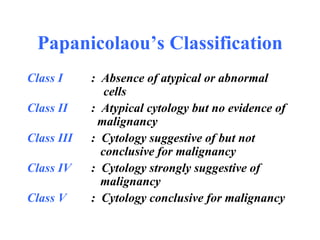
Papanicolaou’s Classification Class I :  Absence of atypical or abnormal    cells Class II :  Atypical cytology but no evidence of    malignancy Class III :  Cytology suggestive of but not    conclusive for malignancy Class IV :  Cytology strongly suggestive of    malignancy Class V :  Cytology conclusive for malignancy
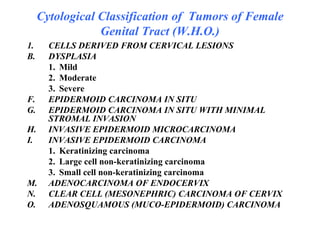
Cytological Classification of  Tumors of Female Genital Tract (W.H.O.) CELLS DERIVED FROM CERVICAL LESIONS DYSPLASIA 1.  Mild 2.  Moderate 3.  Severe EPIDERMOID CARCINOMA IN SITU EPIDERMOID CARCINOMA IN SITU WITH MINIMAL STROMAL INVASION INVASIVE EPIDERMOID MICROCARCINOMA INVASIVE EPIDERMOID CARCINOMA 1. Keratinizing carcinoma 2. Large cell non-keratinizing carcinoma 3. Small cell non-keratinizing carcinoma ADENOCARCINOMA OF ENDOCERVIX CLEAR CELL (MESONEPHRIC) CARCINOMA OF CERVIX ADENOSQUAMOUS (MUCO-EPIDERMOID) CARCINOMA
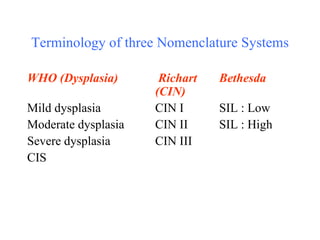
Terminology of three Nomenclature Systems WHO (Dysplasia)    Richart  Bethesda   (CIN) Mild dysplasia   CIN I  SIL : Low Moderate dysplasia  CIN II  SIL : High  Severe dysplasia  CIN III CIS
Current concepts :Cervical Cytology Bethesda System for Reporting Cervical/Vaginal Cytologic Diagnosis
Bethesda System: Why? 1.Need for standard system of nomenclature so that the results are comparable 2.A clear statement of Adequacy of the specimen 3.General categorization 4.Appropriateness of making recommendations for further evaluation if clinically indicated
Why?Bethesda System It is important to distinguish cervical intraepithelial neoplasia from benign & reactive atypias.  More recent information pointing to an apparent biologic dichotomy between mere “infection” and genuine “neoplasia” has resulted in latest entry:Bethesda System
Why?Bethesda System The Bethesda System terminology suggests that the disease is not a continuum but rather a discontinuous two disease system emphasized by terminology of low (6 & 11) and high grade (16-18) squamous intraepithelial lesion.
The 1991 Bethesda System Epithelial Cell Abnormalities Squamous Cell Atypical squamous cells of undetermined significance: [Qualify †] Low-grade squamous intraepithelial lesion encompassing:HPV *   mild dysplasia/CIN I High-grade squamous intraepithelial lesion encompassing: Moderate and severe dysplasia, CIS/CIN II and CIN III Squamous cell acrcinoma Glandular Cell Endometrial cells, cytologically benign, in a postmenopausal woman Atypical glandular cells of undetermined significance :  [Qualify †] Endocervical adenocarcinoma Endometrial adenocarcinoma Extrauterine adenocarcinoma Adenocarcinoma, not otherwise specified Other Malignant Neoplasms : [Specify] Hormonal Evaluation (applies to vaginal smears only) Hormonal pattern compatible with age and history Hormonal pattern incompatible with age and history: [Specify] Hormonal evaluation not possible [Specify] Adequacy of the Specimen Satisfactory for evaluation Satisfactory for evaluation but limited by …  [specify reason] Unsatisfactory for evaluation …[specify reason] General Categorization (Optional) Within normal limits Benign cellular changes: See Descriptive  Diagnosis Epithelial cell abnormality: See Descriptive  Diagnosis Descriptive Diagnosis Benign Cellular Changes Infection Trichomonas vaginalis Fungal organisms morphologically consistent with  Candida species Predominance of coccobacilli consistent with shift in  vaginal flora Bacteria morphologically consistent with  Actinomyces species Cellular changes associated with herpes simplex  virus  Others * Reactive Changes Reactive cellular changes associated with: Inflammation (includes typical repair) Atrophy with inflammation “”atrophic vaginitis” Radiation Intrauterine contraceptive device (IUD) Other Cellular changes of human papillomavirus (HPV) previously termed koilocytosis, koilocytotic atypia, or condylomatous atypia are included in the category of low-grade squamous intraepithelial lesion. †  Atypical squamous or glandular cells of undetermined significance should be further qualified, if possible, as to whether a reactive or a premalignant/malignant process is favoured.
Bethesda System  2001 One example of a significant change in this version of The Bethesda System is the incorporation of the new technology called "liquid-based" collection. Instead of taking a conventional smear that spreads the cell specimen across a glass slide, liquid-based collection involves rinsing or dropping the collection instrument in a vial of liquid fixative.  Previous versions of Bethesda required an evaluation of whether the specimen was considered adequate, but criteria were based on the conventional smear and did not address the new technologies.  The 2001 Bethesda System incorporates new criteria for evaluating liquid-based specimens.
Adequacy: Bethesda 2001 Bethesda 2001 also proposes new numeric criteria for an adequate squamous component for both conventional and liquid based preparations. Conventional smears : “Unsatisfactory” if <8000 well preserved and visualized squamous cells. Liquid based preparations : adequate squamous component is 5000 well preserved and visualized cells JAMA 2002;14:172-177.
Bethesda System  2001 There have been a number of studies over the past decade that have identified a subset of women who have ambiguous findings – either squamous atypical changes  glandular atypical changes  These women are at higher risk of having an occult, or under diagnosed, high-grade lesion, who need treatment.  To help identify this subset of women, Bethesda 2001 does two things:  First, it eliminates any kind of false assurance to the clinician, by getting rid of the phrases &quot;favor reactive process&quot; or &quot;favor benign process.“ Second, it focuses clinicians' attention on a subset of women with squamous cell changes who are at highest risk of having a lesion that needs treatment. It does this by creating a new category -- atypical squamous cells -- cannot exclude a high-grade lesion (ASC-H). So these higher-risk cells are now flagged for clinicians - not just in the new terminology but also in the management guidelines.  These women are managed differently than the general pool of women who have ambiguous test results.
THE 2001 BETHESDA SYSTEM SPECIMEN TYPE   Indicate conventional smear (Pap smear) vs. liquid-based preparation vs. other     SPECIMEN ADEQUACY Satisfactory for evaluation: (describe presence or absence of endocervical/transformation zone component and any other quality indicators, e.g., partially obscuring blood, inflammation, etc) Unsatisfactory for evaluation(specify reason)  Specimen rejected/not processed (specify reason)  Specimen processedand examinedbut Unsatisfactory for epithelial abnormality because of (specify reason)
THE 2001 BETHESDA SYSTEM (Cont.) INTERPRETATION / RESULT   NEGATIVE for Intraepithelial lesion or malignancy Organisms: Trichomonas vaginalis Fungal: Candida  Altered flora:Actinomyces species  Herpes Simplex virus  Other non neoplastic findings  Reactive cellular changes associated with:  Inflammation  (includes typical repair)  Radiation  Intrauterine Contraceptive Devices(IUD) Glandular cells status post hysterectomy Atrophy Other:Endometrial cells (in a woman >= 40 years of age)  (Specify if ‘negative for squamous intraepithelial lesion’)
THE 2001 BETHESDA SYSTEM (Cont.) Epithelial Cell Abnormalities Squamous cells Atypical squamous cells  Undetermined significance (ASCUS ) Can not exclude H SIL  (ASC-H)  Low grade Squamous Intraepithelial Lesion Encompassing: HPV/mild dysplasia/CIN 1 High grade Squamous Intraepithelial Lesion (HSIL) Encompassing: moderate and severe dysplasia, CIS; CIN 2 and CIN 3  With features suspicious for Invasion (if invasion is suspected)  Squamous Cell Carcinoma
THE 2001 BETHESDA SYSTEM (CONT) GLANDULAR CELL Atypical Endocervical Cells,NOS or specify in comments  Endometrial cells,NOS or specify in comments  Glandular cells ,NOS   or specify in comments  Atypical Endocervical cells,Favour neoplastic Glandular cells,favourneoplastic  Endocervical adenocarcinoma in situ Adenocarcinoma:Endocervical,Endometrial, Extrauterine,not otherwise specified(NOS)  OTHER MALIGNANT NEOPLASMS Ancillary Testing
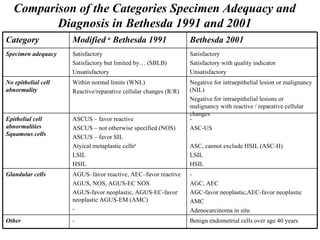
Comparison of the Categories Specimen Adequacy and Diagnosis in Bethesda 1991 and 2001 Benign endometrial cells over age 40 years - Other - AGC, AEC AGC-favor neoplastic,AEC-favor neoplastic AMC Adenocarcinoma in situ AGUS–favor reactive, AEC–favor reactive AGUS, NOS, AGUS-EC NOS AGUS-favor neoplastic, AGUS-EC-favor neoplastic AGUS-EM (AMC) - Glandular cells - ASC-US ASC, cannot exclude HSIL (ASC-H) LSIL HSIL ASCUS – favor reactive ASCUS – not otherwise specified (NOS) ASCUS – favor SIL Atyical metaplastic cells 6 LSIL HSIL Epithelial cell abnormalities Squamous cells Negative for intraepithelial lesion or malignancy (NIL) Negative for intraepithelial lesions or malignancy with reactive / reparative cellular changes Within normal limits (WNL) Reactive/reparative cellular changes (R/R) No epithelial cell abnormality Satisfactory Satisfactory with quality indicator Unsatisfactory Satisfactory Satisfactory but limited by… (SBLB) Unsatisfactory Specimen adequacy Bethesda 2001 Modified  a  Bethesda 1991 Category
Bethesda 1991 Vs.2001 Using Bethesda 1991 ‘SBLB’ smears may be classified in “Unsatisfactory” under Bethesda 2001. Acta Cytol 2004;48:355-362 There will be no ASCUS favour reactive There will be no AGUS favour reactive Liquid based preparation will become the order of the day
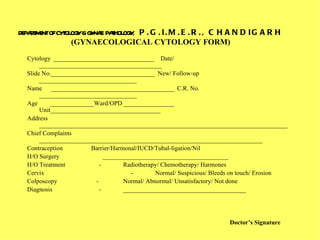
DEPARTMENT OF CYTOLOGY & GYNAE  PATHOLOGY ,  P.G.I.M.E.R., CHANDIGARH (GYNAECOLOGICAL CYTOLOGY FORM) Cytology  ________________________________  Date/ _______________________________________ Slide No._________________________________  New/ Follow-up _______________________________ Name  _______________________________________  C.R. No. _______________________________ Age  ______________Ward/OPD ________________ Unit___________________________________ Address  _______________________________________________________________________________ Chief Complaints   _______________________________________________________________________  Contraception Barrier/Harmonal/IUCD/Tubal-ligation/Nil  H/O Surgery  ________________________________________ H/O Treatment   - Radiotherapy/ Chemotherapy/ Harmones Cervix     - Normal/ Suspicious/ Bleeds on touch/ Erosion Colposcopy   - Normal/ Abnormal/ Unsatisfactory/ Not done Diagnosis     - _______________________________________         Doctor’s Signature    
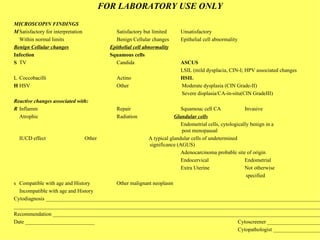
FOR LABORATORY USE ONLY MICROSCOPIN FINDINGS    Satisfactory for interpretation     Satisfactory but limited     Unsatisfactory    Within normal limits     Benign Cellular changes     Epithelial cell abnormality Benign Cellular changes   Epithelial cell abnormality Infection Squamous cells    TV     Candida      ASCUS      LSIL (mild dysplacia, CIN-I; HPV associated changes    Coccobacilli     Actino      HSIL    HSV     Other   Moderate dysplasia (CIN Grade-II)   Severe displasia/CA-in-situ(CIN GradeIII) Reactive changes associated with:    Inflamm     Repair     Squamouc cell CA     Invasive    Atrophic     Radiation Glandular cells      Endometrial cells, cytologically benign in a    post menopausal    IUCD effect     Other     A typical glandular cells of undetermined    significance (AGUS)      Adenocarcinoma probable site of origin      Endocervical     Endometrial      Extra Uterine     Not otherwise   specified    Compatible with age and History     Other malignant neoplasm    Incompatible with age and History Cytodiagnosis _________________________________________________________________________________________________________ _____________________________________________________________________________________________________________________ Recommendation ______________________________________________________________________________________________________ Date __________________________ Cytoscreener ______________________ Cytopathologist ____________________
Proposed Sheffield quantitative criteria in cervical cytology to assist the grading of squamous cell dyskaryosis, as the British Society for Clinical Cytology definitions require amendment Slater DN, Rice S, Stewart R,  Melling  SE, Hewer EM, Smith JH. Cytopathology Volume 16 Issue 4 Page 179  - August 2005 in 2002, however, the BSCC recommended on their website that the three-tier model should be replaced by a new two-tier system of low- and high-grade squamous abnormalities. The latter broadly equate with the two-grade Bethesda System (TBS) for reporting squamous intraepithelial lesions  Differences, however, were noted in area measurements between SurePath TM  and ThinPrep ®  and this has potential implications for classifications (such as TBS) using area comparisons as their basis. In addition, it was found that the increased NC ratio, associated with higher grades of dyskaryosis is more a consequence of progressive cytoplasmic area reduction rather than nuclear area increase. The similar NC ratios of borderline nuclear changes associated with human papilloma virus and mild dyskaryosis support the BSCC proposal that these can be combined to constitute a low-grade category. This study shows that the BSCC area NC ratio criteria of grading squamous cell dyskaryosis require amendment. In addition, this study supports the new BSCC recommendation of low- and high-grade squamous cell categories. The study proposes Sheffield quantitative criteria to assist the grading of squamous cell abnormalities. Quantitative diameter NC ratio measurements, however, must always be accompanied by detailed assessment of qualitative morphological features and in particular those relating to nuclear chromatin. This is equally relevant to both two- and three-tier models.
BSCC, Bethesda or other? Terminology in cervical cytology European panel discussion Kocjan  G,  Priollet  BC, Desai M,  Koutselini  H,  Mahovlic  V, Oliveira MH,  Pohar-Marinsek  Z, Sauer T, Schenk U,  Shabalova  I, Herbert A. Cytopathology. 2005 Jun;16(3):113-9. The European panel agreed that reproducibility and translatability of terminology in cervical cytology were essential, arguing well for harmonization of reporting systems. The majority at this meeting use a modification of the Bethesda system (BS). Local modifications involved reporting subcategories within high grade and low grade lesions, which would not alter the overall translatability of their systems both with each other and BS. The majority agree that low grade lesions with and without koilocytosis should be managed similarly as should high grade lesions (moderate dysplasia/CIN2 or worse). Those systems linking moderate dysplasia with mild rather than severe dysplasia would need to define moderate dysplasia as such, if their results were to be translatable, which would be preferable to their using a different definition of low grade and high grade lesions. Translation between systems might anyway be facilitated by reporting moderate dysplasia as a subcategory within high grade, which was favoured by most of those present. Therefore, there is no need for exact agreement of terminology if broad principles are agreed.
Eliminating the diagnosis atypical squamous cells of undetermined significance: impact on the accuracy of the Papanicolaou test. Sodhani  P ,  Gupta S ,  Singh V ,  Sehgal  A ,  Mitra  AB . Acta Cytol. 2004 Nov-Dec;48(6):783-7. To assess eliminating the diagnosis &quot;atypical squamous cells of undetermined significance&quot; (ASCUS) from the Bethesda System for Reporting Cervical/Vaginal Cytological Diagnoses and analyze its impact on the sensitivity and positive predictive value of Pap smears.  STUDY DESIGN: A total of 166 previously diagnosed ASCUS cases with follow-up biopsy results available were prospectively downgraded to within normal limits/benign cellular changes or upgraded to specific squamous intraepithelial lesions (SILs) or the malignant category. These review cytodiagnoses were compared with the histologic outcome. The impact on the sensitivity and positive predictive value of Pap smears was also assessed.  RESULTS: Though there was a decrease in the sensitivity of the Pap smear from 100% to 76.3% for SIL overall and from 100% to 80% for high grade SIL (HSIL) alone, there was an improvement in the positive predictive value of diagnosing SIL from 46% to 85% and from 6% to 15% for HSIL alone. CONCLUSION: The ASCUS diagnosis can be minimized to a great extent, if not eliminated completely. The &quot;ASCUS-favor reactive&quot; group can be eliminated, while the diagnoses &quot;ASCUS favor SIL&quot; and &quot;ASCUS-not otherwise specified&quot; should be used sparingly.

Current concepts in cervical cytology

  • 1.
    Dr.ARVIND RAJWANSHI ( MODERATOR) Dr.Kunal SEHGAL Cervical Cytology : Nomenclature & Classification
  • 2.
    Papanicolaou’s Classification ClassI : Absence of atypical or abnormal cells Class II : Atypical cytology but no evidence of malignancy Class III : Cytology suggestive of but not conclusive for malignancy Class IV : Cytology strongly suggestive of malignancy Class V : Cytology conclusive for malignancy
  • 3.
    Cytological Classification of Tumors of Female Genital Tract (W.H.O.) CELLS DERIVED FROM CERVICAL LESIONS DYSPLASIA 1. Mild 2. Moderate 3. Severe EPIDERMOID CARCINOMA IN SITU EPIDERMOID CARCINOMA IN SITU WITH MINIMAL STROMAL INVASION INVASIVE EPIDERMOID MICROCARCINOMA INVASIVE EPIDERMOID CARCINOMA 1. Keratinizing carcinoma 2. Large cell non-keratinizing carcinoma 3. Small cell non-keratinizing carcinoma ADENOCARCINOMA OF ENDOCERVIX CLEAR CELL (MESONEPHRIC) CARCINOMA OF CERVIX ADENOSQUAMOUS (MUCO-EPIDERMOID) CARCINOMA
  • 4.
    Terminology of threeNomenclature Systems WHO (Dysplasia) Richart Bethesda (CIN) Mild dysplasia CIN I SIL : Low Moderate dysplasia CIN II SIL : High Severe dysplasia CIN III CIS
  • 5.
    Current concepts :CervicalCytology Bethesda System for Reporting Cervical/Vaginal Cytologic Diagnosis
  • 6.
    Bethesda System: Why?1.Need for standard system of nomenclature so that the results are comparable 2.A clear statement of Adequacy of the specimen 3.General categorization 4.Appropriateness of making recommendations for further evaluation if clinically indicated
  • 7.
    Why?Bethesda System Itis important to distinguish cervical intraepithelial neoplasia from benign & reactive atypias. More recent information pointing to an apparent biologic dichotomy between mere “infection” and genuine “neoplasia” has resulted in latest entry:Bethesda System
  • 8.
    Why?Bethesda System TheBethesda System terminology suggests that the disease is not a continuum but rather a discontinuous two disease system emphasized by terminology of low (6 & 11) and high grade (16-18) squamous intraepithelial lesion.
  • 9.
    The 1991 BethesdaSystem Epithelial Cell Abnormalities Squamous Cell Atypical squamous cells of undetermined significance: [Qualify †] Low-grade squamous intraepithelial lesion encompassing:HPV * mild dysplasia/CIN I High-grade squamous intraepithelial lesion encompassing: Moderate and severe dysplasia, CIS/CIN II and CIN III Squamous cell acrcinoma Glandular Cell Endometrial cells, cytologically benign, in a postmenopausal woman Atypical glandular cells of undetermined significance : [Qualify †] Endocervical adenocarcinoma Endometrial adenocarcinoma Extrauterine adenocarcinoma Adenocarcinoma, not otherwise specified Other Malignant Neoplasms : [Specify] Hormonal Evaluation (applies to vaginal smears only) Hormonal pattern compatible with age and history Hormonal pattern incompatible with age and history: [Specify] Hormonal evaluation not possible [Specify] Adequacy of the Specimen Satisfactory for evaluation Satisfactory for evaluation but limited by … [specify reason] Unsatisfactory for evaluation …[specify reason] General Categorization (Optional) Within normal limits Benign cellular changes: See Descriptive Diagnosis Epithelial cell abnormality: See Descriptive Diagnosis Descriptive Diagnosis Benign Cellular Changes Infection Trichomonas vaginalis Fungal organisms morphologically consistent with Candida species Predominance of coccobacilli consistent with shift in vaginal flora Bacteria morphologically consistent with Actinomyces species Cellular changes associated with herpes simplex virus Others * Reactive Changes Reactive cellular changes associated with: Inflammation (includes typical repair) Atrophy with inflammation “”atrophic vaginitis” Radiation Intrauterine contraceptive device (IUD) Other Cellular changes of human papillomavirus (HPV) previously termed koilocytosis, koilocytotic atypia, or condylomatous atypia are included in the category of low-grade squamous intraepithelial lesion. † Atypical squamous or glandular cells of undetermined significance should be further qualified, if possible, as to whether a reactive or a premalignant/malignant process is favoured.
  • 10.
    Bethesda System 2001 One example of a significant change in this version of The Bethesda System is the incorporation of the new technology called &quot;liquid-based&quot; collection. Instead of taking a conventional smear that spreads the cell specimen across a glass slide, liquid-based collection involves rinsing or dropping the collection instrument in a vial of liquid fixative. Previous versions of Bethesda required an evaluation of whether the specimen was considered adequate, but criteria were based on the conventional smear and did not address the new technologies. The 2001 Bethesda System incorporates new criteria for evaluating liquid-based specimens.
  • 11.
    Adequacy: Bethesda 2001Bethesda 2001 also proposes new numeric criteria for an adequate squamous component for both conventional and liquid based preparations. Conventional smears : “Unsatisfactory” if <8000 well preserved and visualized squamous cells. Liquid based preparations : adequate squamous component is 5000 well preserved and visualized cells JAMA 2002;14:172-177.
  • 12.
    Bethesda System 2001 There have been a number of studies over the past decade that have identified a subset of women who have ambiguous findings – either squamous atypical changes glandular atypical changes These women are at higher risk of having an occult, or under diagnosed, high-grade lesion, who need treatment. To help identify this subset of women, Bethesda 2001 does two things: First, it eliminates any kind of false assurance to the clinician, by getting rid of the phrases &quot;favor reactive process&quot; or &quot;favor benign process.“ Second, it focuses clinicians' attention on a subset of women with squamous cell changes who are at highest risk of having a lesion that needs treatment. It does this by creating a new category -- atypical squamous cells -- cannot exclude a high-grade lesion (ASC-H). So these higher-risk cells are now flagged for clinicians - not just in the new terminology but also in the management guidelines. These women are managed differently than the general pool of women who have ambiguous test results.
  • 13.
    THE 2001 BETHESDASYSTEM SPECIMEN TYPE Indicate conventional smear (Pap smear) vs. liquid-based preparation vs. other   SPECIMEN ADEQUACY Satisfactory for evaluation: (describe presence or absence of endocervical/transformation zone component and any other quality indicators, e.g., partially obscuring blood, inflammation, etc) Unsatisfactory for evaluation(specify reason) Specimen rejected/not processed (specify reason) Specimen processedand examinedbut Unsatisfactory for epithelial abnormality because of (specify reason)
  • 14.
    THE 2001 BETHESDASYSTEM (Cont.) INTERPRETATION / RESULT NEGATIVE for Intraepithelial lesion or malignancy Organisms: Trichomonas vaginalis Fungal: Candida Altered flora:Actinomyces species Herpes Simplex virus Other non neoplastic findings Reactive cellular changes associated with: Inflammation (includes typical repair) Radiation Intrauterine Contraceptive Devices(IUD) Glandular cells status post hysterectomy Atrophy Other:Endometrial cells (in a woman >= 40 years of age) (Specify if ‘negative for squamous intraepithelial lesion’)
  • 15.
    THE 2001 BETHESDASYSTEM (Cont.) Epithelial Cell Abnormalities Squamous cells Atypical squamous cells Undetermined significance (ASCUS ) Can not exclude H SIL (ASC-H) Low grade Squamous Intraepithelial Lesion Encompassing: HPV/mild dysplasia/CIN 1 High grade Squamous Intraepithelial Lesion (HSIL) Encompassing: moderate and severe dysplasia, CIS; CIN 2 and CIN 3 With features suspicious for Invasion (if invasion is suspected) Squamous Cell Carcinoma
  • 16.
    THE 2001 BETHESDASYSTEM (CONT) GLANDULAR CELL Atypical Endocervical Cells,NOS or specify in comments Endometrial cells,NOS or specify in comments Glandular cells ,NOS or specify in comments Atypical Endocervical cells,Favour neoplastic Glandular cells,favourneoplastic Endocervical adenocarcinoma in situ Adenocarcinoma:Endocervical,Endometrial, Extrauterine,not otherwise specified(NOS) OTHER MALIGNANT NEOPLASMS Ancillary Testing
  • 17.
    Comparison of theCategories Specimen Adequacy and Diagnosis in Bethesda 1991 and 2001 Benign endometrial cells over age 40 years - Other - AGC, AEC AGC-favor neoplastic,AEC-favor neoplastic AMC Adenocarcinoma in situ AGUS–favor reactive, AEC–favor reactive AGUS, NOS, AGUS-EC NOS AGUS-favor neoplastic, AGUS-EC-favor neoplastic AGUS-EM (AMC) - Glandular cells - ASC-US ASC, cannot exclude HSIL (ASC-H) LSIL HSIL ASCUS – favor reactive ASCUS – not otherwise specified (NOS) ASCUS – favor SIL Atyical metaplastic cells 6 LSIL HSIL Epithelial cell abnormalities Squamous cells Negative for intraepithelial lesion or malignancy (NIL) Negative for intraepithelial lesions or malignancy with reactive / reparative cellular changes Within normal limits (WNL) Reactive/reparative cellular changes (R/R) No epithelial cell abnormality Satisfactory Satisfactory with quality indicator Unsatisfactory Satisfactory Satisfactory but limited by… (SBLB) Unsatisfactory Specimen adequacy Bethesda 2001 Modified a Bethesda 1991 Category
  • 18.
    Bethesda 1991 Vs.2001Using Bethesda 1991 ‘SBLB’ smears may be classified in “Unsatisfactory” under Bethesda 2001. Acta Cytol 2004;48:355-362 There will be no ASCUS favour reactive There will be no AGUS favour reactive Liquid based preparation will become the order of the day
  • 19.
    DEPARTMENT OF CYTOLOGY& GYNAE PATHOLOGY , P.G.I.M.E.R., CHANDIGARH (GYNAECOLOGICAL CYTOLOGY FORM) Cytology ________________________________ Date/ _______________________________________ Slide No._________________________________ New/ Follow-up _______________________________ Name _______________________________________ C.R. No. _______________________________ Age ______________Ward/OPD ________________ Unit___________________________________ Address _______________________________________________________________________________ Chief Complaints _______________________________________________________________________ Contraception Barrier/Harmonal/IUCD/Tubal-ligation/Nil H/O Surgery ________________________________________ H/O Treatment - Radiotherapy/ Chemotherapy/ Harmones Cervix - Normal/ Suspicious/ Bleeds on touch/ Erosion Colposcopy - Normal/ Abnormal/ Unsatisfactory/ Not done Diagnosis - _______________________________________       Doctor’s Signature    
  • 20.
    FOR LABORATORY USEONLY MICROSCOPIN FINDINGS  Satisfactory for interpretation  Satisfactory but limited  Unsatisfactory  Within normal limits  Benign Cellular changes  Epithelial cell abnormality Benign Cellular changes Epithelial cell abnormality Infection Squamous cells  TV  Candida  ASCUS  LSIL (mild dysplacia, CIN-I; HPV associated changes  Coccobacilli  Actino  HSIL  HSV  Other Moderate dysplasia (CIN Grade-II) Severe displasia/CA-in-situ(CIN GradeIII) Reactive changes associated with:  Inflamm  Repair  Squamouc cell CA  Invasive  Atrophic  Radiation Glandular cells  Endometrial cells, cytologically benign in a post menopausal  IUCD effect  Other  A typical glandular cells of undetermined significance (AGUS)  Adenocarcinoma probable site of origin  Endocervical  Endometrial  Extra Uterine  Not otherwise specified  Compatible with age and History  Other malignant neoplasm  Incompatible with age and History Cytodiagnosis _________________________________________________________________________________________________________ _____________________________________________________________________________________________________________________ Recommendation ______________________________________________________________________________________________________ Date __________________________ Cytoscreener ______________________ Cytopathologist ____________________
  • 21.
    Proposed Sheffield quantitativecriteria in cervical cytology to assist the grading of squamous cell dyskaryosis, as the British Society for Clinical Cytology definitions require amendment Slater DN, Rice S, Stewart R, Melling SE, Hewer EM, Smith JH. Cytopathology Volume 16 Issue 4 Page 179  - August 2005 in 2002, however, the BSCC recommended on their website that the three-tier model should be replaced by a new two-tier system of low- and high-grade squamous abnormalities. The latter broadly equate with the two-grade Bethesda System (TBS) for reporting squamous intraepithelial lesions Differences, however, were noted in area measurements between SurePath TM and ThinPrep ® and this has potential implications for classifications (such as TBS) using area comparisons as their basis. In addition, it was found that the increased NC ratio, associated with higher grades of dyskaryosis is more a consequence of progressive cytoplasmic area reduction rather than nuclear area increase. The similar NC ratios of borderline nuclear changes associated with human papilloma virus and mild dyskaryosis support the BSCC proposal that these can be combined to constitute a low-grade category. This study shows that the BSCC area NC ratio criteria of grading squamous cell dyskaryosis require amendment. In addition, this study supports the new BSCC recommendation of low- and high-grade squamous cell categories. The study proposes Sheffield quantitative criteria to assist the grading of squamous cell abnormalities. Quantitative diameter NC ratio measurements, however, must always be accompanied by detailed assessment of qualitative morphological features and in particular those relating to nuclear chromatin. This is equally relevant to both two- and three-tier models.
  • 22.
    BSCC, Bethesda orother? Terminology in cervical cytology European panel discussion Kocjan G, Priollet BC, Desai M, Koutselini H, Mahovlic V, Oliveira MH, Pohar-Marinsek Z, Sauer T, Schenk U, Shabalova I, Herbert A. Cytopathology. 2005 Jun;16(3):113-9. The European panel agreed that reproducibility and translatability of terminology in cervical cytology were essential, arguing well for harmonization of reporting systems. The majority at this meeting use a modification of the Bethesda system (BS). Local modifications involved reporting subcategories within high grade and low grade lesions, which would not alter the overall translatability of their systems both with each other and BS. The majority agree that low grade lesions with and without koilocytosis should be managed similarly as should high grade lesions (moderate dysplasia/CIN2 or worse). Those systems linking moderate dysplasia with mild rather than severe dysplasia would need to define moderate dysplasia as such, if their results were to be translatable, which would be preferable to their using a different definition of low grade and high grade lesions. Translation between systems might anyway be facilitated by reporting moderate dysplasia as a subcategory within high grade, which was favoured by most of those present. Therefore, there is no need for exact agreement of terminology if broad principles are agreed.
  • 23.
    Eliminating the diagnosisatypical squamous cells of undetermined significance: impact on the accuracy of the Papanicolaou test. Sodhani P , Gupta S , Singh V , Sehgal A , Mitra AB . Acta Cytol. 2004 Nov-Dec;48(6):783-7. To assess eliminating the diagnosis &quot;atypical squamous cells of undetermined significance&quot; (ASCUS) from the Bethesda System for Reporting Cervical/Vaginal Cytological Diagnoses and analyze its impact on the sensitivity and positive predictive value of Pap smears. STUDY DESIGN: A total of 166 previously diagnosed ASCUS cases with follow-up biopsy results available were prospectively downgraded to within normal limits/benign cellular changes or upgraded to specific squamous intraepithelial lesions (SILs) or the malignant category. These review cytodiagnoses were compared with the histologic outcome. The impact on the sensitivity and positive predictive value of Pap smears was also assessed. RESULTS: Though there was a decrease in the sensitivity of the Pap smear from 100% to 76.3% for SIL overall and from 100% to 80% for high grade SIL (HSIL) alone, there was an improvement in the positive predictive value of diagnosing SIL from 46% to 85% and from 6% to 15% for HSIL alone. CONCLUSION: The ASCUS diagnosis can be minimized to a great extent, if not eliminated completely. The &quot;ASCUS-favor reactive&quot; group can be eliminated, while the diagnoses &quot;ASCUS favor SIL&quot; and &quot;ASCUS-not otherwise specified&quot; should be used sparingly.