Dr. Mostafa Rashed
Family Medicine PGY2
Faculty: Dr. Abeer Abu Abbas
Cancer cervix screening
objectives
 Epidemiology
 Risk factors
 Screening
 Technique
 Inrepretation
Epidemiology
 Cancer of the uterine cervix is the third most
common gynecologic cancer diagnosis and cause
of death among gynecologic cancers in the
United States .
 Unfortunately, in countries that don’t have access
to cervical cancer screening , it remains the
second most common type of cancer (17.8 per
100,000) and cause of cancer deaths (9.8 per
100,000) among all types of cancer in women.
 Human papillomavirus (HPV) is central to the
development of cervical neoplasia and can be
detected in 99.7 percent of cervical cancers.
 The most common histologic types of cervical
cancer are squamous cell (69 percent of cervical
cancers) and adenocarcinoma (25 percent)
 Globally, cervical cancer accounted for an
estimated 530,000 new cancer cases worldwide
and for 275,000 deaths in 2008.
 Eighty-six percent of new cervical cancer cases
will be seen in developing countries and mortality
rate is 52% worldwide.
 Global incidence and mortality rates depend upon
the presence of screening programs for cervical
precancer and cancer and of human
papillomavirus (HPV) vaccination, which are most
likely to be available in developed countries. Due
to these interventions, there has been a 75
percent decrease in the incidence and mortality of
cervical cancer over the past 50 years in
developed countries
Risk factors
 Early onset of sexual activity – Compared with age at first intercourse of
21 years or older, the risk is approximately 1.5-fold for 18 to 20 years
and twofold for younger than 18 years
 Multiple sexual partners – Compared with one partner, the risk is
approximately twofold with two partners and threefold with six or more
partners
 A high-risk sexual partner (eg, a partner with multiple sexual partners or
known HPV infection)
 History of sexually transmitted infections (eg, Chlamydia trachomatis,
genital herpes)
 History of vulvar or vaginal squamous intraepithelial neoplasia or cancer
(HPV infection is also the etiology of most cases of these conditions)
 Immunosuppression (eg, human immunodeficiency virus infection)
 Cervical cancer is less common in sexual partners of circumcised males
 Low socioeconomic status is associated with an increased risk of
cervical cancer
 Oral contraceptive use has been reported to be associated with an
increased risk of cervical cancer.
HPV
 More than 150 types
of HPV are
acknowledged to exist
(some sources
indicate more than
200 subtypes).
 Types 16and 18 are
generally
acknowledged to
cause about 70% of
cervical cancer cases.
Together with type
31, they are the prime
risk factors for cervical
cancer
 High risk
 16, 18, 31, 33, 35, 39,
45, 51, 52, 56, 58, 59,
68, 73, and 82
 Probable high risk
 26, 53, and 66
 Low risk
 6, 11, 40, 42, 43, 44,
54, 61, 70, 72, 81,
and CP6108
HPV INFECTION
 HPV is spread through genital skin contact during
sex. The virus passes through tiny breaks in the
skin. HPV is not spread through blood or other
body fluid.
 Condoms offer limited protection as they do not
cover all of the genital skin.
 Warts on any other parts of the body rarely
spread to the genital area.
 Blood- debatable
 After it enters the body, HPV behaves in one of
two ways:
• it can stay dormant (inside the body’s cells)
• it can become active.
BENEFITS OF SCREENING:
 Cervical cancer screening detects precancerous
lesions and early-stage disease, the treatment of
which decreases the incidence of cervical cancer
and cervical cancer mortality, respectively.
 The United States adopted screening with the
Pap test in the 1950s and by the mid-1980s
cervical cancer incidence decreased by 70
percent
SCREENING
 Discontinuing screening :
— The age to discontinue screening in older women
depends on whether or not they have received adequate
prior screening.
 Adequate prior screening — In general, we
suggest not screening women aged 65 years and older
provided they meet the following criteria:
 No increased risk (ie, history of abnormal screening,
current smoker or history of smoking, unknown screening
history, previous HPV-related disease, new partners,
immunocompromised, in utero diethylstilbestrol
exposure)
 Adequate prior screening: two negative consecutive co-
tests or three negative Pap tests within the past 10 years,
with the most recent test within the previous five years
[43]
 No history of high-grade dysplasia or worse
 SPECIAL POPULATIONS
 Immunocompromised women
 Women with HIV – Women who are infected with
HIV are more likely to have persistent HPV infection,
increased rates of high-grade cervical dysplasia, and
are at increased risk for the development of cervical
cancer. ACOG suggests initiating annual Pap test
screening at age 21. We initiate screening one year
after the onset of sexual activity and screen yearly
with Pap test and human papilloma virus testing.
Atypical squamous cells of
undetermined significance (ASC-US)
 Most common cytological abnormality.
 Option 1: repeat cytology in 12 months
If negative – cytology in 3 years
If ASC or greater – COLPOSCOPY
 Option 2: Preferred: reflex HPV Testing
If positive: colposcopy
If negative: repeat co testing in 3 years
HPV Positive, cytology negative
 Option1: repeat cotesting in 12 months
If HPV positive or ASC-US +: COLPOSCOPY
If HPV negative or cytology –ve: rescreen with
cotesting in 3 years
 Option 2: reflex test for HPV16 or HPV16/18
genotypes
If HPV16 or HPV 16/18 +ve: colposcopy
If HPV16 or HPV 16/18 –ve: co test in 12 months
PAP Smear
 PAP smear sampling of cervix involves
scraping of cervical surface and a portion of
non visualised cervical canal using various
sampling devices
Transformation zone
 Cervix develops from 2 embryonic sites
* from Mullerian duct - lined by columnar
epithelium
* from urogenital plate - lined by stratified
squamous epithelium
 Point at which columnar and squamous
epithelium meet is called as original squamo-
columnar junction
Tranformation zone
 Transformation zone may not be viewed
during routine speculum examination
How to take a Pap Smear ?
 Proper technique is very important
 More problems are due to improper sampling
than screening
 Not to be collected during menses
 Avoid vaginal contraceptives, vaginal medications
for at least 48 hrs before taking smear
 Abstinence for 24 hrs
 Postpartum smear should be taken only after 6 -
8 weeks of delivery
 Pregnancy is NOT a contraindication for pap
smear.
SAMPLING INSTRUMENTS
 SPATULA’S SPATULA
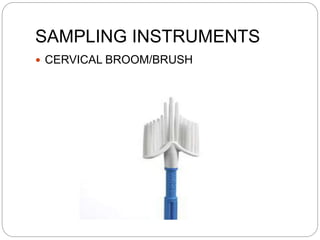
SAMPLING INSTRUMENTS
 CERVICAL BROOM/BRUSH
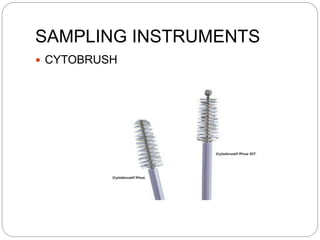
SAMPLING INSTRUMENTS
 CYTOBRUSH
An optimal cervical specimen includes sampling of the squamous
epithelium (Ectocervix) and columnar epithelium (Endocervix)
and in particular the TRANSFORMATION ZONE, where the
majority of cervical neoplasias arise.
COLLECTING PAP SMEAR :
SPATULA
 Choose the contoured end of the spatula which
best conforms to the cervix and the
transformation zone.
 Rotate the spatula 360o about the circumference
of the cervix, while maintaining firm contact with
the epithelial surface.
 With a clockwise rotation beginning and ending at
9 o'clock (or counter-clockwise rotation from 3
o'clock to 3 o'clock), the collected material is
retained on the upper horizontal surface as the
instrument is removed.
COLLECTING PAP SMEAR :
CERVICAL BRUSH
 These brushes have circumferential bristles that
come into contact with the entire os surface on
insertion.
 The brush need only be turned 1/4 turn.
 Roll the brush across the slide by twirling the
handle.
 Not recommended for pregnancy.
PLACEMENT ON SLIDE
 Spread : quick and even , cellular material in a
monolayer on the slide.
 Thin out large clumps of material as much as
possible, avoide excessive manipulation which
can damage cells.
 Fix the specimen by either immersing the
slide in 95% ethanol or coating the slide with a
surface fixative.
Spread the material collected on the spatula / cervix
brush evenly over the slide with a painting action and
single smooth stroke motion using both sides
Spreading options
/ Cervix brush
Bethesda system
Results :
 Within normal limits ( WNL )
Benign cellular changes - this term was removed and group was included in
WNL in 2001
 Reactive or Reparative changes – seen with atrophy, inflammation, surgery,
radiation, IUCD, tampoons
 Infections – trichomoniasis, fungal, bacterial, HSV.
Normal cervix-cytology
 Squamous cells
 Exfoliated indivisual cells
 Navicular in shape with abundant cytoplasm and small, dark, round /oval,
pyknotic nuclei
 Glandular cells
 Many times seen in clumps - linear or honeycombed pattern.
 Slightly larger and basal nuclei
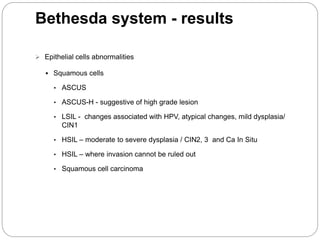
Bethesda system - results
 Epithelial cells abnormalities
 Squamous cells
• ASCUS
• ASCUS-H - suggestive of high grade lesion
• LSIL - changes associated with HPV, atypical changes, mild dysplasia/
CIN1
• HSIL – moderate to severe dysplasia / CIN2, 3 and Ca In Situ
• HSIL – where invasion cannot be ruled out
• Squamous cell carcinoma
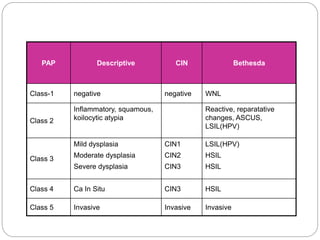
PAP Descriptive CIN Bethesda
Class-1 negative negative WNL
Class 2
Inflammatory, squamous,
koilocytic atypia
Reactive, reparatative
changes, ASCUS,
LSIL(HPV)
Class 3
Mild dysplasia
Moderate dysplasia
Severe dysplasia
CIN1
CIN2
CIN3
LSIL(HPV)
HSIL
HSIL
Class 4 Ca In Situ CIN3 HSIL
Class 5 Invasive Invasive Invasive
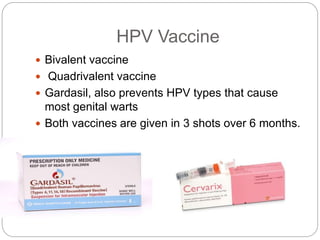
HPV Vaccine
 Bivalent vaccine (CERVARIX)
 Quadrivalent vaccine (GARDASIL).
 Gardasil, also prevents HPV types that cause
most genital warts
 Both vaccines are given in 3 shots over 6 months.
HPV VACCINE
 HPV vaccination is recommended with either
vaccine for 11 and 12 year-old girls.
 It is also recommended for girls and women age
13 through 26 years of age who have not yet
been vaccinated or completed the vaccine series;
 HPV vaccine can also be given to girls beginning
at age 9 years
 Research suggests that vaccine protection is
long-lasting.
 Current studies have followed vaccinated
individuals for six years, and show that there is no
evidence of weakened protection over time
Cancer cervix screening

Cancer cervix screening

  • 1.
    Dr. Mostafa Rashed FamilyMedicine PGY2 Faculty: Dr. Abeer Abu Abbas Cancer cervix screening
  • 2.
    objectives  Epidemiology  Riskfactors  Screening  Technique  Inrepretation
  • 3.
    Epidemiology  Cancer ofthe uterine cervix is the third most common gynecologic cancer diagnosis and cause of death among gynecologic cancers in the United States .  Unfortunately, in countries that don’t have access to cervical cancer screening , it remains the second most common type of cancer (17.8 per 100,000) and cause of cancer deaths (9.8 per 100,000) among all types of cancer in women.
  • 4.
     Human papillomavirus(HPV) is central to the development of cervical neoplasia and can be detected in 99.7 percent of cervical cancers.  The most common histologic types of cervical cancer are squamous cell (69 percent of cervical cancers) and adenocarcinoma (25 percent)  Globally, cervical cancer accounted for an estimated 530,000 new cancer cases worldwide and for 275,000 deaths in 2008.  Eighty-six percent of new cervical cancer cases will be seen in developing countries and mortality rate is 52% worldwide.
  • 5.
     Global incidenceand mortality rates depend upon the presence of screening programs for cervical precancer and cancer and of human papillomavirus (HPV) vaccination, which are most likely to be available in developed countries. Due to these interventions, there has been a 75 percent decrease in the incidence and mortality of cervical cancer over the past 50 years in developed countries
  • 6.
    Risk factors  Earlyonset of sexual activity – Compared with age at first intercourse of 21 years or older, the risk is approximately 1.5-fold for 18 to 20 years and twofold for younger than 18 years  Multiple sexual partners – Compared with one partner, the risk is approximately twofold with two partners and threefold with six or more partners  A high-risk sexual partner (eg, a partner with multiple sexual partners or known HPV infection)  History of sexually transmitted infections (eg, Chlamydia trachomatis, genital herpes)  History of vulvar or vaginal squamous intraepithelial neoplasia or cancer (HPV infection is also the etiology of most cases of these conditions)  Immunosuppression (eg, human immunodeficiency virus infection)  Cervical cancer is less common in sexual partners of circumcised males  Low socioeconomic status is associated with an increased risk of cervical cancer  Oral contraceptive use has been reported to be associated with an increased risk of cervical cancer.
  • 7.
    HPV  More than150 types of HPV are acknowledged to exist (some sources indicate more than 200 subtypes).  Types 16and 18 are generally acknowledged to cause about 70% of cervical cancer cases. Together with type 31, they are the prime risk factors for cervical cancer  High risk  16, 18, 31, 33, 35, 39, 45, 51, 52, 56, 58, 59, 68, 73, and 82  Probable high risk  26, 53, and 66  Low risk  6, 11, 40, 42, 43, 44, 54, 61, 70, 72, 81, and CP6108
  • 8.
    HPV INFECTION  HPVis spread through genital skin contact during sex. The virus passes through tiny breaks in the skin. HPV is not spread through blood or other body fluid.  Condoms offer limited protection as they do not cover all of the genital skin.  Warts on any other parts of the body rarely spread to the genital area.  Blood- debatable  After it enters the body, HPV behaves in one of two ways: • it can stay dormant (inside the body’s cells) • it can become active.
  • 9.
    BENEFITS OF SCREENING: Cervical cancer screening detects precancerous lesions and early-stage disease, the treatment of which decreases the incidence of cervical cancer and cervical cancer mortality, respectively.  The United States adopted screening with the Pap test in the 1950s and by the mid-1980s cervical cancer incidence decreased by 70 percent
  • 10.
  • 11.
     Discontinuing screening: — The age to discontinue screening in older women depends on whether or not they have received adequate prior screening.  Adequate prior screening — In general, we suggest not screening women aged 65 years and older provided they meet the following criteria:  No increased risk (ie, history of abnormal screening, current smoker or history of smoking, unknown screening history, previous HPV-related disease, new partners, immunocompromised, in utero diethylstilbestrol exposure)  Adequate prior screening: two negative consecutive co- tests or three negative Pap tests within the past 10 years, with the most recent test within the previous five years [43]  No history of high-grade dysplasia or worse
  • 12.
     SPECIAL POPULATIONS Immunocompromised women  Women with HIV – Women who are infected with HIV are more likely to have persistent HPV infection, increased rates of high-grade cervical dysplasia, and are at increased risk for the development of cervical cancer. ACOG suggests initiating annual Pap test screening at age 21. We initiate screening one year after the onset of sexual activity and screen yearly with Pap test and human papilloma virus testing.
  • 13.
    Atypical squamous cellsof undetermined significance (ASC-US)  Most common cytological abnormality.  Option 1: repeat cytology in 12 months If negative – cytology in 3 years If ASC or greater – COLPOSCOPY  Option 2: Preferred: reflex HPV Testing If positive: colposcopy If negative: repeat co testing in 3 years
  • 14.
    HPV Positive, cytologynegative  Option1: repeat cotesting in 12 months If HPV positive or ASC-US +: COLPOSCOPY If HPV negative or cytology –ve: rescreen with cotesting in 3 years  Option 2: reflex test for HPV16 or HPV16/18 genotypes If HPV16 or HPV 16/18 +ve: colposcopy If HPV16 or HPV 16/18 –ve: co test in 12 months
  • 16.
    PAP Smear  PAPsmear sampling of cervix involves scraping of cervical surface and a portion of non visualised cervical canal using various sampling devices
  • 17.
    Transformation zone  Cervixdevelops from 2 embryonic sites * from Mullerian duct - lined by columnar epithelium * from urogenital plate - lined by stratified squamous epithelium  Point at which columnar and squamous epithelium meet is called as original squamo- columnar junction
  • 18.
  • 19.
     Transformation zonemay not be viewed during routine speculum examination
  • 20.
    How to takea Pap Smear ?  Proper technique is very important  More problems are due to improper sampling than screening  Not to be collected during menses  Avoid vaginal contraceptives, vaginal medications for at least 48 hrs before taking smear  Abstinence for 24 hrs  Postpartum smear should be taken only after 6 - 8 weeks of delivery  Pregnancy is NOT a contraindication for pap smear.
  • 22.
  • 23.
  • 24.
  • 25.
    An optimal cervicalspecimen includes sampling of the squamous epithelium (Ectocervix) and columnar epithelium (Endocervix) and in particular the TRANSFORMATION ZONE, where the majority of cervical neoplasias arise.
  • 26.
    COLLECTING PAP SMEAR: SPATULA  Choose the contoured end of the spatula which best conforms to the cervix and the transformation zone.  Rotate the spatula 360o about the circumference of the cervix, while maintaining firm contact with the epithelial surface.  With a clockwise rotation beginning and ending at 9 o'clock (or counter-clockwise rotation from 3 o'clock to 3 o'clock), the collected material is retained on the upper horizontal surface as the instrument is removed.
  • 27.
    COLLECTING PAP SMEAR: CERVICAL BRUSH  These brushes have circumferential bristles that come into contact with the entire os surface on insertion.  The brush need only be turned 1/4 turn.  Roll the brush across the slide by twirling the handle.  Not recommended for pregnancy.
  • 28.
    PLACEMENT ON SLIDE Spread : quick and even , cellular material in a monolayer on the slide.  Thin out large clumps of material as much as possible, avoide excessive manipulation which can damage cells.  Fix the specimen by either immersing the slide in 95% ethanol or coating the slide with a surface fixative.
  • 29.
    Spread the materialcollected on the spatula / cervix brush evenly over the slide with a painting action and single smooth stroke motion using both sides
  • 30.
  • 31.
    Bethesda system Results : Within normal limits ( WNL ) Benign cellular changes - this term was removed and group was included in WNL in 2001  Reactive or Reparative changes – seen with atrophy, inflammation, surgery, radiation, IUCD, tampoons  Infections – trichomoniasis, fungal, bacterial, HSV.
  • 32.
    Normal cervix-cytology  Squamouscells  Exfoliated indivisual cells  Navicular in shape with abundant cytoplasm and small, dark, round /oval, pyknotic nuclei  Glandular cells  Many times seen in clumps - linear or honeycombed pattern.  Slightly larger and basal nuclei
  • 33.
    Bethesda system -results  Epithelial cells abnormalities  Squamous cells • ASCUS • ASCUS-H - suggestive of high grade lesion • LSIL - changes associated with HPV, atypical changes, mild dysplasia/ CIN1 • HSIL – moderate to severe dysplasia / CIN2, 3 and Ca In Situ • HSIL – where invasion cannot be ruled out • Squamous cell carcinoma
  • 34.
    PAP Descriptive CINBethesda Class-1 negative negative WNL Class 2 Inflammatory, squamous, koilocytic atypia Reactive, reparatative changes, ASCUS, LSIL(HPV) Class 3 Mild dysplasia Moderate dysplasia Severe dysplasia CIN1 CIN2 CIN3 LSIL(HPV) HSIL HSIL Class 4 Ca In Situ CIN3 HSIL Class 5 Invasive Invasive Invasive
  • 35.
    HPV Vaccine  Bivalentvaccine (CERVARIX)  Quadrivalent vaccine (GARDASIL).  Gardasil, also prevents HPV types that cause most genital warts  Both vaccines are given in 3 shots over 6 months.
  • 36.
    HPV VACCINE  HPVvaccination is recommended with either vaccine for 11 and 12 year-old girls.  It is also recommended for girls and women age 13 through 26 years of age who have not yet been vaccinated or completed the vaccine series;  HPV vaccine can also be given to girls beginning at age 9 years  Research suggests that vaccine protection is long-lasting.  Current studies have followed vaccinated individuals for six years, and show that there is no evidence of weakened protection over time