Management of Women with Abnormal Pap Test
Bethesda System 2001 Squamous cell  Atypical squamous cells (ASC)  of undetermined significance (ASC-US)  cannot exclude HSIL (ASC-H)  Low-grade squamous intraepithelial lesion (LSIL) High-grade squamous intraepithelial lesion (HSIL) Squamous cell carcinoma
Bethesda System 2001 Glandular cell  Atypical glandular cells (AGC)  Atypical glandular cells, favor neoplastic  Endocervical adenocarcinoma in situ (AIS) Adenocarcinoma
Comparison of Terminology  Bethesda System CIN system Dysplasia ASCUS Cellular Atypia Unspecified Cellular  changes LSIL CIN I Mild Dysplasia HSIL CIN II Moderate dysplasia CIN III Severe Dysplasia/ CIS
Management strategy depends  Availability of resources for diagnosis like Colposcope, HPV testing Availability of resources for treatment like LEEP, Cryotherapy, LASER Age of the woman Need of reproductive life Grade & extent of the lesion Motivation for follow up Expertise
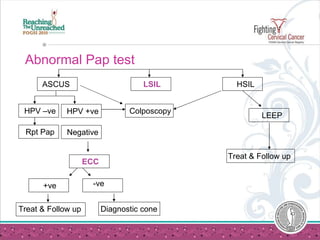
Abnormal Pap test ASCUS LSIL HSIL HPV –ve HPV +ve Rpt Pap Negative Colposcopy LEEP ECC +ve -ve Treat & Follow up Diagnostic cone Treat & Follow up
ATYPICAL SQUAMOUS CELLS
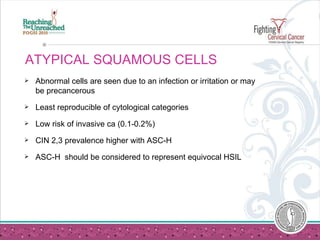
ATYPICAL SQUAMOUS CELLS Abnormal cells are seen due to an infection or irritation or may be precancerous Least reproducible of cytological categories Low risk of invasive ca (0.1-0.2%) CIN 2,3 prevalence higher with ASC-H ASC-H  should be considered to represent equivocal HSIL
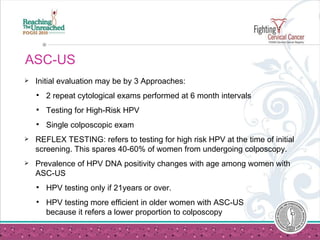
ASC-US Initial evaluation may be by 3 Approaches:  2 repeat cytological exams performed at 6 month intervals Testing for High-Risk HPV Single colposcopic exam REFLEX TESTING: refers to testing for high risk HPV at the time of initial screening. This spares 40-60% of women from undergoing colposcopy. Prevalence of HPV DNA positivity changes with age among women with ASC-US HPV testing only if 21years or over. HPV testing more efficient in older women with ASC-US  because it refers a lower proportion to colposcopy
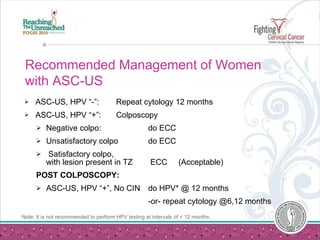
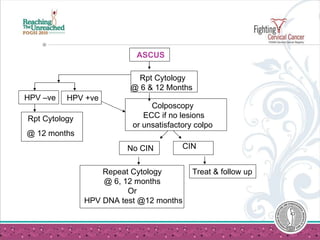
Recommended Management of Women with ASC-US ASC-US, HPV “-”: Repeat cytology 12 months  ASC-US, HPV “+”: Colposcopy Negative colpo: do ECC   Unsatisfactory colpo do ECC   Satisfactory colpo,  with lesion present in TZ  ECC  (Acceptable)  POST COLPOSCOPY: ASC-US, HPV “+”, No CIN do HPV* @ 12 months -or- repeat cytology @6,12 months Note: It is not recommended to perform HPV testing at intervals of < 12 months.
Rpt Cytology @ 6 & 12 Months  HPV –ve HPV +ve Rpt Cytology @ 12 months Colposcopy  ECC if no lesions or unsatisfactory colpo  No CIN CIN Repeat Cytology  @ 6, 12 months  Or  HPV DNA test @12 months Treat & follow up ASCUS
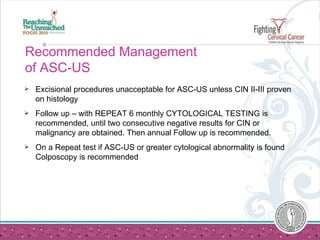
Recommended Management  of ASC-US Excisional procedures unacceptable for ASC-US unless CIN II-III proven on histology Follow up – with REPEAT 6 monthly CYTOLOGICAL TESTING is recommended, until two consecutive negative results for CIN or malignancy are obtained. Then annual Follow up is recommended. On a Repeat test if ASC-US or greater cytological abnormality is found Colposcopy is recommended
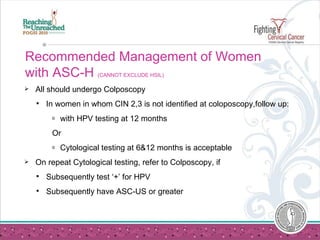
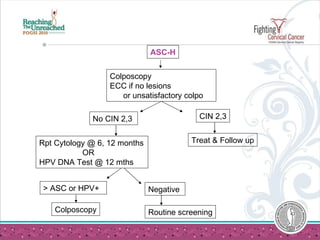
Recommended Management of Women with ASC-H  (CANNOT EXCLUDE HSIL) All should undergo Colposcopy   In women in whom CIN 2,3 is not identified at coloposcopy,follow up:  with HPV testing at 12 months   Or Cytological testing at 6&12 months is acceptable On repeat Cytological testing, refer to Colposcopy, if  Subsequently test ‘+’ for HPV Subsequently have ASC-US or greater
ASC-H Colposcopy ECC if no lesions  or unsatisfactory colpo CIN 2,3 > ASC or HPV+ Treat & Follow up Rpt Cytology @ 6, 12 months   OR HPV DNA Test @ 12 mths No CIN 2,3  Colposcopy Negative  Routine screening
Low Grade SIL
LSIL  Cytological diagnosis of LSIL, 2% of women 2nd most  common abnormal cytology report (ASC-US is most common) 85% with LSIL, have biopsy-confirmed CIN 18% CIN II-III .03% invasive cervical cancer LSIL is highly predictive of HPV infection COLPOSCOPY: recommended with LSIL
LSIL  ECC is preferred  for Non-pregnant women in whom no lesions are identified Women with an ‘unsatisfactory colposcopy’  ECC is acceptable for ‘ Satisfactory colposcopy’ & a Lesion identified in the transformation zone
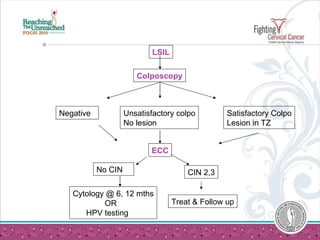
LSIL Colposcopy Negative Unsatisfactory colpo No lesion Satisfactory Colpo Lesion in TZ ECC No CIN CIN 2,3 Cytology @ 6, 12 mths OR HPV testing Treat & Follow up
LSIL – Post Colposcopy Management In the absence of histologically identified CIN, diagnostic excisional or ablative procedures are unacceptable for the initial management of patients with LSIL
HIGH GRADE SIL HSIL
High-grade Squamous Intraepithelial Lesion (HSIL) 0.45% OF cytology reports 75% will have biopsy-confirmed CIN II-III 1-2 % invasive Cervical Ca An immediate Leep or Colposcopy/ECC is acceptable (except in pregnancy or adolescents)
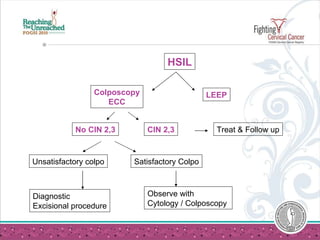
HSIL Colposcopy ECC Unsatisfactory colpo Satisfactory Colpo No CIN 2,3 Diagnostic  Excisional procedure Observe with  Cytology / Colposcopy  Treat & Follow up LEEP CIN 2,3
Managing Women with HSIL UNACCEPTABLE STRATEGIES Ablation is unacceptable in the following circumstances: Colposcopy has not been performed CIN II-III is not identified histologically ECC identifies CIN of any grade Triage utilizing either of the following is unacceptable Repeat cytology HPV DNA testing
SIL in Pregnancy Aim of Colposcopy is to Identify invasive Ca Lesser lesions never treated Colposcopy is preferred for pregnant, non-adolescent with LSIL, HSIL In LSIL Deferring Colpo until at least 6 wks PostPartum is acceptable In HSIL Colposcopy is recommended Performed by experienced clinician
SIL in Pregnancy Biopsy of lesions suspicious for CIN II-III or cancer is preferred  Biopsy of other lesions is acceptable ECC is unacceptable in pregnancy Re-evaluation with cytology /  colposcopy is recommended no sooner than 6 weeks PP
ASCUS & LSIL in ADOLESCENTS Adolescent women Should not be screened unless they have been sexually active for 3 years HPV testing is unacceptable for adolescent with ASCUS or LSIL  >80% of sexually active adolescents test + for HPV over a 2 year obsv. period If HPV testing was performed, the results should not influence management With LSIL, follow-up with annual cytological testing is recommended  91% show regression at 36 months CIN III before age 20, RARE
LSIL in POSTMENOPAUSAL WOMEN Prevalence of HPV, CIN II-III decline with age in women with LSIL Manage less aggressively, triage using HPV  may be attractive Postmenopause with LSIL, should be managed the same as premenopausal women with ASC-US Postmenopausal  & immunosuppressed women with ASC-US should be managed in the same manner as women in the general population.
ATYPICAL Glandular Cells
ATYPICAL GLANDULAR CELLS  0.2% of Pap results High incidence of underlying neoplasia (9-38% AGC have associated neoplasia CIN 2 or 3, AIS, Cancer) Both Cytology or HPV lack sensitivity to be used alone as a triage test.
ATYPICAL GLANDULAR CELLS  3 Categories:  AGC, NOS AGC, FAVOR NEOPLASIA AIS (adenocarcinoma in situ)
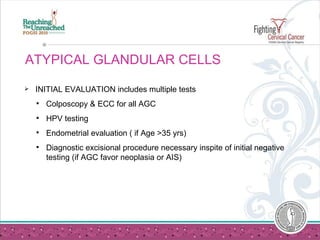
ATYPICAL GLANDULAR CELLS  INITIAL EVALUATION includes multiple tests Colposcopy & ECC for all AGC HPV testing Endometrial evaluation ( if Age >35 yrs) Diagnostic excisional procedure necessary inspite of initial negative testing (if AGC favor neoplasia or AIS)
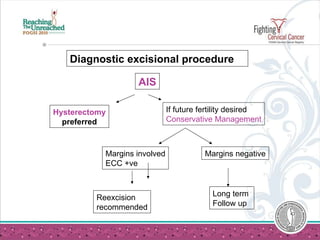
AIS Hysterectomy preferred Margins involved ECC +ve Reexcision  recommended Long term  Follow up Diagnostic excisional procedure If future fertility desired Conservative Management Margins negative
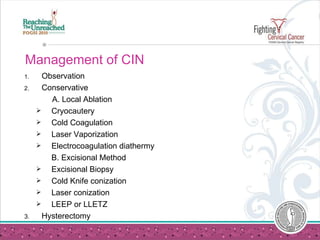
Management of CIN Observation Conservative A. Local Ablation Cryocautery Cold Coagulation Laser Vaporization Electrocoagulation diathermy  B. Excisional Method Excisional Biopsy Cold Knife conization Laser conization LEEP or LLETZ 3. Hysterectomy
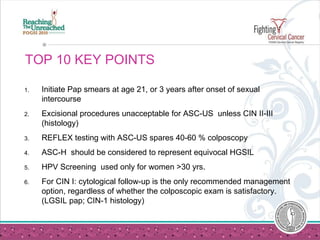
TOP 10 KEY POINTS Initiate Pap smears at age 21, or 3 years after onset of sexual intercourse Excisional procedures unacceptable for ASC-US  unless CIN II-III (histology) REFLEX testing with ASC-US spares 40-60 % colposcopy ASC-H  should be considered to represent equivocal HGSIL HPV Screening  used only for women >30 yrs. For CIN I: cytological follow-up is the only recommended management option, regardless of whether the colposcopic exam is satisfactory. (LGSIL pap; CIN-1 histology)

Abnormal Pap Test

  • 1.
    Management of Womenwith Abnormal Pap Test
  • 2.
    Bethesda System 2001Squamous cell Atypical squamous cells (ASC) of undetermined significance (ASC-US) cannot exclude HSIL (ASC-H) Low-grade squamous intraepithelial lesion (LSIL) High-grade squamous intraepithelial lesion (HSIL) Squamous cell carcinoma
  • 3.
    Bethesda System 2001Glandular cell Atypical glandular cells (AGC) Atypical glandular cells, favor neoplastic Endocervical adenocarcinoma in situ (AIS) Adenocarcinoma
  • 4.
    Comparison of Terminology Bethesda System CIN system Dysplasia ASCUS Cellular Atypia Unspecified Cellular changes LSIL CIN I Mild Dysplasia HSIL CIN II Moderate dysplasia CIN III Severe Dysplasia/ CIS
  • 5.
    Management strategy depends Availability of resources for diagnosis like Colposcope, HPV testing Availability of resources for treatment like LEEP, Cryotherapy, LASER Age of the woman Need of reproductive life Grade & extent of the lesion Motivation for follow up Expertise
  • 6.
    Abnormal Pap testASCUS LSIL HSIL HPV –ve HPV +ve Rpt Pap Negative Colposcopy LEEP ECC +ve -ve Treat & Follow up Diagnostic cone Treat & Follow up
  • 7.
  • 8.
    ATYPICAL SQUAMOUS CELLSAbnormal cells are seen due to an infection or irritation or may be precancerous Least reproducible of cytological categories Low risk of invasive ca (0.1-0.2%) CIN 2,3 prevalence higher with ASC-H ASC-H should be considered to represent equivocal HSIL
  • 9.
    ASC-US Initial evaluationmay be by 3 Approaches: 2 repeat cytological exams performed at 6 month intervals Testing for High-Risk HPV Single colposcopic exam REFLEX TESTING: refers to testing for high risk HPV at the time of initial screening. This spares 40-60% of women from undergoing colposcopy. Prevalence of HPV DNA positivity changes with age among women with ASC-US HPV testing only if 21years or over. HPV testing more efficient in older women with ASC-US because it refers a lower proportion to colposcopy
  • 10.
    Recommended Management ofWomen with ASC-US ASC-US, HPV “-”: Repeat cytology 12 months ASC-US, HPV “+”: Colposcopy Negative colpo: do ECC Unsatisfactory colpo do ECC Satisfactory colpo, with lesion present in TZ ECC (Acceptable) POST COLPOSCOPY: ASC-US, HPV “+”, No CIN do HPV* @ 12 months -or- repeat cytology @6,12 months Note: It is not recommended to perform HPV testing at intervals of < 12 months.
  • 11.
    Rpt Cytology @6 & 12 Months HPV –ve HPV +ve Rpt Cytology @ 12 months Colposcopy ECC if no lesions or unsatisfactory colpo No CIN CIN Repeat Cytology @ 6, 12 months Or HPV DNA test @12 months Treat & follow up ASCUS
  • 12.
    Recommended Management of ASC-US Excisional procedures unacceptable for ASC-US unless CIN II-III proven on histology Follow up – with REPEAT 6 monthly CYTOLOGICAL TESTING is recommended, until two consecutive negative results for CIN or malignancy are obtained. Then annual Follow up is recommended. On a Repeat test if ASC-US or greater cytological abnormality is found Colposcopy is recommended
  • 13.
    Recommended Management ofWomen with ASC-H (CANNOT EXCLUDE HSIL) All should undergo Colposcopy In women in whom CIN 2,3 is not identified at coloposcopy,follow up: with HPV testing at 12 months Or Cytological testing at 6&12 months is acceptable On repeat Cytological testing, refer to Colposcopy, if Subsequently test ‘+’ for HPV Subsequently have ASC-US or greater
  • 14.
    ASC-H Colposcopy ECCif no lesions or unsatisfactory colpo CIN 2,3 > ASC or HPV+ Treat & Follow up Rpt Cytology @ 6, 12 months OR HPV DNA Test @ 12 mths No CIN 2,3 Colposcopy Negative Routine screening
  • 15.
  • 16.
    LSIL Cytologicaldiagnosis of LSIL, 2% of women 2nd most common abnormal cytology report (ASC-US is most common) 85% with LSIL, have biopsy-confirmed CIN 18% CIN II-III .03% invasive cervical cancer LSIL is highly predictive of HPV infection COLPOSCOPY: recommended with LSIL
  • 17.
    LSIL ECCis preferred for Non-pregnant women in whom no lesions are identified Women with an ‘unsatisfactory colposcopy’ ECC is acceptable for ‘ Satisfactory colposcopy’ & a Lesion identified in the transformation zone
  • 18.
    LSIL Colposcopy NegativeUnsatisfactory colpo No lesion Satisfactory Colpo Lesion in TZ ECC No CIN CIN 2,3 Cytology @ 6, 12 mths OR HPV testing Treat & Follow up
  • 19.
    LSIL – PostColposcopy Management In the absence of histologically identified CIN, diagnostic excisional or ablative procedures are unacceptable for the initial management of patients with LSIL
  • 20.
  • 21.
    High-grade Squamous IntraepithelialLesion (HSIL) 0.45% OF cytology reports 75% will have biopsy-confirmed CIN II-III 1-2 % invasive Cervical Ca An immediate Leep or Colposcopy/ECC is acceptable (except in pregnancy or adolescents)
  • 22.
    HSIL Colposcopy ECCUnsatisfactory colpo Satisfactory Colpo No CIN 2,3 Diagnostic Excisional procedure Observe with Cytology / Colposcopy Treat & Follow up LEEP CIN 2,3
  • 23.
    Managing Women withHSIL UNACCEPTABLE STRATEGIES Ablation is unacceptable in the following circumstances: Colposcopy has not been performed CIN II-III is not identified histologically ECC identifies CIN of any grade Triage utilizing either of the following is unacceptable Repeat cytology HPV DNA testing
  • 24.
    SIL in PregnancyAim of Colposcopy is to Identify invasive Ca Lesser lesions never treated Colposcopy is preferred for pregnant, non-adolescent with LSIL, HSIL In LSIL Deferring Colpo until at least 6 wks PostPartum is acceptable In HSIL Colposcopy is recommended Performed by experienced clinician
  • 25.
    SIL in PregnancyBiopsy of lesions suspicious for CIN II-III or cancer is preferred Biopsy of other lesions is acceptable ECC is unacceptable in pregnancy Re-evaluation with cytology / colposcopy is recommended no sooner than 6 weeks PP
  • 26.
    ASCUS & LSILin ADOLESCENTS Adolescent women Should not be screened unless they have been sexually active for 3 years HPV testing is unacceptable for adolescent with ASCUS or LSIL >80% of sexually active adolescents test + for HPV over a 2 year obsv. period If HPV testing was performed, the results should not influence management With LSIL, follow-up with annual cytological testing is recommended 91% show regression at 36 months CIN III before age 20, RARE
  • 27.
    LSIL in POSTMENOPAUSALWOMEN Prevalence of HPV, CIN II-III decline with age in women with LSIL Manage less aggressively, triage using HPV may be attractive Postmenopause with LSIL, should be managed the same as premenopausal women with ASC-US Postmenopausal & immunosuppressed women with ASC-US should be managed in the same manner as women in the general population.
  • 28.
  • 29.
    ATYPICAL GLANDULAR CELLS 0.2% of Pap results High incidence of underlying neoplasia (9-38% AGC have associated neoplasia CIN 2 or 3, AIS, Cancer) Both Cytology or HPV lack sensitivity to be used alone as a triage test.
  • 30.
    ATYPICAL GLANDULAR CELLS 3 Categories: AGC, NOS AGC, FAVOR NEOPLASIA AIS (adenocarcinoma in situ)
  • 31.
    ATYPICAL GLANDULAR CELLS INITIAL EVALUATION includes multiple tests Colposcopy & ECC for all AGC HPV testing Endometrial evaluation ( if Age >35 yrs) Diagnostic excisional procedure necessary inspite of initial negative testing (if AGC favor neoplasia or AIS)
  • 32.
    AIS Hysterectomy preferredMargins involved ECC +ve Reexcision recommended Long term Follow up Diagnostic excisional procedure If future fertility desired Conservative Management Margins negative
  • 33.
    Management of CINObservation Conservative A. Local Ablation Cryocautery Cold Coagulation Laser Vaporization Electrocoagulation diathermy B. Excisional Method Excisional Biopsy Cold Knife conization Laser conization LEEP or LLETZ 3. Hysterectomy
  • 34.
    TOP 10 KEYPOINTS Initiate Pap smears at age 21, or 3 years after onset of sexual intercourse Excisional procedures unacceptable for ASC-US unless CIN II-III (histology) REFLEX testing with ASC-US spares 40-60 % colposcopy ASC-H should be considered to represent equivocal HGSIL HPV Screening used only for women >30 yrs. For CIN I: cytological follow-up is the only recommended management option, regardless of whether the colposcopic exam is satisfactory. (LGSIL pap; CIN-1 histology)