CEREBROVASCULAR ACCIDENT
& INITIAL APPROACH TO
MANAGEMENT
DR KEMI DELE-IJAGBULU
Dept. Of Family Medicine
Dora Nginza Hospital
October 2017
CONTENT
• Introduction/Epidemiology
• Aetiological Classification
• Anatomy
• Clinical Picture
• Complications
• Management Options
Introduction: Definition of Terms
• TIA (transient Ischemic Attack): a focal neurological deficit due to a compromise in
cerebral circulation that lasts less than 24 hours with complete clinical recovery.
• STROKE: a focal neurological deficit due to a compromise in cerebral circulation. The
onset is sudden and the symptoms last more than 24 hours, if the patient survives.
• Progression: Up to 15% of patients with TIA may have a STROKE in the first 2 weeks
Epidemiology
• 3rd most common cause of death after HIV/AIDS and Ischaemic Heart
disease in South Africa
• A leading cause of adult disability
• Prevalence and cost implication rises with increasing aging population.
• A medical emergency with high morbidity and mortality.
• Mortality of 125 per 100000 deaths
AETIOLOGICAL
CLASSIFICATION
Aetiological Classification Of Stroke
• Causes of Stroke are heterogeneous with different pathophysiology
• They can however be broadly categorized into 2:
Haemorrhagic and Ischemic Stroke
• Haemorrhagic Stroke: Characterized by too much blood within the closed cranial
cavity, secondary to rupture of blood vessels
• Ischemic Stroke: Characterized by too little blood to supply an adequate supply of
oxygen and nutrition to a part of the brain as a result of Thrombosis, Embolism
or Systemic hypoperfusion.
Aetiological Types
1. Ischaemic Stroke
80% of all strokes
Anterior circulation ischemic stroke accounts for approximately 70% of all ischemic
strokes.
2. Haemorrhagic Stroke
Intracerebral (or parenchymal) haemorrhage – bleeding onto the brain tissue
Subarachnoid Haemorrhage (SAH) – bleeding into the subarachnoid space into the CSF
RISK FACTORS
Risk factors: Non-Modifiable
• Age (risk rises exponentially with age)
• Sex (more common in males at all ages)
• Race (African American > Asian > Caucasian)
• Geography (Eastern Europe > Western Europe > Asia > rest of Europe or
North America)
• Genetic risk factors (eg stroke or heart disease in individuals younger than 60
yr; familial syndromes, such as cerebral autosomal arteriopathy [CADASIL]
Potentially modifiable risk factors
• Hypertension (diastolic or isolated
systolic)
• Diabetes mellitus type 1 or 2
• Atrial fibrillation
• Smoking
• Coronary artery disease
• Hypercholesterolemia
• Alcohol abuse
• Drug abuse (eg, cocaine)
• Oral contraceptive use
• Pregnancy
Risk factors (Stroke and TIA)
• Hypertension
• Diabetes mellitus
• Cardiac disease
• Valvular
• Arrhythmias
• Presence of coronary artery disease
• Hyperlipidaemia
• Smoking
• Diet and obesity
• Family history
• Oral contraceptives
• HIV infection
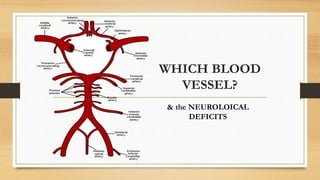
WHICH BLOOD
VESSEL?
& the NEUROLOICAL
DEFICITS
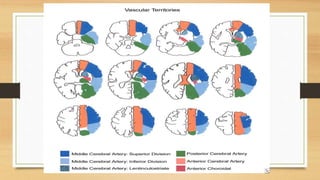
Middle Cerebral Artery Stroke
• Contralateral hemiparesis
• Contralateral hypoesthesia
• Ipsilateral hemianopsia
• Agnosia
• Receptive or expressive aphasia, especially if the lesion is in the dominant hemisphere
• Neglect, inattention.
• Flat affect
• MCA supply upper extremity motor strip. Hence, weakness of arm and face is worse than
lower limbs
Anterior Cerebral Artery Stroke
Affects mainly the frontal lobe function
• Disinhibition and speech perseveration
• Primitive reflexes
• Altered mental status
• Impaired judgement
• Contralateral weakness (greater in legs than arms
• Contralateral cortical sensory deficit
• Urinary incontinence
• Gait apraxia
Posterior Cerebral Artery Stroke
• Mostly affect vision and thoughts.
• Contralateral homonymous hemianopsia
• Cortical blindness
• Visual agnosia
• Altered mental status
• Impaired memory
Vestibulobasilar Artery
• Wide variety of cranial nerve, cerebellar and brainstem deficit, often vague
• Vertigo
• Diploplia
• Nystagmus
• Syncope
• Ataxia
• Dysphagia
• Dysarthria
• Visual fields defects
Lacunar syndromes
It affects the smaller branches of MCA, more common in Hypertension.
Not usually associated with impaired cognition, memory, speech or level of consciousness
5 categories:
1. Pure motor hemiparesis:
• Contralateral - Usually affects the face and upper and lower extremities equally
• Also associated with dysarthria
• No sensory or visual loss
• No cognitive impairment
2. Pure sensory stroke:
• Contralateral loss of all sensory modalities - Equally affects the face and upper and
lower extremities
• No motor signs, dysarthria, visual loss, or cognitive impairment
3. Homolateral ataxia and crural paresis:
• Paresis of the contralateral leg and side of the face
• Prominent ataxia of the contralateral leg and arm
4. Isolated motor/sensory stroke:
• Paralysis and sensory loss of the contralateral leg, arm, and face
• No visual loss or cognitive impairment
5. Dysarthria-clumsy hand syndrome:
• Dysarthria
• Dysphagia
• Contralateral tongue and facial weakness and paresis
• Clumsiness of the contralateral arm and hand
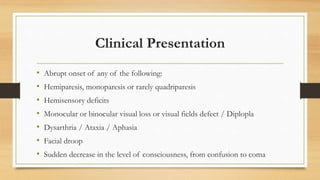
CLINICAL
PRESENTATION
Clinical Presentation
• Abrupt onset of any of the following:
• Hemiparesis, monoparesis or rarely quadriparesis
• Hemisensory deficits
• Monocular or binocular visual loss or visual fields defect / Diplopla
• Dysarthria / Ataxia / Aphasia
• Facial droop
• Sudden decrease in the level of consciousness, from confusion to coma
COMPLICATIONS
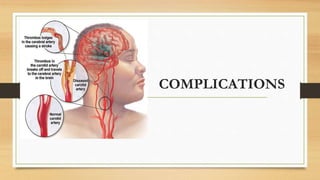
Complications
Neurologic complications
• these include cerebral oedema, haemorrhagic transformation of
cerebral infarction, seizures, hydrocephalus, increased intracranial
pressure, and depression.
Respiratory complications
• these include aspiration, pneumonia, airway obstruction,
hypoventilation, and atelectasis.
Complications (contd.)
Cardiovascular complications
• these include myocardial infarction, congestive heart failure,
hypertension, orthostatic hypotension, deep venous thrombosis,
and pulmonary embolism.
Orthopaedic and dermatologic complications
• these include pressure sores, contractures, adhesive capsulitis of
the shoulder, and falls with fractures.
Complications (contd.)
Urinary complications
• these include incontinence and urinary tract infections.
Nutritional, metabolic, and gastrointestinal complications
• these include stress ulcers, gastrointestinal bleeding, constipation,
dehydration, electrolyte disturbances, malnutrition, and
hyperglycaemia.
Differential Diagnoses
• Hypoglycaemia and other toxic metabolic disorders
• Mass lesions e.g. brain abscess or brain tumour
• Benign positional vertigo
• Post ictal phase in epilepsy
• Migraine
• Multiple sclerosis
• Transient global amnesia
• Systemic Infections
Approach To
Management
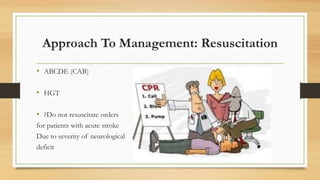
Approach To Management: Resuscitation
• ABCDE (CAB)
• HGT
• ?Do not resuscitate orders
for patients with acute stroke
Due to severity of neurological
deficit
Approach To Management: History
Emphasis on:
• Time of onset (if less than 4.5 hrs can still use
tPA)
• Premorbid functioning (to structure rehab goals)
• Risk factors and previous medication
• Current clinical presentation
Approach To Management: Examination
• Confirm adequate airway and maintain
• Do vitals and support adequately
• Neurological examination
• Assess the level of consciousness, cortical dysfunction, cranial nerves,
hemianopia, weakness, sensory loss, cerebellar function
• Localize lesion based on clinical picture
• Exclude AF, carotid bruits
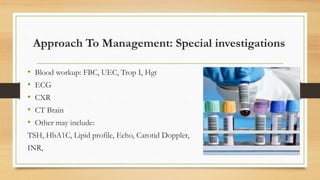
Approach To Management: Special investigations
• Blood workup: FBC, UEC, Trop I, Hgt
• ECG
• CXR
• CT Brain
• Other may include:
TSH, HbA1C, Lipid profile, Echo, Carotid Doppler,
INR,
Approach To Management, contd.
• Cardiac monitoring
• Head elevation <30 degrees
• Maintain hydration
• BP reduction only if more than 220/120, then lower by no more than 15-
20%. All patients will benefit from blood pressure control subsequently.
• Osmotic diuresis to reduce intracranial pressure/cerebral oedema
IVI Mannitol 0.25-0.5mg/kg bolus repeat 6x up to 2g/kg/day
• Glucose control, sliding scale if >10, treat hypoglycaemia
Approach To Management, contd.
• Early seizure control: diazepam or lozarepam
• Then load with phenytoin if warranted. Anticonvulsant of choice is Phenytoin
• All patients to receive an antiplatelet agent after excluding haemorrhagic stroke
• Aspirin 75-150mg daily
• Clopidogrel 75mg daily if contraindications to aspirin or high risk
• Warfarin if Atrial Fibrillation is present
• Pulmonary embolus or DVT: low dose heparin 5000 IU bd s/c
Approach To Management, contd.
• Monitor level of consciousness: decreasing levels may be due to large infarct
with cerebral oedema
• Prevent aspiration pneumonia: NPO until swallowing deficit is excluded
• Statin 10mg nocte irrespective of baseline cholesterol
• Temperature management, if increase may increase infarct size
Approach To Management, contd.
• Invasive procedures, e.g.
• In symptomatic carotid stenosis, i.e. >70% occlusion, stenting before end
carotid arteriectomy in Acute ischemic stroke
• Surgical evacuation of hematoma in haemorrhagic stroke
• Patient on warfarin: IV Vitamin K, FFP
• Early mobilization/rehabilitation: physio, OT, speech therapy
Approach To Management, contd.
Prevent Further Stroke
• S = statins
• W = warfarin
• A = aspirin
• B = BP control
• S = surgery
Approach To Management, contd.
• Long term management
• Multidisciplinary team
• Lifestyle modification:
• Ongoing rehabilitation
• Manage depression: especially if dominant hemisphere is affected, as this
may hinder rehabilitation. Refer psychiatry for treatment
Prognosis
• After transient ischaemic attack, the risk of stroke is 10.5% over the next 3 months,
with the highest risk in the 2 days following a TIA.
• Stroke is the third leading cause of death in the United States and the leading cause
of adult disability.
• High rates of morbidity and mortality are associated with all types of stroke, but the
prognosis varies among subtypes; e.g.,
• mortality rates after intracerebral haemorrhage are as high as 30% at 1 month.
• the ischemic lacunar syndromes quite often are associated with a good prognosis and
have a better prognosis than MCA syndromes.
• Overall, at 6 months after a stroke, as many as 30% of patients have died,
20-30% are moderately to severely disabled, 20-30% have mild to moderate
disability, and 20-30% are without deficits.
THANK YOU!

Cerebrovascular accident oct 2017

  • 1.
    CEREBROVASCULAR ACCIDENT & INITIALAPPROACH TO MANAGEMENT DR KEMI DELE-IJAGBULU Dept. Of Family Medicine Dora Nginza Hospital October 2017
  • 2.
    CONTENT • Introduction/Epidemiology • AetiologicalClassification • Anatomy • Clinical Picture • Complications • Management Options
  • 3.
    Introduction: Definition ofTerms • TIA (transient Ischemic Attack): a focal neurological deficit due to a compromise in cerebral circulation that lasts less than 24 hours with complete clinical recovery. • STROKE: a focal neurological deficit due to a compromise in cerebral circulation. The onset is sudden and the symptoms last more than 24 hours, if the patient survives. • Progression: Up to 15% of patients with TIA may have a STROKE in the first 2 weeks
  • 4.
    Epidemiology • 3rd mostcommon cause of death after HIV/AIDS and Ischaemic Heart disease in South Africa • A leading cause of adult disability • Prevalence and cost implication rises with increasing aging population. • A medical emergency with high morbidity and mortality. • Mortality of 125 per 100000 deaths
  • 5.
  • 6.
    Aetiological Classification OfStroke • Causes of Stroke are heterogeneous with different pathophysiology • They can however be broadly categorized into 2: Haemorrhagic and Ischemic Stroke • Haemorrhagic Stroke: Characterized by too much blood within the closed cranial cavity, secondary to rupture of blood vessels • Ischemic Stroke: Characterized by too little blood to supply an adequate supply of oxygen and nutrition to a part of the brain as a result of Thrombosis, Embolism or Systemic hypoperfusion.
  • 7.
    Aetiological Types 1. IschaemicStroke 80% of all strokes Anterior circulation ischemic stroke accounts for approximately 70% of all ischemic strokes. 2. Haemorrhagic Stroke Intracerebral (or parenchymal) haemorrhage – bleeding onto the brain tissue Subarachnoid Haemorrhage (SAH) – bleeding into the subarachnoid space into the CSF
  • 8.
  • 9.
    Risk factors: Non-Modifiable •Age (risk rises exponentially with age) • Sex (more common in males at all ages) • Race (African American > Asian > Caucasian) • Geography (Eastern Europe > Western Europe > Asia > rest of Europe or North America) • Genetic risk factors (eg stroke or heart disease in individuals younger than 60 yr; familial syndromes, such as cerebral autosomal arteriopathy [CADASIL]
  • 10.
    Potentially modifiable riskfactors • Hypertension (diastolic or isolated systolic) • Diabetes mellitus type 1 or 2 • Atrial fibrillation • Smoking • Coronary artery disease • Hypercholesterolemia • Alcohol abuse • Drug abuse (eg, cocaine) • Oral contraceptive use • Pregnancy
  • 11.
    Risk factors (Strokeand TIA) • Hypertension • Diabetes mellitus • Cardiac disease • Valvular • Arrhythmias • Presence of coronary artery disease • Hyperlipidaemia • Smoking • Diet and obesity • Family history • Oral contraceptives • HIV infection
  • 12.
    WHICH BLOOD VESSEL? & theNEUROLOICAL DEFICITS
  • 14.
    Middle Cerebral ArteryStroke • Contralateral hemiparesis • Contralateral hypoesthesia • Ipsilateral hemianopsia • Agnosia • Receptive or expressive aphasia, especially if the lesion is in the dominant hemisphere • Neglect, inattention. • Flat affect • MCA supply upper extremity motor strip. Hence, weakness of arm and face is worse than lower limbs
  • 15.
    Anterior Cerebral ArteryStroke Affects mainly the frontal lobe function • Disinhibition and speech perseveration • Primitive reflexes • Altered mental status • Impaired judgement • Contralateral weakness (greater in legs than arms • Contralateral cortical sensory deficit • Urinary incontinence • Gait apraxia
  • 16.
    Posterior Cerebral ArteryStroke • Mostly affect vision and thoughts. • Contralateral homonymous hemianopsia • Cortical blindness • Visual agnosia • Altered mental status • Impaired memory
  • 17.
    Vestibulobasilar Artery • Widevariety of cranial nerve, cerebellar and brainstem deficit, often vague • Vertigo • Diploplia • Nystagmus • Syncope • Ataxia • Dysphagia • Dysarthria • Visual fields defects
  • 18.
    Lacunar syndromes It affectsthe smaller branches of MCA, more common in Hypertension. Not usually associated with impaired cognition, memory, speech or level of consciousness 5 categories: 1. Pure motor hemiparesis: • Contralateral - Usually affects the face and upper and lower extremities equally • Also associated with dysarthria • No sensory or visual loss • No cognitive impairment
  • 19.
    2. Pure sensorystroke: • Contralateral loss of all sensory modalities - Equally affects the face and upper and lower extremities • No motor signs, dysarthria, visual loss, or cognitive impairment 3. Homolateral ataxia and crural paresis: • Paresis of the contralateral leg and side of the face • Prominent ataxia of the contralateral leg and arm
  • 20.
    4. Isolated motor/sensorystroke: • Paralysis and sensory loss of the contralateral leg, arm, and face • No visual loss or cognitive impairment 5. Dysarthria-clumsy hand syndrome: • Dysarthria • Dysphagia • Contralateral tongue and facial weakness and paresis • Clumsiness of the contralateral arm and hand
  • 21.
  • 22.
    Clinical Presentation • Abruptonset of any of the following: • Hemiparesis, monoparesis or rarely quadriparesis • Hemisensory deficits • Monocular or binocular visual loss or visual fields defect / Diplopla • Dysarthria / Ataxia / Aphasia • Facial droop • Sudden decrease in the level of consciousness, from confusion to coma
  • 23.
  • 24.
    Complications Neurologic complications • theseinclude cerebral oedema, haemorrhagic transformation of cerebral infarction, seizures, hydrocephalus, increased intracranial pressure, and depression. Respiratory complications • these include aspiration, pneumonia, airway obstruction, hypoventilation, and atelectasis.
  • 25.
    Complications (contd.) Cardiovascular complications •these include myocardial infarction, congestive heart failure, hypertension, orthostatic hypotension, deep venous thrombosis, and pulmonary embolism. Orthopaedic and dermatologic complications • these include pressure sores, contractures, adhesive capsulitis of the shoulder, and falls with fractures.
  • 26.
    Complications (contd.) Urinary complications •these include incontinence and urinary tract infections. Nutritional, metabolic, and gastrointestinal complications • these include stress ulcers, gastrointestinal bleeding, constipation, dehydration, electrolyte disturbances, malnutrition, and hyperglycaemia.
  • 27.
    Differential Diagnoses • Hypoglycaemiaand other toxic metabolic disorders • Mass lesions e.g. brain abscess or brain tumour • Benign positional vertigo • Post ictal phase in epilepsy • Migraine • Multiple sclerosis • Transient global amnesia • Systemic Infections
  • 28.
  • 29.
    Approach To Management:Resuscitation • ABCDE (CAB) • HGT • ?Do not resuscitate orders for patients with acute stroke Due to severity of neurological deficit
  • 30.
    Approach To Management:History Emphasis on: • Time of onset (if less than 4.5 hrs can still use tPA) • Premorbid functioning (to structure rehab goals) • Risk factors and previous medication • Current clinical presentation
  • 31.
    Approach To Management:Examination • Confirm adequate airway and maintain • Do vitals and support adequately • Neurological examination • Assess the level of consciousness, cortical dysfunction, cranial nerves, hemianopia, weakness, sensory loss, cerebellar function • Localize lesion based on clinical picture • Exclude AF, carotid bruits
  • 32.
    Approach To Management:Special investigations • Blood workup: FBC, UEC, Trop I, Hgt • ECG • CXR • CT Brain • Other may include: TSH, HbA1C, Lipid profile, Echo, Carotid Doppler, INR,
  • 33.
    Approach To Management,contd. • Cardiac monitoring • Head elevation <30 degrees • Maintain hydration • BP reduction only if more than 220/120, then lower by no more than 15- 20%. All patients will benefit from blood pressure control subsequently. • Osmotic diuresis to reduce intracranial pressure/cerebral oedema IVI Mannitol 0.25-0.5mg/kg bolus repeat 6x up to 2g/kg/day • Glucose control, sliding scale if >10, treat hypoglycaemia
  • 34.
    Approach To Management,contd. • Early seizure control: diazepam or lozarepam • Then load with phenytoin if warranted. Anticonvulsant of choice is Phenytoin • All patients to receive an antiplatelet agent after excluding haemorrhagic stroke • Aspirin 75-150mg daily • Clopidogrel 75mg daily if contraindications to aspirin or high risk • Warfarin if Atrial Fibrillation is present • Pulmonary embolus or DVT: low dose heparin 5000 IU bd s/c
  • 35.
    Approach To Management,contd. • Monitor level of consciousness: decreasing levels may be due to large infarct with cerebral oedema • Prevent aspiration pneumonia: NPO until swallowing deficit is excluded • Statin 10mg nocte irrespective of baseline cholesterol • Temperature management, if increase may increase infarct size
  • 36.
    Approach To Management,contd. • Invasive procedures, e.g. • In symptomatic carotid stenosis, i.e. >70% occlusion, stenting before end carotid arteriectomy in Acute ischemic stroke • Surgical evacuation of hematoma in haemorrhagic stroke • Patient on warfarin: IV Vitamin K, FFP • Early mobilization/rehabilitation: physio, OT, speech therapy
  • 37.
    Approach To Management,contd. Prevent Further Stroke • S = statins • W = warfarin • A = aspirin • B = BP control • S = surgery
  • 38.
    Approach To Management,contd. • Long term management • Multidisciplinary team • Lifestyle modification: • Ongoing rehabilitation • Manage depression: especially if dominant hemisphere is affected, as this may hinder rehabilitation. Refer psychiatry for treatment
  • 39.
    Prognosis • After transientischaemic attack, the risk of stroke is 10.5% over the next 3 months, with the highest risk in the 2 days following a TIA. • Stroke is the third leading cause of death in the United States and the leading cause of adult disability. • High rates of morbidity and mortality are associated with all types of stroke, but the prognosis varies among subtypes; e.g., • mortality rates after intracerebral haemorrhage are as high as 30% at 1 month. • the ischemic lacunar syndromes quite often are associated with a good prognosis and have a better prognosis than MCA syndromes.
  • 40.
    • Overall, at6 months after a stroke, as many as 30% of patients have died, 20-30% are moderately to severely disabled, 20-30% have mild to moderate disability, and 20-30% are without deficits.
  • 41.