Carbon-carbon composites are composites with carbon fiber reinforcement and a carbon matrix. They offer high strength and can withstand very high temperatures up to 3000°C. The fibers and matrix are both carbon, resulting in low density, high thermal conductivity, and strength retention even at elevated temperatures. However, carbon-carbon composites also have some limitations like high fabrication costs and poor oxidation resistance.
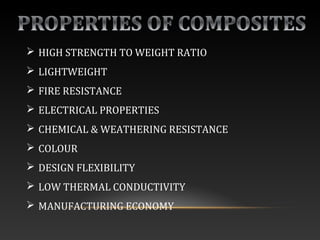
Key attributes: high strength-to-weight ratio, lightweight, fire resistance, electrical properties, chemical/weathering resistance, color, design flexibility, low thermal conductivity, and manufacturing economy.
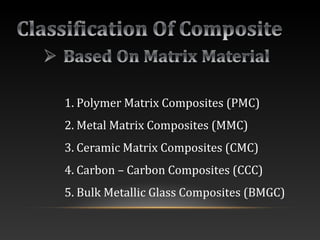
Classification of composites: Polymer Matrix Composites (PMC), Metal Matrix Composites (MMC), Ceramic Matrix Composites (CMC), Carbon-Carbon Composites (CCC), and Bulk Metallic Glass Composites (BMGC).
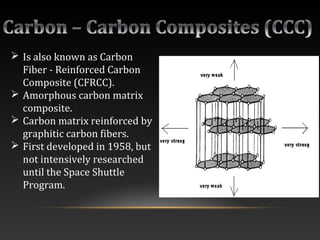
Carbon Fiber-Reinforced Carbon Composite (CFRCC): features amorphous carbon, reinforced by graphitic fibers; initially developed in 1958 for space applications.
These composites have pure carbon fibers and matrix, high strength, lightweight, stability up to 3000°C, and configurable structure.
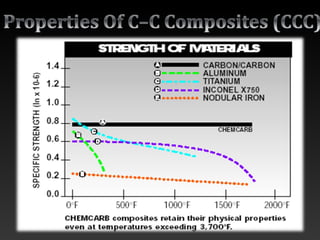
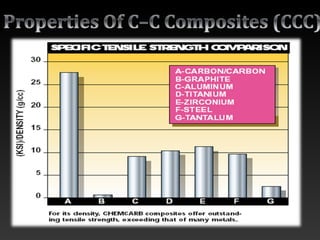
Features include excellent thermal shock resistance, high modulus of elasticity (200 GPa), low density, and non-brittle failure characteristics.
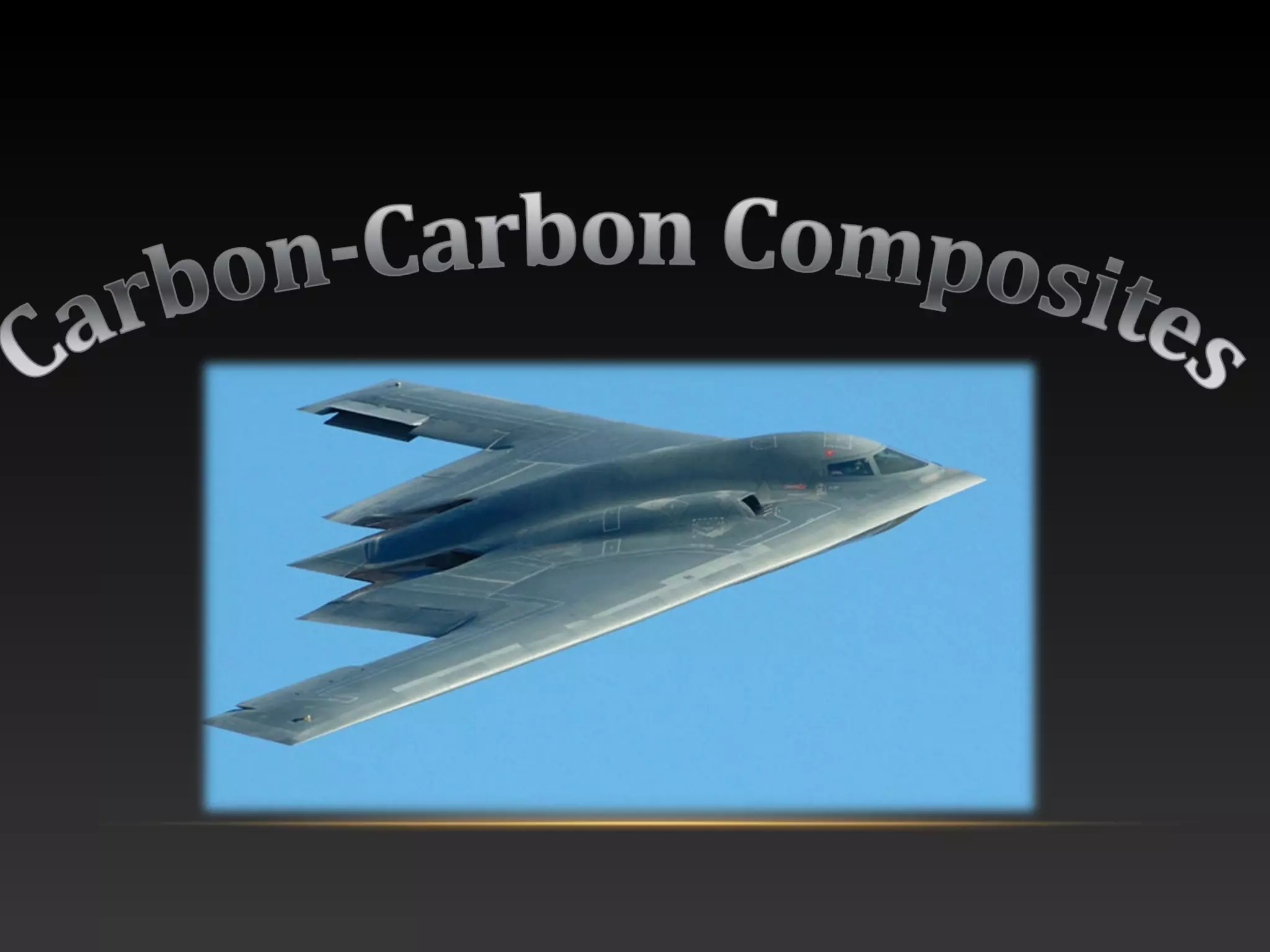
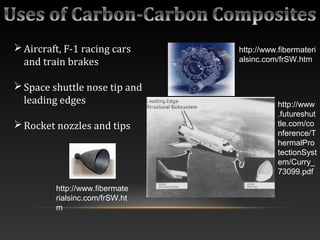
Used in high-stress applications: aircraft brakes, F-1 cars, rocket nozzles, and space shuttle components.
90% of carbon fibers are sourced from polyacrylonitrile (PAN), with 10% from rayon/petroleum pitch.
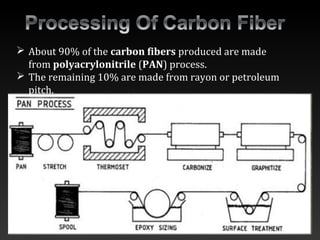
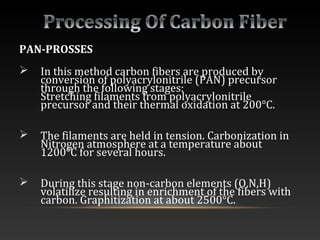
Describes PAN process: fiber stretching, thermal oxidation, carbonization, and graphitization stages to create carbon fibers.
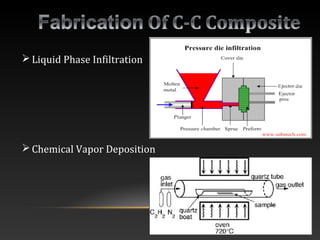
Methods include Liquid Phase Infiltration and Chemical Vapor Deposition for fiber strengthening.
C/C fiber preform preparation involves pyrolysis and repeated cycles to achieve higher density and strength.
Densification via chemical vapor deposition, involves infiltration and heat treatment for improved strength and modulus.
Issues like infiltration of gases causing porosity and potential need for reinfiltration in the manufacturing process.
Is alsoknown as Carbon
Fiber - Reinforced Carbon
Composite (CFRCC).
Amorphous carbon matrix
composite.
Carbon matrix reinforced by
graphitic carbon fibers.
First developed in 1958, but
not intensively researched
until the Space Shuttle
Program.
6.
Carbon CarbonComposites are those special composites
in which both the reinforcing fibers and the matrix
material are both pure carbon.
Carbon-Carbon Composites are the woven mesh of
Carbon-fibers.
Carbon-Carbon Composites are used for their high
strength and modulus of rigidity.
Carbon-Carbon Composites are light weight material
which can withstand temperatures up to 3000°C.
Carbon-Carbon Composites' structure can be tailored to
meet requirements.
7.
Excellent ThermalShock Resistance(Over 2000o
C)
Low Coefficient of Thermal Expansion
High Modulus of Elasticity ( 200 GPa )
High Thermal Conductivity ( 100 W/m*K )
Low Density ( 1830 Kg/m^3 )
High Strength
Low Coefficient of Friction ( in Fiber direction )
Thermal Resistance in non-oxidizing atmosphere
High Abrasion Resistance
High Electrical Conductivity
Non-Brittle Failure
10.
Aircraft, F-1 racingcars
and train brakes
Space shuttle nose tip and
leading edges
Rocket nozzles and tips
http://www.fibermateri
alsinc.com/frSW.htm
http://www
.futureshut
tle.com/co
nference/T
hermalPro
tectionSyst
em/Curry_
73099.pdf
http://www.fibermate
rialsinc.com/frSW.ht
m
11.
About 90%of the carbon fibers produced are made
from polyacrylonitrile (PAN) process.
The remaining 10% are made from rayon or petroleum
pitch.
12.
PAN-PROSSES
In thismethod carbon fibers are produced by
conversion of polyacrylonitrile (PAN) precursor
through the following stages:
Stretching filaments from polyacrylonitrile
precursor and their thermal oxidation at 200°C.
The filaments are held in tension. Carbonization in
Nitrogen atmosphere at a temperature about
1200°C for several hours.
During this stage non-carbon elements (O,N,H)
volatilize resulting in enrichment of the fibers with
carbon. Graphitization at about 2500°C.
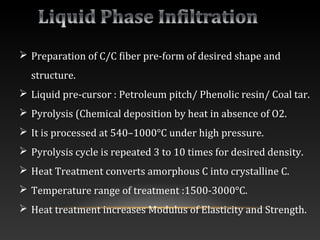
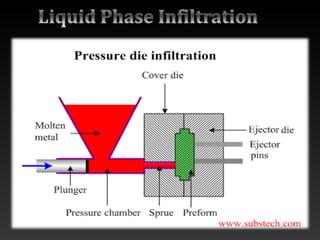
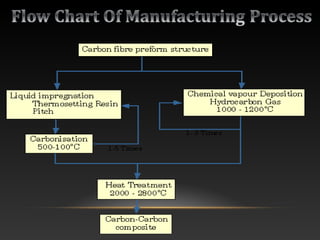
Preparation ofC/C fiber pre-form of desired shape and
structure.
Liquid pre-cursor : Petroleum pitch/ Phenolic resin/ Coal tar.
Pyrolysis (Chemical deposition by heat in absence of O2.
It is processed at 540–1000°C under high pressure.
Pyrolysis cycle is repeated 3 to 10 times for desired density.
Heat Treatment converts amorphous C into crystalline C.
Temperature range of treatment :1500-3000°C.
Heat treatment increases Modulus of Elasticity and Strength.
17.
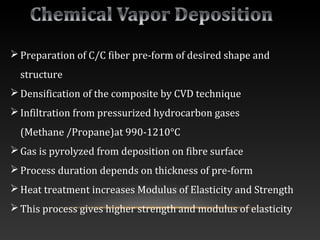
Preparation of C/Cfiber pre-form of desired shape and
structure
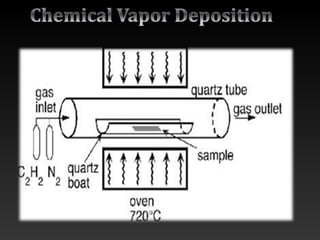
Densification of the composite by CVD technique
Infiltration from pressurized hydrocarbon gases
(Methane /Propane)at 990-1210°C
Gas is pyrolyzed from deposition on fibre surface
Process duration depends on thickness of pre-form
Heat treatment increases Modulus of Elasticity and Strength
This process gives higher strength and modulus of elasticity
19.
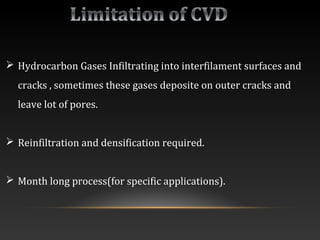
Hydrocarbon GasesInfiltrating into interfilament surfaces and
cracks , sometimes these gases deposite on outer cracks and
leave lot of pores.
Reinfiltration and densification required.
Month long process(for specific applications).
20.
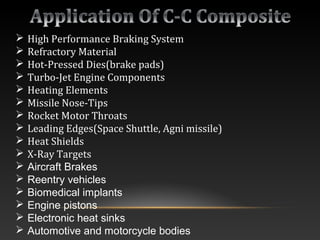
High PerformanceBraking System
Refractory Material
Hot-Pressed Dies(brake pads)
Turbo-Jet Engine Components
Heating Elements
Missile Nose-Tips
Rocket Motor Throats
Leading Edges(Space Shuttle, Agni missile)
Heat Shields
X-Ray Targets
Aircraft Brakes
Reentry vehicles
Biomedical implants
Engine pistons
Electronic heat sinks
Automotive and motorcycle bodies
21.
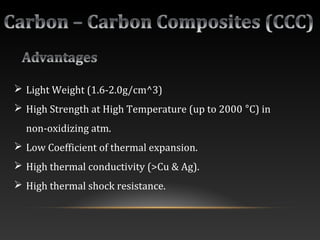
Light Weight(1.6-2.0g/cm^3)
High Strength at High Temperature (up to 2000 °C) in
non-oxidizing atm.
Low Coefficient of thermal expansion.
High thermal conductivity (>Cu & Ag).
High thermal shock resistance.
22.
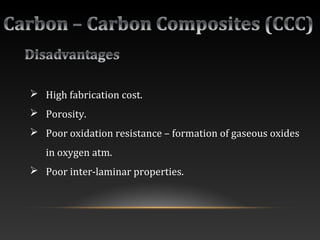
High fabricationcost.
Porosity.
Poor oxidation resistance – formation of gaseous oxides
in oxygen atm.
Poor inter-laminar properties.