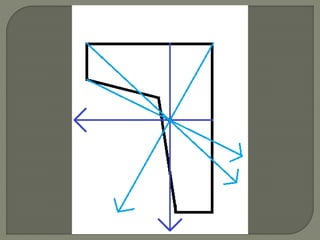
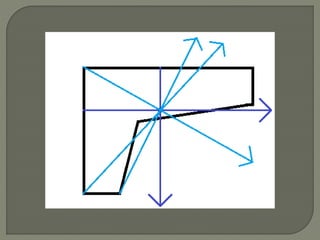
By Dillon O’Connor
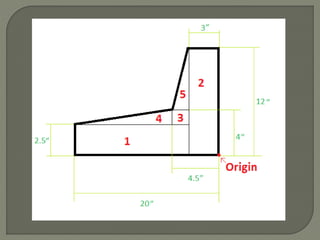
Divide the shape into components that can
have their area easily calculated.
Add these areas together for the area of
the shape.
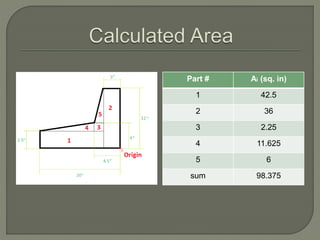
Part # Ai (sq. in)
1 42.5
2 36
3 2.25
4 11.625
5 6
sum 98.375
Find the geometric center of each
component that you have divided the
shape into.
Calculate the distance from the origin to
the geometric center on an axis.
Remain consistent with the shapes used
from calculating the area.
For rectangles:
• Half the length of the rectangle’s side along an
axis
For right triangles:
• 1/3 of the distance from the triangle’s vertex that is
a right angle along an axis.
Remember to add the distance between
the origin and the start of the shape.
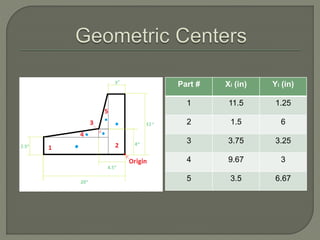
Part # Xi (in) Yi (in)
1 11.5 1.25
2 1.5 6
3 3.75 3.25
4 9.67 3
5 3.5 6.67
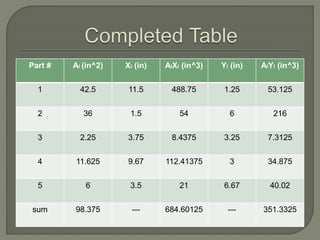
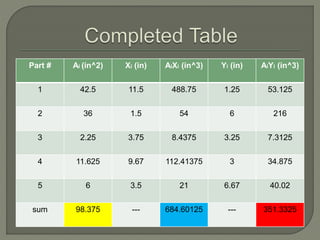
Part # Ai (in^2) Xi (in) AiXi (in^3) Yi (in) AiYi (in^3)
1 42.5 11.5 488.75 1.25 53.125
2 36 1.5 54 6 216
3 2.25 3.75 8.4375 3.25 7.3125
4 11.625 9.67 112.41375 3 34.875
5 6 3.5 21 6.67 40.02
sum 98.375 --- 684.60125 --- 351.3325
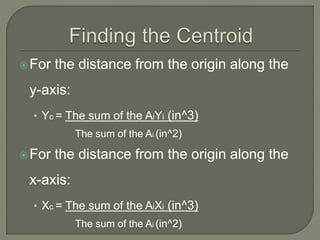
For the distance from the origin along the
y-axis:
• Yc = The sum of the AiYi (in^3)
The sum of the Ai (in^2)
For the distance from the origin along the
x-axis:
• Xc = The sum of the AiXi (in^3)
The sum of the Ai (in^2)
Part # Ai (in^2) Xi (in) AiXi (in^3) Yi (in) AiYi (in^3)
1 42.5 11.5 488.75 1.25 53.125
2 36 1.5 54 6 216
3 2.25 3.75 8.4375 3.25 7.3125
4 11.625 9.67 112.41375 3 34.875
5 6 3.5 21 6.67 40.02
sum 98.375 --- 684.60125 --- 351.3325
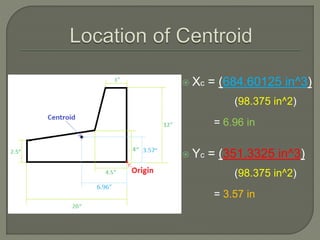
 Xc = (684.60125 in^3)
(98.375 in^2)
= 6.96 in
 Yc = (351.3325 in^3)
(98.375 in^2)
= 3.57 in
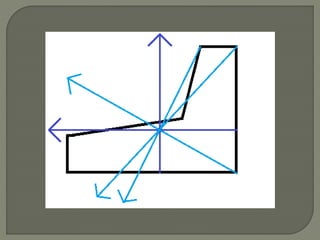
Centroids
Centroids
Centroids

Centroids

  • 1.
  • 3.
    Divide the shapeinto components that can have their area easily calculated. Add these areas together for the area of the shape.
  • 5.
    Part # Ai(sq. in) 1 42.5 2 36 3 2.25 4 11.625 5 6 sum 98.375
  • 6.
    Find the geometriccenter of each component that you have divided the shape into. Calculate the distance from the origin to the geometric center on an axis. Remain consistent with the shapes used from calculating the area.
  • 7.
    For rectangles: • Halfthe length of the rectangle’s side along an axis For right triangles: • 1/3 of the distance from the triangle’s vertex that is a right angle along an axis. Remember to add the distance between the origin and the start of the shape.
  • 8.
    Part # Xi(in) Yi (in) 1 11.5 1.25 2 1.5 6 3 3.75 3.25 4 9.67 3 5 3.5 6.67
  • 9.
    Part # Ai(in^2) Xi (in) AiXi (in^3) Yi (in) AiYi (in^3) 1 42.5 11.5 488.75 1.25 53.125 2 36 1.5 54 6 216 3 2.25 3.75 8.4375 3.25 7.3125 4 11.625 9.67 112.41375 3 34.875 5 6 3.5 21 6.67 40.02 sum 98.375 --- 684.60125 --- 351.3325
  • 10.
    For the distancefrom the origin along the y-axis: • Yc = The sum of the AiYi (in^3) The sum of the Ai (in^2) For the distance from the origin along the x-axis: • Xc = The sum of the AiXi (in^3) The sum of the Ai (in^2)
  • 11.
    Part # Ai(in^2) Xi (in) AiXi (in^3) Yi (in) AiYi (in^3) 1 42.5 11.5 488.75 1.25 53.125 2 36 1.5 54 6 216 3 2.25 3.75 8.4375 3.25 7.3125 4 11.625 9.67 112.41375 3 34.875 5 6 3.5 21 6.67 40.02 sum 98.375 --- 684.60125 --- 351.3325
  • 12.
     Xc =(684.60125 in^3) (98.375 in^2) = 6.96 in  Yc = (351.3325 in^3) (98.375 in^2) = 3.57 in