COMPOSITE MOMENT OF INERTIA
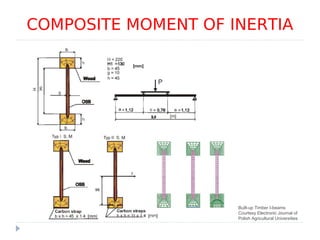
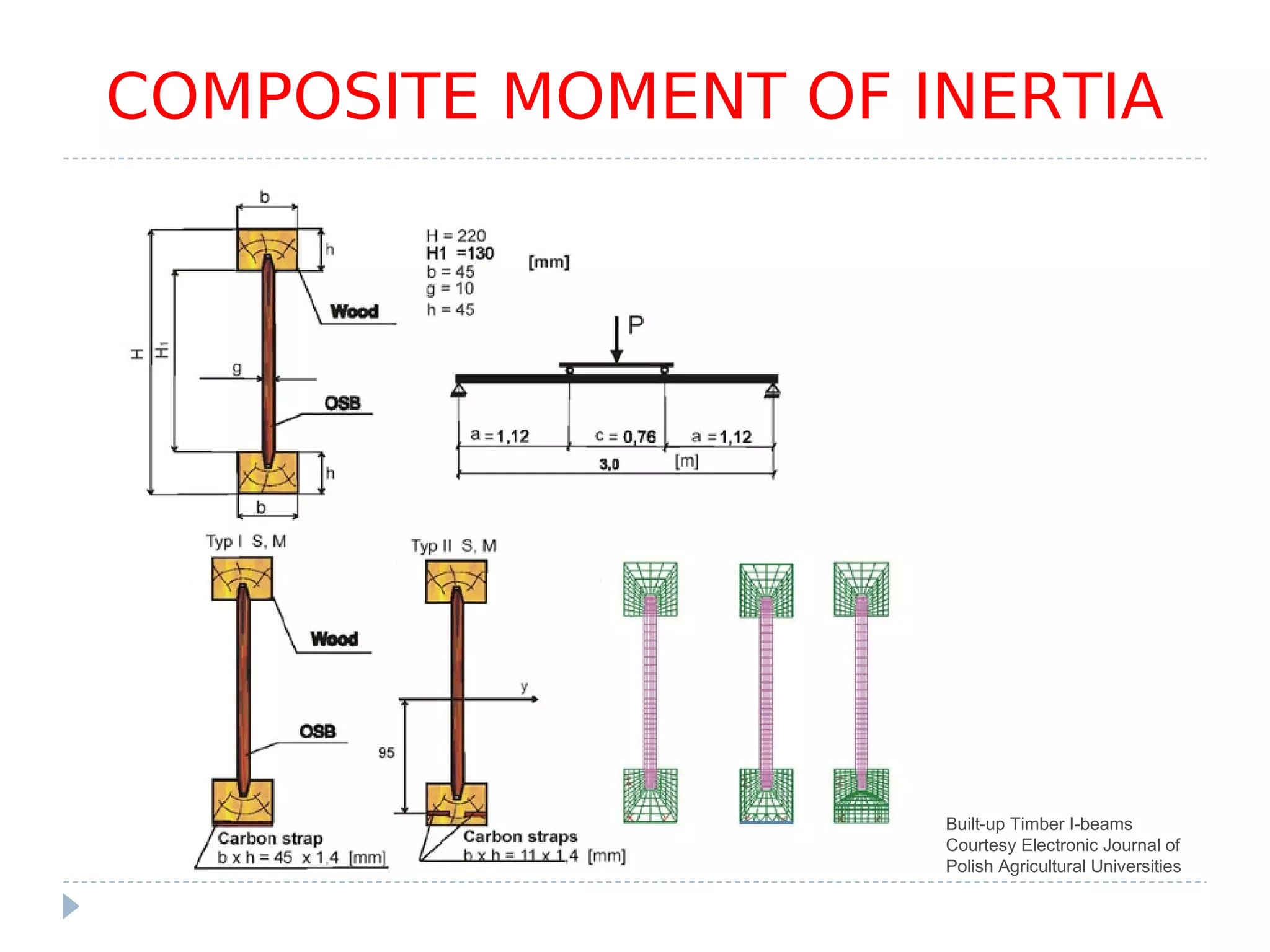
Built-up Timber I-beams
Courtesy Electronic Journal of
Polish Agricultural Universities
Moment of Inertia for
Composite Areas
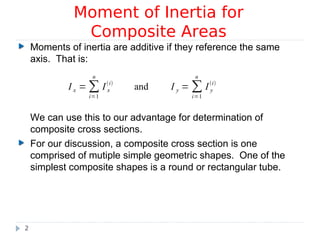
Moments of inertia are additive if they reference the same
axis. That is:
We can use this to our advantage for determination of
composite cross sections.
For our discussion, a composite cross section is one
comprised of mutiple simple geometric shapes. One of the
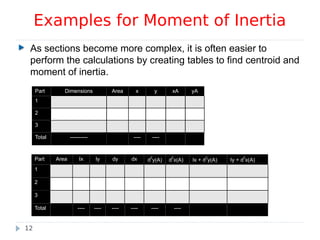
simplest composite shapes is a round or rectangular tube.
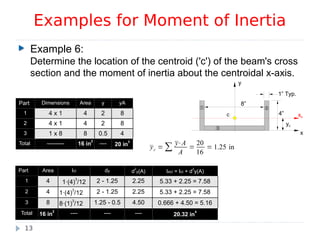
I x = ∑
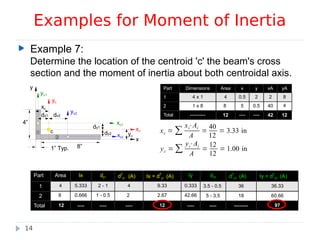
i=1
n
I x
i
and I y = ∑
i=1
n
I y
i
2
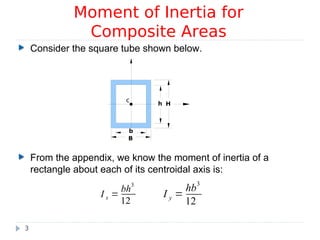
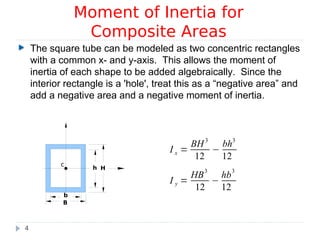
Consider the square tube shown below.
From the appendix, we know the moment of inertia of a
rectangle about each of its centroidal axis is:
Moment of Inertia for
Composite Areas
I x =
bh
3
12
I y =
hb
3
12
3
B
b
Hh
c
The square tube can be modeled as two concentric rectangles
with a common x- and y-axis. This allows the moment of
inertia of each shape to be added algebraically. Since the
interior rectangle is a 'hole', treat this as a “negative area” and
add a negative area and a negative moment of inertia.
Moment of Inertia for
Composite Areas
I x =
BH3
12
−
bh3
12
I y =
HB
3
12
−
hb
3
12
4
B
b
Hh
c
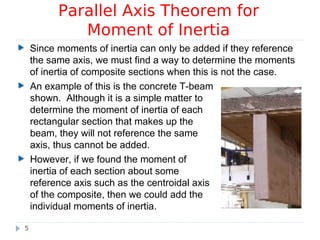
Since moments of inertia can only be added if they reference
the same axis, we must find a way to determine the moments
of inertia of composite sections when this is not the case.
Parallel Axis Theorem for
Moment of Inertia
5
An example of this is the concrete T-beam
shown. Although it is a simple matter to
determine the moment of inertia of each
rectangular section that makes up the
beam, they will not reference the same
axis, thus cannot be added.
However, if we found the moment of
inertia of each section about some
reference axis such as the centroidal axis
of the composite, then we could add the
individual moments of inertia.
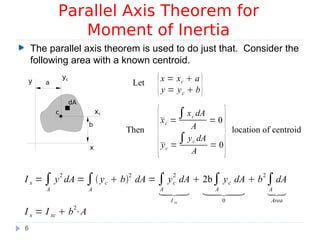
The parallel axis theorem is used to do just that. Consider the
following area with a known centroid.
x
y
b
a
c
dA
yc
xc
I x =∫
A
y
2
dA =∫
A
 yc  b
2
dA = ∫
A
yc
2
dA

I xc
 2b∫
A
yc dA

0
 b
2
∫
A
dA

Area
I x = I xc  b
2
⋅A
Parallel Axis Theorem for
Moment of Inertia
6
Let
{x = xc  a
y = yc  b}
Then
{xc =
∫xc dA
A
= 0
yc =
∫ yc dA
A
= 0}location of centroid
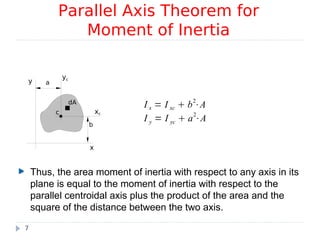
Thus, the area moment of inertia with respect to any axis in its
plane is equal to the moment of inertia with respect to the
parallel centroidal axis plus the product of the area and the
square of the distance between the two axis.
Parallel Axis Theorem for
Moment of Inertia
x
y
b
a
c
dA
yc
xc
I x = I xc  b2
⋅A
I y = I yc  a2
⋅A
7
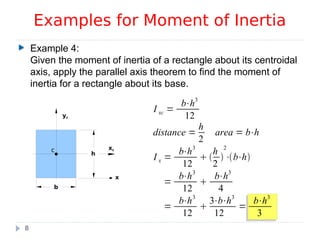
Example 4:
Given the moment of inertia of a rectangle about its centroidal
axis, apply the parallel axis theorem to find the moment of
inertia for a rectangle about its base.
Examples for Moment of Inertia
8
b
h
c xc
yc
x
I xc =
b⋅h3
12
distance =
h
2
area = b⋅h
I x =
b⋅h3
12
 
h
2

2
⋅b⋅h
=
b⋅h3
12

b⋅h3
4
=
b⋅h3
12

3⋅b⋅h3
12
=
b⋅h3
3
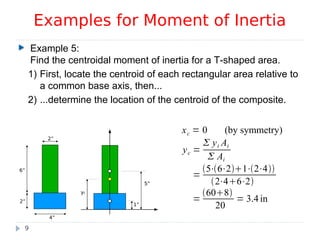
Example 5:
Find the centroidal moment of inertia for a T-shaped area.
1) First, locate the centroid of each rectangular area relative to
a common base axis, then...
2) ...determine the location of the centroid of the composite.
Examples for Moment of Inertia
9
4”
2”
2”
6”
5”
1”
5”5”
yc
xc = 0 (by symmetry)
yc =
 yi Ai
 Ai
=
5⋅6⋅21⋅2⋅4
2⋅46⋅2
=
608
20
= 3.4 in
10


3.4”
x
xc
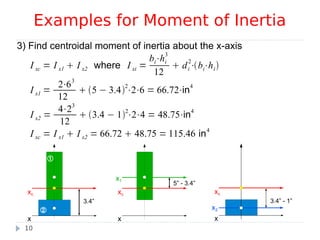
3) Find centroidal moment of inertia about the x-axis
I xc = I x1  I x2 where I xi =
bi⋅hi
3
12
 di
2
⋅bi⋅hi
I x1 =
2⋅63
12
 5 − 3.4
2
⋅2⋅6 = 66.72⋅in
4
I x2 =
4⋅23
12
 3.4 − 12
⋅2⋅4 = 48.75⋅in4
I xc = I x1  I x2 = 66.72  48.75 = 115.46 in4
Examples for Moment of Inertia
3.4” - 1”
x
xc
x2
5” - 3.4”
x
xc
x1
11
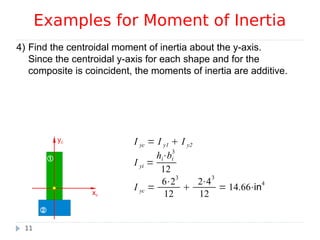
I yc = I y1  I y2
I yi =
hi⋅bi
3
12
I yc =
6⋅2
3
12

2⋅4
3
12
= 14.66⋅in
4
4) Find the centroidal moment of inertia about the y-axis.
Since the centroidal y-axis for each shape and for the
composite is coincident, the moments of inertia are additive.
Examples for Moment of Inertia


xc
yc
As sections become more complex, it is often easier to
perform the calculations by creating tables to find centroid and
moment of inertia.
Examples for Moment of Inertia
Part Dimensions Area x y xA yA
1
2
3
Total ---------- ---- ----
Part Area Ix Iy dy dx d
2
y(A) d
2
x(A) Ix + d
2
y(A) Iy + d
2
x(A)
1
2
3
Total ---- ---- ---- ---- ---- ----
12
Example 6:
Determine the location of the centroid ('c') of the beam's cross
section and the moment of inertia about the centroidal x-axis.
Examples for Moment of Inertia
13
Part Dimensions Area y yA
1 4 x 1 4 2 8
2 4 x 1 4 2 8
3 1 x 8 8 0.5 4
Total ---------- 16 in
2
---- 20 in
3
Part Area Ici dy d
2
y(A) Ixci = Ici + d
2
y(A)
1 4 1·(4)
3
/12 2 - 1.25 2.25 5.33 + 2.25 = 7.58
2 4 1·(4)
3
/12 2 - 1.25 2.25 5.33 + 2.25 = 7.58
3 8 8·(1)
3
/12 1.25 - 0.5 4.50 0.666 + 4.50 = 5.16
Total 16 in
2
---- ---- ---- 20.32 in
4
yc = ∑ y⋅A
A
=
20
16
= 1.25 in


1” Typ.
4”
8”
c
x
xc
y
yc
Part Area Ix dy1 d
2
y1 (A) Ix + d
2
y1 (A) Iy dx2 d
2
x2 (A) Iy + d
2
x2 (A)
1 4 5.333 2 - 1 4 9.33 0.333 3.5 - 0.5 36 36.33
2 8 0.666 1 - 0.5 2 2.67 42.66 5 - 3.5 18 60.66
Total 12 ---- ---- ---- 12 ---- ---- -------- 97
Example 7:
Determine the location of the centroid 'c' the beam's cross
section and the moment of inertia about both centroidal axis.
Examples for Moment of Inertia
14
8”


1” Typ.
4”
c
x
xc
yc
yc
y
xc
yc1
yc2
xc2
xc1
dx1 dx2
dy1
dy2
Part Dimensions Area x y xA yA
1 4 x 1 4 0.5 2 2 8
2 1 x 8 8 5 0.5 40 4
Total ---------- 12 ---- ---- 42 12
xc = ∑
xi⋅Ai
A
=
40
12
= 3.33 in
yc = ∑
yi⋅Ai
A
=
12
12
= 1.00 in

Mi2

  • 1.
    COMPOSITE MOMENT OFINERTIA Built-up Timber I-beams Courtesy Electronic Journal of Polish Agricultural Universities
  • 2.
    Moment of Inertiafor Composite Areas Moments of inertia are additive if they reference the same axis. That is: We can use this to our advantage for determination of composite cross sections. For our discussion, a composite cross section is one comprised of mutiple simple geometric shapes. One of the simplest composite shapes is a round or rectangular tube. I x = ∑ i=1 n I x i and I y = ∑ i=1 n I y i 2
  • 3.
    Consider the squaretube shown below. From the appendix, we know the moment of inertia of a rectangle about each of its centroidal axis is: Moment of Inertia for Composite Areas I x = bh 3 12 I y = hb 3 12 3 B b Hh c
  • 4.
    The square tubecan be modeled as two concentric rectangles with a common x- and y-axis. This allows the moment of inertia of each shape to be added algebraically. Since the interior rectangle is a 'hole', treat this as a “negative area” and add a negative area and a negative moment of inertia. Moment of Inertia for Composite Areas I x = BH3 12 − bh3 12 I y = HB 3 12 − hb 3 12 4 B b Hh c
  • 5.
    Since moments ofinertia can only be added if they reference the same axis, we must find a way to determine the moments of inertia of composite sections when this is not the case. Parallel Axis Theorem for Moment of Inertia 5 An example of this is the concrete T-beam shown. Although it is a simple matter to determine the moment of inertia of each rectangular section that makes up the beam, they will not reference the same axis, thus cannot be added. However, if we found the moment of inertia of each section about some reference axis such as the centroidal axis of the composite, then we could add the individual moments of inertia.
  • 6.
    The parallel axistheorem is used to do just that. Consider the following area with a known centroid. x y b a c dA yc xc I x =∫ A y 2 dA =∫ A  yc  b 2 dA = ∫ A yc 2 dA  I xc  2b∫ A yc dA  0  b 2 ∫ A dA  Area I x = I xc  b 2 ⋅A Parallel Axis Theorem for Moment of Inertia 6 Let {x = xc  a y = yc  b} Then {xc = ∫xc dA A = 0 yc = ∫ yc dA A = 0}location of centroid
  • 7.
    Thus, the areamoment of inertia with respect to any axis in its plane is equal to the moment of inertia with respect to the parallel centroidal axis plus the product of the area and the square of the distance between the two axis. Parallel Axis Theorem for Moment of Inertia x y b a c dA yc xc I x = I xc  b2 ⋅A I y = I yc  a2 ⋅A 7
  • 8.
    Example 4: Given themoment of inertia of a rectangle about its centroidal axis, apply the parallel axis theorem to find the moment of inertia for a rectangle about its base. Examples for Moment of Inertia 8 b h c xc yc x I xc = b⋅h3 12 distance = h 2 area = b⋅h I x = b⋅h3 12   h 2  2 ⋅b⋅h = b⋅h3 12  b⋅h3 4 = b⋅h3 12  3⋅b⋅h3 12 = b⋅h3 3
  • 9.
    Example 5: Find thecentroidal moment of inertia for a T-shaped area. 1) First, locate the centroid of each rectangular area relative to a common base axis, then... 2) ...determine the location of the centroid of the composite. Examples for Moment of Inertia 9 4” 2” 2” 6” 5” 1” 5”5” yc xc = 0 (by symmetry) yc =  yi Ai  Ai = 5⋅6⋅21⋅2⋅4 2⋅46⋅2 = 608 20 = 3.4 in
  • 10.
    10   3.4” x xc 3) Find centroidalmoment of inertia about the x-axis I xc = I x1  I x2 where I xi = bi⋅hi 3 12  di 2 ⋅bi⋅hi I x1 = 2⋅63 12  5 − 3.4 2 ⋅2⋅6 = 66.72⋅in 4 I x2 = 4⋅23 12  3.4 − 12 ⋅2⋅4 = 48.75⋅in4 I xc = I x1  I x2 = 66.72  48.75 = 115.46 in4 Examples for Moment of Inertia 3.4” - 1” x xc x2 5” - 3.4” x xc x1
  • 11.
    11 I yc =I y1  I y2 I yi = hi⋅bi 3 12 I yc = 6⋅2 3 12  2⋅4 3 12 = 14.66⋅in 4 4) Find the centroidal moment of inertia about the y-axis. Since the centroidal y-axis for each shape and for the composite is coincident, the moments of inertia are additive. Examples for Moment of Inertia   xc yc
  • 12.
    As sections becomemore complex, it is often easier to perform the calculations by creating tables to find centroid and moment of inertia. Examples for Moment of Inertia Part Dimensions Area x y xA yA 1 2 3 Total ---------- ---- ---- Part Area Ix Iy dy dx d 2 y(A) d 2 x(A) Ix + d 2 y(A) Iy + d 2 x(A) 1 2 3 Total ---- ---- ---- ---- ---- ---- 12
  • 13.
    Example 6: Determine thelocation of the centroid ('c') of the beam's cross section and the moment of inertia about the centroidal x-axis. Examples for Moment of Inertia 13 Part Dimensions Area y yA 1 4 x 1 4 2 8 2 4 x 1 4 2 8 3 1 x 8 8 0.5 4 Total ---------- 16 in 2 ---- 20 in 3 Part Area Ici dy d 2 y(A) Ixci = Ici + d 2 y(A) 1 4 1·(4) 3 /12 2 - 1.25 2.25 5.33 + 2.25 = 7.58 2 4 1·(4) 3 /12 2 - 1.25 2.25 5.33 + 2.25 = 7.58 3 8 8·(1) 3 /12 1.25 - 0.5 4.50 0.666 + 4.50 = 5.16 Total 16 in 2 ---- ---- ---- 20.32 in 4 yc = ∑ y⋅A A = 20 16 = 1.25 in   1” Typ. 4” 8” c x xc y yc
  • 14.
    Part Area Ixdy1 d 2 y1 (A) Ix + d 2 y1 (A) Iy dx2 d 2 x2 (A) Iy + d 2 x2 (A) 1 4 5.333 2 - 1 4 9.33 0.333 3.5 - 0.5 36 36.33 2 8 0.666 1 - 0.5 2 2.67 42.66 5 - 3.5 18 60.66 Total 12 ---- ---- ---- 12 ---- ---- -------- 97 Example 7: Determine the location of the centroid 'c' the beam's cross section and the moment of inertia about both centroidal axis. Examples for Moment of Inertia 14 8”   1” Typ. 4” c x xc yc yc y xc yc1 yc2 xc2 xc1 dx1 dx2 dy1 dy2 Part Dimensions Area x y xA yA 1 4 x 1 4 0.5 2 2 8 2 1 x 8 8 5 0.5 40 4 Total ---------- 12 ---- ---- 42 12 xc = ∑ xi⋅Ai A = 40 12 = 3.33 in yc = ∑ yi⋅Ai A = 12 12 = 1.00 in