PARTICLE SIZE ANALYSIS:
PRINCIPLE OF STATIC & DYNAMIC LASER
LIGHT SCATTERING.
Presented by;
Ashvini. B.Tanpure
Department of Pharmaceutical Technology
(Process Chemistry)
M. Tech. (Pharm), Sem-II
National Institute of Pharmaceutical Education and
Research (NIPER) SAS Nagar, Mohali.
1
2
WHAT IS PARTICLE SIZE ANALYSIS…?
Particle size analysis is used to characterise the size distribution of particles in a given
sample. It can be applied to solid materials, suspensions, emulsions and even aerosols. There
are many different methods employed to measure particle size. It is a very important test and
is used for quality control in many different industries. particle size is a critical factor in
determining the efficiency of manufacturing processes and performance of the final
product.
Some industries and product types where particle sizing is used includes:
Pharmaceuticals
Building materials
Paints and coatings
Food and beverages
Aerosols
What is particle size…?
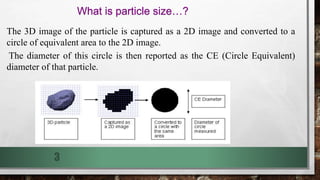
The 3D image of the particle is captured as a 2D image and converted to a
circle of equivalent area to the 2D image.
The diameter of this circle is then reported as the CE (Circle Equivalent)
diameter of that particle.
3
Purpose of particle size (PS)analysis
The purpose of particle size analysis in pharmacy is to obtain
quantitative data on the size, size distribution, and shapes of drug and
other components to be used in pharmaceutical formulations.
4
Importance of particle size (PS)
 Dissolution rate & Bioavailability.
 Production of formulated medicines as solid dosage forms.
 Formulation & Suspension Stability.
 Flow & Packing Properties.
 Grittiness of Solid Particles in Topical Semi-solids.
 Equipment Validation e.g. Particle retention by HEPA filters.
 Chemical reactivity of certain chemicals.
 All the novel drug delivery systems like nanoparticles etc.
 Aerosol formulation.
 During analysis of formulation on HPLC column.
5
6
 Microscopy
Optical
Transmission Electron Microscopy (TEM)
Scanning Electron Microscopy (SEM)
Atomic Force Microscopy (AFM)
 Electrical Property Methods
Coulter counter
Differential Mobility Analyzer (DMA)
Electrophoretic Mobility
Zeta Potential
 Sedimentation Methods
Photosedimentation
Centrifugal Sedimentation
 Sorting and Classification Methods
Field Flow Fractionation (FFF)
Sieving and Screening
Air Classification
 Light Interaction Methods
Rayleigh or Static Laser Light Scattering(SLS)
Photon Correlation Spectroscopy/Dynamic Laser
Light Scattering(DLS)
Single Particle Light Scattering
Multi-Angle Light Scattering
Methods of Particle size Analysis
7
PARTICLE SIZING BY LASER DIFFRACTION
Laser diffraction has become one of the most commonly used particle sizing methods, especially for particles
in the range of 0.5 to 1000 microns. It works on the principle that when a beam of light (a laser) is scattered
by a group of particles, the angle of light scattering is inversely proportional to particle size (ie. the smaller the
particle size, the larger the angle of light scattering). It is also a very fast, reliable and reproducible technique
and can measure over a very wide size range.
OTHER METHODS.
There are many other methods for analysing particle size, other than laser diffraction. Sieving is one of the
oldest particle sizing methods and is still widely used for relatively large particles (ie. > 1mm). When
measuring very small particles (ie. < 0.5um), Dynamic Light Scattering is by far the easiest methods to use.
And if you need to measure morphological properties of particles, (ie. shape as well as size), then image
analysis methods are the only way to gain the extra information.
8
 Light scattering is the alteration of direction and intensity of a light
beam that strikes an object, the alteration being due to the combined
effects of reflection, refraction, and diffraction
 Scattering = reflection+ refraction + diffraction
 The amplitude of scattered light at different angles (the scattering
pattern) depends not only on concentration and particle size, but also on
the ratio of the refractive indices of the particles to the medium in
which the particle exists.
9
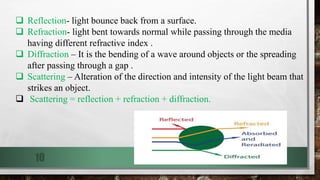
 Reflection- light bounce back from a surface.
 Refraction- light bent towards normal while passing through the media
having different refractive index .
 Diffraction – It is the bending of a wave around objects or the spreading
after passing through a gap .
 Scattering – Alteration of the direction and intensity of the light beam that
strikes an object.
 Scattering = reflection + refraction + diffraction.
10
By laser diffraction analysis it is possible to measure particles sizes between 0.5 and 3000 µm. The sample
is dispersed in either air or a suitable liquid media. The laser passes through the dispersion media and is
diffracted by the particles. The sample is dispersed well and it is ensured that the particles pass the laser
beam in a homogeneous stream. When particles are exposed to a collimated beam of light a diffraction
pattern is produced. The laser beam consists of two light sources (He-Ne) having different wavelength.
The blue laser is used for measuring the small particles, while the red detects the larger particles. The
diffraction pattern is measured by detectors, and the signal is then transformed to a particle size distribution
based on an optical model.
11
12
1.Static laser light scattering
Measures Total Intensity of Scattered light
(Mass ,Size, Radius of gyration, Second virial coefficient A2)
2. Dynamic laser light scattering
Measures Fluctuation Changes on the intensity of the scattered light
(Diffusion constant ,Size, Hydrodynamic radius, Polydispersity index)
13
Theory of Light scattering
I. Rayleigh Theory
II. Mie Theory
III. Fraunhofer Theory
Fraunhofer approximation or the Mie theory is used for transforming the measured data to
a particle size distribution.
Opticle properties are essential for Mie and it gives true result of spherical particle.
Mie theory is recommended for the particles having size less than 50 micrometer.
Fraunhofer theory, it state that the intensity of light scattered by the particle is directly
proportion to the particle size.it is recommended for particle having size greater than 50
micrometer.
1.RAYLEIGH THEORY
Rayleigh scattering occurs when the size of the particle responsible for the scattering event is much
smaller than the wavelength of the incident light.
The amount of Rayleigh scattering that occurs to a beam of light is dependent upon the size of the
particles and the wavelength of the light.
Rayleigh scattering applies to particles that are small with respect to wavelengths of light, and that are
optically "soft" (i.e., with a refractive index close to 1). Anomalous diffraction theory applies to optically
soft but larger particles.
For particles, d ≤ wavelength
Most prominently seen in gases.
Eg. Blue color light get scattered most in all direction because of the shortest wavelength.
red color light has longest wavelength of all visible light colors so it scattered least.
14
II. MIE THEORY
Mie scattering theory is induced from Maxwell's electromagnetic theory. It describes the
analysis to the mechanism of light scattering from a smooth sphere. Mie scattering theory
took into account optical properties (refractive index, absorptivity, and reflectivity) of
the particle and the refractive index of the medium.
Therefore, it can provide accurate analysis for samples with varies optical properties and
offer more precise results for particle sizing. Scattering by particles with a size comparable
to or larger than the wavelength of the light is typically treated by the Mie theory.
Mie scattering theory can be applied to sub-micron to millimeter particles.
15
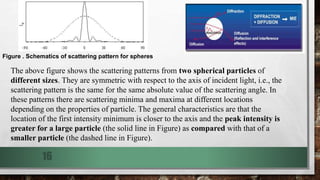
Figure . Schematics of scattering pattern for spheres
The above figure shows the scattering patterns from two spherical particles of
different sizes. They are symmetric with respect to the axis of incident light, i.e., the
scattering pattern is the same for the same absolute value of the scattering angle. In
these patterns there are scattering minima and maxima at different locations
depending on the properties of particle. The general characteristics are that the
location of the first intensity minimum is closer to the axis and the peak intensity is
greater for a large particle (the solid line in Figure) as compared with that of a
smaller particle (the dashed line in Figure).
16
III. FRAUNHOFER THEORY
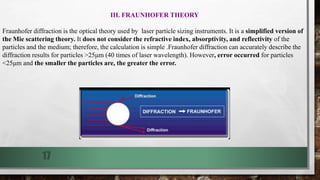
Fraunhofer diffraction is the optical theory used by laser particle sizing instruments. It is a simplified version of
the Mie scattering theory. It does not consider the refractive index, absorptivity, and reflectivity of the
particles and the medium; therefore, the calculation is simple .Fraunhofer diffraction can accurately describe the
diffraction results for particles >25μm (40 times of laser wavelength). However, error occurred for particles
<25μm and the smaller the particles are, the greater the error.
17
18
Dynamic light scattering (DLS) is a technique for determining particle size by
measuring the Brownian motion (the random movement) of particles in a suspension or
solution. The bigger the particle, the slower the Brownian motion will be. Fluctuations
in the intensity of scattered light are measured for a period of time and then the data is
processed into a ‘correlation function’ (a mathematical function that identifies the
patterns). Then a second mathematical analysis known as a ‘polydispersity analysis’ is
performed on the correlation function to determine the size of particles and the relative
numbers of each size.
Static Light Scattering(SLS) involves measuring the scattering intensity of a number of
concentrations of the sample from which the molecular weight of proteins and polymers .
It is an optical technique that measures the intensity of the scattered light in
dependence of the scattering angle to obtain information on the scattering source.
Measurement of the scattering intensity at different angles allows calculation of the root
mean square radius, also called the radius of gyration Rg.
1.Static Light
Scattering
19
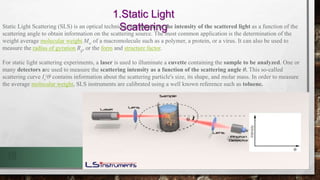
Static Light Scattering (SLS) is an optical technique that measures the intensity of the scattered light as a function of the
scattering angle to obtain information on the scattering source. The most common application is the determination of the
weight average molecular weight Mw of a macromolecule such as a polymer, a protein, or a virus. It can also be used to
measure the radius of gyration Rg, or the form and structure factor.
For static light scattering experiments, a laser is used to illuminate a cuvette containing the sample to be analyzed. One or
many detectors are used to measure the scattering intensity as a function of the scattering angle θ. This so-called
scattering curve Is
(θ) contains information about the scattering particle's size, its shape, and molar mass. In order to measure
the average molecular weight, SLS instruments are calibrated using a well known reference such as toluene.
20
Static laser light scattering can be used to measure particle size ranging from approximately 10-20 nm up to
a few millimetres. When particles are illuminated by a laser beam, light scattering is observed and their size
can be determined from the angular intensity distribution.
The physical theories that support this calculation are the Fraunhofer theory for rather large particles and
the Mie theory which applies both to large and small particles.
Particles are defined “small” when their diameter is not larger than the wavelength of the illuminating
laser light. Typically, Laser Particle Sizers use laser light with a wavelength between 500 and 700 nm.
Therefore, the transition between the Fraunhofer and the Mie limit takes place in the region 0.5-1 μm. For the
sake of completeness, it must be said that the Mie and Fraunhofer limits may not only depend on the particle
size, but also on the sample material and the specific application.
The Need for Dispersion
It is possible that particles are found in the form of agglomerates. Agglomerates need to be dispersed and the
clusters need to be separated. There, in most cases, wet dispersion is used.
21
Measurement of the scattering intensity at many angles allows calculation of the root mean square radius, also
called the radius of gyration Rg.
By measuring the scattering intensity for many samples of various concentrations, the second virial
coefficient A2, can be calculated.
Static light scattering is also commonly utilized to determine the size of particle suspensions in the sub-μm
and supra-μm ranges, via the Lorenz-Mie (see Mie scattering) and Fraunhofer diffraction formalisms,
respectively.
For static light scattering experiments, a high-intensity monochromatic light, usually a laser, is launched in a
solution containing the macromolecules. One or many detectors are used to measure the scattering intensity at
one or many angles. The angular dependence is required to obtain accurate measurements of both molar mass
and size for all macromolecules of radius above 1–2% the incident wavelength. Hence simultaneous
measurements at several angles relative to the direction of incident light, known as multi-angle light scattering
(MALS) or multi-angle laser light scattering (MALLS), is generally regarded as the standard implementation
of static light scattering.
22
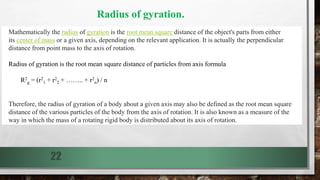
Mathematically the radius of gyration is the root mean square distance of the object's parts from either
its center of mass or a given axis, depending on the relevant application. It is actually the perpendicular
distance from point mass to the axis of rotation.
Radius of gyration is the root mean square distance of particles from axis formula
R2
g = (r2
1 + r2
2 + …….. + r2
n) / n
Therefore, the radius of gyration of a body about a given axis may also be defined as the root mean square
distance of the various particles of the body from the axis of rotation. It is also known as a measure of the
way in which the mass of a rotating rigid body is distributed about its axis of rotation.
Radius of gyration.
23
2.Dynamic light scattering (DLS)
Dynamic light scattering (DLS), sometimes referred to as Quasi Elastic Light Scattering (QELS), is a
non-invasive, well-established technique for measuring the size and size distribution of molecules and
particles typically in the submicron region, and with the latest technology, lower than 1nm.
Typical applications of dynamic light scattering are the characterization of particles, emulsions or
molecules which have been dispersed or dissolved in a liquid.
It is based on the Brownian motion of dispersed particles. When particles are dispersed in a liquid they
move randomly in all directions. The principle of Brownian motion is that particles are constantly
colliding with solvent molecules. These collisions cause a certain amount of energy to be transferred,
which induces particle movement. The energy transfer is more or less constant and therefore has a greater
effect on smaller particles.
As a result, smaller particles are moving at higher speeds than larger particles. If you know all other
parameters which have an influence on particle movement, you can determine the hydrodynamic
diameter by measuring the speed of the particles.
24
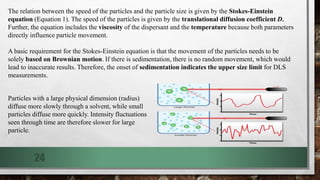
The relation between the speed of the particles and the particle size is given by the Stokes-Einstein
equation (Equation 1). The speed of the particles is given by the translational diffusion coefficient D.
Further, the equation includes the viscosity of the dispersant and the temperature because both parameters
directly influence particle movement.
A basic requirement for the Stokes-Einstein equation is that the movement of the particles needs to be
solely based on Brownian motion. If there is sedimentation, there is no random movement, which would
lead to inaccurate results. Therefore, the onset of sedimentation indicates the upper size limit for DLS
measurements.
Particles with a large physical dimension (radius)
diffuse more slowly through a solvent, while small
particles diffuse more quickly. Intensity fluctuations
seen through time are therefore slower for large
particle.
25
In contrast, the lower size limit is defined by the signal-to-noise ratio. Small particles do not scatter
much light, which leads to an insufficient measurement signal.
D= KT/6πη RH
Equation : The Stokes-Einstein equation
D Translational diffusion coefficient [m²/s]
k Boltzmann constant [m²kg/Ks²]
T Temperature [K]
h Viscosity [Pa.s]
RH Hydrodynamic radius [m]
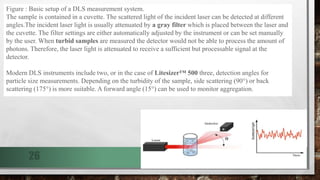
The basic DLS setup
The basic setup of a DLS instrument is shown in Figure . A single frequency laser is directed to the sample
contained in a cuvette. If there are particles in the sample, the incident laser light gets scattered in all
directions. The scattered light is detected at a certain angle over time and this signal is used to determine the
diffusion coefficient and the particle size by the Stokes-Einstein equation.
26
Figure : Basic setup of a DLS measurement system.
The sample is contained in a cuvette. The scattered light of the incident laser can be detected at different
angles.The incident laser light is usually attenuated by a gray filter which is placed between the laser and
the cuvette. The filter settings are either automatically adjusted by the instrument or can be set manually
by the user. When turbid samples are measured the detector would not be able to process the amount of
photons. Therefore, the laser light is attenuated to receive a sufficient but processable signal at the
detector.
Modern DLS instruments include two, or in the case of Litesizer™ 500 three, detection angles for
particle size measurements. Depending on the turbidity of the sample, side scattering (90°) or back
scattering (175°) is more suitable. A forward angle (15°) can be used to monitor aggregation.
27
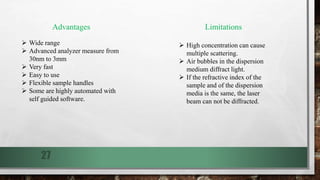
Advantages
 Wide range
 Advanced analyzer measure from
30nm to 3mm
 Very fast
 Easy to use
 Flexible sample handles
 Some are highly automated with
self guided software.
Limitations
 High concentration can cause
multiple scattering.
 Air bubbles in the dispersion
medium diffract light.
 If the refractive index of the
sample and of the dispersion
media is the same, the laser
beam can not be diffracted.
28

Particle Size Analysis by Laser Diffraction Method.

  • 1.
    PARTICLE SIZE ANALYSIS: PRINCIPLEOF STATIC & DYNAMIC LASER LIGHT SCATTERING. Presented by; Ashvini. B.Tanpure Department of Pharmaceutical Technology (Process Chemistry) M. Tech. (Pharm), Sem-II National Institute of Pharmaceutical Education and Research (NIPER) SAS Nagar, Mohali. 1
  • 2.
    2 WHAT IS PARTICLESIZE ANALYSIS…? Particle size analysis is used to characterise the size distribution of particles in a given sample. It can be applied to solid materials, suspensions, emulsions and even aerosols. There are many different methods employed to measure particle size. It is a very important test and is used for quality control in many different industries. particle size is a critical factor in determining the efficiency of manufacturing processes and performance of the final product. Some industries and product types where particle sizing is used includes: Pharmaceuticals Building materials Paints and coatings Food and beverages Aerosols
  • 3.
    What is particlesize…? The 3D image of the particle is captured as a 2D image and converted to a circle of equivalent area to the 2D image. The diameter of this circle is then reported as the CE (Circle Equivalent) diameter of that particle. 3
  • 4.
    Purpose of particlesize (PS)analysis The purpose of particle size analysis in pharmacy is to obtain quantitative data on the size, size distribution, and shapes of drug and other components to be used in pharmaceutical formulations. 4
  • 5.
    Importance of particlesize (PS)  Dissolution rate & Bioavailability.  Production of formulated medicines as solid dosage forms.  Formulation & Suspension Stability.  Flow & Packing Properties.  Grittiness of Solid Particles in Topical Semi-solids.  Equipment Validation e.g. Particle retention by HEPA filters.  Chemical reactivity of certain chemicals.  All the novel drug delivery systems like nanoparticles etc.  Aerosol formulation.  During analysis of formulation on HPLC column. 5
  • 6.
    6  Microscopy Optical Transmission ElectronMicroscopy (TEM) Scanning Electron Microscopy (SEM) Atomic Force Microscopy (AFM)  Electrical Property Methods Coulter counter Differential Mobility Analyzer (DMA) Electrophoretic Mobility Zeta Potential  Sedimentation Methods Photosedimentation Centrifugal Sedimentation  Sorting and Classification Methods Field Flow Fractionation (FFF) Sieving and Screening Air Classification  Light Interaction Methods Rayleigh or Static Laser Light Scattering(SLS) Photon Correlation Spectroscopy/Dynamic Laser Light Scattering(DLS) Single Particle Light Scattering Multi-Angle Light Scattering Methods of Particle size Analysis
  • 7.
    7 PARTICLE SIZING BYLASER DIFFRACTION Laser diffraction has become one of the most commonly used particle sizing methods, especially for particles in the range of 0.5 to 1000 microns. It works on the principle that when a beam of light (a laser) is scattered by a group of particles, the angle of light scattering is inversely proportional to particle size (ie. the smaller the particle size, the larger the angle of light scattering). It is also a very fast, reliable and reproducible technique and can measure over a very wide size range. OTHER METHODS. There are many other methods for analysing particle size, other than laser diffraction. Sieving is one of the oldest particle sizing methods and is still widely used for relatively large particles (ie. > 1mm). When measuring very small particles (ie. < 0.5um), Dynamic Light Scattering is by far the easiest methods to use. And if you need to measure morphological properties of particles, (ie. shape as well as size), then image analysis methods are the only way to gain the extra information.
  • 8.
  • 9.
     Light scatteringis the alteration of direction and intensity of a light beam that strikes an object, the alteration being due to the combined effects of reflection, refraction, and diffraction  Scattering = reflection+ refraction + diffraction  The amplitude of scattered light at different angles (the scattering pattern) depends not only on concentration and particle size, but also on the ratio of the refractive indices of the particles to the medium in which the particle exists. 9
  • 10.
     Reflection- lightbounce back from a surface.  Refraction- light bent towards normal while passing through the media having different refractive index .  Diffraction – It is the bending of a wave around objects or the spreading after passing through a gap .  Scattering – Alteration of the direction and intensity of the light beam that strikes an object.  Scattering = reflection + refraction + diffraction. 10
  • 11.
    By laser diffractionanalysis it is possible to measure particles sizes between 0.5 and 3000 µm. The sample is dispersed in either air or a suitable liquid media. The laser passes through the dispersion media and is diffracted by the particles. The sample is dispersed well and it is ensured that the particles pass the laser beam in a homogeneous stream. When particles are exposed to a collimated beam of light a diffraction pattern is produced. The laser beam consists of two light sources (He-Ne) having different wavelength. The blue laser is used for measuring the small particles, while the red detects the larger particles. The diffraction pattern is measured by detectors, and the signal is then transformed to a particle size distribution based on an optical model. 11
  • 12.
    12 1.Static laser lightscattering Measures Total Intensity of Scattered light (Mass ,Size, Radius of gyration, Second virial coefficient A2) 2. Dynamic laser light scattering Measures Fluctuation Changes on the intensity of the scattered light (Diffusion constant ,Size, Hydrodynamic radius, Polydispersity index)
  • 13.
    13 Theory of Lightscattering I. Rayleigh Theory II. Mie Theory III. Fraunhofer Theory Fraunhofer approximation or the Mie theory is used for transforming the measured data to a particle size distribution. Opticle properties are essential for Mie and it gives true result of spherical particle. Mie theory is recommended for the particles having size less than 50 micrometer. Fraunhofer theory, it state that the intensity of light scattered by the particle is directly proportion to the particle size.it is recommended for particle having size greater than 50 micrometer.
  • 14.
    1.RAYLEIGH THEORY Rayleigh scatteringoccurs when the size of the particle responsible for the scattering event is much smaller than the wavelength of the incident light. The amount of Rayleigh scattering that occurs to a beam of light is dependent upon the size of the particles and the wavelength of the light. Rayleigh scattering applies to particles that are small with respect to wavelengths of light, and that are optically "soft" (i.e., with a refractive index close to 1). Anomalous diffraction theory applies to optically soft but larger particles. For particles, d ≤ wavelength Most prominently seen in gases. Eg. Blue color light get scattered most in all direction because of the shortest wavelength. red color light has longest wavelength of all visible light colors so it scattered least. 14
  • 15.
    II. MIE THEORY Miescattering theory is induced from Maxwell's electromagnetic theory. It describes the analysis to the mechanism of light scattering from a smooth sphere. Mie scattering theory took into account optical properties (refractive index, absorptivity, and reflectivity) of the particle and the refractive index of the medium. Therefore, it can provide accurate analysis for samples with varies optical properties and offer more precise results for particle sizing. Scattering by particles with a size comparable to or larger than the wavelength of the light is typically treated by the Mie theory. Mie scattering theory can be applied to sub-micron to millimeter particles. 15
  • 16.
    Figure . Schematicsof scattering pattern for spheres The above figure shows the scattering patterns from two spherical particles of different sizes. They are symmetric with respect to the axis of incident light, i.e., the scattering pattern is the same for the same absolute value of the scattering angle. In these patterns there are scattering minima and maxima at different locations depending on the properties of particle. The general characteristics are that the location of the first intensity minimum is closer to the axis and the peak intensity is greater for a large particle (the solid line in Figure) as compared with that of a smaller particle (the dashed line in Figure). 16
  • 17.
    III. FRAUNHOFER THEORY Fraunhoferdiffraction is the optical theory used by laser particle sizing instruments. It is a simplified version of the Mie scattering theory. It does not consider the refractive index, absorptivity, and reflectivity of the particles and the medium; therefore, the calculation is simple .Fraunhofer diffraction can accurately describe the diffraction results for particles >25μm (40 times of laser wavelength). However, error occurred for particles <25μm and the smaller the particles are, the greater the error. 17
  • 18.
    18 Dynamic light scattering(DLS) is a technique for determining particle size by measuring the Brownian motion (the random movement) of particles in a suspension or solution. The bigger the particle, the slower the Brownian motion will be. Fluctuations in the intensity of scattered light are measured for a period of time and then the data is processed into a ‘correlation function’ (a mathematical function that identifies the patterns). Then a second mathematical analysis known as a ‘polydispersity analysis’ is performed on the correlation function to determine the size of particles and the relative numbers of each size. Static Light Scattering(SLS) involves measuring the scattering intensity of a number of concentrations of the sample from which the molecular weight of proteins and polymers . It is an optical technique that measures the intensity of the scattered light in dependence of the scattering angle to obtain information on the scattering source. Measurement of the scattering intensity at different angles allows calculation of the root mean square radius, also called the radius of gyration Rg.
  • 19.
    1.Static Light Scattering 19 Static LightScattering (SLS) is an optical technique that measures the intensity of the scattered light as a function of the scattering angle to obtain information on the scattering source. The most common application is the determination of the weight average molecular weight Mw of a macromolecule such as a polymer, a protein, or a virus. It can also be used to measure the radius of gyration Rg, or the form and structure factor. For static light scattering experiments, a laser is used to illuminate a cuvette containing the sample to be analyzed. One or many detectors are used to measure the scattering intensity as a function of the scattering angle θ. This so-called scattering curve Is (θ) contains information about the scattering particle's size, its shape, and molar mass. In order to measure the average molecular weight, SLS instruments are calibrated using a well known reference such as toluene.
  • 20.
    20 Static laser lightscattering can be used to measure particle size ranging from approximately 10-20 nm up to a few millimetres. When particles are illuminated by a laser beam, light scattering is observed and their size can be determined from the angular intensity distribution. The physical theories that support this calculation are the Fraunhofer theory for rather large particles and the Mie theory which applies both to large and small particles. Particles are defined “small” when their diameter is not larger than the wavelength of the illuminating laser light. Typically, Laser Particle Sizers use laser light with a wavelength between 500 and 700 nm. Therefore, the transition between the Fraunhofer and the Mie limit takes place in the region 0.5-1 μm. For the sake of completeness, it must be said that the Mie and Fraunhofer limits may not only depend on the particle size, but also on the sample material and the specific application. The Need for Dispersion It is possible that particles are found in the form of agglomerates. Agglomerates need to be dispersed and the clusters need to be separated. There, in most cases, wet dispersion is used.
  • 21.
    21 Measurement of thescattering intensity at many angles allows calculation of the root mean square radius, also called the radius of gyration Rg. By measuring the scattering intensity for many samples of various concentrations, the second virial coefficient A2, can be calculated. Static light scattering is also commonly utilized to determine the size of particle suspensions in the sub-μm and supra-μm ranges, via the Lorenz-Mie (see Mie scattering) and Fraunhofer diffraction formalisms, respectively. For static light scattering experiments, a high-intensity monochromatic light, usually a laser, is launched in a solution containing the macromolecules. One or many detectors are used to measure the scattering intensity at one or many angles. The angular dependence is required to obtain accurate measurements of both molar mass and size for all macromolecules of radius above 1–2% the incident wavelength. Hence simultaneous measurements at several angles relative to the direction of incident light, known as multi-angle light scattering (MALS) or multi-angle laser light scattering (MALLS), is generally regarded as the standard implementation of static light scattering.
  • 22.
    22 Mathematically the radiusof gyration is the root mean square distance of the object's parts from either its center of mass or a given axis, depending on the relevant application. It is actually the perpendicular distance from point mass to the axis of rotation. Radius of gyration is the root mean square distance of particles from axis formula R2 g = (r2 1 + r2 2 + …….. + r2 n) / n Therefore, the radius of gyration of a body about a given axis may also be defined as the root mean square distance of the various particles of the body from the axis of rotation. It is also known as a measure of the way in which the mass of a rotating rigid body is distributed about its axis of rotation. Radius of gyration.
  • 23.
    23 2.Dynamic light scattering(DLS) Dynamic light scattering (DLS), sometimes referred to as Quasi Elastic Light Scattering (QELS), is a non-invasive, well-established technique for measuring the size and size distribution of molecules and particles typically in the submicron region, and with the latest technology, lower than 1nm. Typical applications of dynamic light scattering are the characterization of particles, emulsions or molecules which have been dispersed or dissolved in a liquid. It is based on the Brownian motion of dispersed particles. When particles are dispersed in a liquid they move randomly in all directions. The principle of Brownian motion is that particles are constantly colliding with solvent molecules. These collisions cause a certain amount of energy to be transferred, which induces particle movement. The energy transfer is more or less constant and therefore has a greater effect on smaller particles. As a result, smaller particles are moving at higher speeds than larger particles. If you know all other parameters which have an influence on particle movement, you can determine the hydrodynamic diameter by measuring the speed of the particles.
  • 24.
    24 The relation betweenthe speed of the particles and the particle size is given by the Stokes-Einstein equation (Equation 1). The speed of the particles is given by the translational diffusion coefficient D. Further, the equation includes the viscosity of the dispersant and the temperature because both parameters directly influence particle movement. A basic requirement for the Stokes-Einstein equation is that the movement of the particles needs to be solely based on Brownian motion. If there is sedimentation, there is no random movement, which would lead to inaccurate results. Therefore, the onset of sedimentation indicates the upper size limit for DLS measurements. Particles with a large physical dimension (radius) diffuse more slowly through a solvent, while small particles diffuse more quickly. Intensity fluctuations seen through time are therefore slower for large particle.
  • 25.
    25 In contrast, thelower size limit is defined by the signal-to-noise ratio. Small particles do not scatter much light, which leads to an insufficient measurement signal. D= KT/6πη RH Equation : The Stokes-Einstein equation D Translational diffusion coefficient [m²/s] k Boltzmann constant [m²kg/Ks²] T Temperature [K] h Viscosity [Pa.s] RH Hydrodynamic radius [m] The basic DLS setup The basic setup of a DLS instrument is shown in Figure . A single frequency laser is directed to the sample contained in a cuvette. If there are particles in the sample, the incident laser light gets scattered in all directions. The scattered light is detected at a certain angle over time and this signal is used to determine the diffusion coefficient and the particle size by the Stokes-Einstein equation.
  • 26.
    26 Figure : Basicsetup of a DLS measurement system. The sample is contained in a cuvette. The scattered light of the incident laser can be detected at different angles.The incident laser light is usually attenuated by a gray filter which is placed between the laser and the cuvette. The filter settings are either automatically adjusted by the instrument or can be set manually by the user. When turbid samples are measured the detector would not be able to process the amount of photons. Therefore, the laser light is attenuated to receive a sufficient but processable signal at the detector. Modern DLS instruments include two, or in the case of Litesizer™ 500 three, detection angles for particle size measurements. Depending on the turbidity of the sample, side scattering (90°) or back scattering (175°) is more suitable. A forward angle (15°) can be used to monitor aggregation.
  • 27.
    27 Advantages  Wide range Advanced analyzer measure from 30nm to 3mm  Very fast  Easy to use  Flexible sample handles  Some are highly automated with self guided software. Limitations  High concentration can cause multiple scattering.  Air bubbles in the dispersion medium diffract light.  If the refractive index of the sample and of the dispersion media is the same, the laser beam can not be diffracted.
  • 28.