
Characteristics/Classification of
Neoplasm
NEOPLASIA
Presented By
Chhavi Singh
Definition
• Neoplasia means new growth
• Neoplasm means tumor/ cancer
• Cancer is an uncontrolled proliferation of cells that express varying
degree of fidelity to their precursors.
• It can be Benign or malignant.
• Benign: Cells grow as a compact mass and remain at their site of
origin.
• Malignant: Growth of cells is uncontrolled. Cells can spread into
surrounding tissue and to distant sites.
Normal cells
Atrophy
Hyperplasia
Neoplasia
(malignancy)
Dysplasia
Hypertrophy
Metaplasia
Difference b/w normal cells and cancerous cells
Difference b/w Benign & Malignant Neoplasm
Chemical carcinogenesis
-Mutagens
-Chemical carcinogenesis and their
metabolism
Physical carcinogenesis (radiations)
-UV radiation
-Asbestos
Infectious pathogens (viral)
-Human T-cell leukemia viruses, DNA viruses,
-human papillomaviruses
-Hepatitis B virus
Causes of Cancer
Three major type of carcinogens
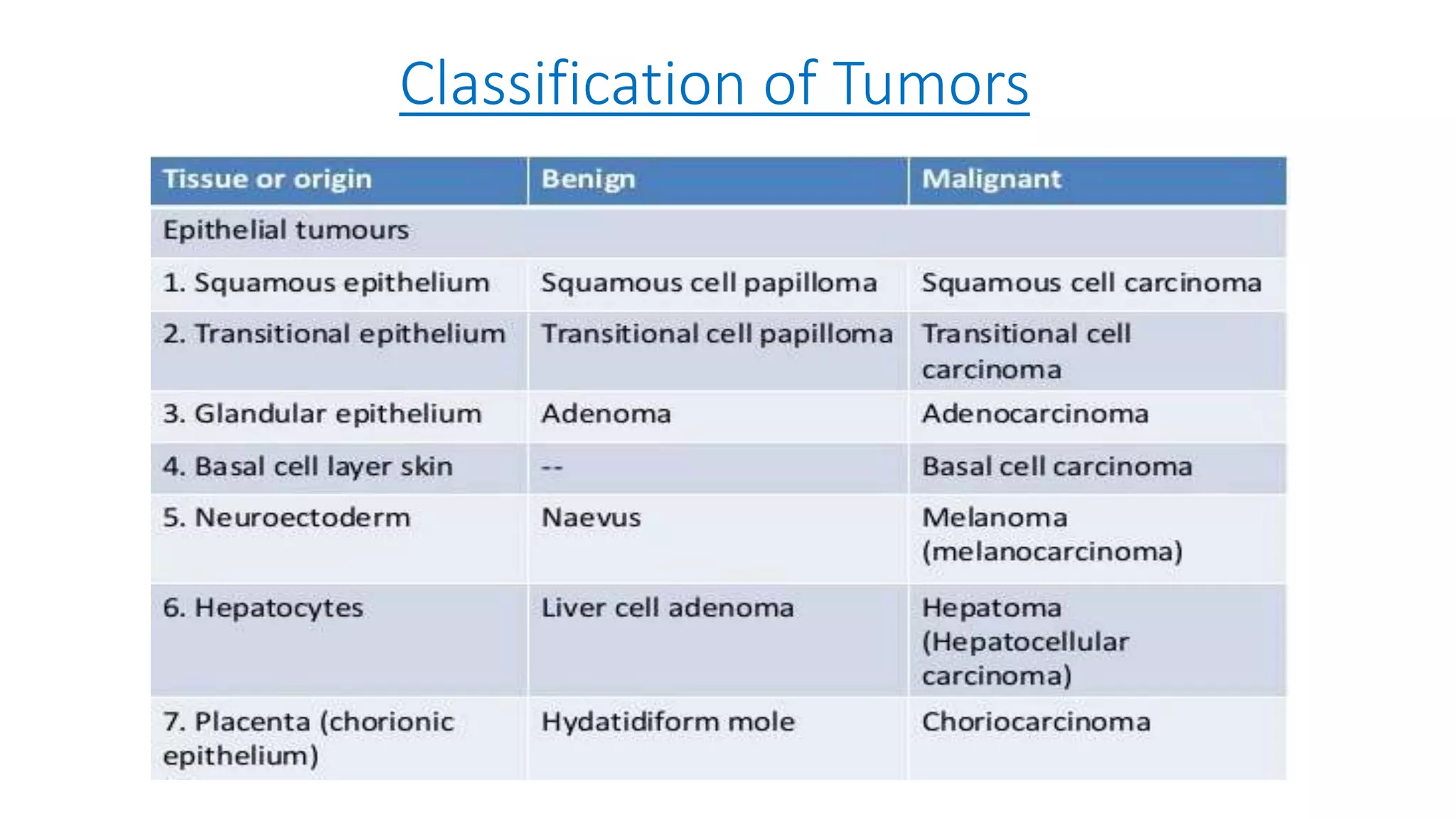
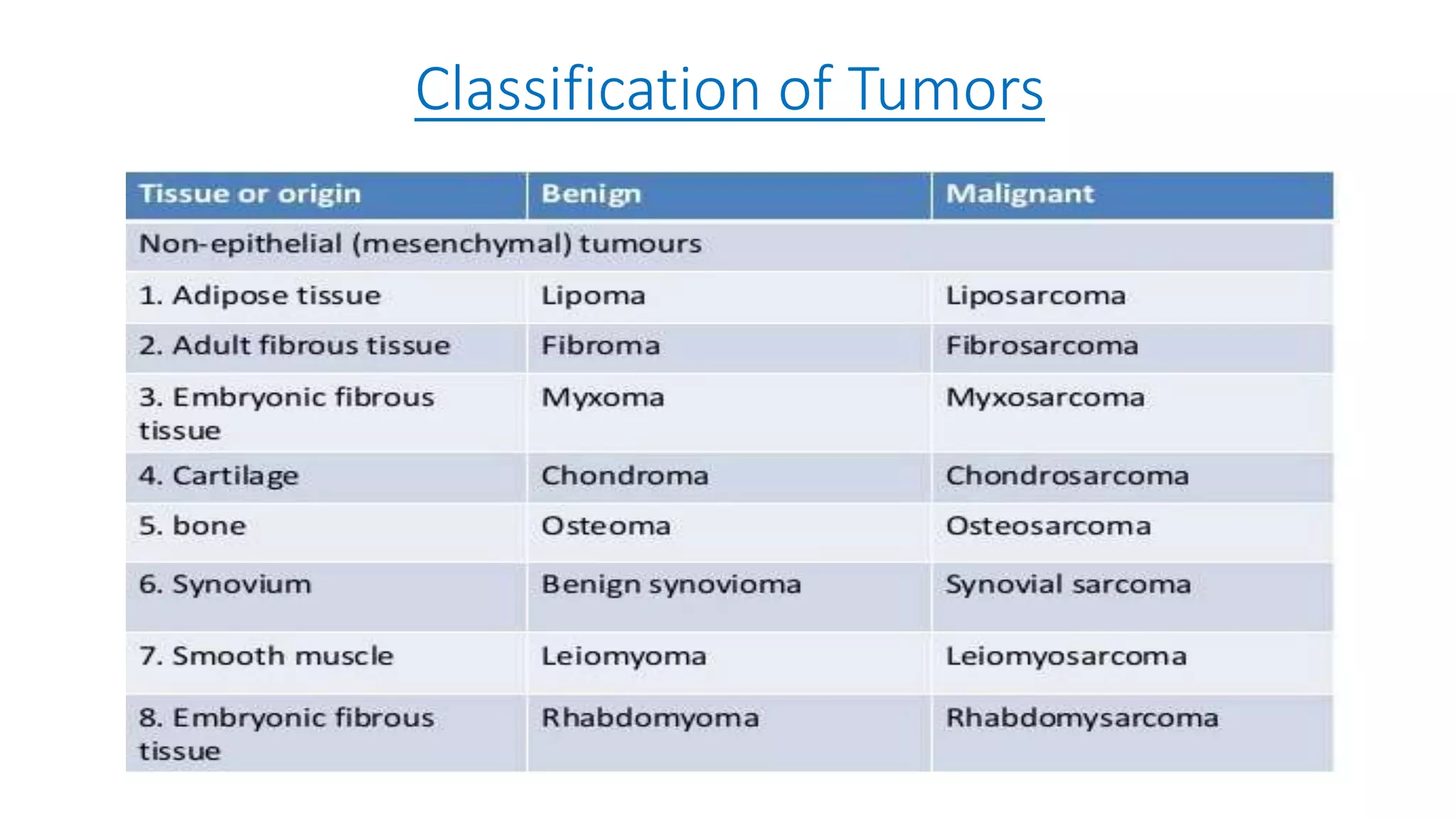
Classification of Tumors
Characteristics of Tumors
• Rate of growth
• Cancer phenotype & stem cells
• Clinical & gross features
• Microscopic features
• Local invasion (Direct spread)
• Metastasis (Distant spread)
Characteristics of Tumors
1. Rate of growth
- The tumor cell proliferate more rapidly than the normal cells.
- The tumor enlarge rate depends upon:
a. Rate of cell production, growth fraction & rate of cell loss
b. Degree of differentiation of the tumor.
a. Rate of growth of a tumor depends upon:
I. Doubling time of tumor cells
II. No. of cells remaining in proliferative pool (growth fraction)
III. Rate of loss of tumor cells by cell shedding.
Characteristics of Tumors
1. Rate of growth
b. Degree of Differentiation
-The growth rate of malignant tumor is directly proportionate to the
degree of differentiation.
-Poorly differentiated tumors show aggressive growth pattern as
compared to better differentiated tumors.
-Rarely, a malignant tumor may disappear spontaneously from the
primary site, possibly due to necrosis caused by good host immune attack.
Characteristics of Tumors
2. Cancer Phenotype & Stem cells
cancer cells
• Disobey the growth control ----- proliferate rapidly
• Escape death signals ------ immortality
• Imbalance b/w cell proliferation and cell death in cancer ------ excessive growth
• Lose properties of differentiation ------ no function
• Genetically unstable ------ newer mutation
• Over run neighboring tissue ------ invade locally
• Have the ability to travel from the site of origin to other sites ----Distant metastasis
Cancer stem cells have the properties of prolonged self renewal, asymmetric
replication & trans differentiation (i.e. plasticity).
Characteristics of Tumors
3. Clinical & gross features
• Gross appearance
-Benign tumors are generally spherical or ovoid in shape.
encapsulated or well-circumscribed, freely movable, firm &uniform.
-Malignant tumors are usually irregular in shape, poorly-circumscribed & extend into
the adjacent tissues.
• Clinical Features
-Benign tumors are slow growing & may remain asymptomatic (e.g. subcutaneous
lipoma) or may produce serious symptoms.
-Malignant tumors grow rapidly, may ulcerate on the surface, invade locally into
deeper tissues, may spread to distant sites (metastasis).
Characteristics of Tumors
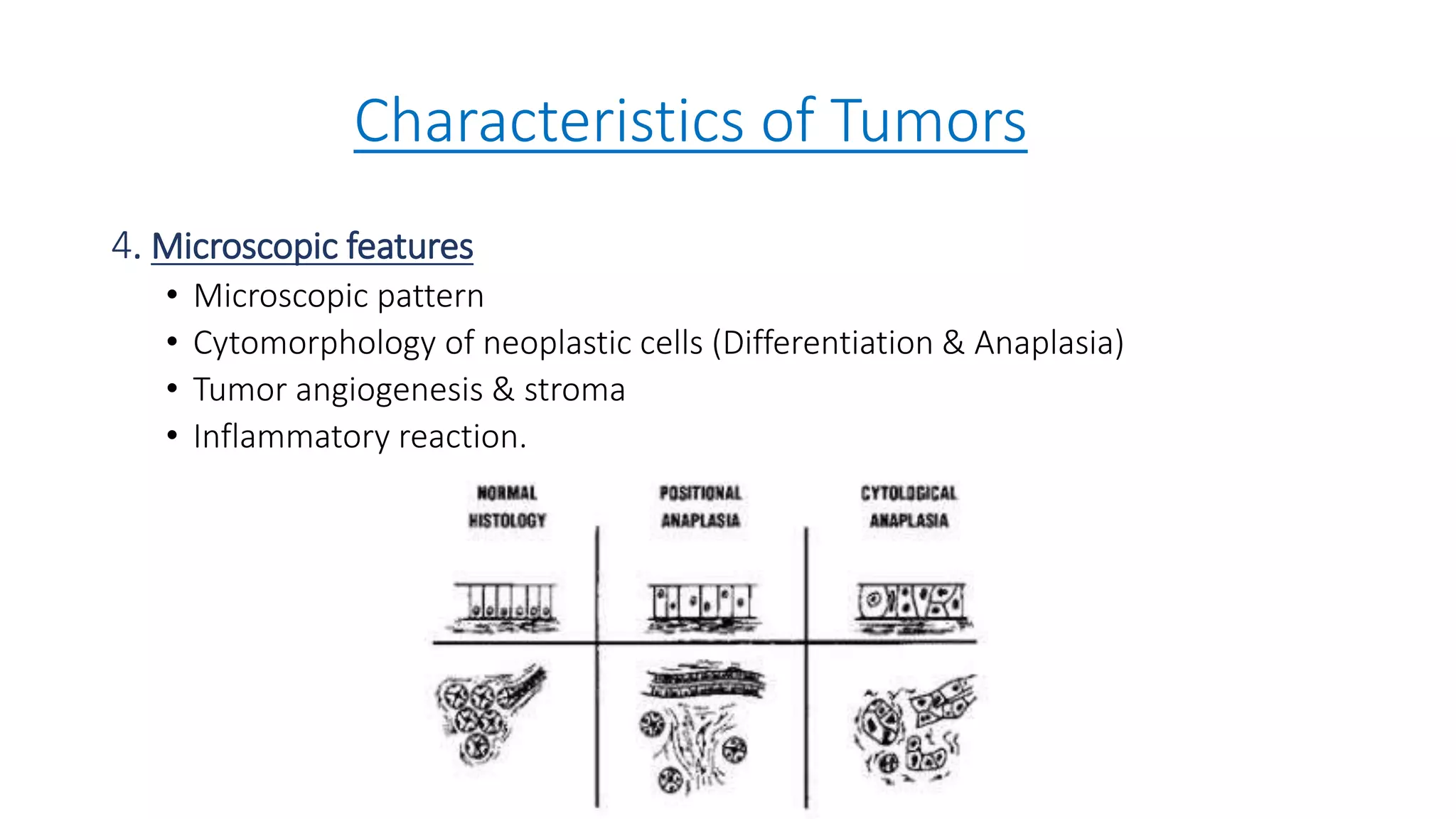
4. Microscopic features
• Microscopic pattern
• Cytomorphology of neoplastic cells (Differentiation & Anaplasia)
• Tumor angiogenesis & stroma
• Inflammatory reaction.
Characteristics of Tumors
5. Local invasion (Direct spread)
- Benign
Expand and push aside without invading, infiltrating or metastasising.
- Malignant
Expand, invasion, infiltration & destruction of the surrounding tissue.
6. Metastasis (Direct spread)
Metastasis : spread of tumor by invasion.
Routes of metastasis
• Lymphatic spread
• Haematogenous spread
• Spread along body cavities & neutral passages.
THANKYOU!

Neoplasia - Characteristics & Classification of Neoplasm

  • 1.
  • 2.
  • 3.
    Definition • Neoplasia meansnew growth • Neoplasm means tumor/ cancer • Cancer is an uncontrolled proliferation of cells that express varying degree of fidelity to their precursors. • It can be Benign or malignant. • Benign: Cells grow as a compact mass and remain at their site of origin. • Malignant: Growth of cells is uncontrolled. Cells can spread into surrounding tissue and to distant sites.
  • 4.
  • 5.
    Difference b/w normalcells and cancerous cells
  • 6.
    Difference b/w Benign& Malignant Neoplasm
  • 7.
    Chemical carcinogenesis -Mutagens -Chemical carcinogenesisand their metabolism Physical carcinogenesis (radiations) -UV radiation -Asbestos Infectious pathogens (viral) -Human T-cell leukemia viruses, DNA viruses, -human papillomaviruses -Hepatitis B virus Causes of Cancer Three major type of carcinogens
  • 8.
  • 9.
  • 10.
  • 11.
  • 12.
    Characteristics of Tumors •Rate of growth • Cancer phenotype & stem cells • Clinical & gross features • Microscopic features • Local invasion (Direct spread) • Metastasis (Distant spread)
  • 13.
    Characteristics of Tumors 1.Rate of growth - The tumor cell proliferate more rapidly than the normal cells. - The tumor enlarge rate depends upon: a. Rate of cell production, growth fraction & rate of cell loss b. Degree of differentiation of the tumor. a. Rate of growth of a tumor depends upon: I. Doubling time of tumor cells II. No. of cells remaining in proliferative pool (growth fraction) III. Rate of loss of tumor cells by cell shedding.
  • 14.
    Characteristics of Tumors 1.Rate of growth b. Degree of Differentiation -The growth rate of malignant tumor is directly proportionate to the degree of differentiation. -Poorly differentiated tumors show aggressive growth pattern as compared to better differentiated tumors. -Rarely, a malignant tumor may disappear spontaneously from the primary site, possibly due to necrosis caused by good host immune attack.
  • 15.
    Characteristics of Tumors 2.Cancer Phenotype & Stem cells cancer cells • Disobey the growth control ----- proliferate rapidly • Escape death signals ------ immortality • Imbalance b/w cell proliferation and cell death in cancer ------ excessive growth • Lose properties of differentiation ------ no function • Genetically unstable ------ newer mutation • Over run neighboring tissue ------ invade locally • Have the ability to travel from the site of origin to other sites ----Distant metastasis Cancer stem cells have the properties of prolonged self renewal, asymmetric replication & trans differentiation (i.e. plasticity).
  • 16.
    Characteristics of Tumors 3.Clinical & gross features • Gross appearance -Benign tumors are generally spherical or ovoid in shape. encapsulated or well-circumscribed, freely movable, firm &uniform. -Malignant tumors are usually irregular in shape, poorly-circumscribed & extend into the adjacent tissues. • Clinical Features -Benign tumors are slow growing & may remain asymptomatic (e.g. subcutaneous lipoma) or may produce serious symptoms. -Malignant tumors grow rapidly, may ulcerate on the surface, invade locally into deeper tissues, may spread to distant sites (metastasis).
  • 17.
    Characteristics of Tumors 4.Microscopic features • Microscopic pattern • Cytomorphology of neoplastic cells (Differentiation & Anaplasia) • Tumor angiogenesis & stroma • Inflammatory reaction.
  • 18.
    Characteristics of Tumors 5.Local invasion (Direct spread) - Benign Expand and push aside without invading, infiltrating or metastasising. - Malignant Expand, invasion, infiltration & destruction of the surrounding tissue. 6. Metastasis (Direct spread) Metastasis : spread of tumor by invasion. Routes of metastasis • Lymphatic spread • Haematogenous spread • Spread along body cavities & neutral passages.
  • 19.