By: Nityanand Upadhyay
Associate Professor
Department of MLT
Integral University, Lucknow
 DEFINITION
 CAUSES
 CLASSIFICATION
 SYMPTOMS
 MANAGEMENT
 LABORATORY INVESTIGATION
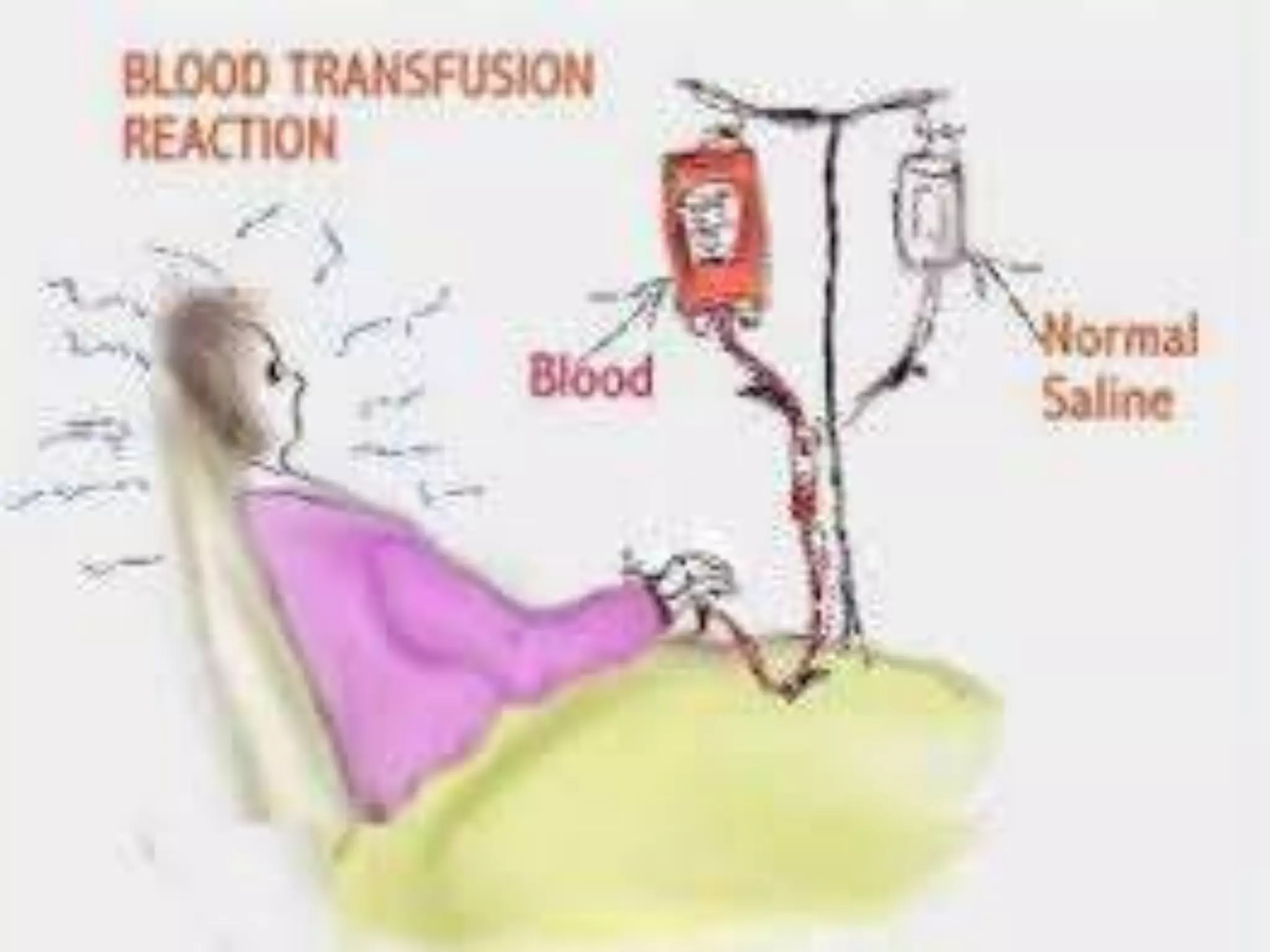
“Any unfavorable and harmful transfusion
related events occurring in the patient
during or after transfusion of blood or
components is called transfusion
reaction.”
=> About 10 percent of recipient usually
experience Transfusion Reaction.
• Misidentification of the patient.
• Improper sample identification.
• Wrong blood issued.
• Administration error.
• Technical error.
• Storage error.
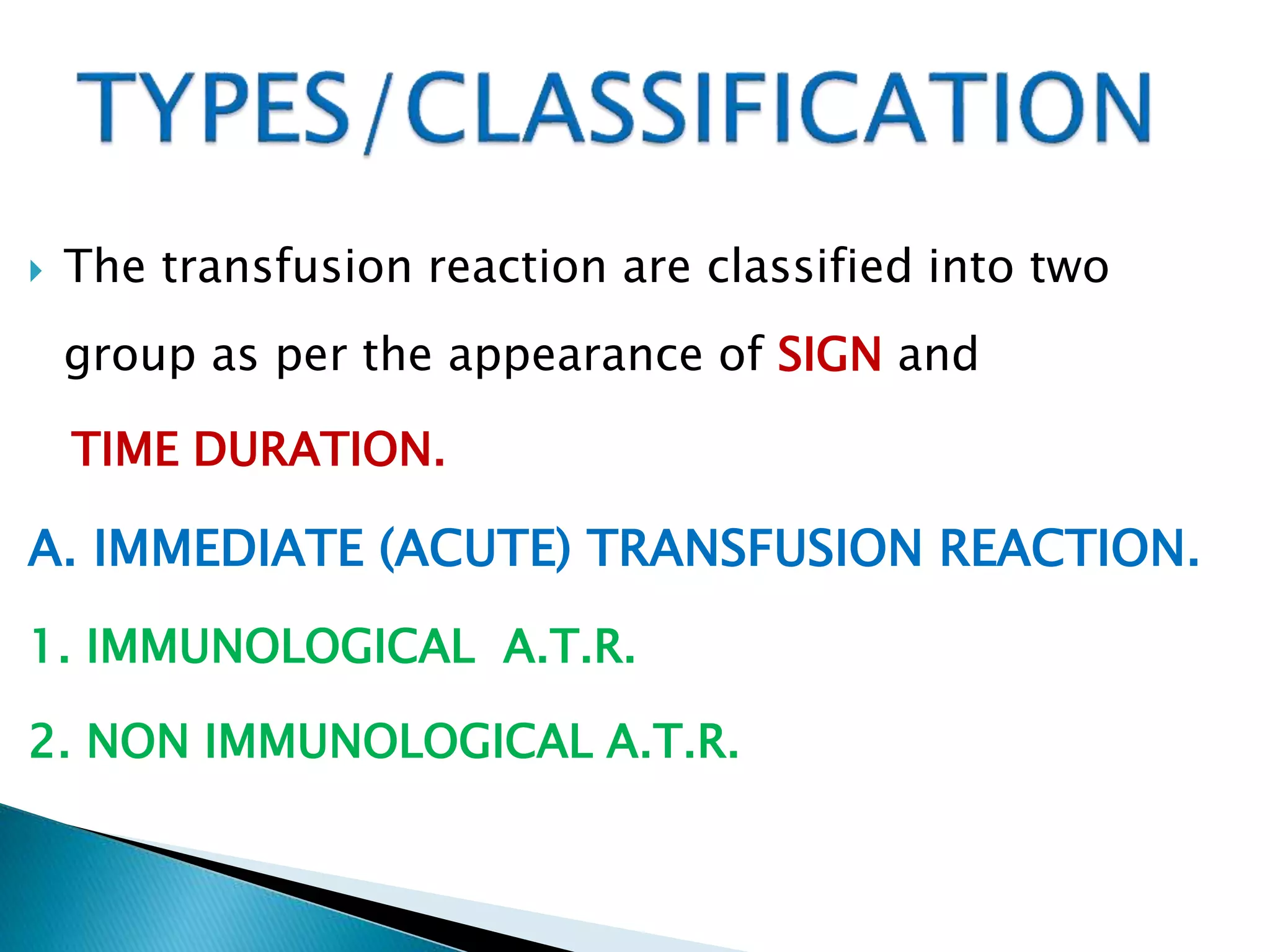
 The transfusion reaction are classified into two
group as per the appearance of SIGN and
TIME DURATION.
A. IMMEDIATE (ACUTE) TRANSFUSION REACTION.
1. IMMUNOLOGICAL A.T.R.
2. NON IMMUNOLOGICAL A.T.R.
B. DELAYED (CHRONIC) TRANSFUSION RAECTION.
1. IMMUNOLOGICAL C.T.R.
2. NON IMMUNOLOGICAL C.T.R.
“ The Acute transfusion may be defined as any
undesired reaction appears during or after some
times of Blood transfusion.”
The Acute transfusion reaction are Two types-
1. Immunological Immediate
(Acute )Transfusion Reaction.
2. Non Immunological Immediate ATR.
1. Immunological Immediate (Acute)
Transfusion Reaction.
“Transfusion reaction due to Involvement of
Antigen- Antibody Reaction between Donor and
Recipient Blood.”
These are-
i. Acute (Immediate ) Haemolytic Transfusion
Reaction /Intravascular HTR.
ii. Non- Haemolytic Fibrile Transfusion
Reaction (NHFTR).
iii. Allergic Transfusion Reaction.
iv. Anaphylatic Transfusion Reaction.
v. Non – Cardiogenic Pulmonary Reaction.
. In intravascular transfusion reaction the
haemolysis of red cells takes place within
the circulatory system.
. Haemolysis occur within few min after
starting transfusion ( <24 hrs ).
. As little as 10-15 ml of ABO incompatible
blood infusion can produce symptoms.
This type of reaction is mainly due to IgM ab’s
(ant-A, & anti-B), mediated by the rapid
activation of complement and is usually
associated with the transfusion of ABO in
compatible blood.
 • Fever
 • Chills
 • Hypotension
 • Chest and back pain
 • Nausea
 • Dyspnea
 • Vomiting
 • Haemoglobinuria
 • Acute renal failure
 • Pain at transfusion site
 • Shock & DIC
 Stop transfusion immediately.
 Intravenous line kept open
 Administer 0.9% saline to hydrate kidney.
 Mannitol is the agent used to prevent the
renal failure.
 Hypotension: intravenous fluid and
vasoactive drugs .e.g. dopamine
“ NHFTR is defined as by noting temperature of
1centigrade or more above baseline level during
transfusion of blood or its components.”
 These reactions are the most common and
account for over 90 % of TR.
 These are occur within minutes of starting the
transfusion
 These reactions are due to a reaction between
HLA (Human Leukocyte Antigen) class-I
antigen on transfused Lymphocytes,
Granulocytes or Platelets in Donor blood unit
and antibodies in previously alloimmunised
Recipients (multi transfused patients) .
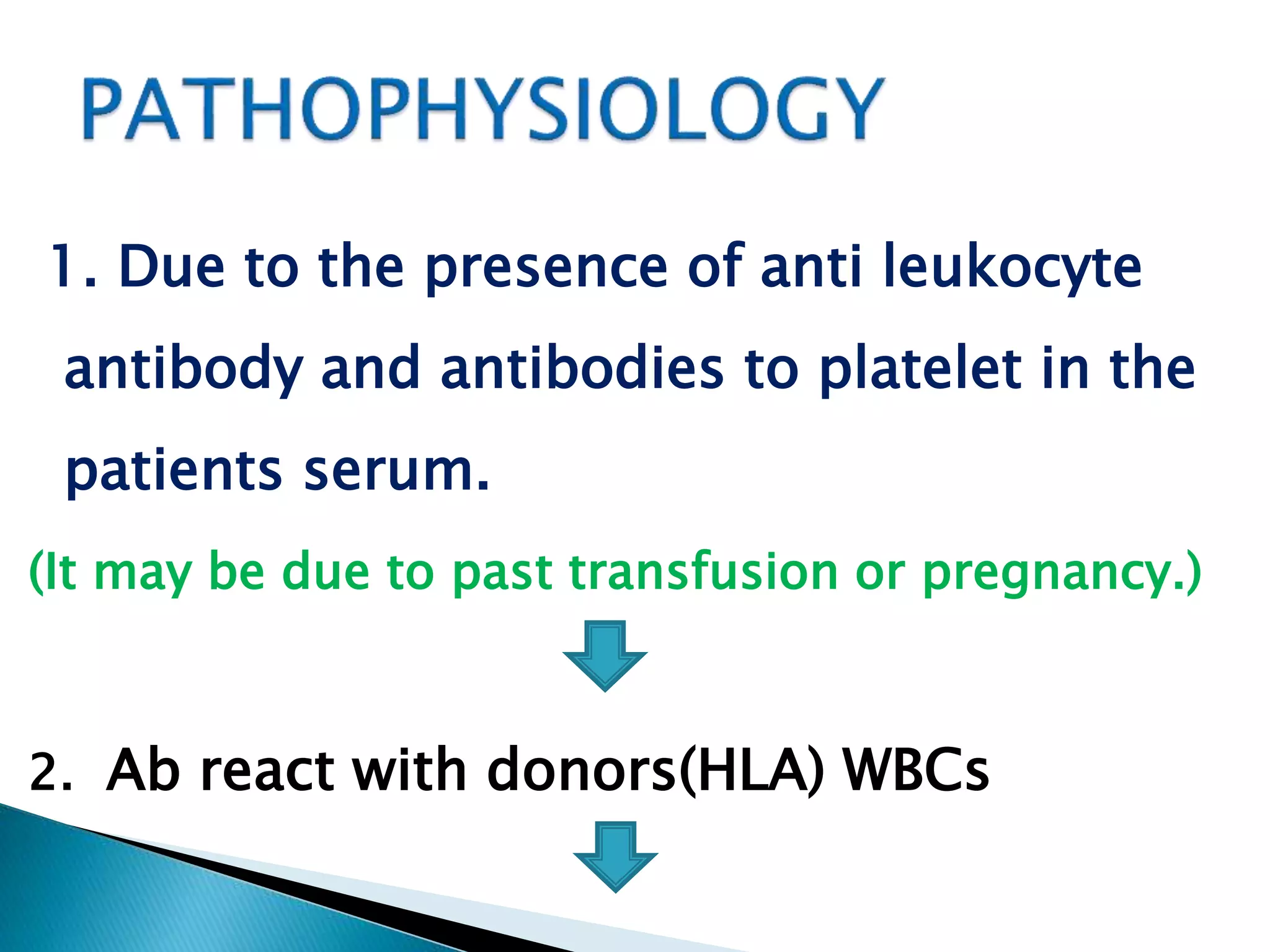
1. Due to the presence of anti leukocyte
antibody and antibodies to platelet in the
patients serum.
(It may be due to past transfusion or pregnancy.)
2. Ab react with donors(HLA) WBCs
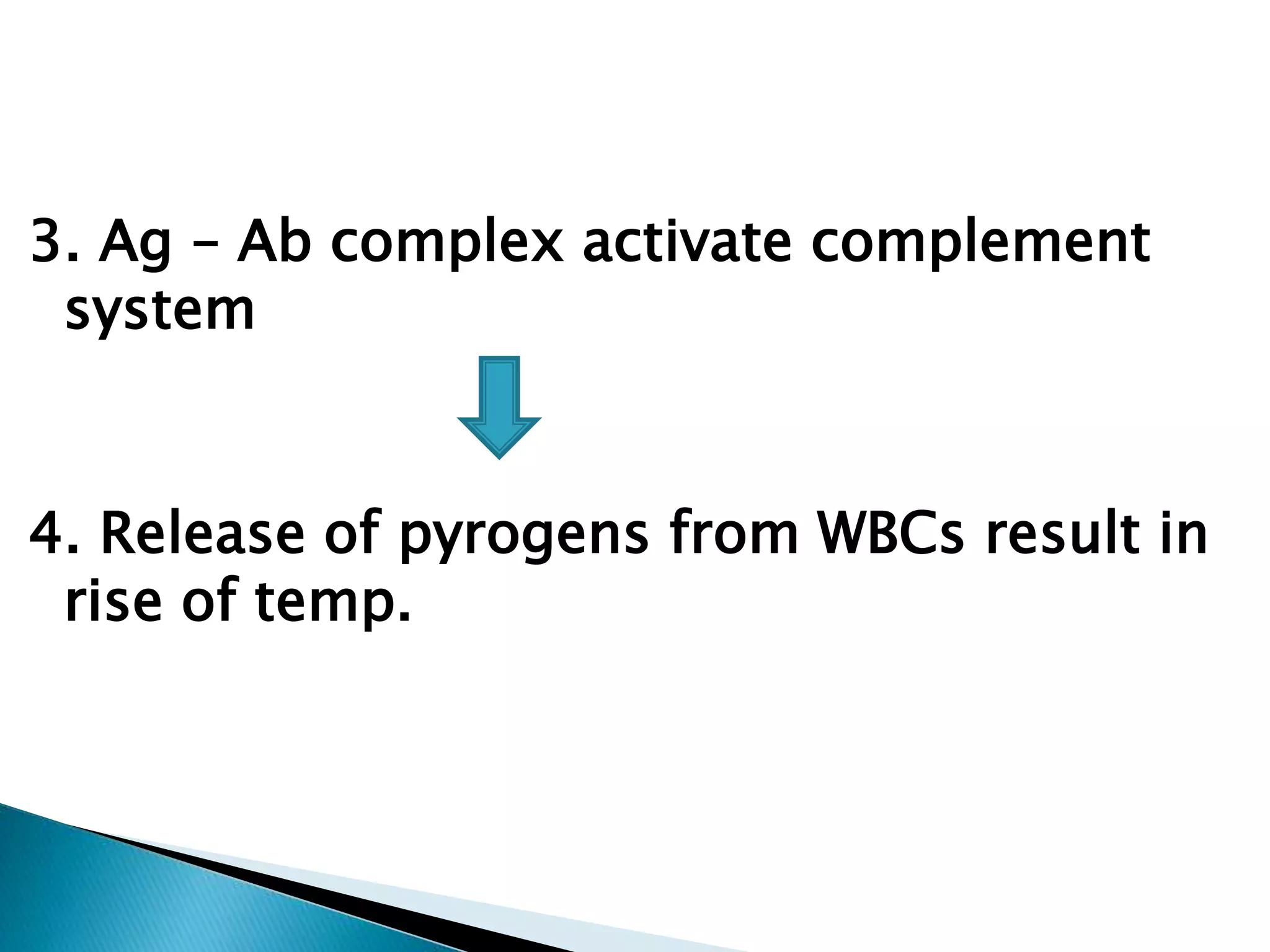
3. Ag – Ab complex activate complement
system
4. Release of pyrogens from WBCs result in
rise of temp.
 Fever
 Chills
 Malaise
 Give leukocyte poor red cells.
 Patient with history of NHFTR may be
premedicated before Transfusion
 Anti pyretic can be given before starting
transfusion, but they must be avoided as
much as possible as they mask IHTR.
 A type of immediate hyper sensitivity reaction.
 Allergic signs and symptoms appear within
few minutes of exposure.
They may be mild, moderate or life
threatening.
Causes: The donors plasma contain allergens
which react with reagin present in patients plasma.
The donors plasma contains reagin that combines
with allergens in the patient plasma.
Allergen- Regin Complex
Attached The Mast cell Surface
Release Histamine
Symptoms:
 Local erythema
 Urticaria
 Hives(raised red wheal)
 Hypotension
 Loss of consciousness
 Shock
1. Stop Transfusion.
2. Antihistaminic drugs are given
orally or Intramuscularly.
 This reaction is most sever form of allergic
transfusion reactions.
 This is life threatening.
 These reaction developed quickly- within
minutes of starting the transfusion
Causes:
In rare patients who are IgA
deficient and have developed
anti-IgA ab’s.
Symptoms:
 Respiratory tract- cough,
bronchospasm, dyspnea.
 GIT- nausea, vomiting, diarrhoea.
 Circulatory system- hypotension,
syncope.
 Skin- generalized flushing,
Urticaria.
1. Stop Transfusion.
2. Keep the line open with normal saline.
3. Treat Hypotension.
4. Inject epinephrine.
5. Inject antihistaminic
6. Hypoxia- give oxygen by mask
 Also Known as TRANSFUSION RELATED ACUTE
LUNGS INJURY(TRALI).
 They are manifested by apparent pulmonary
edema.
 TRALI is characterized by acute respiratory
distress , bilateral pulmonary edema,
hypoxemia, fever and hypotension.
Causes:
1. Passively transfused leukocyte antibodies in
blood or plasma of donor react with the
transfusion recipient’s leukocytes.
2.The reaction between leukocyte antigens and
antibodies may result in
LEUKOAGGLUTINATION with the white cell
aggregates becoming trapped in
microcirculation of lungs, Causing Pulmonary
Edema.
Symptoms: Symptoms occurs within 1 to 6
hours of transfusion.
Usually symptoms resolve within 24 to 48
hours.
 Acute onset of respiratory distress
 Dyspnea
 Cyanosis
 Fever
 Chill
1. Immediate stop blood transfusion.
2. Appropriate respiratory support.
3. Intravenous administration of
Steroids.
4. Leukocyte poor component is used.
2. Non Immunological Immediate/ATR.
“In this types of reaction there is no any
involvement of Antigen - Antibody.” Reaction by
other factors like, Bacteria.
These are-
i. Bacterial Contamination.
ii. Circulatory Overload
iii. Haemolysis due to Physical or Chemical
Agents
. Bacteria or other microorganisms may enter
Blood during phlebotomy and Blood
components stored at refrigerated temp.
. Blood stored at room temp. has more
chances of microbial contamination.
“Result of bacterial contamination of
blood can be life threatening.”
 Endotoxins producing gram negative bacteria
encountered in blood contamination are-
E. Coli
Citrobacter freundii
Yersinia enterocolitica
Symptoms: are as-
1. High grade fever.
2. Shock: is associate with flushing ,
dryness of skin, Abdominal pain,
Cramp, dirrhaea and muscular pain.
3. Haemoglobinuria.
4. Renal failure.
5. DIC.
1. Stop transfusion.
2. Administration of Intravenous
antibiotics.
3. Treat Hypotension with fluid.
4. Treat DIC.
“Due to Hypervolemia by transfusing
blood very rapidly”
Susceptible patients may be very
young, old ones.
Symptoms: Including
. Heart Problem
. Chronic Anaemia
. Congestive Heart failure
. Coughing
. Cyanosis
. Sever headache
. Difficulty in breathing
1. Stop transfusion or continue it very
slowly.
2. Intravenous administration of Diuretics.
3. Give Oxygen.
4. If pulmonary edema develops,
phlebotomy may be indicated.
Such as-
. Overheating.
. Freezing.
. Freezing without cryoprotective agents.
. Mechanical stress.
. Mixing of hypotonic solution (5%
dextrose in saline) or Hypertonic
solutions (50% dextrose in water) wiyh
RBC may cause hemolysis of RBC.
1. Asymptomatic hemoglobinuria is the
common symptoms.(Because
transfusion of Hemolytic Blood).
2. DIC may develop.
Fluid Therapy.
Regular monitoring of patient.
“ The Chronic transfusion may be defined as any
undesired reaction appears after Blood
transfusion.”
The Chronic transfusion reaction are Two types-
1. Immunological Delayed (Chronic )
Transfusion Reaction.
2. Non Immunological Delayed
(Chronic)Transfusion Reaction.
1. Immunological Delayed (Chronic)
Transfusion Reaction.
These are-
i. Chronic Haemolytic Transfusion Reaction (Delayed/
Extravascular HTR).
ii. Trnasfusion Associated Graft Versus Host Disease ( TA-
GVHD).
iii. Post Transfusion Purpura.
2. Non Immunological (Delayed)
Chronic Transfusion Reaction.
. Transfusion Induced Haemosiderosis.
(Iron Overload)
Also known as Extravascular Hemolytic
Transfusion Reaction.
This reaction appear due to Rh
incompatibility .
Haemolysis occur after few hours or after
about 3-7 days of transfusion.
Causes:
1. Recipient serum amnestic
antibody response to alloantigens
on donor cells.
2. These ab’s bring about the
destruction of red cells by the
macrophages in the spleen or liver.
IgG of Recipient, coats the RBC,s of Donor
and Sensitized them
Sensitized RBC,s Interact with Phagocytic
Cells
Engulf and Destroy RBC,s
 IgG antibodies coated red cells interact with
receptors of phagocytic cell (macrophage).
 Phagocytic cell engulfs the antibody coated
cell and incorporates it into the intracellular
vacuole.
 Lysis of red cells with in the intra cellular
vacuole of phagocytic cell.
Symptoms:
 Fall in Hb
 Rise in bilirubin and mild jaundice
with in 5-7 days of transfusion
 Fever.
 Renal failure ( rare )
1. Urine output and renal functions
should be followed.
2. If DAT positive identify antibody.
It results from transfusion of Immunologically
components cells (Cytotoxic CD8 T
lymphocytes) in an immunologically
incompetent host(who may be incapable of
rejecting the CD8 T lymphocytes).
Individual at high risks are:
1.Congenital Immunodeficient.
2. Aquired cell mediated Immunodeficient.
3. Autologous bone marrow transplant Recipient.
4. Fetus receiving intrauterine transfusion.
5. New born infants receiving exchange transfusion.
Symptoms: Symptoms of acute TAGVHD is
2 to 30 days after transfusion.
And in chronic TAGGVHD it occurs after 100
days.
 Fever
 Rash
 Diarrhea
 Hepatitis
 Liver dysfunction
 Bone marrow suppression
 Fatal
Most communally in women in their Sixty or
Seventy years of life.
Occur with platelet concentrate transfusion.
Due to alloimmunized to platelets antigens
through previous transfusion.
Symptoms: Symptoms may occurs after 7-14
days from transfusion.
1. Purpura
(Due to red discoloration of the skin caused by
hemorrhage.)
=> Hemorrhage resulting from
destruction of platelets by
antiplatelet antibodies in the
recipient.
1. Administration of Corticosteroids.
2. Plasma exchange.
3. Intravenous Immunoglobulin.
Transfusion Induced Haemosiderosis
(Iron Overload).
1. It is deposition of Iron in tissues or organs.
2. It may results from long term administration of
blood(RBC,s or Whole) to Recipient.
3. Iron accumulation : affect functions of heart,
liver, endocrine system
1. Beta thalassemia major.
2. Congenital Hemolytic anaemia.
3. Aplastic Anaemia.
=> Hemosiderosis because of blood
transfusion may occur after transfusion of
as few as 100 units of Blood.
Symptoms:
1.Muscle weakness.
2. Fatigue.
3. Weight loss.
4. Mild jaundice.
5. Anaemia.
1. Deferoxamine mesylate is a iron
chelating drug.
2. Transfusion should be kept to
aminimum.
3. Transfusion of Young Red cells.
 Check all the records to ensure that the
correct unit of blood was transfused to the
right patient.
 This includes :
a) Patient’s details
b) Blood requisition form
c) Compatibility report
d) Labels
 Examine the patient pre-transfusion &
posttransfusion plasma from EDTA sample
for evidence of free Hb or increased
bilirubin.
 Pink or red discolouration in post-
transfusion
plasma indicates the presence of free Hb
due to red cell destruction.
 Yellow discoluration of the sample
drawn 6-8 hr after transfusion
indicates increased blirubin.
 Perform DCT on the pre- and post
transfusion sample.
 A positive DCT test usually indicates the
presence of recipient ab’s on the surface of
donor red cells, however if all the cells have
been already destroyed , the test may be
negative.
 Check urine (post-transfusion) 1st sample.
If Dark Yellow Colour :- Extravascular
Hemolysis.
If Cock or Pink Colour: Intravascular
Hemolysis.
 If nothing abnormal, indicates that no
acute hemolytic reaction.
 If any finding is positive, or clinical finding
strongly suggest a hemolytic reaction, the
following investigations to be done;-
1) Repeat the crossmatch, testing both pre
and post transfusion sample of the patient
against the sample from the bag by
saline/albumin,coombs techniques.
2) Repeat antibody screening and
identification of patients pre and post
transfusion samples.
THANK
YOU………..
nityanandu@iul.ac.in

Blood transfusion reaction

  • 1.
    By: Nityanand Upadhyay AssociateProfessor Department of MLT Integral University, Lucknow
  • 2.
     DEFINITION  CAUSES CLASSIFICATION  SYMPTOMS  MANAGEMENT  LABORATORY INVESTIGATION
  • 3.
    “Any unfavorable andharmful transfusion related events occurring in the patient during or after transfusion of blood or components is called transfusion reaction.” => About 10 percent of recipient usually experience Transfusion Reaction.
  • 5.
    • Misidentification ofthe patient. • Improper sample identification. • Wrong blood issued. • Administration error. • Technical error. • Storage error.
  • 6.
     The transfusionreaction are classified into two group as per the appearance of SIGN and TIME DURATION. A. IMMEDIATE (ACUTE) TRANSFUSION REACTION. 1. IMMUNOLOGICAL A.T.R. 2. NON IMMUNOLOGICAL A.T.R.
  • 7.
    B. DELAYED (CHRONIC)TRANSFUSION RAECTION. 1. IMMUNOLOGICAL C.T.R. 2. NON IMMUNOLOGICAL C.T.R.
  • 8.
    “ The Acutetransfusion may be defined as any undesired reaction appears during or after some times of Blood transfusion.” The Acute transfusion reaction are Two types- 1. Immunological Immediate (Acute )Transfusion Reaction. 2. Non Immunological Immediate ATR.
  • 9.
    1. Immunological Immediate(Acute) Transfusion Reaction. “Transfusion reaction due to Involvement of Antigen- Antibody Reaction between Donor and Recipient Blood.” These are- i. Acute (Immediate ) Haemolytic Transfusion Reaction /Intravascular HTR.
  • 10.
    ii. Non- HaemolyticFibrile Transfusion Reaction (NHFTR). iii. Allergic Transfusion Reaction. iv. Anaphylatic Transfusion Reaction. v. Non – Cardiogenic Pulmonary Reaction.
  • 11.
    . In intravasculartransfusion reaction the haemolysis of red cells takes place within the circulatory system.
  • 12.
    . Haemolysis occurwithin few min after starting transfusion ( <24 hrs ). . As little as 10-15 ml of ABO incompatible blood infusion can produce symptoms.
  • 13.
    This type ofreaction is mainly due to IgM ab’s (ant-A, & anti-B), mediated by the rapid activation of complement and is usually associated with the transfusion of ABO in compatible blood.
  • 14.
     • Fever • Chills  • Hypotension  • Chest and back pain  • Nausea  • Dyspnea  • Vomiting  • Haemoglobinuria  • Acute renal failure  • Pain at transfusion site  • Shock & DIC
  • 15.
     Stop transfusionimmediately.  Intravenous line kept open  Administer 0.9% saline to hydrate kidney.  Mannitol is the agent used to prevent the renal failure.  Hypotension: intravenous fluid and vasoactive drugs .e.g. dopamine
  • 16.
    “ NHFTR isdefined as by noting temperature of 1centigrade or more above baseline level during transfusion of blood or its components.”  These reactions are the most common and account for over 90 % of TR.  These are occur within minutes of starting the transfusion
  • 17.
     These reactionsare due to a reaction between HLA (Human Leukocyte Antigen) class-I antigen on transfused Lymphocytes, Granulocytes or Platelets in Donor blood unit and antibodies in previously alloimmunised Recipients (multi transfused patients) .
  • 18.
    1. Due tothe presence of anti leukocyte antibody and antibodies to platelet in the patients serum. (It may be due to past transfusion or pregnancy.) 2. Ab react with donors(HLA) WBCs
  • 19.
    3. Ag –Ab complex activate complement system 4. Release of pyrogens from WBCs result in rise of temp.
  • 20.
  • 21.
     Give leukocytepoor red cells.  Patient with history of NHFTR may be premedicated before Transfusion  Anti pyretic can be given before starting transfusion, but they must be avoided as much as possible as they mask IHTR.
  • 22.
     A typeof immediate hyper sensitivity reaction.  Allergic signs and symptoms appear within few minutes of exposure. They may be mild, moderate or life threatening.
  • 23.
    Causes: The donorsplasma contain allergens which react with reagin present in patients plasma. The donors plasma contains reagin that combines with allergens in the patient plasma. Allergen- Regin Complex Attached The Mast cell Surface Release Histamine
  • 24.
    Symptoms:  Local erythema Urticaria  Hives(raised red wheal)  Hypotension  Loss of consciousness  Shock
  • 25.
    1. Stop Transfusion. 2.Antihistaminic drugs are given orally or Intramuscularly.
  • 26.
     This reactionis most sever form of allergic transfusion reactions.  This is life threatening.  These reaction developed quickly- within minutes of starting the transfusion
  • 27.
    Causes: In rare patientswho are IgA deficient and have developed anti-IgA ab’s.
  • 28.
    Symptoms:  Respiratory tract-cough, bronchospasm, dyspnea.  GIT- nausea, vomiting, diarrhoea.  Circulatory system- hypotension, syncope.  Skin- generalized flushing, Urticaria.
  • 29.
    1. Stop Transfusion. 2.Keep the line open with normal saline. 3. Treat Hypotension. 4. Inject epinephrine. 5. Inject antihistaminic 6. Hypoxia- give oxygen by mask
  • 30.
     Also Knownas TRANSFUSION RELATED ACUTE LUNGS INJURY(TRALI).  They are manifested by apparent pulmonary edema.  TRALI is characterized by acute respiratory distress , bilateral pulmonary edema, hypoxemia, fever and hypotension.
  • 31.
    Causes: 1. Passively transfusedleukocyte antibodies in blood or plasma of donor react with the transfusion recipient’s leukocytes. 2.The reaction between leukocyte antigens and antibodies may result in LEUKOAGGLUTINATION with the white cell aggregates becoming trapped in microcirculation of lungs, Causing Pulmonary Edema.
  • 32.
    Symptoms: Symptoms occurswithin 1 to 6 hours of transfusion. Usually symptoms resolve within 24 to 48 hours.  Acute onset of respiratory distress  Dyspnea  Cyanosis  Fever  Chill
  • 33.
    1. Immediate stopblood transfusion. 2. Appropriate respiratory support. 3. Intravenous administration of Steroids. 4. Leukocyte poor component is used.
  • 34.
    2. Non ImmunologicalImmediate/ATR. “In this types of reaction there is no any involvement of Antigen - Antibody.” Reaction by other factors like, Bacteria. These are- i. Bacterial Contamination. ii. Circulatory Overload iii. Haemolysis due to Physical or Chemical Agents
  • 35.
    . Bacteria orother microorganisms may enter Blood during phlebotomy and Blood components stored at refrigerated temp. . Blood stored at room temp. has more chances of microbial contamination. “Result of bacterial contamination of blood can be life threatening.”
  • 36.
     Endotoxins producinggram negative bacteria encountered in blood contamination are- E. Coli Citrobacter freundii Yersinia enterocolitica
  • 37.
    Symptoms: are as- 1.High grade fever. 2. Shock: is associate with flushing , dryness of skin, Abdominal pain, Cramp, dirrhaea and muscular pain. 3. Haemoglobinuria. 4. Renal failure. 5. DIC.
  • 38.
    1. Stop transfusion. 2.Administration of Intravenous antibiotics. 3. Treat Hypotension with fluid. 4. Treat DIC.
  • 39.
    “Due to Hypervolemiaby transfusing blood very rapidly” Susceptible patients may be very young, old ones.
  • 40.
    Symptoms: Including . HeartProblem . Chronic Anaemia . Congestive Heart failure . Coughing . Cyanosis . Sever headache . Difficulty in breathing
  • 41.
    1. Stop transfusionor continue it very slowly. 2. Intravenous administration of Diuretics. 3. Give Oxygen. 4. If pulmonary edema develops, phlebotomy may be indicated.
  • 42.
    Such as- . Overheating. .Freezing. . Freezing without cryoprotective agents.
  • 43.
    . Mechanical stress. .Mixing of hypotonic solution (5% dextrose in saline) or Hypertonic solutions (50% dextrose in water) wiyh RBC may cause hemolysis of RBC.
  • 44.
    1. Asymptomatic hemoglobinuriais the common symptoms.(Because transfusion of Hemolytic Blood). 2. DIC may develop.
  • 45.
  • 46.
    “ The Chronictransfusion may be defined as any undesired reaction appears after Blood transfusion.” The Chronic transfusion reaction are Two types- 1. Immunological Delayed (Chronic ) Transfusion Reaction. 2. Non Immunological Delayed (Chronic)Transfusion Reaction.
  • 47.
    1. Immunological Delayed(Chronic) Transfusion Reaction. These are- i. Chronic Haemolytic Transfusion Reaction (Delayed/ Extravascular HTR). ii. Trnasfusion Associated Graft Versus Host Disease ( TA- GVHD). iii. Post Transfusion Purpura.
  • 48.
    2. Non Immunological(Delayed) Chronic Transfusion Reaction. . Transfusion Induced Haemosiderosis. (Iron Overload)
  • 49.
    Also known asExtravascular Hemolytic Transfusion Reaction. This reaction appear due to Rh incompatibility . Haemolysis occur after few hours or after about 3-7 days of transfusion.
  • 50.
    Causes: 1. Recipient serumamnestic antibody response to alloantigens on donor cells. 2. These ab’s bring about the destruction of red cells by the macrophages in the spleen or liver.
  • 51.
    IgG of Recipient,coats the RBC,s of Donor and Sensitized them Sensitized RBC,s Interact with Phagocytic Cells Engulf and Destroy RBC,s
  • 52.
     IgG antibodiescoated red cells interact with receptors of phagocytic cell (macrophage).  Phagocytic cell engulfs the antibody coated cell and incorporates it into the intracellular vacuole.  Lysis of red cells with in the intra cellular vacuole of phagocytic cell.
  • 53.
    Symptoms:  Fall inHb  Rise in bilirubin and mild jaundice with in 5-7 days of transfusion  Fever.  Renal failure ( rare )
  • 54.
    1. Urine outputand renal functions should be followed. 2. If DAT positive identify antibody.
  • 55.
    It results fromtransfusion of Immunologically components cells (Cytotoxic CD8 T lymphocytes) in an immunologically incompetent host(who may be incapable of rejecting the CD8 T lymphocytes).
  • 56.
    Individual at highrisks are: 1.Congenital Immunodeficient. 2. Aquired cell mediated Immunodeficient. 3. Autologous bone marrow transplant Recipient. 4. Fetus receiving intrauterine transfusion. 5. New born infants receiving exchange transfusion.
  • 57.
    Symptoms: Symptoms ofacute TAGVHD is 2 to 30 days after transfusion. And in chronic TAGGVHD it occurs after 100 days.  Fever  Rash  Diarrhea  Hepatitis  Liver dysfunction  Bone marrow suppression  Fatal
  • 58.
    Most communally inwomen in their Sixty or Seventy years of life. Occur with platelet concentrate transfusion. Due to alloimmunized to platelets antigens through previous transfusion.
  • 59.
    Symptoms: Symptoms mayoccurs after 7-14 days from transfusion. 1. Purpura (Due to red discoloration of the skin caused by hemorrhage.) => Hemorrhage resulting from destruction of platelets by antiplatelet antibodies in the recipient.
  • 60.
    1. Administration ofCorticosteroids. 2. Plasma exchange. 3. Intravenous Immunoglobulin.
  • 61.
    Transfusion Induced Haemosiderosis (IronOverload). 1. It is deposition of Iron in tissues or organs. 2. It may results from long term administration of blood(RBC,s or Whole) to Recipient. 3. Iron accumulation : affect functions of heart, liver, endocrine system
  • 62.
    1. Beta thalassemiamajor. 2. Congenital Hemolytic anaemia. 3. Aplastic Anaemia. => Hemosiderosis because of blood transfusion may occur after transfusion of as few as 100 units of Blood.
  • 63.
    Symptoms: 1.Muscle weakness. 2. Fatigue. 3.Weight loss. 4. Mild jaundice. 5. Anaemia.
  • 64.
    1. Deferoxamine mesylateis a iron chelating drug. 2. Transfusion should be kept to aminimum. 3. Transfusion of Young Red cells.
  • 65.
     Check allthe records to ensure that the correct unit of blood was transfused to the right patient.  This includes : a) Patient’s details b) Blood requisition form c) Compatibility report d) Labels
  • 66.
     Examine thepatient pre-transfusion & posttransfusion plasma from EDTA sample for evidence of free Hb or increased bilirubin.  Pink or red discolouration in post- transfusion plasma indicates the presence of free Hb due to red cell destruction.
  • 67.
     Yellow discolurationof the sample drawn 6-8 hr after transfusion indicates increased blirubin.  Perform DCT on the pre- and post transfusion sample.
  • 68.
     A positiveDCT test usually indicates the presence of recipient ab’s on the surface of donor red cells, however if all the cells have been already destroyed , the test may be negative.  Check urine (post-transfusion) 1st sample. If Dark Yellow Colour :- Extravascular Hemolysis. If Cock or Pink Colour: Intravascular Hemolysis.
  • 69.
     If nothingabnormal, indicates that no acute hemolytic reaction.  If any finding is positive, or clinical finding strongly suggest a hemolytic reaction, the following investigations to be done;-
  • 70.
    1) Repeat thecrossmatch, testing both pre and post transfusion sample of the patient against the sample from the bag by saline/albumin,coombs techniques. 2) Repeat antibody screening and identification of patients pre and post transfusion samples.
  • 71.