Bhabha engineering research institute
bhopal
ELECTRONIC & COMMUNICATION ENGG.
DEPARMENT
GLOBAL SYSTEM FOR MOBILE COMMUNICATION
SUBMITTED BY:-
NEHA PARWALA
7TH SEM
SUBMITTED
TO:-
SURESH
GAWANDE
• Introduction to gsm.
• WHAT IS GSM.
• Specifications of gsm.
• Gsm network area.
• Gsm architecture.
• Mobile station.
• Mobile identification numbers.
It contains
WHATE IS GSM?
•
Global System for Mobile (GSM) is a
second generation cellular standard
developed to cater voice services and
data delivery using digital modulation
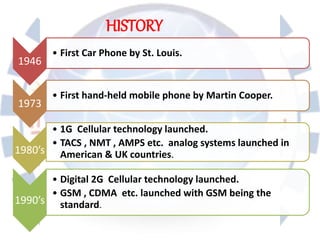
1946
• First Car Phone by St. Louis.
1973
• First hand-held mobile phone by Martin Cooper.
1980’s
• 1G Cellular technology launched.
• TACS , NMT , AMPS etc. analog systems launched in
American & UK countries.
1990’s
• Digital 2G Cellular technology launched.
• GSM , CDMA etc. launched with GSM being the
standard.
HISTORY
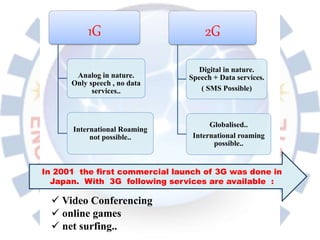
1G
Analog in nature.
Only speech , no data
services..
International Roaming
not possible..
2G
Digital in nature.
Speech + Data services.
( SMS Possible)
Globalised..
International roaming
possible..
In 2001 the first commercial launch of 3G was done in
Japan. With 3G following services are available :
 Video Conferencing
 online games
 net surfing..
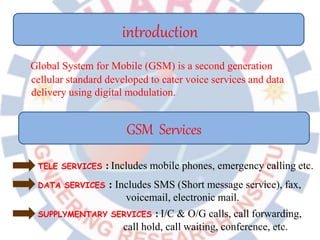
introduction
Global System for Mobile (GSM) is a second generation
cellular standard developed to cater voice services and data
delivery using digital modulation.
GSM Services
TELE SERVICES : Includes mobile phones, emergency calling etc.
DATA SERVICES : Includes SMS (Short message service), fax,
voicemail, electronic mail.
SUPPLYMENTARY SERVICES : I/C & O/G calls, call forwarding,
call hold, call waiting, conference, etc.
Gsm architecture
now
Network sub-system
Radio sub-system
Operation and maintenance sub-
system
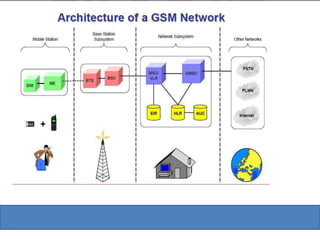
Network subsystem
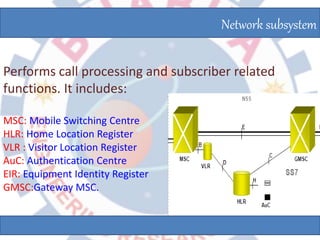
Performs call processing and subscriber related
functions. It includes:
MSC: Mobile Switching Centre
HLR: Home Location Register
VLR : Visitor Location Register
AuC: Authentication Centre
EIR: Equipment Identity Register
GMSC:Gateway MSC.
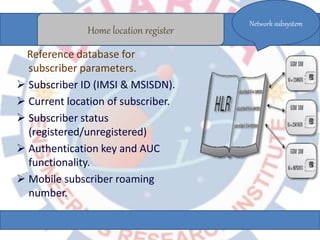
Reference database for
subscriber parameters.
 Subscriber ID (IMSI & MSISDN).
 Current location of subscriber.
 Subscriber status
(registered/unregistered)
 Authentication key and AUC
functionality.
 Mobile subscriber roaming
number.
Home location register
Network subsystem
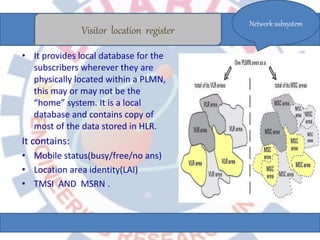
• It provides local database for the
subscribers wherever they are
physically located within a PLMN,
this may or may not be the
“home” system. It is a local
database and contains copy of
most of the data stored in HLR.
It contains:
• Mobile status(busy/free/no ans)
• Location area identity(LAI)
• TMSI AND MSRN .
Network subsystem
Visitor location register
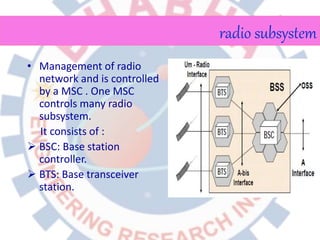
radio subsystem
• Management of radio
network and is controlled
by a MSC . One MSC
controls many radio
subsystem.
It consists of :
 BSC: Base station
controller.
 BTS: Base transceiver
station.
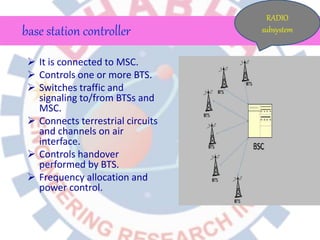
base station controller
 It is connected to MSC.
 Controls one or more BTS.
 Switches traffic and
signaling to/from BTSs and
MSC.
 Connects terrestrial circuits
and channels on air
interface.
 Controls handover
performed by BTS.
 Frequency allocation and
power control.
RADIO
subsystem
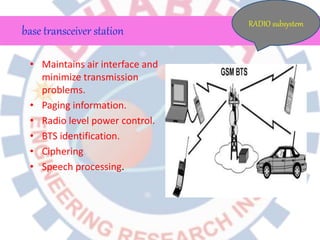
base transceiver station
• Maintains air interface and
minimize transmission
problems.
• Paging information.
• Radio level power control.
• BTS identification.
• Ciphering
• Speech processing.
RADIO subsystem
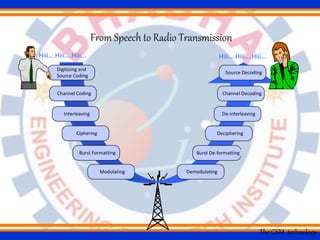
The GSM technology
From Speech to Radio Transmission
Hiii... Hiii....Hiii...Hiii... Hiii....Hiii...
Digitizing and
Source Coding
Channel Coding
Interleaving
Ciphering
Burst Formatting
Modulating Demodulating
Burst De-formatting
Deciphering
De-interleaving
Channel Decoding
Source Decoding
• Call Originating from MS
• Call termination to MS
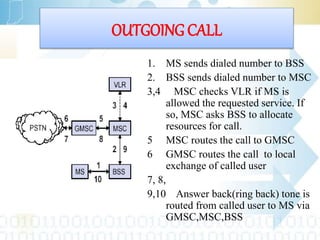
OUTGOING CALL
1. MS sends dialed number to BSS
2. BSS sends dialed number to MSC
3,4 MSC checks VLR if MS is
allowed the requested service. If
so, MSC asks BSS to allocate
resources for call.
5 MSC routes the call to GMSC
6 GMSC routes the call to local
exchange of called user
7, 8,
9,10 Answer back(ring back) tone is
routed from called user to MS via
GMSC,MSC,BSS
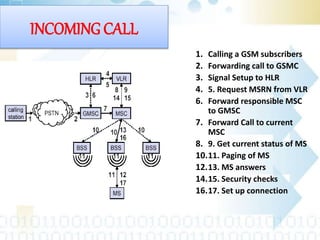
INCOMING CALL
1. Calling a GSM subscribers
2. Forwarding call to GSMC
3. Signal Setup to HLR
4. 5. Request MSRN from VLR
6. Forward responsible MSC
to GMSC
7. Forward Call to current
MSC
8. 9. Get current status of MS
10.11. Paging of MS
12.13. MS answers
14.15. Security checks
16.17. Set up connection
FUTURE OF GSM
2nd Generation
 GSM -9.6 Kbps (data rate)
2.5 Generation ( Future of GSM)
HSCSD (High Speed ckt Switched data)
Data rate : 76.8 Kbps (9.6 x 8 kbps)
GPRS (General) Packet Radio service)
Data rate: 14.4 - 115.2 Kbps
EDGE (Enhanced data rate for GSM Evolution)
Data rate: 547.2 Kbps (max)
 3 Generation
WCDMA(Wide band CDMA)
Data rate : 0.348 – 2.0 Mbps
ppt of gsm network

ppt of gsm network

  • 1.
    Bhabha engineering researchinstitute bhopal ELECTRONIC & COMMUNICATION ENGG. DEPARMENT GLOBAL SYSTEM FOR MOBILE COMMUNICATION SUBMITTED BY:- NEHA PARWALA 7TH SEM SUBMITTED TO:- SURESH GAWANDE
  • 2.
    • Introduction togsm. • WHAT IS GSM. • Specifications of gsm. • Gsm network area. • Gsm architecture. • Mobile station. • Mobile identification numbers. It contains
  • 3.
    WHATE IS GSM? • GlobalSystem for Mobile (GSM) is a second generation cellular standard developed to cater voice services and data delivery using digital modulation
  • 4.
    1946 • First CarPhone by St. Louis. 1973 • First hand-held mobile phone by Martin Cooper. 1980’s • 1G Cellular technology launched. • TACS , NMT , AMPS etc. analog systems launched in American & UK countries. 1990’s • Digital 2G Cellular technology launched. • GSM , CDMA etc. launched with GSM being the standard. HISTORY
  • 5.
    1G Analog in nature. Onlyspeech , no data services.. International Roaming not possible.. 2G Digital in nature. Speech + Data services. ( SMS Possible) Globalised.. International roaming possible.. In 2001 the first commercial launch of 3G was done in Japan. With 3G following services are available :  Video Conferencing  online games  net surfing..
  • 6.
    introduction Global System forMobile (GSM) is a second generation cellular standard developed to cater voice services and data delivery using digital modulation. GSM Services TELE SERVICES : Includes mobile phones, emergency calling etc. DATA SERVICES : Includes SMS (Short message service), fax, voicemail, electronic mail. SUPPLYMENTARY SERVICES : I/C & O/G calls, call forwarding, call hold, call waiting, conference, etc.
  • 7.
    Gsm architecture now Network sub-system Radiosub-system Operation and maintenance sub- system
  • 9.
    Network subsystem Performs callprocessing and subscriber related functions. It includes: MSC: Mobile Switching Centre HLR: Home Location Register VLR : Visitor Location Register AuC: Authentication Centre EIR: Equipment Identity Register GMSC:Gateway MSC.
  • 10.
    Reference database for subscriberparameters.  Subscriber ID (IMSI & MSISDN).  Current location of subscriber.  Subscriber status (registered/unregistered)  Authentication key and AUC functionality.  Mobile subscriber roaming number. Home location register Network subsystem
  • 11.
    • It provideslocal database for the subscribers wherever they are physically located within a PLMN, this may or may not be the “home” system. It is a local database and contains copy of most of the data stored in HLR. It contains: • Mobile status(busy/free/no ans) • Location area identity(LAI) • TMSI AND MSRN . Network subsystem Visitor location register
  • 12.
    radio subsystem • Managementof radio network and is controlled by a MSC . One MSC controls many radio subsystem. It consists of :  BSC: Base station controller.  BTS: Base transceiver station.
  • 13.
    base station controller It is connected to MSC.  Controls one or more BTS.  Switches traffic and signaling to/from BTSs and MSC.  Connects terrestrial circuits and channels on air interface.  Controls handover performed by BTS.  Frequency allocation and power control. RADIO subsystem
  • 14.
    base transceiver station •Maintains air interface and minimize transmission problems. • Paging information. • Radio level power control. • BTS identification. • Ciphering • Speech processing. RADIO subsystem
  • 15.
    The GSM technology FromSpeech to Radio Transmission Hiii... Hiii....Hiii...Hiii... Hiii....Hiii... Digitizing and Source Coding Channel Coding Interleaving Ciphering Burst Formatting Modulating Demodulating Burst De-formatting Deciphering De-interleaving Channel Decoding Source Decoding
  • 16.
    • Call Originatingfrom MS • Call termination to MS
  • 17.
    OUTGOING CALL 1. MSsends dialed number to BSS 2. BSS sends dialed number to MSC 3,4 MSC checks VLR if MS is allowed the requested service. If so, MSC asks BSS to allocate resources for call. 5 MSC routes the call to GMSC 6 GMSC routes the call to local exchange of called user 7, 8, 9,10 Answer back(ring back) tone is routed from called user to MS via GMSC,MSC,BSS
  • 18.
    INCOMING CALL 1. Callinga GSM subscribers 2. Forwarding call to GSMC 3. Signal Setup to HLR 4. 5. Request MSRN from VLR 6. Forward responsible MSC to GMSC 7. Forward Call to current MSC 8. 9. Get current status of MS 10.11. Paging of MS 12.13. MS answers 14.15. Security checks 16.17. Set up connection
  • 19.
    FUTURE OF GSM 2ndGeneration  GSM -9.6 Kbps (data rate) 2.5 Generation ( Future of GSM) HSCSD (High Speed ckt Switched data) Data rate : 76.8 Kbps (9.6 x 8 kbps) GPRS (General) Packet Radio service) Data rate: 14.4 - 115.2 Kbps EDGE (Enhanced data rate for GSM Evolution) Data rate: 547.2 Kbps (max)  3 Generation WCDMA(Wide band CDMA) Data rate : 0.348 – 2.0 Mbps