The GSM TechnoloGy 
GloBAl SySTeM 
FoR MoBIle 
coMMUnIcATIon 
Anshul Joshi 
ECE-A 
Roll No-17
conTenTS 
• hISToRy & evolUTIon 
• InTRodUcTIon 
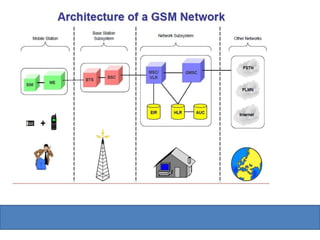
• GSM ARchITecTURe 
• FRoM Speech To RAdIo 
• cAll RoUTInG 
• AdvAnTAGeS 
• pRAcTIcAl KnowledGe AT BSnl.
hISToRy
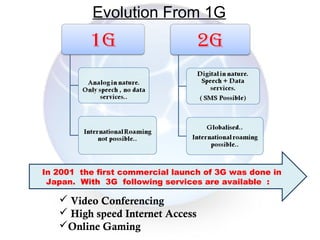
Evolution From 1G 
In 2001 the first commercial launch of 3G was done in 
Japan. With 3G following services are available : 
 Video Conferencing 
 High speed Internet Access 
Online Gaming
InTRodUcTIon 
Global System for Mobile (GSM) is a second generation 
cellular standard developed to cater voice services and data 
delivery using digital modulation. 
GSM SeRvIceS 
TELE SERVICES : Includes mobile phones, emergency calling etc. 
DATA SERVICES : Includes SMS (Short message service), fax, 
voicemail, electronic mail. 
SUPPLYMENTARY SERVICES : I/C & O/G calls, call forwarding, 
call hold, call waiting, conference, etc.
GSM 
NAetwRocrkh suIbT-syestecmTURe 
Radio sub-system 
Operation and maintenance sub-system
neTwoRK SUBSySTeM 
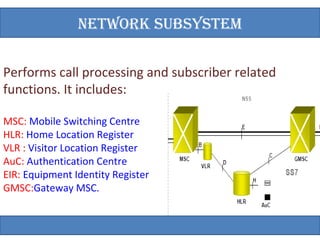
Performs call processing and subscriber related 
functions. It includes: 
MSC: Mobile Switching Centre 
HLR: Home Location Register 
VLR : Visitor Location Register 
AuC: Authentication Centre 
EIR: Equipment Identity Register 
GMSC:Gateway MSC.
Network 
mobile switchiNg ceNtre subsystem 
The functions carried out by the MSC are listed 
below: 
Call Processing 
Call Switching 
Operations And Maintenance Support 
Internetwork Networking 
When the MSC provides the interface with the other 
networks in the GSM network it is known as a 
Gateway MSC.
home locatioN register 
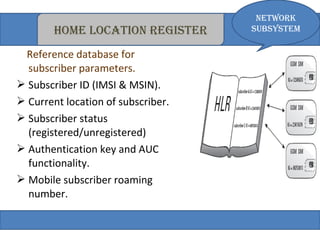
Reference database for 
subscriber parameters. 
 Subscriber ID (IMSI & MSIN). 
 Current location of subscriber. 
 Subscriber status 
(registered/unregistered) 
 Authentication key and AUC 
functionality. 
 Mobile subscriber roaming 
number. 
Network 
subsystem
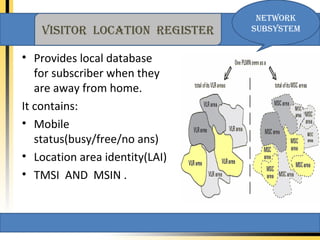
• Provides local database 
for subscriber when they 
are away from home. 
It contains: 
• Mobile 
status(busy/free/no ans) 
• Location area identity(LAI) 
• TMSI AND MSIN . 
Network 
Visitor locatioN register subsystem
autheNticatioN ceNtre 
Network 
subsystem 
• Provides authentication and encryption. 
• Ensures confidentiality of each cell. 
• Protects network operators from frauds. 
• Associated with HLR. 
• Takes place each time the subscriber 
initializes” on the system.
eQuiPmeNt iDeNtity register 
• Centralized database for validating the 
IMEI. 
• It contains three lists- 
 White List 
 Black List 
 Grey List 
Network 
subsystem
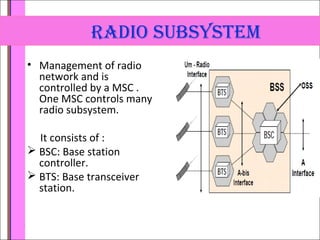
raDio subsystem 
• Management of radio 
network and is 
controlled by a MSC . 
One MSC controls many 
radio subsystem. 
It consists of : 
 BSC: Base station 
controller. 
 BTS: Base transceiver 
station.
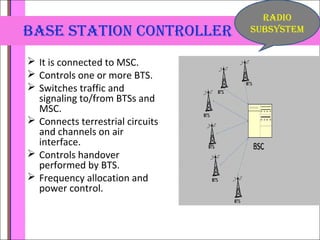
base statioN coNtroller 
 It is connected to MSC. 
 Controls one or more BTS. 
 Switches traffic and 
signaling to/from BTSs and 
MSC. 
 Connects terrestrial circuits 
and channels on air 
interface. 
 Controls handover 
performed by BTS. 
 Frequency allocation and 
power control. 
raDio 
subsystem
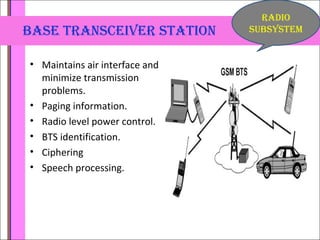
base traNsceiVer statioN 
• Maintains air interface and 
minimize transmission 
problems. 
• Paging information. 
• Radio level power control. 
• BTS identification. 
• Ciphering 
• Speech processing. 
raDio 
subsystem
OPERATION AND MAINTENANCE SUBSYSTEM 
Dynamic monitoring and controlling of 
network. 
Operation and maintenance data function. 
Configuration management. 
Fault report and alarm handling. 
Performance supervision. 
Storage of software and data. 
Stores data for minimum one year.
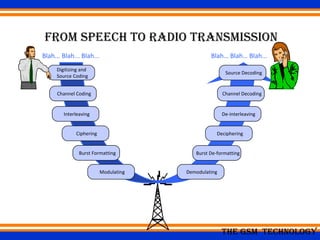
FROM SPEECh TO RADIO TRANSMISSION 
Blah... Blah... Blah... Blah… Blah… Blah... 
Source Decoding 
Channel Decoding 
Deciphering 
Burst De-formatting 
ThE GSM TEChNOlOGY 
Digitizing and 
Source Coding 
Channel Coding 
Interleaving 
Ciphering 
Burst Formatting 
Modulating Demodulating 
De-interleaving
• Call Originating from MS 
• Call termination to MS
OOUUTTGGOOIINNGG CCAAllll 
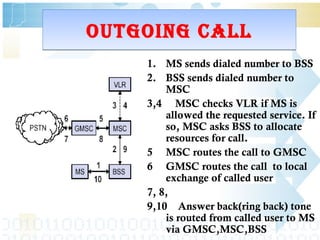
1. MS sends dialed number to BSS 
2. BSS sends dialed number to 
MSC 
3,4 MSC checks VLR if MS is 
allowed the requested service. If 
so, MSC asks BSS to allocate 
resources for call. 
5 MSC routes the call to GMSC 
6 GMSC routes the call to local 
exchange of called user 
7, 8, 
9,10 Answer back(ring back) tone 
is routed from called user to MS 
via GMSC,MSC,BSS
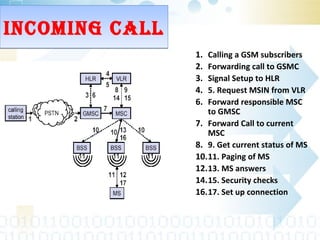
IINNCCOOMMIINNGG CCAAllll 
1. Calling a GSM subscribers 
2. Forwarding call to GSMC 
3. Signal Setup to HLR 
4. 5. Request MSIN from VLR 
6. Forward responsible MSC 
to GMSC 
7. Forward Call to current 
MSC 
8. 9. Get current status of MS 
10.11. Paging of MS 
12.13. MS answers 
14.15. Security checks 
16.17. Set up connection
ADvANTAGES OF GSM 
 Communication 
– mobile, wireless communication, support for voice and data 
services 
 Total mobility 
– international access, chip-card enables use of access points of 
different providers. 
 Worldwide connectivity 
– one number, the network handles every location. 
 High capacity 
– better frequency efficiency, smaller cells, more customers per cell. 
 High transmission quality 
– high audio quality and reliability for wireless, uninterrupted phone 
calls at higher speeds (e.g., from cars, trains). 
• Security functions 
– access control, authentication via chip-card and PIN
PRACTICAl KNOwlEDGE AT BSNl 
Topics Covered- 
Splicing 
Breakage Of Optical Fiber 
National Optical Fiber Network(NOFN) 
BSNL Leased Line 
Reliance Scenario
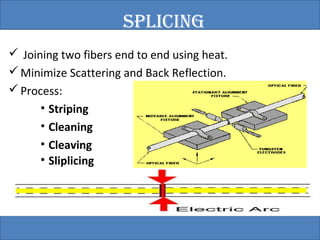
 Joining two fibers end to end using heat. 
Minimize Scattering and Back Reflection. 
Process: 
• Striping 
• Cleaning 
• Cleaving 
• Sliplicing 
SPlICING
Breakage Of Optical fiBer 
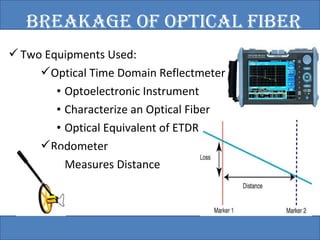
Two Equipments Used: 
Optical Time Domain Reflectmeter 
• Optoelectronic Instrument 
• Characterize an Optical Fiber 
• Optical Equivalent of ETDR 
Rodometer 
• Measures Distance
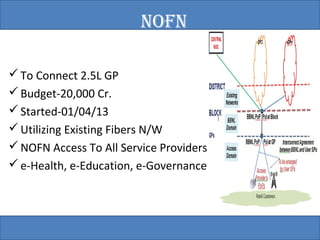
NOfN 
To Connect 2.5L GP 
Budget-20,000 Cr. 
Started-01/04/13 
Utilizing Existing Fibers N/W 
NOFN Access To All Service Providers 
e-Health, e-Education, e-Governance
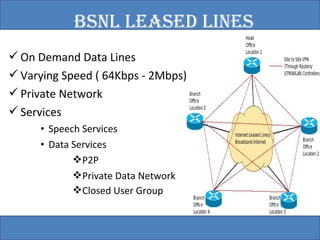
BSNl leaSed liNeS 
On Demand Data Lines 
Varying Speed ( 64Kbps - 2Mbps) 
Private Network 
Services 
• Speech Services 
• Data Services 
P2P 
Private Data Network 
Closed User Group
reliaNce SceNariO 
Why Reliance is the first to launch 4G 
service over a broader area?
Industrial presentation(Summer Training) On GSM at BSNL

Industrial presentation(Summer Training) On GSM at BSNL

  • 1.
    The GSM TechnoloGy GloBAl SySTeM FoR MoBIle coMMUnIcATIon Anshul Joshi ECE-A Roll No-17
  • 2.
    conTenTS • hISToRy& evolUTIon • InTRodUcTIon • GSM ARchITecTURe • FRoM Speech To RAdIo • cAll RoUTInG • AdvAnTAGeS • pRAcTIcAl KnowledGe AT BSnl.
  • 3.
  • 4.
    Evolution From 1G In 2001 the first commercial launch of 3G was done in Japan. With 3G following services are available :  Video Conferencing  High speed Internet Access Online Gaming
  • 5.
    InTRodUcTIon Global Systemfor Mobile (GSM) is a second generation cellular standard developed to cater voice services and data delivery using digital modulation. GSM SeRvIceS TELE SERVICES : Includes mobile phones, emergency calling etc. DATA SERVICES : Includes SMS (Short message service), fax, voicemail, electronic mail. SUPPLYMENTARY SERVICES : I/C & O/G calls, call forwarding, call hold, call waiting, conference, etc.
  • 6.
    GSM NAetwRocrkh suIbT-syestecmTURe Radio sub-system Operation and maintenance sub-system
  • 8.
    neTwoRK SUBSySTeM Performscall processing and subscriber related functions. It includes: MSC: Mobile Switching Centre HLR: Home Location Register VLR : Visitor Location Register AuC: Authentication Centre EIR: Equipment Identity Register GMSC:Gateway MSC.
  • 9.
    Network mobile switchiNgceNtre subsystem The functions carried out by the MSC are listed below: Call Processing Call Switching Operations And Maintenance Support Internetwork Networking When the MSC provides the interface with the other networks in the GSM network it is known as a Gateway MSC.
  • 10.
    home locatioN register Reference database for subscriber parameters.  Subscriber ID (IMSI & MSIN).  Current location of subscriber.  Subscriber status (registered/unregistered)  Authentication key and AUC functionality.  Mobile subscriber roaming number. Network subsystem
  • 11.
    • Provides localdatabase for subscriber when they are away from home. It contains: • Mobile status(busy/free/no ans) • Location area identity(LAI) • TMSI AND MSIN . Network Visitor locatioN register subsystem
  • 12.
    autheNticatioN ceNtre Network subsystem • Provides authentication and encryption. • Ensures confidentiality of each cell. • Protects network operators from frauds. • Associated with HLR. • Takes place each time the subscriber initializes” on the system.
  • 13.
    eQuiPmeNt iDeNtity register • Centralized database for validating the IMEI. • It contains three lists-  White List  Black List  Grey List Network subsystem
  • 14.
    raDio subsystem •Management of radio network and is controlled by a MSC . One MSC controls many radio subsystem. It consists of :  BSC: Base station controller.  BTS: Base transceiver station.
  • 15.
    base statioN coNtroller  It is connected to MSC.  Controls one or more BTS.  Switches traffic and signaling to/from BTSs and MSC.  Connects terrestrial circuits and channels on air interface.  Controls handover performed by BTS.  Frequency allocation and power control. raDio subsystem
  • 16.
    base traNsceiVer statioN • Maintains air interface and minimize transmission problems. • Paging information. • Radio level power control. • BTS identification. • Ciphering • Speech processing. raDio subsystem
  • 17.
    OPERATION AND MAINTENANCESUBSYSTEM Dynamic monitoring and controlling of network. Operation and maintenance data function. Configuration management. Fault report and alarm handling. Performance supervision. Storage of software and data. Stores data for minimum one year.
  • 18.
    FROM SPEECh TORADIO TRANSMISSION Blah... Blah... Blah... Blah… Blah… Blah... Source Decoding Channel Decoding Deciphering Burst De-formatting ThE GSM TEChNOlOGY Digitizing and Source Coding Channel Coding Interleaving Ciphering Burst Formatting Modulating Demodulating De-interleaving
  • 19.
    • Call Originatingfrom MS • Call termination to MS
  • 20.
    OOUUTTGGOOIINNGG CCAAllll 1.MS sends dialed number to BSS 2. BSS sends dialed number to MSC 3,4 MSC checks VLR if MS is allowed the requested service. If so, MSC asks BSS to allocate resources for call. 5 MSC routes the call to GMSC 6 GMSC routes the call to local exchange of called user 7, 8, 9,10 Answer back(ring back) tone is routed from called user to MS via GMSC,MSC,BSS
  • 21.
    IINNCCOOMMIINNGG CCAAllll 1.Calling a GSM subscribers 2. Forwarding call to GSMC 3. Signal Setup to HLR 4. 5. Request MSIN from VLR 6. Forward responsible MSC to GMSC 7. Forward Call to current MSC 8. 9. Get current status of MS 10.11. Paging of MS 12.13. MS answers 14.15. Security checks 16.17. Set up connection
  • 22.
    ADvANTAGES OF GSM  Communication – mobile, wireless communication, support for voice and data services  Total mobility – international access, chip-card enables use of access points of different providers.  Worldwide connectivity – one number, the network handles every location.  High capacity – better frequency efficiency, smaller cells, more customers per cell.  High transmission quality – high audio quality and reliability for wireless, uninterrupted phone calls at higher speeds (e.g., from cars, trains). • Security functions – access control, authentication via chip-card and PIN
  • 23.
    PRACTICAl KNOwlEDGE ATBSNl Topics Covered- Splicing Breakage Of Optical Fiber National Optical Fiber Network(NOFN) BSNL Leased Line Reliance Scenario
  • 24.
     Joining twofibers end to end using heat. Minimize Scattering and Back Reflection. Process: • Striping • Cleaning • Cleaving • Sliplicing SPlICING
  • 25.
    Breakage Of OpticalfiBer Two Equipments Used: Optical Time Domain Reflectmeter • Optoelectronic Instrument • Characterize an Optical Fiber • Optical Equivalent of ETDR Rodometer • Measures Distance
  • 26.
    NOfN To Connect2.5L GP Budget-20,000 Cr. Started-01/04/13 Utilizing Existing Fibers N/W NOFN Access To All Service Providers e-Health, e-Education, e-Governance
  • 27.
    BSNl leaSed liNeS On Demand Data Lines Varying Speed ( 64Kbps - 2Mbps) Private Network Services • Speech Services • Data Services P2P Private Data Network Closed User Group
  • 28.
    reliaNce SceNariO WhyReliance is the first to launch 4G service over a broader area?