Alexey Bersenev, MD, PhD
Advanced Cell Therapy Laboratory,
Yale-New Haven Hospital, Yale University www.celltrials.info
8th the BioProcessing Summit, Boston, Aug. 15, 2016
CELL THERAPY –
Definitions, Classifications and Trends
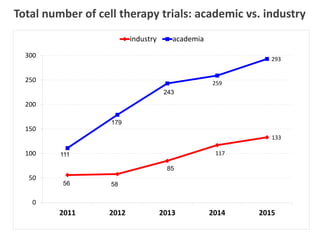
56 58
85
117
133
111
179
243
259
293
0
50
100
150
200
250
300
2011 2012 2013 2014 2015
industry academia
Total number of cell therapy trials: academic vs. industry
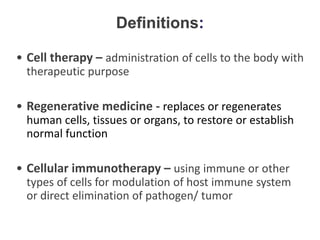
• Cell therapy – administration of cells to the body with
therapeutic purpose
• Regenerative medicine - replaces or regenerates
human cells, tissues or organs, to restore or establish
normal function
• Cellular immunotherapy – using immune or other
types of cells for modulation of host immune system
or direct elimination of pathogen/ tumor
Definitions:
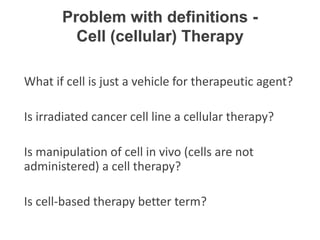
What if cell is just a vehicle for therapeutic agent?
Is irradiated cancer cell line a cellular therapy?
Is manipulation of cell in vivo (cells are not
administered) a cell therapy?
Is cell-based therapy better term?
Problem with definitions -
Cell (cellular) Therapy
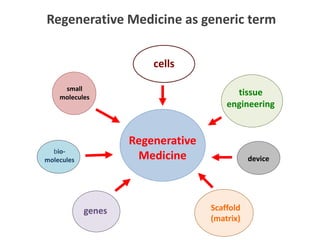
cells
tissue
engineering
Scaffold
(matrix)
genes
small
molecules
Regenerative Medicine as generic term
Regenerative
Medicinebio-
molecules device
RM is not equal to cellular immunotherapy. Equation
is confusing!
Tissue engineering was rebranded as RM
RM and Cell Therapy may have different challenges
and obstacles (example: EPO as regenerative)
Organizations successfully exploit RM brand to attract
public trust, money, and lobby politicians (CIRM, ARM)
Problem with definitions -
Regenerative Medicine
• Immunocellular
• Regenerative
Classification based on
mechanism of action
46 62
137 156 174
121 175
191 220 252
0%
20%
40%
60%
80%
100%
2011 2012 2013 2014 2015
Immuno- Regenerative-
Trend: Immunocellular therapy vs. cell-based
regenerative medicine
• Autologous
• Allogeneic
• Auto + Allo
• Xenogeneic
Classification based on donor cell origin
Industry is not in favor of allo- model
Total
number of
registered
clinical trials
31 26
48
70
79
24 29
34
45
54
0
20
40
60
80
100
120
140
2011 2012 2013 2014 2015
allo
auto
Trend: Allo- vs. auto- commercial trials
Origin:
• Somatic cell therapy
• Germline cell modifications
Differentiation:
• Stem cells
• Progenitor cells
• Mature (differentiated) cells
Cell types classifications
52
80
90
116
140
22
42
60
81
96
38
25
13
22
26
3 3
8
11
41
32
17
0
20
40
60
80
100
120
140
2011 2012 2013 2014 2015
MSC total
T-cells
BM MNC
HSPC
adipose SVF
ESC
DC
NK cells
Trend: Interest to major cell types
23 24
19
28
40
31
58
71
89
100
0
20
40
60
80
100
2011 2012 2013 2014 2015
industry academic
Cell therapy trials: cell type – mesenchymal stem cells
5
9
13 22
26
6
13
10 18
37
0%
20%
40%
60%
80%
100%
2011 2012 2013 2014 2015
Fresh SVF Adipose SC expanded
Trend: Interest to adipose tissue-derived cells
Based on:
• Degree of cell manipulation
• Homology
• Risks to recipient
Disregard:
• Cell biology, cell type and origin
• Therapeutic intention
Regulatory classifications
Cell Therapy
(somatic cell,
including stem
cells)
Gene Therapy
Devices related
to cells
351 HCT/P (drug, biologic or device)
361 HCT/P (tissues)
cartilage, bone, tendon, skin,
ocular tissue, reproductive cells
and tissues…
HCT/P
Regulatory classification: USA
Cells & Tissues but not HCT/Ps:
(blood and blood components, minimally manipulated bone marrow for
homologous use, xenogenic cells/ tissue…)
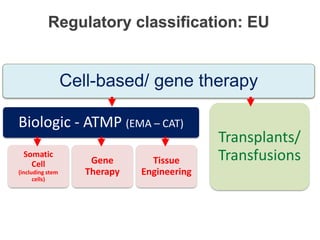
Regulatory classification: EU
Cell-based/ gene therapy
Biologic - ATMP (EMA – CAT)
Somatic
Cell
(including stem
cells)
Gene
Therapy
Transplants/
TransfusionsTissue
Engineering
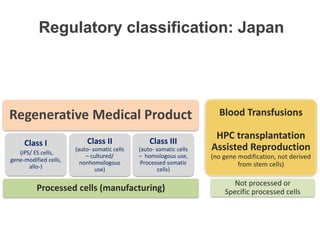
Regulatory classification: Japan
Class I
(iPS/ ES cells,
gene-modified cells,
allo-)
Class II
(auto- somatic cells
– cultured/
nonhomologous
use)
Class III
(auto- somatic cells
– homologous use,
Processed somatic
cells)
Regenerative Medical Product Blood Transfusions
HPC transplantation
Assisted Reproduction
(no gene modification, not derived
from stem cells)
Processed cells (manufacturing)
Not processed or
Specific processed cells
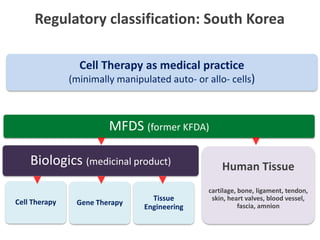
Cell Therapy Gene Therapy
Tissue
Engineering
Biologics (medicinal product)
Human Tissue
cartilage, bone, ligament, tendon,
skin, heart valves, blood vessel,
fascia, amnion
MFDS (former KFDA)
Regulatory classification: South Korea
Cell Therapy as medical practice
(minimally manipulated auto- or allo- cells)
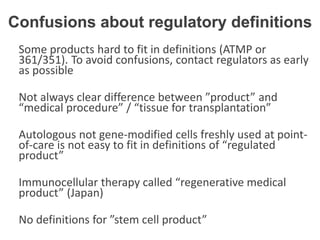
Some products hard to fit in definitions (ATMP or
361/351). To avoid confusions, contact regulators as early
as possible
Not always clear difference between ”product” and
“medical procedure” / “tissue for transplantation”
Autologous not gene-modified cells freshly used at point-
of-care is not easy to fit in definitions of “regulated
product”
Immunocellular therapy called “regenerative medical
product” (Japan)
No definitions for ”stem cell product”
Confusions about regulatory definitions

Cell Therapy - Definitions and Classifications

  • 1.
    Alexey Bersenev, MD,PhD Advanced Cell Therapy Laboratory, Yale-New Haven Hospital, Yale University www.celltrials.info 8th the BioProcessing Summit, Boston, Aug. 15, 2016 CELL THERAPY – Definitions, Classifications and Trends
  • 2.
    56 58 85 117 133 111 179 243 259 293 0 50 100 150 200 250 300 2011 20122013 2014 2015 industry academia Total number of cell therapy trials: academic vs. industry
  • 3.
    • Cell therapy– administration of cells to the body with therapeutic purpose • Regenerative medicine - replaces or regenerates human cells, tissues or organs, to restore or establish normal function • Cellular immunotherapy – using immune or other types of cells for modulation of host immune system or direct elimination of pathogen/ tumor Definitions:
  • 4.
    What if cellis just a vehicle for therapeutic agent? Is irradiated cancer cell line a cellular therapy? Is manipulation of cell in vivo (cells are not administered) a cell therapy? Is cell-based therapy better term? Problem with definitions - Cell (cellular) Therapy
  • 5.
  • 6.
    RM is notequal to cellular immunotherapy. Equation is confusing! Tissue engineering was rebranded as RM RM and Cell Therapy may have different challenges and obstacles (example: EPO as regenerative) Organizations successfully exploit RM brand to attract public trust, money, and lobby politicians (CIRM, ARM) Problem with definitions - Regenerative Medicine
  • 7.
  • 8.
    46 62 137 156174 121 175 191 220 252 0% 20% 40% 60% 80% 100% 2011 2012 2013 2014 2015 Immuno- Regenerative- Trend: Immunocellular therapy vs. cell-based regenerative medicine
  • 9.
    • Autologous • Allogeneic •Auto + Allo • Xenogeneic Classification based on donor cell origin
  • 10.
    Industry is notin favor of allo- model Total number of registered clinical trials 31 26 48 70 79 24 29 34 45 54 0 20 40 60 80 100 120 140 2011 2012 2013 2014 2015 allo auto Trend: Allo- vs. auto- commercial trials
  • 11.
    Origin: • Somatic celltherapy • Germline cell modifications Differentiation: • Stem cells • Progenitor cells • Mature (differentiated) cells Cell types classifications
  • 12.
    52 80 90 116 140 22 42 60 81 96 38 25 13 22 26 3 3 8 11 41 32 17 0 20 40 60 80 100 120 140 2011 20122013 2014 2015 MSC total T-cells BM MNC HSPC adipose SVF ESC DC NK cells Trend: Interest to major cell types
  • 13.
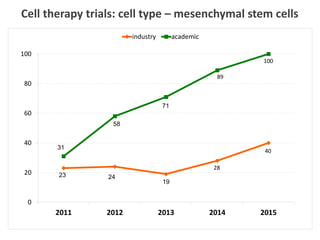
    23 24 19 28 40 31 58 71 89 100 0 20 40 60 80 100 2011 20122013 2014 2015 industry academic Cell therapy trials: cell type – mesenchymal stem cells
  • 14.
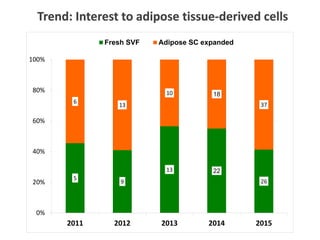
    5 9 13 22 26 6 13 10 18 37 0% 20% 40% 60% 80% 100% 20112012 2013 2014 2015 Fresh SVF Adipose SC expanded Trend: Interest to adipose tissue-derived cells
  • 15.
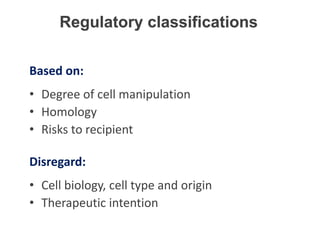
    Based on: • Degreeof cell manipulation • Homology • Risks to recipient Disregard: • Cell biology, cell type and origin • Therapeutic intention Regulatory classifications
  • 16.
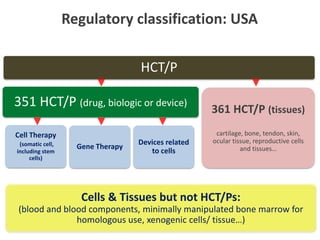
    Cell Therapy (somatic cell, includingstem cells) Gene Therapy Devices related to cells 351 HCT/P (drug, biologic or device) 361 HCT/P (tissues) cartilage, bone, tendon, skin, ocular tissue, reproductive cells and tissues… HCT/P Regulatory classification: USA Cells & Tissues but not HCT/Ps: (blood and blood components, minimally manipulated bone marrow for homologous use, xenogenic cells/ tissue…)
  • 17.
    Regulatory classification: EU Cell-based/gene therapy Biologic - ATMP (EMA – CAT) Somatic Cell (including stem cells) Gene Therapy Transplants/ TransfusionsTissue Engineering
  • 18.
    Regulatory classification: Japan ClassI (iPS/ ES cells, gene-modified cells, allo-) Class II (auto- somatic cells – cultured/ nonhomologous use) Class III (auto- somatic cells – homologous use, Processed somatic cells) Regenerative Medical Product Blood Transfusions HPC transplantation Assisted Reproduction (no gene modification, not derived from stem cells) Processed cells (manufacturing) Not processed or Specific processed cells
  • 19.
    Cell Therapy GeneTherapy Tissue Engineering Biologics (medicinal product) Human Tissue cartilage, bone, ligament, tendon, skin, heart valves, blood vessel, fascia, amnion MFDS (former KFDA) Regulatory classification: South Korea Cell Therapy as medical practice (minimally manipulated auto- or allo- cells)
  • 20.
    Some products hardto fit in definitions (ATMP or 361/351). To avoid confusions, contact regulators as early as possible Not always clear difference between ”product” and “medical procedure” / “tissue for transplantation” Autologous not gene-modified cells freshly used at point- of-care is not easy to fit in definitions of “regulated product” Immunocellular therapy called “regenerative medical product” (Japan) No definitions for ”stem cell product” Confusions about regulatory definitions

Editor's Notes

  • #3 Cell therapy is mostly experimental field right now. So, one of the best ways to track activities in this field is to look at number of clinical trials, registered in databases. Just to illustrate how field is active and where are we at, I’d like to show this trend – total number of clinical trials in cell therapy, registered worldwide. Since this conference industry-focused, I broke it down for commercial versus academic trials. As you can see, both – industry and academic trials have a steady growth over the last 5 years. Please note that I’ve captured only newly registered trials from year to year, so this is not cumulative graph.
  • #4 Now, I’d like to start from definitions. First, Cell Therapy (CT) is administration of cells to the body with therapeutic purpose. I’m intentionally skipping “human” here, because cell therapy is growing very rapidly in veterinary medicine. Next definition, that I’ll discuss today is Regenerative Medicine (RM). RM – replaces or regenerate human cells, tissues or organs, to restore or establish normal function. It is important to distinguish CT and RM. I’ll discuss this a bit later. Finally, I’d like to define Cellular Immunotherapy, which is important for understanding a difference between CT and RM. So, Cellular Immunotherapy (CI) is using immune or other types of cells for therapeutic modulation of host immune system or direct elimination or pathogen or tumor.
  • #5 I’d like to bring few challenges to definition of CT. A few applications of cells could be judge as ”CT” by some people, but could be deemed as not “CT” the others. For example, what if cells administered to the body used only as a vehicle to deliver therapeutic agent (gene or other therapeutic molecule). Next, what if irradiated tumor cell line used as cancer vaccine? Most of these cells could be dead or apoptotic, but still carry antigen, which would stimulate immune system. Finally, an example of so-called “cell therapy without cells”, when administered drugs (but not cells) modulate activity of particular cell populations in vivo. For example, progenitor cell mobilization from bone marrow to bloodstream or injection of chemoattractants into problematic tissues for migration of particular tissue resident cells for reparation. Some people would call it “cell therapy in situ”. These examples beg the question – Is cell-based therapy a little bit better term?
  • #6 To understand RM term better, please look at this diagram. RM is generic term. Tissue regeneration could be done by variety of agents or technologies. For example, small molecules, biomolecules, genes alone, scaffolds or matrices alone, devices, tissue engineered constructs and, finally, cells can regenerate tissue. So, RM is more like medical specialty, but not platform technology.
  • #7 There are several problems with current wide use of term RM. First of all, many people apply term RM to cellular immunotherapy. But one of the most important mechanisms of immunotherapeutic is direct tumor killing (lysis), but not tissue regeneration. Therefore, immunotherapy is one of the best examples for distinction of CT and RM. Historically, RM is rebranded tissue engineering. On the one hand, this kind of rebranding was useful for promotion of tissue engineering, but on the other hand it was also expanded to CT and made definitions more confusing. To illustrate importance of RM and CT distinction, I’d like to bring to your attention an example from the recent editorial by Chris Mason. Manufacturing is cited as the most frequent obstacle to successful product development and commercialization in RM, but if regeneration is done by biomolecule (example EPO – erythropoetin, which regenerate red blood cell lineage in bone marrow), there is no manufacturing challenge here. Biotech is well established and producing some commercial ”regenerative drugs” for number of years. The last point, I’d like to make here is exploitation of RM brand by several professional organizations (example: CIRM and ARM). These organizations put any cell- and gene-based therapeutic under RM umbrella. This tactic is successful attract money, public attention and lobby politicians. However, such branding does not have scientific foundation.
  • #8 One of the most important (in my view) and practical classifications of cell-based therapies is their subdivision for immunocellular and regenerative.
  • #9 Here I was trying to quantify the interest to immunocellular versus regenerative cell-based therapies, based on listings in clinical trials databases. As you can see, interest to immunocellular therapies grew significantly since 2011 and remains steady around 40% in the last 3 years. The major contributor to this growth is explosion of CAR-T cell therapies.
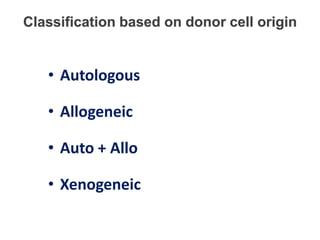
  • #10 Based on donor cell origin, cell therapies can be classified as autologus, allogeneic, xenogeneic and mixed – auto+allo.
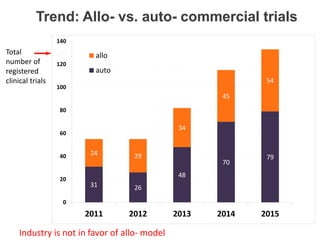
  • #11 Very important question for the industry is what donor cell type is better for invetment – allogeneic vs. autologous business model. There is an assumption that allogeneic model is more attractive for industry, because it’s quite clear and similar to conventional Pharma of Biotech. However, when I analysed interest to donor cell type among commercial trials, I found that allo- model is not as attractive as auto-.
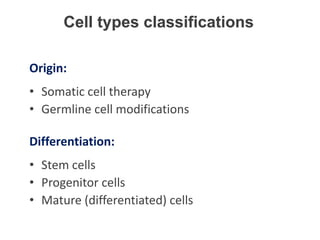
  • #12 Cell types can be also classified, based on origin as somatic or germline and based on differentiation status as stem cells, progenitor cells and mature (differentiated) cells. Interestingly, FDA defined “somatic cell therapy” in1993 as any type of cell: autologous, allogeneic, or xenogeneic cells that have been propagated, expanded, selected, pharmacologically treated, or otherwise altered in biological characteristics ex vivo to be administered to humans and applicable to the prevention, treatment, cure, diagnosis or mitigation of disease or injuries. FDA and other regulatory agencies widely use term “somatic cell therapy” as anything different from “stem cells”. However, in biology, somatic means different from germline. I think, somatic cell therapy is obsolescent term.
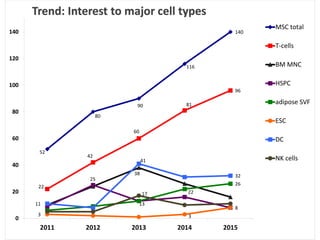
  • #13 The next graph demonstrates interested to major cell types in the field, based on number of listings in clinical trial databases. I picked only some cell types, because people use a great variety of cells (more than 50), but most of them used in few trials. The most important message here is that 2 cell types hugely dominated the others in the recent few years. Just look at these 2 rocketing lines – blue, which represents MSCs and red, which represents T-cells. For other cell types, I’d like to highlight adipose Stromal Vascular Fraction - trending up and hematopoietic stem/ progenitor cells - trending down.
  • #14 The next graph demonstrates the value of “academic” versus “commercial” clinical trials, involved the most popular cell type – MSC. As you can see, based on number of trials, listed in databases, academia is outperforming industry significantly.
  • #15 Finally, I’d like to show an interest of investigators to other popular cell types – adipose tissue-derived (i) fresh SVF and (ii) cultured (ex vivo expanded) MSC. There is no very clear trend here, but seem like researchers had about equal interest to both of them.
  • #16 Now, I’d like to move to the most interesting classification of cell therapies – regulatory classifications. Generally, regulatory classifications of cell-based products based on the 3 main things: (1) degree of cell manipulation, (2) homology of use and (3) risk to recipient. In the same time, regulators frequently disregard cell biology, cell type and origin. For example, adult or embryonic stem cells and mature cells can fall in the same regulatory classification if expanded in culture (HCT/P 351 by FDA). Regulators also disregard therapeutic intention. For example, adipocytes or cultured stromal cells, derived from fat tissue, may get different regulatory classification, despite the same therapeutic intent – cosmetic body reshaping.
  • #17 In US, FDA regulates mostly all cell-based products/ tissues. These products called “Human Cell Tissue Products – HCT/P). Definition of HCT/P: Articles containing or consisting of human cells or tissues that are intended implantation, transplantation, infusion or transfer into human recipient. HCT/P subdivided by FDA for 2 category: 361 and 351. For 361 HCT/P premarket review and approval not required. 351 products could be regulated as drug, biologic or device. Delineation between 361 and 351 products you can find in CRF 21 part 1271.10 http://www.accessdata.fda.gov/scripts/cdrh/cfdocs/cfcfr/CFRSearch.cfm?fr=1271.10 FDA does not use term “regenerative medicine products” anywhere. FDA does not have separate unique regulation for cell/ tissue/ gene products and use existent regulations, designed for drugs, biologics and devices. Examples of some cells and tissues, which are not considered by FDA as HCT/Ps include, but not limited to: blood and blood components, xenogenic cells/ tissues, minimally manipulated bone marrow for homologous use.
  • #18 In Erope, EMA regulates all cell-based/ gene therapies as biologics, but in separate category - “Advanced Therapeutic Medicinal Products” (ATMP). EMA defines ATMPs as medicines for human use that are based on genes or cells. ATMPs can be further classified as 4 different groups: (1) somatic cell therapy, (2) gene therapy, (3) tissue engineering and (4) combined. Developer may request assessment and classification of their particular product by the agency, if it is not very clear. EMA's Committee for Advanced Therapies (CAT) assesses the product and recommends classification. Even though, classification is optional, developers frequently request it from the Agency in case of borderline classification. Examples of such product may include: decellularized tissue matrices, platelet-rich plasma, fresh adipose-tissue derived cells, bone marrow concentrate and others.
  • #19 In Japan, very recent Act on the Safety of Regenerative Medicine and revised Pharmaceutical Affairs Act (in effect since 2014) defines all cell-based and gene products as “Regenerative Medical Product” (RMP). RMP definition: processed human/ animal cells for medical use to reconstruct, restore, or form structure or function of the human body and to treat or prevent human diseases as well as gene therapy products. RMP subdivided for 3 classes, based on safety-risk assessment, where Class I is “the most risky” RMPs. Immunocellular therapy falls under definition of “RMP” as well. This is an example of how regulators ignore therapeutic intention. Specific processed cells entails minimal manipulation – these cell/ tissue therapies are outside of scope of these Acts.
  • #20 In South Korea, MFDS (Ministry Food and Drug Safety) regulates cell/ gene therapy and tissue engineering as biologic under Pharmaceutical Affair Act or Medical Device Act. Human tissues (including 9 categories) are regulated by MFDS under Human Tissue Safety and Control Act (2004) and do not require pre-market authorization, but only approval of operations as registered GMP tissue bank.
  • #21 Finally, I’d like to bring for discussion some confusions, associated with regulatory definitions and classifications of cell therapy products. First of all, some developers confused by ATMP or 351/361 HCT/P classifications. Borderline ATMPs I mentioned before. The same products considered by US developers as 361 and self-launched on a market. However, in the last 5 years FDA inspected and issued a number of letters, related to misclassification of HCT/Ps as 361. Developers also sometimes consider regulated products as “medical procedures” or “tissues for transplantation”. A typical example here is autologous fat tissue-derived or bone marrow-derived freshly isolated cells with point-of-care (usually local) administration. FDA usually classifies most of these products as 351, based on homology of use. The next confusion is misuse of terms regenerative medical products and immunocellular therapy. Japanese regulation emphasizes that immunocellular product fall into “RMP”. FDA does not use language “regenerative” or “immunocellular” at all. Finally, none of regulatory jurisdictions define “stem cell product”. For example, FDA careless of HCT/P “stem” or “non-stem”, it is usually always 351, even though risk profile could be significantly different. Public would like to know how many “stem cell products” approved or in development/ clinical trials, however this information almost impossible to track accurately, because there is no definitions.