KARNATAKA VETERINARY, ANIMALAND FISHERIES
SCIENCES UNIV`ERSITY
VETERINARY COLLEGE, BENGALURU
DEPT. OF VETERINARY BIOCHEMISTRY
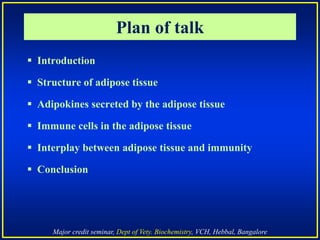
ADIPOSE TISSUE IN IMMUNITY
Major advisor:
Dr. V GIRISH KUMAR
Co-guide:
Dr. V SEJIAN
Presented by,
Dr. VIDYA M K
MVHK 1519
Major credit seminar, Dept of Vety. Biochemistry, VCH, Hebbal, Bangalore
Plan of talk
 Introduction
 Structure of adipose tissue
 Adipokines secreted by the adipose tissue
 Immune cells in the adipose tissue
 Interplay between adipose tissue and immunity
 Conclusion
Major credit seminar, Dept of Vety. Biochemistry, VCH, Hebbal, Bangalore
Introduction
• Complex, multidepot, anatomically dissectible discrete
structure with a high metabolic activity.
• It comprises of two types of adipocytes, white and brown,
each of which differ in their anatomy and physiology.
• Important functions:
- Insulating layer
- Mechanical protection
- Energy storage
Major credit seminar, Dept of Vety. Biochemistry, VCH, Hebbal, Bangalore
Mere fat storage sink????
Discovery
of leptin
Major credit seminar, Dept of Vety. Biochemistry, VCH, Hebbal, Bangalore
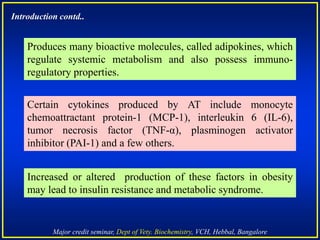
Produces many bioactive molecules, called adipokines, which
regulate systemic metabolism and also possess immuno-
regulatory properties.
Increased or altered production of these factors in obesity
may lead to insulin resistance and metabolic syndrome.
Introduction contd..
Certain cytokines produced by AT include monocyte
chemoattractant protein-1 (MCP-1), interleukin 6 (IL-6),
tumor necrosis factor (TNF-α), plasminogen activator
inhibitor (PAI-1) and a few others.
Major credit seminar, Dept of Vety. Biochemistry, VCH, Hebbal, Bangalore
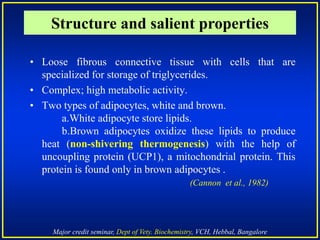
• Loose fibrous connective tissue with cells that are
specialized for storage of triglycerides.
• Complex; high metabolic activity.
• Two types of adipocytes, white and brown.
a.White adipocyte store lipids.
b.Brown adipocytes oxidize these lipids to produce
heat (non-shivering thermogenesis) with the help of
uncoupling protein (UCP1), a mitochondrial protein. This
protein is found only in brown adipocytes .
(Cannon et al., 1982)
Structure and salient properties
Major credit seminar, Dept of Vety. Biochemistry, VCH, Hebbal, Bangalore
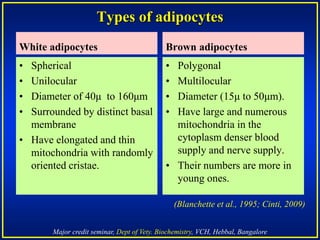
Types of adipocytes
White adipocytes
• Spherical
• Unilocular
• Diameter of 40μ to 160μm
• Surrounded by distinct basal
membrane
• Have elongated and thin
mitochondria with randomly
oriented cristae.
Brown adipocytes
• Polygonal
• Multilocular
• Diameter (15μ to 50μm).
• Have large and numerous
mitochondria in the
cytoplasm denser blood
supply and nerve supply.
• Their numbers are more in
young ones.
(Blanchette et al., 1995; Cinti, 2009)
Major credit seminar, Dept of Vety. Biochemistry, VCH, Hebbal, Bangalore
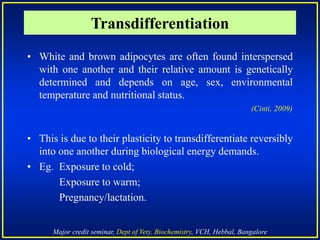
• White and brown adipocytes are often found interspersed
with one another and their relative amount is genetically
determined and depends on age, sex, environmental
temperature and nutritional status.
(Cinti, 2009)
• This is due to their plasticity to transdifferentiate reversibly
into one another during biological energy demands.
• Eg. Exposure to cold;
Exposure to warm;
Pregnancy/lactation.
Transdifferentiation
Major credit seminar, Dept of Vety. Biochemistry, VCH, Hebbal, Bangalore
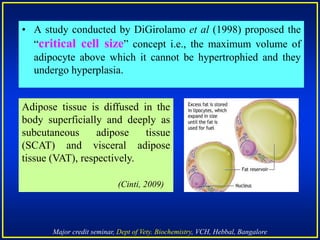
• A study conducted by DiGirolamo et al (1998) proposed the
“critical cell size” concept i.e., the maximum volume of
adipocyte above which it cannot be hypertrophied and they
undergo hyperplasia.
Adipose tissue is diffused in the
body superficially and deeply as
subcutaneous adipose tissue
(SCAT) and visceral adipose
tissue (VAT), respectively.
(Cinti, 2009)
Major credit seminar, Dept of Vety. Biochemistry, VCH, Hebbal, Bangalore
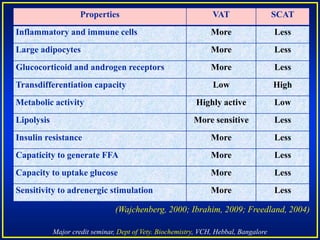
Properties VAT SCAT
Inflammatory and immune cells More Less
Large adipocytes More Less
Glucocorticoid and androgen receptors More Less
Transdifferentiation capacity Low High
Metabolic activity Highly active Low
Lipolysis More sensitive Less
Insulin resistance More Less
Capaticity to generate FFA More Less
Capacity to uptake glucose More Less
Sensitivity to adrenergic stimulation More Less
(Wajchenberg, 2000; Ibrahim, 2009; Freedland, 2004)
Major credit seminar, Dept of Vety. Biochemistry, VCH, Hebbal, Bangalore
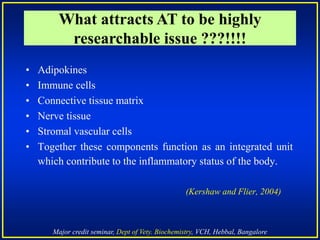
• Adipokines
• Immune cells
• Connective tissue matrix
• Nerve tissue
• Stromal vascular cells
• Together these components function as an integrated unit
which contribute to the inflammatory status of the body.
(Kershaw and Flier, 2004)
What attracts AT to be highly
researchable issue ???!!!!
Major credit seminar, Dept of Vety. Biochemistry, VCH, Hebbal, Bangalore
Adipokines
• Adipose tissue is capable of synthesizing a diverse group
of peptides, proteins and cytokines.
• Adipokines are the bioactive peptides produced by the
endocrine adipose organ which regulate systemic
metabolism and also possess immunoregulatory properties.
• Eg. Leptin, adiponectin, visfatin, apelin, vaspin, omentin,
resistin, hepacidin, etc.
(Trayhurn and Wood 2004)
Major credit seminar, Dept of Vety. Biochemistry, VCH, Hebbal, Bangalore
• “The satiety hormone”
• Zhang et al., 1994
• Appetite.
• Atherogenic.
• Haematopoiesis and angiogenesis.
• Puberty.
• Obesity is associated with elevated leptin levels.
• Leptin is a sensitive marker for predicting cardiovascular
risk and the metabolic syndrome.
(Lago et al., 2007; Umemoto et al., 1997; Bouloumie et al., 1998)
Leptin
Major credit seminar, Dept of Vety. Biochemistry, VCH, Hebbal, Bangalore
• It promotes survivability and maturation of DCs.
• It increases the proliferative and phagocytic capacity of
macrophages and monocytes. It also promotes infiltration of
macrophage into the wound site. (Goren et al., 2003)
• Stimulates chemotaxis. (Belouzard et al.,2006)
• Leptin promotes longevity of naive T cells and survivability
of B cells.
• The production of TNF-α , IFN-γ and IL-2 are also enhanced.
• Switching of cytokine production from T cell towards Th1
phenotype. (Faggioni et al., 2001)
Role of leptin in innate & adaptive immunity
Major credit seminar, Dept of Vety. Biochemistry, VCH, Hebbal, Bangalore
Adiponectin
• Adiponectin is decreased in abdominal obesity.
(Shklyaev et al, 2003; Wolf et al., 2006; Ouchi et al., 1999)
Anti-atherogenic
Anti-diabetic
Anti-inflammatory
Major credit seminar, Dept of Vety. Biochemistry, VCH, Hebbal, Bangalore
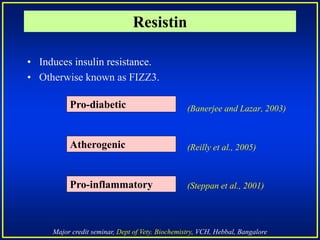
Resistin
• Induces insulin resistance.
• Otherwise known as FIZZ3.
(Banerjee and Lazar, 2003)
(Reilly et al., 2005)
(Steppan et al., 2001)
Atherogenic
Pro-diabetic
Pro-inflammatory
Major credit seminar, Dept of Vety. Biochemistry, VCH, Hebbal, Bangalore
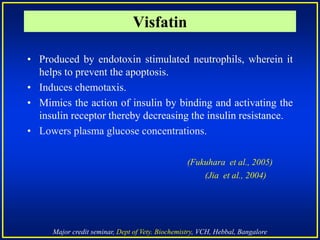
Visfatin
• Produced by endotoxin stimulated neutrophils, wherein it
helps to prevent the apoptosis.
• Induces chemotaxis.
• Mimics the action of insulin by binding and activating the
insulin receptor thereby decreasing the insulin resistance.
• Lowers plasma glucose concentrations.
(Fukuhara et al., 2005)
(Jia et al., 2004)
Major credit seminar, Dept of Vety. Biochemistry, VCH, Hebbal, Bangalore
Adipsin
• Also called as factor D, is involved in complement
activation and metabolic control.
• Increased adipsin level reported with:
- Adiposity,
- Insulin resistance,
- Dyslipidemia, and
- Cardiovascular disease.
(Cianflone et al., 2003)
Major credit seminar, Dept of Vety. Biochemistry, VCH, Hebbal, Bangalore
Amalgamation between metabolism
and immunology in AT
• A close anatomical interaction with lymphoid organs.
• Adipocytes are far more than lipid-storage cells.
• Immune cells are co-localized with adipocytes in adipose
tissue.
• Excess of adiposity.
(Pond, 2003; Fain et al., 2004; Saillan et al., 2003; Xu et al., 2003)
EVIDENCE?????
Major credit seminar, Dept of Vety. Biochemistry, VCH, Hebbal, Bangalore
Why immune cells???
• Obesity provides bacterial and metabolic danger signals
that mimic bacterial infection, and drives a shift in immune
cell phenotypes and numbers, and inflammatory response.
• Housekeeping functions
How ????
- apoptotis
- extracellular matrix remodeling
- angiogenesis
Major credit seminar, Dept of Vety. Biochemistry, VCH, Hebbal, Bangalore
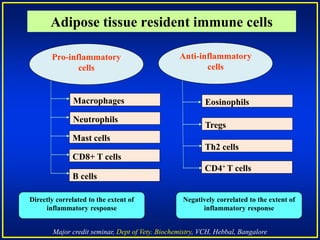
Macrophages
Neutrophils
Mast cells
Eosinophils
Tregs
Th2 cells
CD4+ T cells
Pro-inflammatory
cells
Anti-inflammatory
cells
CD8+ T cells
Directly correlated to the extent of
inflammatory response
Negatively correlated to the extent of
inflammatory response
Adipose tissue resident immune cells
B cells
Major credit seminar, Dept of Vety. Biochemistry, VCH, Hebbal, Bangalore
• Macrophages are the most abundantly found leukocytes in
AT. Represent 5% of adipose cells in lean AT up to 25-
30% in obese AT. (Nishimura et al., 2009)
• There are two phenotypic states, M1 (classically activated)
and M2 (alternatively activated).
– M2 phenotype maintain the state of insulin sensitivity through
secretion of anti-inflammatory cytokine IL-10.
– The pro-inflammatory M1 macrophages produce IL-6 and TNF-α
which are directly involved in local and systemic inflammation,
and insulin resistance.
(Odegaard et al. 2007; Wentworth et al. 2010)
Macrophages
Major credit seminar, Dept of Vety. Biochemistry, VCH, Hebbal, Bangalore
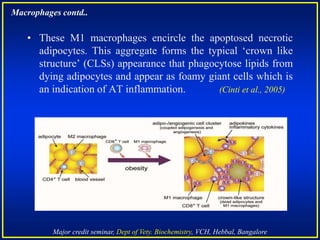
• These M1 macrophages encircle the apoptosed necrotic
adipocytes. This aggregate forms the typical ‘crown like
structure’ (CLSs) appearance that phagocytose lipids from
dying adipocytes and appear as foamy giant cells which is
an indication of AT inflammation. (Cinti et al., 2005)
Macrophages contd..
Major credit seminar, Dept of Vety. Biochemistry, VCH, Hebbal, Bangalore
• Comprises of 1.5% of stromal vascular fraction of AT.
• Perpetuates the inflammation. (Soehnlein et al., 2009)
• In obese individuals, elevated plasma myeloperoxidase
level is reported which is a neutrophil marker; indicative of
inflammation. (Andrade et al., 2012)
• Besides, the activity of neutrophil specific elastase is also
increased in obesity corresponding to the infiltration of
neutrophils. It promotes insulin resistance through
increased expression of pro-inflammatory genes.
(Talukdar et al., 2012)
Neutrophils
Major credit seminar, Dept of Vety. Biochemistry, VCH, Hebbal, Bangalore
• They produce cytokines IL-12 and IL-15 which are
involved in
– Inducing the differentiation of naive T cells into Th1 cells
– Proliferation of CD8+ T cells
– Activation NK cells.
(Hashimoto et al., 2011)
• Their circulating numbers are increased in obesity and also
have a role in aggregation of macrophages around the
adipocytes. (Dominguez and Ardavin, 2011)
Dendritic cells
Major credit seminar, Dept of Vety. Biochemistry, VCH, Hebbal, Bangalore
• More numerous in lean VAT, and are major producers of
IL-4 & IL-13, which help to promote M2 macrophage
polarization to maintain a ‘lean phenotype’ through
“browning”. (Wu et al. 2011)
• Obese individuals have increased mast cells within VAT
compared to lean individuals.
• Express proinflammatory cytokines including TNFα, IL-
1β, and IL-6.
Eosinophils
Mast cells
Major credit seminar, Dept of Vety. Biochemistry, VCH, Hebbal, Bangalore
• CD 8+ T cells are cytotoxic T lymphocytes.
• Important mediators of adaptive immunity against certain
viral, protozoan, and bacterial pathogens.
• CD8+ T cells increase the recruitment of macrophages to
adipose tissues.
• Also promote monocyte differentiation into M1
macrophages.
(Rausch et al., 2008)
CD 8+ T cells
Major credit seminar, Dept of Vety. Biochemistry, VCH, Hebbal, Bangalore
• Recognize polypeptides presented by class II MHC
molecules on the surface of APCs such as macrophages
and dendritic cells.
• Activated or effector CD4+ T cells then release cytokines
that recruit other immune cells to the area, resulting in
inflammation.
• Subdivided into three functionally distinct effector cells:
– Th1 (IFN-γ)
– Th2 (IL-4/ IL-13)
– Th17 cells (IL-17) (Oestreich et al., 2012)
CD4+ T cells
Major credit seminar, Dept of Vety. Biochemistry, VCH, Hebbal, Bangalore
• Insulin-sensitizing effect of CD4+ T cells depend on Th2
cells.
• The ratio of Th1 to Th2 cells is increased significantly
during obesity.
– The Th1 cells are increased in obesity while Th2 cells are reduced.
• Th1 cells secrete IFNγ, helps the polarization of M2
macrophages and thus it acts as a pro-inflammatory
immune cell.
(Winer et al., 2011)
CD 4+ T cells contd..
Major credit seminar, Dept of Vety. Biochemistry, VCH, Hebbal, Bangalore
• Tregs are found in more numbers in lean AT and they are
reduced in obesity. Critical for the for maintenance of an
anti-inflammatory environment at steady state in lean
adipose tissue.
• Sustains the macrophages in M2 state through secretion of
IL-10.
• Tregs are highly enriched in AT of lean individuals. Their
number declines in obese individuals.
(Feuerer et al. 2009; Cipolletta et al. 2012)
Treg cells
Major credit seminar, Dept of Vety. Biochemistry, VCH, Hebbal, Bangalore
TNF-α
• Mainly there are two mechanisms by which TNFα exerts
its metabolic effects.
– Inhibit expression of genes involved in uptake and storage of
glucose, adipogenesis and lipogenesis in AT
– While in liver it suppresses expression of genes involved
fatty acid oxidation and increases expression of genes
involved in synthesis of cholesterol and fatty acids.
(Ruan et al., 2002)
– Inhibits insulin signaling either by reducing the levels of
insulin signaling components or by inducing the inhibitory
phosphorylation of insulin receptor substrates (IRSs).
(Rui et al., 2001)
Major credit seminar, Dept of Vety. Biochemistry, VCH, Hebbal, Bangalore
• It influences apoptosis of adipocytes. (Coppack, 2001)
• TNFα is an important mediator in synthesis of IL-6, acute-
phase protein and haptoglobin.
(Peeraully et al., 2004)
• TNF-α is increased in obesity.
• Pro-inflammatory
• Pro-diabetic
• Pro-atherogenic
(Fain et al., 2004)
TNFα contd..
Major credit seminar, Dept of Vety. Biochemistry, VCH, Hebbal, Bangalore
IL-6
• 30% of circulating IL-6 originates from adipose tissue and
is increased is obesity.
• Pro-atherogenic: increase vascular inflammation.
• Pro-diabetic: decrease insulin signalling.
• Major regulator of hepatic CRP production.
(Fernandez and Ricart, 2003)
• IL-10 is a classical anti-inflammatory cytokine expressed
by Tregs, macrophages (M2) and other cells. This cytokine
promotes insulin sensitivity.
IL-10
Major credit seminar, Dept of Vety. Biochemistry, VCH, Hebbal, Bangalore
C reactive protein (CRP)
• Pro-atherogenic
• Pro-diabetic (Yudkin et al., 2000)
• Pro-atherogenic (Gabay & Kushner, 1999)
• It recruits monocytes to sites of inflammation.
• Increased in obesity and insulin resistance.
• Inhibitory effect on growth & differentiation of adipocyte.
(Wellen and Hotamisligil, 2003)
Plasminogen activator inhibitor-1 (PAI-1)
Monocyte chemoattractant protein-1
Major credit seminar, Dept of Vety. Biochemistry, VCH, Hebbal, Bangalore
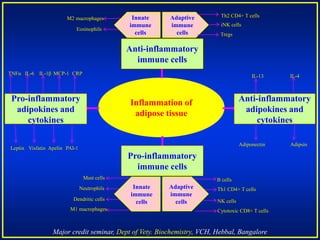
Inflammation of
adipose tissue
Anti-inflammatory
adipokines and
cytokines
Anti-inflammatory
immune cells
Pro-inflammatory
immune cells
Pro-inflammatory
adipokines and
cytokines
Adaptive
immune
cells
Innate
immune
cells
Adaptive
immune
cells
Innate
immune
cells
B cells
NK cells
Th1 CD4+ T cells
Cytotoxic CD8+ T cells
Mast cells
Dendritic cells
Neutrophils
M1 macrophages
M2 macrophages
Eosinophils
iNK cells
Th2 CD4+ T cells
Tregs
Leptin Visfatin Apelin
TNFα IL-6 IL-1β MCP-1 CRP
Adiponectin
IL-13 IL-4
Adipsin
PAI-1
Major credit seminar, Dept of Vety. Biochemistry, VCH, Hebbal, Bangalore
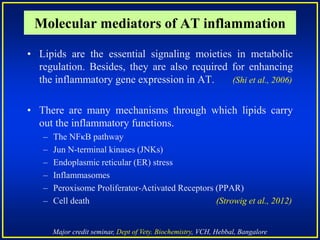
• Lipids are the essential signaling moieties in metabolic
regulation. Besides, they are also required for enhancing
the inflammatory gene expression in AT. (Shi et al., 2006)
• There are many mechanisms through which lipids carry
out the inflammatory functions.
– The NFκB pathway
– Jun N-terminal kinases (JNKs)
– Endoplasmic reticular (ER) stress
– Inflammasomes
– Peroxisome Proliferator-Activated Receptors (PPAR)
– Cell death (Strowig et al., 2012)
Molecular mediators of AT inflammation
Major credit seminar, Dept of Vety. Biochemistry, VCH, Hebbal, Bangalore
• During
– Positive energy balance
– Negative energy balance
Fate of adipose tissue
 Obesity
 Calorie insufficiency
Major credit seminar, Dept of Vety. Biochemistry, VCH, Hebbal, Bangalore
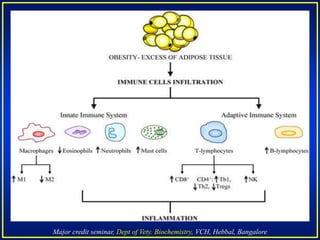
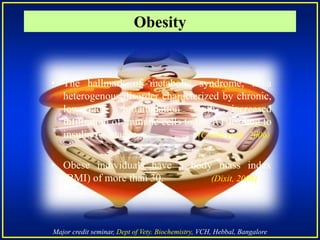
Obesity
• The hallmark of metabolic syndrome, is a
heterogenous disorder characterized by chronic,
low-grade inflammation with increased
infiltration of immune cells to the AT leading to
insulin resistance. (Creely et al., 2006)
• Obese individuals have a body mass index
(BMI) of more than 30. (Dixit, 2008)
Major credit seminar, Dept of Vety. Biochemistry, VCH, Hebbal, Bangalore
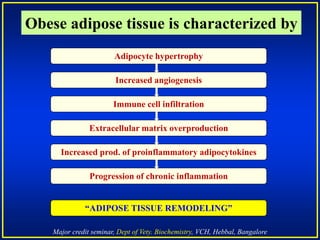
Obese adipose tissue is characterized by
Adipocyte hypertrophy
“ADIPOSE TISSUE REMODELING”
Progression of chronic inflammation
Extracellular matrix overproduction
Increased prod. of proinflammatory adipocytokines
Increased angiogenesis
Immune cell infiltration
Major credit seminar, Dept of Vety. Biochemistry, VCH, Hebbal, Bangalore
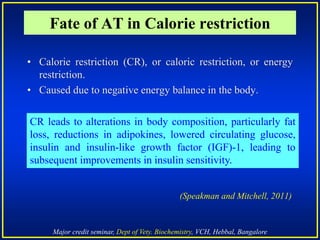
• Calorie restriction (CR), or caloric restriction, or energy
restriction.
• Caused due to negative energy balance in the body.
(Speakman and Mitchell, 2011)
Fate of AT in Calorie restriction
CR leads to alterations in body composition, particularly fat
loss, reductions in adipokines, lowered circulating glucose,
insulin and insulin-like growth factor (IGF)-1, leading to
subsequent improvements in insulin sensitivity.
Major credit seminar, Dept of Vety. Biochemistry, VCH, Hebbal, Bangalore
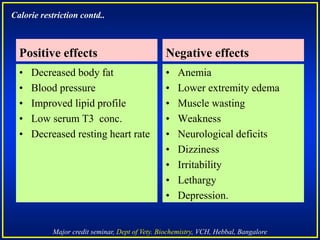
Positive effects
• Decreased body fat
• Blood pressure
• Improved lipid profile
• Low serum T3 conc.
• Decreased resting heart rate
Negative effects
• Anemia
• Lower extremity edema
• Muscle wasting
• Weakness
• Neurological deficits
• Dizziness
• Irritability
• Lethargy
• Depression.
Calorie restriction contd..
Major credit seminar, Dept of Vety. Biochemistry, VCH, Hebbal, Bangalore
• AT was found to be associated in controlling many
biological functions apart from the usual energy
metabolism in mammals
– Adipokines and cytokines
• AT also was found to be the source of resident immune cells –
both adaptive and innate immunity
• There is a strong interrelationship between adipose tissue
and immunity
Conclusion
Major credit seminar, Dept of Vety. Biochemistry, VCH, Hebbal, Bangalore
Acknowledgements:
• Dr. V Girish Kumar, Prof and Head, Dept. of Veterinary
Biochemistry, Bangalore.
• Dr. V Sejian, Senior scientist; Dr. Krishnan, Dr. Bagath,
NIANP, Adugodi, Bangalore.
• Dr. Satyanarayan, Prof and Head, Dept. of Veterinary
Pathology.
• Dr. Karthikesh, Associate Professor, Dept. of Veterinary
Biochemistry, Bidar.
Major credit seminar, Dept of Vety. Biochemistry, VCH, Hebbal, Bangalore
Thank you

Adipose tissue in immunity

  • 1.
    KARNATAKA VETERINARY, ANIMALANDFISHERIES SCIENCES UNIV`ERSITY VETERINARY COLLEGE, BENGALURU DEPT. OF VETERINARY BIOCHEMISTRY ADIPOSE TISSUE IN IMMUNITY Major advisor: Dr. V GIRISH KUMAR Co-guide: Dr. V SEJIAN Presented by, Dr. VIDYA M K MVHK 1519
  • 2.
    Major credit seminar,Dept of Vety. Biochemistry, VCH, Hebbal, Bangalore Plan of talk  Introduction  Structure of adipose tissue  Adipokines secreted by the adipose tissue  Immune cells in the adipose tissue  Interplay between adipose tissue and immunity  Conclusion
  • 3.
    Major credit seminar,Dept of Vety. Biochemistry, VCH, Hebbal, Bangalore Introduction • Complex, multidepot, anatomically dissectible discrete structure with a high metabolic activity. • It comprises of two types of adipocytes, white and brown, each of which differ in their anatomy and physiology. • Important functions: - Insulating layer - Mechanical protection - Energy storage
  • 4.
    Major credit seminar,Dept of Vety. Biochemistry, VCH, Hebbal, Bangalore Mere fat storage sink???? Discovery of leptin
  • 5.
    Major credit seminar,Dept of Vety. Biochemistry, VCH, Hebbal, Bangalore Produces many bioactive molecules, called adipokines, which regulate systemic metabolism and also possess immuno- regulatory properties. Increased or altered production of these factors in obesity may lead to insulin resistance and metabolic syndrome. Introduction contd.. Certain cytokines produced by AT include monocyte chemoattractant protein-1 (MCP-1), interleukin 6 (IL-6), tumor necrosis factor (TNF-α), plasminogen activator inhibitor (PAI-1) and a few others.
  • 6.
    Major credit seminar,Dept of Vety. Biochemistry, VCH, Hebbal, Bangalore • Loose fibrous connective tissue with cells that are specialized for storage of triglycerides. • Complex; high metabolic activity. • Two types of adipocytes, white and brown. a.White adipocyte store lipids. b.Brown adipocytes oxidize these lipids to produce heat (non-shivering thermogenesis) with the help of uncoupling protein (UCP1), a mitochondrial protein. This protein is found only in brown adipocytes . (Cannon et al., 1982) Structure and salient properties
  • 7.
    Major credit seminar,Dept of Vety. Biochemistry, VCH, Hebbal, Bangalore Types of adipocytes White adipocytes • Spherical • Unilocular • Diameter of 40μ to 160μm • Surrounded by distinct basal membrane • Have elongated and thin mitochondria with randomly oriented cristae. Brown adipocytes • Polygonal • Multilocular • Diameter (15μ to 50μm). • Have large and numerous mitochondria in the cytoplasm denser blood supply and nerve supply. • Their numbers are more in young ones. (Blanchette et al., 1995; Cinti, 2009)
  • 8.
    Major credit seminar,Dept of Vety. Biochemistry, VCH, Hebbal, Bangalore • White and brown adipocytes are often found interspersed with one another and their relative amount is genetically determined and depends on age, sex, environmental temperature and nutritional status. (Cinti, 2009) • This is due to their plasticity to transdifferentiate reversibly into one another during biological energy demands. • Eg. Exposure to cold; Exposure to warm; Pregnancy/lactation. Transdifferentiation
  • 9.
    Major credit seminar,Dept of Vety. Biochemistry, VCH, Hebbal, Bangalore • A study conducted by DiGirolamo et al (1998) proposed the “critical cell size” concept i.e., the maximum volume of adipocyte above which it cannot be hypertrophied and they undergo hyperplasia. Adipose tissue is diffused in the body superficially and deeply as subcutaneous adipose tissue (SCAT) and visceral adipose tissue (VAT), respectively. (Cinti, 2009)
  • 10.
    Major credit seminar,Dept of Vety. Biochemistry, VCH, Hebbal, Bangalore Properties VAT SCAT Inflammatory and immune cells More Less Large adipocytes More Less Glucocorticoid and androgen receptors More Less Transdifferentiation capacity Low High Metabolic activity Highly active Low Lipolysis More sensitive Less Insulin resistance More Less Capaticity to generate FFA More Less Capacity to uptake glucose More Less Sensitivity to adrenergic stimulation More Less (Wajchenberg, 2000; Ibrahim, 2009; Freedland, 2004)
  • 11.
    Major credit seminar,Dept of Vety. Biochemistry, VCH, Hebbal, Bangalore • Adipokines • Immune cells • Connective tissue matrix • Nerve tissue • Stromal vascular cells • Together these components function as an integrated unit which contribute to the inflammatory status of the body. (Kershaw and Flier, 2004) What attracts AT to be highly researchable issue ???!!!!
  • 12.
    Major credit seminar,Dept of Vety. Biochemistry, VCH, Hebbal, Bangalore Adipokines • Adipose tissue is capable of synthesizing a diverse group of peptides, proteins and cytokines. • Adipokines are the bioactive peptides produced by the endocrine adipose organ which regulate systemic metabolism and also possess immunoregulatory properties. • Eg. Leptin, adiponectin, visfatin, apelin, vaspin, omentin, resistin, hepacidin, etc. (Trayhurn and Wood 2004)
  • 13.
    Major credit seminar,Dept of Vety. Biochemistry, VCH, Hebbal, Bangalore • “The satiety hormone” • Zhang et al., 1994 • Appetite. • Atherogenic. • Haematopoiesis and angiogenesis. • Puberty. • Obesity is associated with elevated leptin levels. • Leptin is a sensitive marker for predicting cardiovascular risk and the metabolic syndrome. (Lago et al., 2007; Umemoto et al., 1997; Bouloumie et al., 1998) Leptin
  • 14.
    Major credit seminar,Dept of Vety. Biochemistry, VCH, Hebbal, Bangalore • It promotes survivability and maturation of DCs. • It increases the proliferative and phagocytic capacity of macrophages and monocytes. It also promotes infiltration of macrophage into the wound site. (Goren et al., 2003) • Stimulates chemotaxis. (Belouzard et al.,2006) • Leptin promotes longevity of naive T cells and survivability of B cells. • The production of TNF-α , IFN-γ and IL-2 are also enhanced. • Switching of cytokine production from T cell towards Th1 phenotype. (Faggioni et al., 2001) Role of leptin in innate & adaptive immunity
  • 15.
    Major credit seminar,Dept of Vety. Biochemistry, VCH, Hebbal, Bangalore Adiponectin • Adiponectin is decreased in abdominal obesity. (Shklyaev et al, 2003; Wolf et al., 2006; Ouchi et al., 1999) Anti-atherogenic Anti-diabetic Anti-inflammatory
  • 16.
    Major credit seminar,Dept of Vety. Biochemistry, VCH, Hebbal, Bangalore Resistin • Induces insulin resistance. • Otherwise known as FIZZ3. (Banerjee and Lazar, 2003) (Reilly et al., 2005) (Steppan et al., 2001) Atherogenic Pro-diabetic Pro-inflammatory
  • 17.
    Major credit seminar,Dept of Vety. Biochemistry, VCH, Hebbal, Bangalore Visfatin • Produced by endotoxin stimulated neutrophils, wherein it helps to prevent the apoptosis. • Induces chemotaxis. • Mimics the action of insulin by binding and activating the insulin receptor thereby decreasing the insulin resistance. • Lowers plasma glucose concentrations. (Fukuhara et al., 2005) (Jia et al., 2004)
  • 18.
    Major credit seminar,Dept of Vety. Biochemistry, VCH, Hebbal, Bangalore Adipsin • Also called as factor D, is involved in complement activation and metabolic control. • Increased adipsin level reported with: - Adiposity, - Insulin resistance, - Dyslipidemia, and - Cardiovascular disease. (Cianflone et al., 2003)
  • 19.
    Major credit seminar,Dept of Vety. Biochemistry, VCH, Hebbal, Bangalore Amalgamation between metabolism and immunology in AT • A close anatomical interaction with lymphoid organs. • Adipocytes are far more than lipid-storage cells. • Immune cells are co-localized with adipocytes in adipose tissue. • Excess of adiposity. (Pond, 2003; Fain et al., 2004; Saillan et al., 2003; Xu et al., 2003) EVIDENCE?????
  • 20.
    Major credit seminar,Dept of Vety. Biochemistry, VCH, Hebbal, Bangalore Why immune cells??? • Obesity provides bacterial and metabolic danger signals that mimic bacterial infection, and drives a shift in immune cell phenotypes and numbers, and inflammatory response. • Housekeeping functions How ???? - apoptotis - extracellular matrix remodeling - angiogenesis
  • 21.
    Major credit seminar,Dept of Vety. Biochemistry, VCH, Hebbal, Bangalore Macrophages Neutrophils Mast cells Eosinophils Tregs Th2 cells CD4+ T cells Pro-inflammatory cells Anti-inflammatory cells CD8+ T cells Directly correlated to the extent of inflammatory response Negatively correlated to the extent of inflammatory response Adipose tissue resident immune cells B cells
  • 22.
    Major credit seminar,Dept of Vety. Biochemistry, VCH, Hebbal, Bangalore • Macrophages are the most abundantly found leukocytes in AT. Represent 5% of adipose cells in lean AT up to 25- 30% in obese AT. (Nishimura et al., 2009) • There are two phenotypic states, M1 (classically activated) and M2 (alternatively activated). – M2 phenotype maintain the state of insulin sensitivity through secretion of anti-inflammatory cytokine IL-10. – The pro-inflammatory M1 macrophages produce IL-6 and TNF-α which are directly involved in local and systemic inflammation, and insulin resistance. (Odegaard et al. 2007; Wentworth et al. 2010) Macrophages
  • 23.
    Major credit seminar,Dept of Vety. Biochemistry, VCH, Hebbal, Bangalore • These M1 macrophages encircle the apoptosed necrotic adipocytes. This aggregate forms the typical ‘crown like structure’ (CLSs) appearance that phagocytose lipids from dying adipocytes and appear as foamy giant cells which is an indication of AT inflammation. (Cinti et al., 2005) Macrophages contd..
  • 24.
    Major credit seminar,Dept of Vety. Biochemistry, VCH, Hebbal, Bangalore • Comprises of 1.5% of stromal vascular fraction of AT. • Perpetuates the inflammation. (Soehnlein et al., 2009) • In obese individuals, elevated plasma myeloperoxidase level is reported which is a neutrophil marker; indicative of inflammation. (Andrade et al., 2012) • Besides, the activity of neutrophil specific elastase is also increased in obesity corresponding to the infiltration of neutrophils. It promotes insulin resistance through increased expression of pro-inflammatory genes. (Talukdar et al., 2012) Neutrophils
  • 25.
    Major credit seminar,Dept of Vety. Biochemistry, VCH, Hebbal, Bangalore • They produce cytokines IL-12 and IL-15 which are involved in – Inducing the differentiation of naive T cells into Th1 cells – Proliferation of CD8+ T cells – Activation NK cells. (Hashimoto et al., 2011) • Their circulating numbers are increased in obesity and also have a role in aggregation of macrophages around the adipocytes. (Dominguez and Ardavin, 2011) Dendritic cells
  • 26.
    Major credit seminar,Dept of Vety. Biochemistry, VCH, Hebbal, Bangalore • More numerous in lean VAT, and are major producers of IL-4 & IL-13, which help to promote M2 macrophage polarization to maintain a ‘lean phenotype’ through “browning”. (Wu et al. 2011) • Obese individuals have increased mast cells within VAT compared to lean individuals. • Express proinflammatory cytokines including TNFα, IL- 1β, and IL-6. Eosinophils Mast cells
  • 27.
    Major credit seminar,Dept of Vety. Biochemistry, VCH, Hebbal, Bangalore • CD 8+ T cells are cytotoxic T lymphocytes. • Important mediators of adaptive immunity against certain viral, protozoan, and bacterial pathogens. • CD8+ T cells increase the recruitment of macrophages to adipose tissues. • Also promote monocyte differentiation into M1 macrophages. (Rausch et al., 2008) CD 8+ T cells
  • 28.
    Major credit seminar,Dept of Vety. Biochemistry, VCH, Hebbal, Bangalore • Recognize polypeptides presented by class II MHC molecules on the surface of APCs such as macrophages and dendritic cells. • Activated or effector CD4+ T cells then release cytokines that recruit other immune cells to the area, resulting in inflammation. • Subdivided into three functionally distinct effector cells: – Th1 (IFN-γ) – Th2 (IL-4/ IL-13) – Th17 cells (IL-17) (Oestreich et al., 2012) CD4+ T cells
  • 29.
    Major credit seminar,Dept of Vety. Biochemistry, VCH, Hebbal, Bangalore • Insulin-sensitizing effect of CD4+ T cells depend on Th2 cells. • The ratio of Th1 to Th2 cells is increased significantly during obesity. – The Th1 cells are increased in obesity while Th2 cells are reduced. • Th1 cells secrete IFNγ, helps the polarization of M2 macrophages and thus it acts as a pro-inflammatory immune cell. (Winer et al., 2011) CD 4+ T cells contd..
  • 30.
    Major credit seminar,Dept of Vety. Biochemistry, VCH, Hebbal, Bangalore • Tregs are found in more numbers in lean AT and they are reduced in obesity. Critical for the for maintenance of an anti-inflammatory environment at steady state in lean adipose tissue. • Sustains the macrophages in M2 state through secretion of IL-10. • Tregs are highly enriched in AT of lean individuals. Their number declines in obese individuals. (Feuerer et al. 2009; Cipolletta et al. 2012) Treg cells
  • 31.
    Major credit seminar,Dept of Vety. Biochemistry, VCH, Hebbal, Bangalore TNF-α • Mainly there are two mechanisms by which TNFα exerts its metabolic effects. – Inhibit expression of genes involved in uptake and storage of glucose, adipogenesis and lipogenesis in AT – While in liver it suppresses expression of genes involved fatty acid oxidation and increases expression of genes involved in synthesis of cholesterol and fatty acids. (Ruan et al., 2002) – Inhibits insulin signaling either by reducing the levels of insulin signaling components or by inducing the inhibitory phosphorylation of insulin receptor substrates (IRSs). (Rui et al., 2001)
  • 32.
    Major credit seminar,Dept of Vety. Biochemistry, VCH, Hebbal, Bangalore • It influences apoptosis of adipocytes. (Coppack, 2001) • TNFα is an important mediator in synthesis of IL-6, acute- phase protein and haptoglobin. (Peeraully et al., 2004) • TNF-α is increased in obesity. • Pro-inflammatory • Pro-diabetic • Pro-atherogenic (Fain et al., 2004) TNFα contd..
  • 33.
    Major credit seminar,Dept of Vety. Biochemistry, VCH, Hebbal, Bangalore IL-6 • 30% of circulating IL-6 originates from adipose tissue and is increased is obesity. • Pro-atherogenic: increase vascular inflammation. • Pro-diabetic: decrease insulin signalling. • Major regulator of hepatic CRP production. (Fernandez and Ricart, 2003) • IL-10 is a classical anti-inflammatory cytokine expressed by Tregs, macrophages (M2) and other cells. This cytokine promotes insulin sensitivity. IL-10
  • 34.
    Major credit seminar,Dept of Vety. Biochemistry, VCH, Hebbal, Bangalore C reactive protein (CRP) • Pro-atherogenic • Pro-diabetic (Yudkin et al., 2000) • Pro-atherogenic (Gabay & Kushner, 1999) • It recruits monocytes to sites of inflammation. • Increased in obesity and insulin resistance. • Inhibitory effect on growth & differentiation of adipocyte. (Wellen and Hotamisligil, 2003) Plasminogen activator inhibitor-1 (PAI-1) Monocyte chemoattractant protein-1
  • 35.
    Major credit seminar,Dept of Vety. Biochemistry, VCH, Hebbal, Bangalore Inflammation of adipose tissue Anti-inflammatory adipokines and cytokines Anti-inflammatory immune cells Pro-inflammatory immune cells Pro-inflammatory adipokines and cytokines Adaptive immune cells Innate immune cells Adaptive immune cells Innate immune cells B cells NK cells Th1 CD4+ T cells Cytotoxic CD8+ T cells Mast cells Dendritic cells Neutrophils M1 macrophages M2 macrophages Eosinophils iNK cells Th2 CD4+ T cells Tregs Leptin Visfatin Apelin TNFα IL-6 IL-1β MCP-1 CRP Adiponectin IL-13 IL-4 Adipsin PAI-1
  • 36.
    Major credit seminar,Dept of Vety. Biochemistry, VCH, Hebbal, Bangalore • Lipids are the essential signaling moieties in metabolic regulation. Besides, they are also required for enhancing the inflammatory gene expression in AT. (Shi et al., 2006) • There are many mechanisms through which lipids carry out the inflammatory functions. – The NFκB pathway – Jun N-terminal kinases (JNKs) – Endoplasmic reticular (ER) stress – Inflammasomes – Peroxisome Proliferator-Activated Receptors (PPAR) – Cell death (Strowig et al., 2012) Molecular mediators of AT inflammation
  • 37.
    Major credit seminar,Dept of Vety. Biochemistry, VCH, Hebbal, Bangalore • During – Positive energy balance – Negative energy balance Fate of adipose tissue  Obesity  Calorie insufficiency
  • 38.
    Major credit seminar,Dept of Vety. Biochemistry, VCH, Hebbal, Bangalore Obesity • The hallmark of metabolic syndrome, is a heterogenous disorder characterized by chronic, low-grade inflammation with increased infiltration of immune cells to the AT leading to insulin resistance. (Creely et al., 2006) • Obese individuals have a body mass index (BMI) of more than 30. (Dixit, 2008)
  • 39.
    Major credit seminar,Dept of Vety. Biochemistry, VCH, Hebbal, Bangalore Obese adipose tissue is characterized by Adipocyte hypertrophy “ADIPOSE TISSUE REMODELING” Progression of chronic inflammation Extracellular matrix overproduction Increased prod. of proinflammatory adipocytokines Increased angiogenesis Immune cell infiltration
  • 40.
    Major credit seminar,Dept of Vety. Biochemistry, VCH, Hebbal, Bangalore
  • 41.
    Major credit seminar,Dept of Vety. Biochemistry, VCH, Hebbal, Bangalore • Calorie restriction (CR), or caloric restriction, or energy restriction. • Caused due to negative energy balance in the body. (Speakman and Mitchell, 2011) Fate of AT in Calorie restriction CR leads to alterations in body composition, particularly fat loss, reductions in adipokines, lowered circulating glucose, insulin and insulin-like growth factor (IGF)-1, leading to subsequent improvements in insulin sensitivity.
  • 42.
    Major credit seminar,Dept of Vety. Biochemistry, VCH, Hebbal, Bangalore Positive effects • Decreased body fat • Blood pressure • Improved lipid profile • Low serum T3 conc. • Decreased resting heart rate Negative effects • Anemia • Lower extremity edema • Muscle wasting • Weakness • Neurological deficits • Dizziness • Irritability • Lethargy • Depression. Calorie restriction contd..
  • 43.
    Major credit seminar,Dept of Vety. Biochemistry, VCH, Hebbal, Bangalore • AT was found to be associated in controlling many biological functions apart from the usual energy metabolism in mammals – Adipokines and cytokines • AT also was found to be the source of resident immune cells – both adaptive and innate immunity • There is a strong interrelationship between adipose tissue and immunity Conclusion
  • 44.
    Major credit seminar,Dept of Vety. Biochemistry, VCH, Hebbal, Bangalore Acknowledgements: • Dr. V Girish Kumar, Prof and Head, Dept. of Veterinary Biochemistry, Bangalore. • Dr. V Sejian, Senior scientist; Dr. Krishnan, Dr. Bagath, NIANP, Adugodi, Bangalore. • Dr. Satyanarayan, Prof and Head, Dept. of Veterinary Pathology. • Dr. Karthikesh, Associate Professor, Dept. of Veterinary Biochemistry, Bidar.
  • 45.
    Major credit seminar,Dept of Vety. Biochemistry, VCH, Hebbal, Bangalore Thank you