Adoptive T Cell Therapy: Harnessing the Other Arm
of the Adaptive Immune System to Fight Cancer
and Other Disease
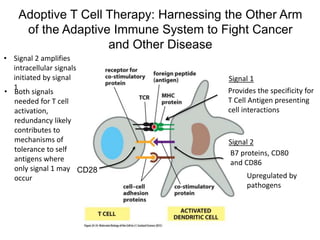
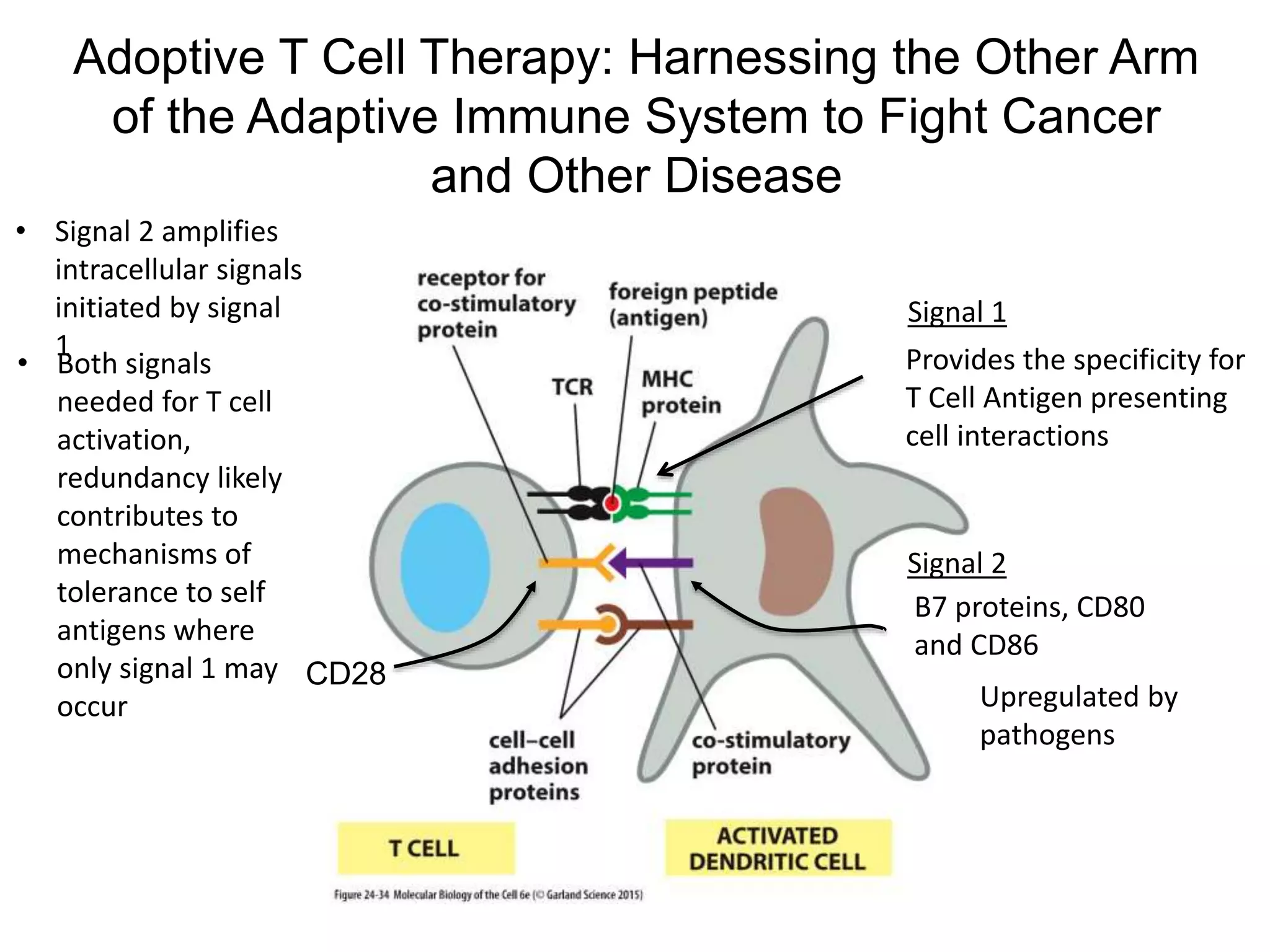
Provides the specificity for
T Cell Antigen presenting
cell interactions
CD28
B7 proteins, CD80
and CD86
Signal 1
Signal 2
• Signal 2 amplifies
intracellular signals
initiated by signal
1
• Both signals
needed for T cell
activation,
redundancy likely
contributes to
mechanisms of
tolerance to self
antigens where
only signal 1 may
occur Upregulated by
pathogens
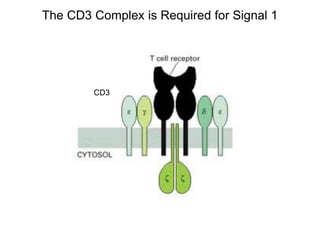
The CD3 Complex is Required for Signal 1
CD3
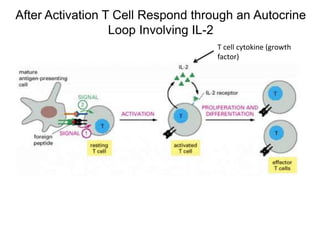
After Activation T Cell Respond through an Autocrine
Loop Involving IL-2
T cell cytokine (growth
factor)
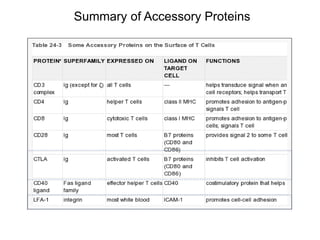
Summary of Accessory Proteins
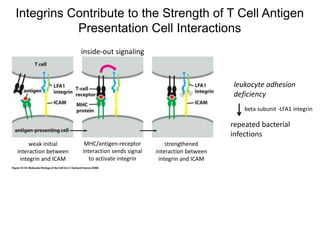
Integrins Contribute to the Strength of T Cell Antigen
Presentation Cell Interactions
weak initial
interaction between
integrin and ICAM
MHC/antigen-receptor
interaction sends signal
to activate integrin
strengthened
interaction between
integrin and ICAM
leukocyte adhesion
deficiency
beta subunit -LFA1 integrin
repeated bacterial
infections
inside-out signaling
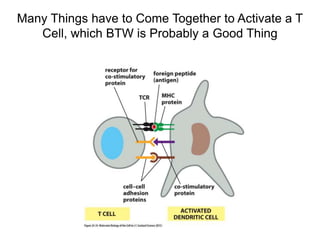
Many Things have to Come Together to Activate a T
Cell, which BTW is Probably a Good Thing
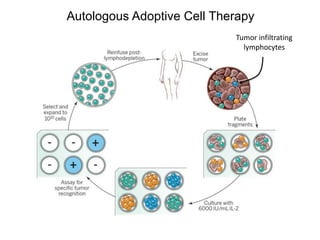
Autologous Adoptive Cell Therapy
Tumor infiltrating
lymphocytes
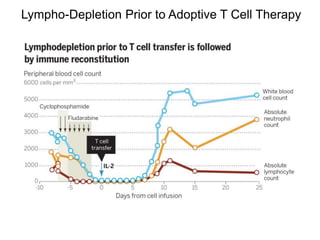
Lympho-Depletion Prior to Adoptive T Cell Therapy
H OH
HOH
O
N
CH
N
C
C
C
N
C
N
HOCH2
H
adenine
arabinose
NH2
F
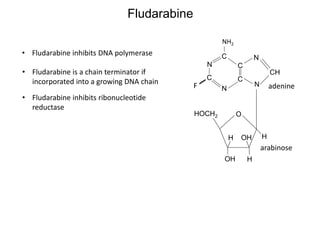
Fludarabine
• Fludarabine inhibits DNA polymerase
• Fludarabine is a chain terminator if
incorporated into a growing DNA chain
• Fludarabine inhibits ribonucleotide
reductase
O
OHOH
BP-P-O-CH2
H H
O
HOH
BP-P-O-CH2
H H
ribonucleotide
reductase
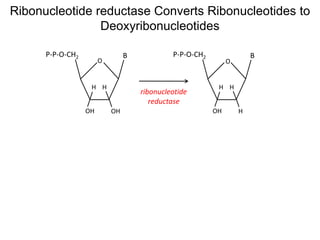
Ribonucleotide reductase Converts Ribonucleotides to
Deoxyribonucleotides
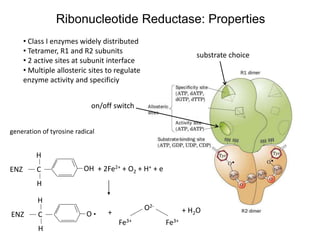
Ribonucleotide Reductase: Properties
• Class I enzymes widely distributed
• Tetramer, R1 and R2 subunits
• 2 active sites at subunit interface
O
OH + 2Fe2+ + O2 + H+ + e
Fe3+
O2-
Fe3+
+ H2O
C
+
H
H
ENZ
C
H
H
ENZ
generation of tyrosine radical
on/off switch
substrate choice
• Multiple allosteric sites to regulate
enzyme activity and specificiy
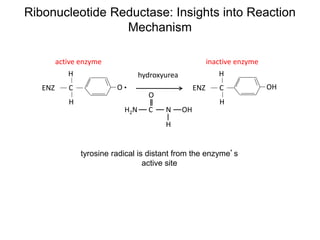
Ribonucleotide Reductase: Insights into Reaction
Mechanism
OC
H
H
ENZ OHC
H
H
ENZ
C N OH
H
O
H2N
hydroxyurea
active enzyme inactive enzyme
tyrosine radical is distant from the enzyme’s
active site
OC
H
H
ENZ
OC
H
H
OC
H
H
OC
H
H
X active site
OC
H
H
ENZ
OC
H
H
OC
H
H
OC
H
H
S active site
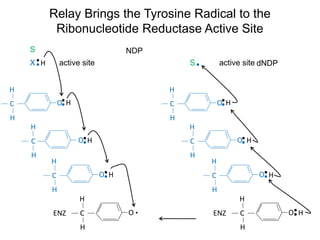
Relay Brings the Tyrosine Radical to the
Ribonucleotide Reductase Active Site
H
H
H
H
H
H
H
H
NDP
dNDP
S
O
OHOH
BP-P-O-CH2
H H
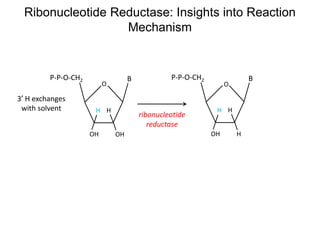
3′ H exchanges
with solvent
Ribonucleotide Reductase: Insights into Reaction
Mechanism
O
HOH
BP-P-O-CH2
H H
ribonucleotide
reductase
freeenergy(G)
reaction progress
S
P
-ΔG (P-S)
activation energy
(uncatalyzed reaction)
activation energy
(catalyzed reaction)
energy state
of substrates
energy state
of products
T*
transition
state
S P
reaction spontaneous
as written
Enzyme Energetics
[ES]
O
OHOH
O
+OH2OH
O
OH
+
O
OH H
O
OH
BP-P-O-CH2
H
H
O
OHOH
BP-P-O-CH2
H H
H H H
H H
Enz-S
Enz-S
E
S H
S H
E
S -
S H
H2O
O
OH
+
H
E
S -
S H
E
S
S
H+
H -
Enz-S H
Enz-S
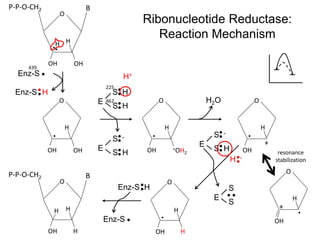
Ribonucleotide Reductase:
Reaction Mechanism
439
225
462
H
resonance
stabilization
754
759
754
759
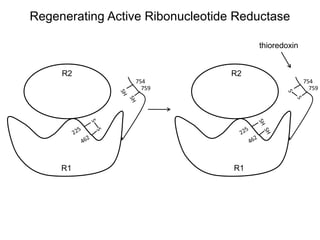
Regenerating Active Ribonucleotide Reductase
R1 R1
R2 R2
thioredoxin
E
S
S
E
S H
S H
NDP
dNDP
225/462
RR
E
S H
S H
E
S
S
754/759
RR
E
S H
S H
E
S
S
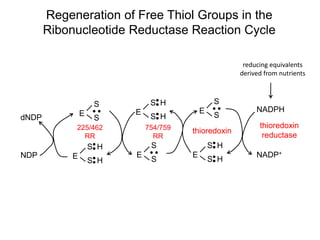
thioredoxin
NADPH
NADP+
thioredoxin
reductase
reducing equivalents
derived from nutrients
Regeneration of Free Thiol Groups in the
Ribonucleotide Reductase Reaction Cycle
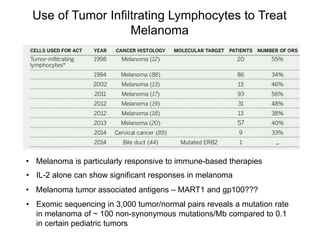
Use of Tumor Infiltrating Lymphocytes to Treat
Melanoma
• Melanoma is particularly responsive to immune-based therapies
• IL-2 alone can show significant responses in melanoma
• Melanoma tumor associated antigens – MART1 and gp100???
• Exomic sequencing in 3,000 tumor/normal pairs reveals a mutation rate
in melanoma of ~ 100 non-synonymous mutations/Mb compared to 0.1
in certain pediatric tumors
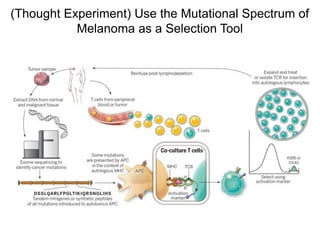
(Thought Experiment) Use the Mutational Spectrum of
Melanoma as a Selection Tool
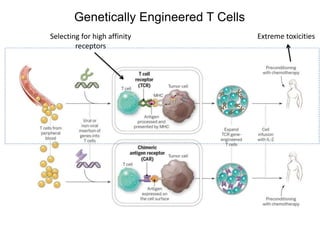
Genetically Engineered T Cells
Selecting for high affinity
receptors
Extreme toxicities
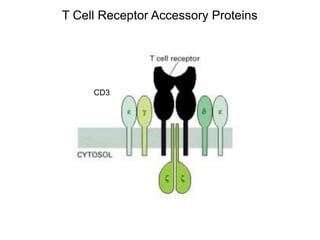
T Cell Receptor Accessory Proteins
CD3
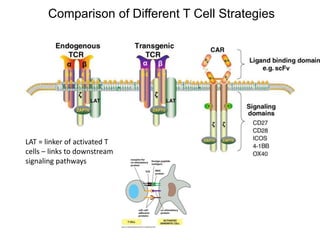
LAT = linker of activated T
cells – links to downstream
signaling pathways
Comparison of Different T Cell Strategies
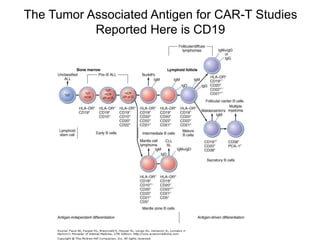
The Tumor Associated Antigen for CAR-T Studies
Reported Here is CD19
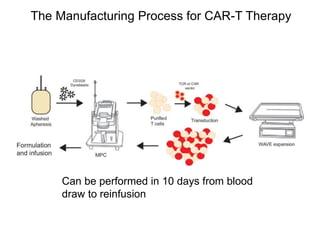
The Manufacturing Process for CAR-T Therapy
Can be performed in 10 days from blood
draw to reinfusion
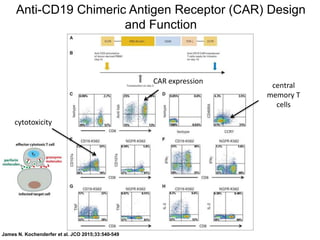
James N. Kochenderfer et al. JCO 2015;33:540-549
CAR expression
central
memory T
cells
cytotoxicity
Anti-CD19 Chimeric Antigen Receptor (CAR) Design
and Function
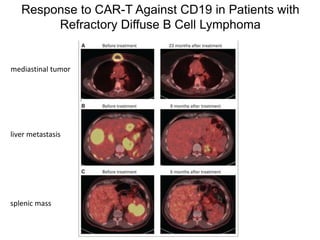
Response to CAR-T Against CD19 in Patients with
Refractory Diffuse B Cell Lymphoma
mediastinal tumor
liver metastasis
splenic mass
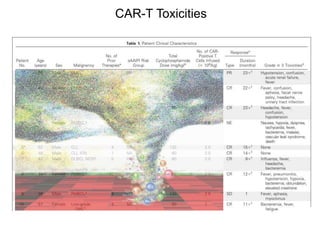
CAR-T Toxicities

adoptive T cell therapy

  • 1.
    Adoptive T CellTherapy: Harnessing the Other Arm of the Adaptive Immune System to Fight Cancer and Other Disease Provides the specificity for T Cell Antigen presenting cell interactions CD28 B7 proteins, CD80 and CD86 Signal 1 Signal 2 • Signal 2 amplifies intracellular signals initiated by signal 1 • Both signals needed for T cell activation, redundancy likely contributes to mechanisms of tolerance to self antigens where only signal 1 may occur Upregulated by pathogens
  • 2.
    The CD3 Complexis Required for Signal 1 CD3
  • 3.
    After Activation TCell Respond through an Autocrine Loop Involving IL-2 T cell cytokine (growth factor)
  • 4.
  • 5.
    Integrins Contribute tothe Strength of T Cell Antigen Presentation Cell Interactions weak initial interaction between integrin and ICAM MHC/antigen-receptor interaction sends signal to activate integrin strengthened interaction between integrin and ICAM leukocyte adhesion deficiency beta subunit -LFA1 integrin repeated bacterial infections inside-out signaling
  • 6.
    Many Things haveto Come Together to Activate a T Cell, which BTW is Probably a Good Thing
  • 7.
    Autologous Adoptive CellTherapy Tumor infiltrating lymphocytes
  • 8.
    Lympho-Depletion Prior toAdoptive T Cell Therapy
  • 9.
    H OH HOH O N CH N C C C N C N HOCH2 H adenine arabinose NH2 F Fludarabine • Fludarabineinhibits DNA polymerase • Fludarabine is a chain terminator if incorporated into a growing DNA chain • Fludarabine inhibits ribonucleotide reductase
  • 10.
    O OHOH BP-P-O-CH2 H H O HOH BP-P-O-CH2 H H ribonucleotide reductase Ribonucleotidereductase Converts Ribonucleotides to Deoxyribonucleotides
  • 11.
    Ribonucleotide Reductase: Properties •Class I enzymes widely distributed • Tetramer, R1 and R2 subunits • 2 active sites at subunit interface O OH + 2Fe2+ + O2 + H+ + e Fe3+ O2- Fe3+ + H2O C + H H ENZ C H H ENZ generation of tyrosine radical on/off switch substrate choice • Multiple allosteric sites to regulate enzyme activity and specificiy
  • 12.
    Ribonucleotide Reductase: Insightsinto Reaction Mechanism OC H H ENZ OHC H H ENZ C N OH H O H2N hydroxyurea active enzyme inactive enzyme tyrosine radical is distant from the enzyme’s active site
  • 13.
    OC H H ENZ OC H H OC H H OC H H X active site OC H H ENZ OC H H OC H H OC H H Sactive site Relay Brings the Tyrosine Radical to the Ribonucleotide Reductase Active Site H H H H H H H H NDP dNDP S
  • 14.
    O OHOH BP-P-O-CH2 H H 3′ Hexchanges with solvent Ribonucleotide Reductase: Insights into Reaction Mechanism O HOH BP-P-O-CH2 H H ribonucleotide reductase
  • 15.
    freeenergy(G) reaction progress S P -ΔG (P-S) activationenergy (uncatalyzed reaction) activation energy (catalyzed reaction) energy state of substrates energy state of products T* transition state S P reaction spontaneous as written Enzyme Energetics [ES]
  • 16.
    O OHOH O +OH2OH O OH + O OH H O OH BP-P-O-CH2 H H O OHOH BP-P-O-CH2 H H HH H H H Enz-S Enz-S E S H S H E S - S H H2O O OH + H E S - S H E S S H+ H - Enz-S H Enz-S Ribonucleotide Reductase: Reaction Mechanism 439 225 462 H resonance stabilization
  • 17.
    754 759 754 759 Regenerating Active RibonucleotideReductase R1 R1 R2 R2 thioredoxin
  • 18.
    E S S E S H S H NDP dNDP 225/462 RR E SH S H E S S 754/759 RR E S H S H E S S thioredoxin NADPH NADP+ thioredoxin reductase reducing equivalents derived from nutrients Regeneration of Free Thiol Groups in the Ribonucleotide Reductase Reaction Cycle
  • 19.
    Use of TumorInfiltrating Lymphocytes to Treat Melanoma • Melanoma is particularly responsive to immune-based therapies • IL-2 alone can show significant responses in melanoma • Melanoma tumor associated antigens – MART1 and gp100??? • Exomic sequencing in 3,000 tumor/normal pairs reveals a mutation rate in melanoma of ~ 100 non-synonymous mutations/Mb compared to 0.1 in certain pediatric tumors
  • 20.
    (Thought Experiment) Usethe Mutational Spectrum of Melanoma as a Selection Tool
  • 21.
    Genetically Engineered TCells Selecting for high affinity receptors Extreme toxicities
  • 22.
    T Cell ReceptorAccessory Proteins CD3
  • 23.
    LAT = linkerof activated T cells – links to downstream signaling pathways Comparison of Different T Cell Strategies
  • 24.
    The Tumor AssociatedAntigen for CAR-T Studies Reported Here is CD19
  • 25.
    The Manufacturing Processfor CAR-T Therapy Can be performed in 10 days from blood draw to reinfusion
  • 26.
    James N. Kochenderferet al. JCO 2015;33:540-549 CAR expression central memory T cells cytotoxicity Anti-CD19 Chimeric Antigen Receptor (CAR) Design and Function
  • 27.
    Response to CAR-TAgainst CD19 in Patients with Refractory Diffuse B Cell Lymphoma mediastinal tumor liver metastasis splenic mass
  • 28.

Editor's Notes

  • #27 Anti-CD19 chimeric antigen receptor (CAR) design and function. (A) Schematic of anti-CD19 CAR. Single-chain (sc) Fv region that recognizes CD19 was derived from FMC63 monoclonal antibody. CAR contained CD28 costimulatory domain and T-cell receptor (TCR) –ζ T-cell activation domain. (B) Anti-CD19 CAR T cells were produced by activating peripheral-blood mononuclear cells (PBMCs) with anti-CD3 antibody OKT3 on day 0 and transducing T cells on day 2. Cells were ready for infusion on day 10. (C) CAR expression on T-cell surface of infused cells of patient No. 1 was detected with anti-Fab antibodies. Isotype control staining of same T cells is also shown. Plots are gated on live CD3+ lymphocytes. (D) Plots show isotype control staining and CD45RA versus CCR7 staining of CD3+ CAR positive–infused cells of patient No. 1. (E) Anti-CD19 CAR-transduced T cells of patient No. 1 were cultured for 4 hours with either CD19-K562 cells expressing CD19 or nerve growth factor receptor (NGFR) –K562 cells not expressing CD19. CAR T cells upregulated CD107a, indicating degranulation, in CD19-specific manner. Plots gated on live CD3+ lymphocytes. Anti-CD19 CAR T cells of patient No. 1 were cultured for 6 hours with CD19-K562 or NGFR-K562 cells, and intracellular cytokine staining for (F) interferon gamma (IFNγ), (G) tumor necrosis factor (TNF), and (H) interleukin-2 (IL-2) was performed. CAR T cells produced cytokines in CD19-specific manner. Plots gated on CD3+ lymphocytes. For (E) to (H), experiments were performed on T cells at time of infusion into patient No. 1. LTR, long terminal repeat.