Principles
of
Tissue Engineering
Dr Roshan V Shetty
Senior Resident In Urology
AJ IMS & RC
Why?
 Organ transplantation remains a mainstay of treatment for
patients with severely compromised organ function.
 Despite initiatives to increase the availability of transplant
organs, however, the number of patients in need of treatment far
exceeds the organ supply, and this shortfall is expected to
worsen as the global population ages.
 One alternative treatment approach is regenerative medicine.
What?
 “An interdisciplinary field of research and clinical applications
focused on repair, replacement or regeneration of cells, tissue
or organs to restore impaired function from any cause(ie.
Congenital defects, disease, trauma, ageing)”
 Combines converging technological approaches, both existing
and newly emerging, moving it beyond traditional
transplantation and replacement therapies.
 Approaches often aim to stimulate and support the body’s own
self healing capacity
How?
 Approaches may include:
 Use of soluble molecules
 Gene therapy
 Stem and progenitor cell therapy
 Tissue engineering
 Reprogramming of cell and tissue types
Regenerative Medicine: Strategies for Tissue
and Organ Reconstitution
 Cell-based therapies
 Biomaterial based therapies
The use of biomaterials (scaffolds) alone, wherein the body’s
natural ability to regenerate is used to orient or direct new tissue
growth)
 Combined (tissue engineering)
The use of scaffolds seeded with cells to create tissue substitutes.
Sources of Cells for Therapy
A. Stem Cells
B. Native Targeted Progenitor Cells
C. Therapeutic Cloning (Somatic Cell Nuclear Transfer)
D. Reprogramming (Induced Pluripotent Stem Cells)
A] Stem Cells
 Defined as having three important properties:
 Ability to self-renew,
 Ability to differentiate into a number of different cell types,
 Ability to easily form clonal populations
 Autologous, Allogenic
Stem Cells
 Three broad categories
 Embryonic stem cells
 Fetal and neonatal amniotic fluid and placenta
 Adult stem cells
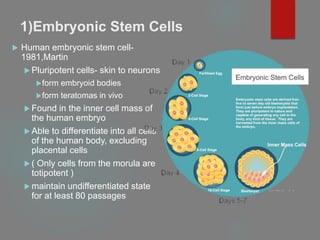
1)Embryonic Stem Cells
 Human embryonic stem cell-
1981,Martin
 Pluripotent cells- skin to neurons
form embryoid bodies
form teratomas in vivo
 Found in the inner cell mass of
the human embryo
 Able to differentiate into all cells
of the human body, excluding
placental cells
 ( Only cells from the morula are
totipotent )
 maintain undifferentiated state
for at least 80 passages
Embryonic Stem Cells
 Ideal resource for regenerative medicine
 Ability to self-renew indefinitely
 Ability to differentiate into cells from all three embryonic germ
layers
 Limited clinical application : Allogenic
 Ethical issues : results in destruction of embryos
Embryonic Stem Cells
Alternate techniques without destroying embryos
 single-cell embryo biopsy
 Arrested embryos
 Altered nuclear transfer
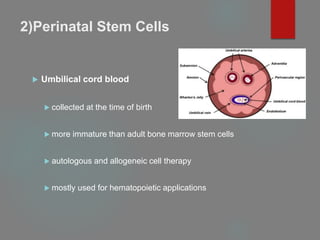
2)Perinatal Stem Cells
 Umbilical cord blood
 collected at the time of birth
 more immature than adult bone marrow stem cells
 autologous and allogeneic cell therapy
 mostly used for hematopoietic applications
Perinatal Stem Cells
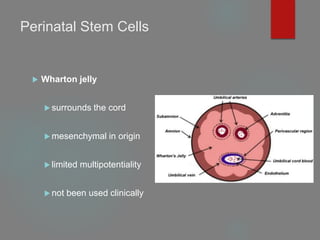
 Wharton jelly
 surrounds the cord
 mesenchymal in origin
 limited multipotentiality
 not been used clinically
Perinatal Stem Cells
Amniotic fluid and placenta
 Capable of extensive self-renewal
 Give rise to cells from all three germ layers
 Properties somewhere between those of embryonic and adult stem
cell
 Do not form teratomas
 For self-use, avoid the problems of rejection
 Obtained either from
Amniocentesis or
Chorionic villous sampling in the developing fetus or
From the placenta at the time of birth.
3)Adult Stem Cells
 Many types of adult stem cells have been identified in organs
throughout the body and are thought to serve as the primary
repair entities for their corresponding organs
 Limited clinical application :
Some cells have very low proliferative capacity in vitro
Functionality is reduced after the cells are cultivated
Isolation of cells has also been problematic
Adult Stem Cells
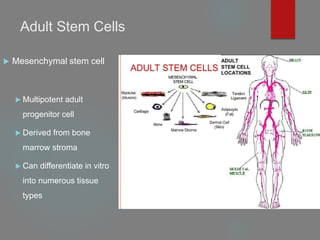
 Mesenchymal stem cell
 Multipotent adult
progenitor cell
 Derived from bone
marrow stroma
 Can differentiate in vitro
into numerous tissue
types
Adult Stem Cells
 Hematopoietic stem cells
 Best understood
 Used for decades for hematopoietic disorders
 Adipose-derived stem cells
 Could give rise to multiple lineages
 Differentiation into urologic cells
 Used experimentally to improve bladder function
 Urine-derived stem cells have also been proposed for
genitourinary reconstruction
B] Native Targeted Progenitor Cells
 Tissue specific unipotent cells derived from most organ
 Already programmed to become the cell type needed, without
any extra-lineage differentiation
 obtained from the specific organ to be regenerated, expanded,
and used in the same patient without rejection
Native Targeted Progenitor Cells
 Exploring the conditions that promote differentiation and/or self-
renewal, it has been possible to overcome some of the obstacles that
limit cell expansion in vitro
donor tissue is dissociated into individual cells
 which are either implanted directly into the host or expanded in culture,
attached to a support matrix, and re-implanted after expansion.
Native Targeted Progenitor Cells
 System of urothelial cell harvesting was developed that does not
use any enzymes or serum.
 Has a large expansion potential
 Possible to expand a urothelial strain from a single specimen
(1cm2)to one covering a surface area of one football field(4202m2)
within 8 weeks.
Native Targeted Progenitor Cells
 Bladder, ureter, and renal pelvis cells can equally be harvested,
cultured, and expanded
 Not all human cells can be grown or expanded in vitro e.g. Liver,
nerve, and pancreas
C] Somatic Cell Nuclear Transfer
 Removal of an oocyte nucleus in culture, followed by its
replacement with a nucleus derived from a somatic cell obtained
from a patient
 Two types of cloning
 Reproductive cloning
 Therapeutic cloning
 Both involve the insertion of donor DNA into an enucleated
oocyte to generate an embryo that has identical genetic material
to its DNA source.
Somatic Cell Nuclear Transfer
Reproductive cloning
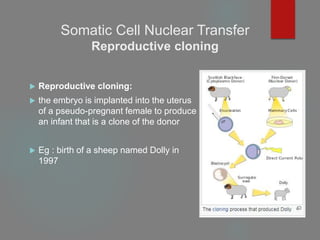
 Reproductive cloning:
 the embryo is implanted into the uterus
of a pseudo-pregnant female to produce
an infant that is a clone of the donor
 Eg : birth of a sheep named Dolly in
1997
Somatic Cell Nuclear Transfer
Therapeutic cloning
 Embryo is used to generate blastocysts that are explanted and
grown in culture rather than in utero
 Embryonic stem cell lines can then be derived from blastocysts,
which are allowed to grow only up to a 100-cell stage
 At this time the inner cell mass is isolated and cultured
 Resulting in embryonic stem cells that are genetically identical
to the patient
Somatic Cell Nuclear Transfer
Therapeutic cloning
 Pluripotent nuclear transferred embryonic stem cells have been
derived from
 fibroblasts,
 lymphocytes,
 olfactory neurons
 perfectly matched to the patient’s immune system and no
immunosuppressants would be required
 However, mitochondrial DNA contained in the oocyte could lead
to immunogenicity after transplantation
Somatic Cell Nuclear Transfer
Therapeutic cloning
 Ethical considerations regarding the potential of the resulting
embryos to develop into cloned embryos
 Limitations that require further improvement
 not been shown to work in humans to date
D] Reprogramming
(Induced Pluripotent Stem Cells)
 Involves de-differentiation of adult somatic cells to produce
patient-specific pluripotent stem cells, eliminating the need to
create embryos
 genetically identical to the somatic cells and would not be
rejected
 iPS cells possessed the characteristics of
 self-renewing embryonic stem cells
 expressed genes specific for embryonic stem cells
 generated embryoid bodies in vitro
 teratomas in vivo
Reprogramming
(Induced Pluripotent Stem Cells)
 Generated human iPS cells are similar to hESCs in terms of
morphology, proliferation, gene expression, surface markers, and
teratoma formation
 Cells have shown great promise in the understanding of human
disease, as well as the use of these cells for therapy.
 Like embryonic stem cells, the iPS cells also form teratomas, and
this has limited their therapeutic potential.
Summary
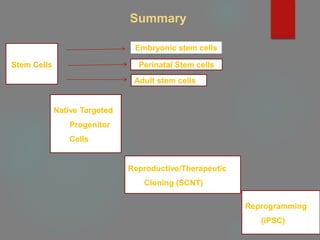
Stem Cells
Reproductive/Therapeutic
Cloning (SCNT)
Reprogramming
(iPSC)
Native Targeted
Progenitor
Cells
Embryonic stem cells
Perinatal Stem cells
Adult stem cells
Biomaterials and Vascularization for
Genitourinary Regenerative Medicine
 Biomaterials function as an artificial ECM and elicit biologic and
mechanical functions of native ECM
 Biomaterials facilitate :
localization and delivery of cells and/or bioactive factors
define a 3D space for formation of new tissues with appropriate
structure
guide development of new tissues with appropriate function
Design and Selection of Biomaterials
 Must be capable of controlling the structure and function of the
engineered tissue in a predesigned manner by interacting with
transplanted cells and/or host cells
 Ideal biomaterial :
 biocompatible
 promote cellular interaction and tissue development
 possess proper mechanical and physical properties
Design and Selection of Biomaterials
Biocompatible
 should be biodegradable and bioresorbable to support the
reconstruction of a completely normal tissue without
inflammation
 degradation rate and the concentration of degradation
products in the tissues surrounding the implant must be at
a tolerable level
Design and Selection of Biomaterials
Promote cellular interaction and tissue development
 should provide an appropriate regulation of cell behavior to
promote the development of functional new tissue
 This is regulated by multiple interactions with the
microenvironment, including interactions with cell adhesion
ligands and with soluble growth factors
Design and Selection of Biomaterials
Promote cellular interaction and tissue development
 provide temporary mechanical support sufficient to withstand in
vivo forces and maintain a potential space for tissue
development
 The mechanical support should be maintained until the
engineered tissue has sufficient mechanical integrity to support
itself
Design and Selection of Biomaterials
Possess proper mechanical and physical properties
 large ratio of surface area to volume is often desirable to allow the
delivery of a high density of cells
 A high-porosity, interconnected pore structure with specific pore
sizes promotes tissue ingrowth from the surrounding host tissue
Types of Biomaterials
 Three classes of biomaterials have been used
Naturally derived materials, such as collagen
Acellular tissue matrices, such as bladder and small-intestinal
submucosa
Synthetic polymers, such as polyglycolic acid (pga), polylactic acid
(pla), and poly(lactic-co-glycolic acid) (plga).
Types of Biomaterials
1) Collagen
 Collagen is the most abundant and ubiquitous structural protein
in the body, and it may be
 Readily purified with an enzyme treatment
 Intermolecular cross-linking reduces the degradation by making
it less susceptible to an enzymatic attack
 Contains cell-adhesion domain sequences that exhibit specific
cellular interactions
Types of Biomaterials
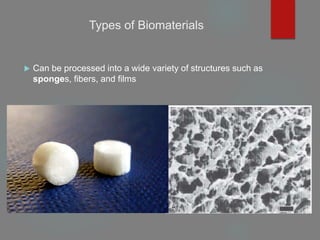
 Can be processed into a wide variety of structures such as
sponges, fibers, and films
Types of Biomaterials
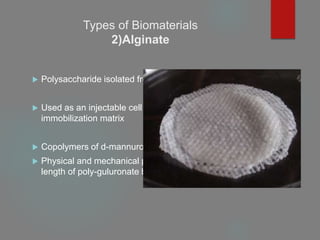
2)Alginate
 Polysaccharide isolated from seaweed
 Used as an injectable cell delivery vehicle and a cell
immobilization matrix
 Copolymers of d-mannuronate and l-guluronate
 Physical and mechanical properties are in proportion to the
length of poly-guluronate block
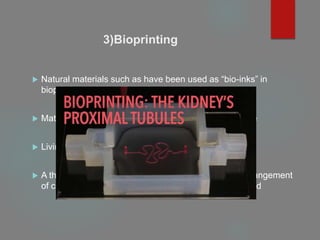
3)Bioprinting
 Natural materials such as have been used as “bio-inks” in
bioprinting technique based on inkjet technology
 Materials can be “printed” into a desired scaffold shape
 Living cells can also be printed using this technology
 A three-dimensional construct containing a precise arrangement
of cells, growth factors, and ecm material can be printed
Types of Biomaterials
4)Acellular tissue matrices
 collagen-rich matrices prepared by removing cellular
components from tissues
 Slowly degrade after implantation and are replaced and
remodeled by ECM proteins synthesized and secreted by
transplanted or ingrowing cells
 Mechanical properties of the acellular matrices are not
significantly different from those of native bladder submucosa
Types of Biomaterials
5)Synthetic polymers
 Polyesters of α-hydroxy acids : PGA, PLA, and PLGA
 Degradation products are nontoxic, natural metabolites that are
eventually eliminated from the body in the form of CO2 and
water
 drawback of the synthetic polymers is lack of biologic
recognition. Needs incorporation of cell recognition domains
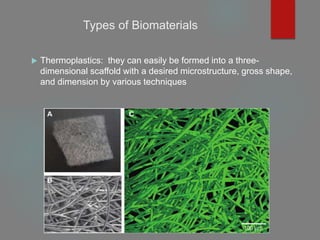
Types of Biomaterials
 Thermoplastics: they can easily be formed into a three-
dimensional scaffold with a desired microstructure, gross shape,
and dimension by various techniques
Vascularization
 A limiting factor for the engineering of tissues is that cells cannot
be implanted in volumes exceeding 3 mm3
 Vascularization of the regenerating cells is essential to provide
nutrition and gas exchange beyond this maximal diffusion
distance
Vascularization
 Two different processes:
 Vasculogenesis, the in situ assembly of capillaries from
undifferentiated endothelial cells (ECs), and
 Angiogenesis, the sprouting of capillaries from preexisting
blood vessels
Vascularization
Vasculogenesis
 ECs are generated from precursor cells, called angioblasts,
 ECs form the vessel primordia and aggregates, have no lumen;
 a nascent endothelial tube is formed, composed of polarized
ECs;
 a primary vascular network is formed from an array of nascent
endothelial tubes; and
 pericytes and vascular smooth muscle cells are recruited
Vascularization
Angiogenesis
 vasodilatation of the parental vessel, reducing the contact
between adjacent ECs;
 degradation of the basement membrane
 EC migration and proliferation to form a leading edge of the new
capillary;
 generation of the capillary lumen and formation of a tube like
structure;
 basement membrane synthesis; and
 recruitment of pericytes and vascular smooth muscle cells
Vascularization
 Three approaches
 incorporation of angiogenic factors before implantation, to attract
host capillaries and to enhance neovascularization
 seeding ECs with other cell types in before implantation eg.
smooth muscle cells and Ecs in penile corporeal tissue
 Pre-vascularization of the matrix before cell seeding to form vascular
network, providing sufficient tissue perfusion
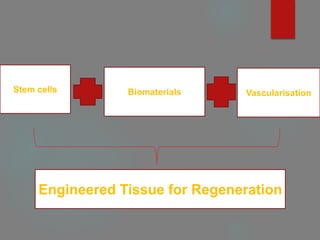
Stem cells Biomaterials Vascularisation
Engineered Tissue for Regeneration
Thank You !

#1 principles of tissue engineering

  • 1.
    Principles of Tissue Engineering Dr RoshanV Shetty Senior Resident In Urology AJ IMS & RC
  • 2.
    Why?  Organ transplantationremains a mainstay of treatment for patients with severely compromised organ function.  Despite initiatives to increase the availability of transplant organs, however, the number of patients in need of treatment far exceeds the organ supply, and this shortfall is expected to worsen as the global population ages.  One alternative treatment approach is regenerative medicine.
  • 3.
    What?  “An interdisciplinaryfield of research and clinical applications focused on repair, replacement or regeneration of cells, tissue or organs to restore impaired function from any cause(ie. Congenital defects, disease, trauma, ageing)”  Combines converging technological approaches, both existing and newly emerging, moving it beyond traditional transplantation and replacement therapies.  Approaches often aim to stimulate and support the body’s own self healing capacity
  • 4.
    How?  Approaches mayinclude:  Use of soluble molecules  Gene therapy  Stem and progenitor cell therapy  Tissue engineering  Reprogramming of cell and tissue types
  • 5.
    Regenerative Medicine: Strategiesfor Tissue and Organ Reconstitution  Cell-based therapies  Biomaterial based therapies The use of biomaterials (scaffolds) alone, wherein the body’s natural ability to regenerate is used to orient or direct new tissue growth)  Combined (tissue engineering) The use of scaffolds seeded with cells to create tissue substitutes.
  • 6.
    Sources of Cellsfor Therapy A. Stem Cells B. Native Targeted Progenitor Cells C. Therapeutic Cloning (Somatic Cell Nuclear Transfer) D. Reprogramming (Induced Pluripotent Stem Cells)
  • 7.
    A] Stem Cells Defined as having three important properties:  Ability to self-renew,  Ability to differentiate into a number of different cell types,  Ability to easily form clonal populations  Autologous, Allogenic
  • 8.
    Stem Cells  Threebroad categories  Embryonic stem cells  Fetal and neonatal amniotic fluid and placenta  Adult stem cells
  • 9.
    1)Embryonic Stem Cells Human embryonic stem cell- 1981,Martin  Pluripotent cells- skin to neurons form embryoid bodies form teratomas in vivo  Found in the inner cell mass of the human embryo  Able to differentiate into all cells of the human body, excluding placental cells  ( Only cells from the morula are totipotent )  maintain undifferentiated state for at least 80 passages
  • 10.
    Embryonic Stem Cells Ideal resource for regenerative medicine  Ability to self-renew indefinitely  Ability to differentiate into cells from all three embryonic germ layers  Limited clinical application : Allogenic  Ethical issues : results in destruction of embryos
  • 11.
    Embryonic Stem Cells Alternatetechniques without destroying embryos  single-cell embryo biopsy  Arrested embryos  Altered nuclear transfer
  • 12.
    2)Perinatal Stem Cells Umbilical cord blood  collected at the time of birth  more immature than adult bone marrow stem cells  autologous and allogeneic cell therapy  mostly used for hematopoietic applications
  • 13.
    Perinatal Stem Cells Wharton jelly  surrounds the cord  mesenchymal in origin  limited multipotentiality  not been used clinically
  • 14.
    Perinatal Stem Cells Amnioticfluid and placenta  Capable of extensive self-renewal  Give rise to cells from all three germ layers  Properties somewhere between those of embryonic and adult stem cell  Do not form teratomas  For self-use, avoid the problems of rejection  Obtained either from Amniocentesis or Chorionic villous sampling in the developing fetus or From the placenta at the time of birth.
  • 15.
    3)Adult Stem Cells Many types of adult stem cells have been identified in organs throughout the body and are thought to serve as the primary repair entities for their corresponding organs  Limited clinical application : Some cells have very low proliferative capacity in vitro Functionality is reduced after the cells are cultivated Isolation of cells has also been problematic
  • 16.
    Adult Stem Cells Mesenchymal stem cell  Multipotent adult progenitor cell  Derived from bone marrow stroma  Can differentiate in vitro into numerous tissue types
  • 17.
    Adult Stem Cells Hematopoietic stem cells  Best understood  Used for decades for hematopoietic disorders  Adipose-derived stem cells  Could give rise to multiple lineages  Differentiation into urologic cells  Used experimentally to improve bladder function  Urine-derived stem cells have also been proposed for genitourinary reconstruction
  • 18.
    B] Native TargetedProgenitor Cells  Tissue specific unipotent cells derived from most organ  Already programmed to become the cell type needed, without any extra-lineage differentiation  obtained from the specific organ to be regenerated, expanded, and used in the same patient without rejection
  • 19.
    Native Targeted ProgenitorCells  Exploring the conditions that promote differentiation and/or self- renewal, it has been possible to overcome some of the obstacles that limit cell expansion in vitro donor tissue is dissociated into individual cells  which are either implanted directly into the host or expanded in culture, attached to a support matrix, and re-implanted after expansion.
  • 20.
    Native Targeted ProgenitorCells  System of urothelial cell harvesting was developed that does not use any enzymes or serum.  Has a large expansion potential  Possible to expand a urothelial strain from a single specimen (1cm2)to one covering a surface area of one football field(4202m2) within 8 weeks.
  • 21.
    Native Targeted ProgenitorCells  Bladder, ureter, and renal pelvis cells can equally be harvested, cultured, and expanded  Not all human cells can be grown or expanded in vitro e.g. Liver, nerve, and pancreas
  • 22.
    C] Somatic CellNuclear Transfer  Removal of an oocyte nucleus in culture, followed by its replacement with a nucleus derived from a somatic cell obtained from a patient  Two types of cloning  Reproductive cloning  Therapeutic cloning  Both involve the insertion of donor DNA into an enucleated oocyte to generate an embryo that has identical genetic material to its DNA source.
  • 23.
    Somatic Cell NuclearTransfer Reproductive cloning  Reproductive cloning:  the embryo is implanted into the uterus of a pseudo-pregnant female to produce an infant that is a clone of the donor  Eg : birth of a sheep named Dolly in 1997
  • 24.
    Somatic Cell NuclearTransfer Therapeutic cloning  Embryo is used to generate blastocysts that are explanted and grown in culture rather than in utero  Embryonic stem cell lines can then be derived from blastocysts, which are allowed to grow only up to a 100-cell stage  At this time the inner cell mass is isolated and cultured  Resulting in embryonic stem cells that are genetically identical to the patient
  • 25.
    Somatic Cell NuclearTransfer Therapeutic cloning  Pluripotent nuclear transferred embryonic stem cells have been derived from  fibroblasts,  lymphocytes,  olfactory neurons  perfectly matched to the patient’s immune system and no immunosuppressants would be required  However, mitochondrial DNA contained in the oocyte could lead to immunogenicity after transplantation
  • 26.
    Somatic Cell NuclearTransfer Therapeutic cloning  Ethical considerations regarding the potential of the resulting embryos to develop into cloned embryos  Limitations that require further improvement  not been shown to work in humans to date
  • 27.
    D] Reprogramming (Induced PluripotentStem Cells)  Involves de-differentiation of adult somatic cells to produce patient-specific pluripotent stem cells, eliminating the need to create embryos  genetically identical to the somatic cells and would not be rejected  iPS cells possessed the characteristics of  self-renewing embryonic stem cells  expressed genes specific for embryonic stem cells  generated embryoid bodies in vitro  teratomas in vivo
  • 28.
    Reprogramming (Induced Pluripotent StemCells)  Generated human iPS cells are similar to hESCs in terms of morphology, proliferation, gene expression, surface markers, and teratoma formation  Cells have shown great promise in the understanding of human disease, as well as the use of these cells for therapy.  Like embryonic stem cells, the iPS cells also form teratomas, and this has limited their therapeutic potential.
  • 29.
    Summary Stem Cells Reproductive/Therapeutic Cloning (SCNT) Reprogramming (iPSC) NativeTargeted Progenitor Cells Embryonic stem cells Perinatal Stem cells Adult stem cells
  • 30.
    Biomaterials and Vascularizationfor Genitourinary Regenerative Medicine  Biomaterials function as an artificial ECM and elicit biologic and mechanical functions of native ECM  Biomaterials facilitate : localization and delivery of cells and/or bioactive factors define a 3D space for formation of new tissues with appropriate structure guide development of new tissues with appropriate function
  • 31.
    Design and Selectionof Biomaterials  Must be capable of controlling the structure and function of the engineered tissue in a predesigned manner by interacting with transplanted cells and/or host cells  Ideal biomaterial :  biocompatible  promote cellular interaction and tissue development  possess proper mechanical and physical properties
  • 32.
    Design and Selectionof Biomaterials Biocompatible  should be biodegradable and bioresorbable to support the reconstruction of a completely normal tissue without inflammation  degradation rate and the concentration of degradation products in the tissues surrounding the implant must be at a tolerable level
  • 33.
    Design and Selectionof Biomaterials Promote cellular interaction and tissue development  should provide an appropriate regulation of cell behavior to promote the development of functional new tissue  This is regulated by multiple interactions with the microenvironment, including interactions with cell adhesion ligands and with soluble growth factors
  • 34.
    Design and Selectionof Biomaterials Promote cellular interaction and tissue development  provide temporary mechanical support sufficient to withstand in vivo forces and maintain a potential space for tissue development  The mechanical support should be maintained until the engineered tissue has sufficient mechanical integrity to support itself
  • 35.
    Design and Selectionof Biomaterials Possess proper mechanical and physical properties  large ratio of surface area to volume is often desirable to allow the delivery of a high density of cells  A high-porosity, interconnected pore structure with specific pore sizes promotes tissue ingrowth from the surrounding host tissue
  • 36.
    Types of Biomaterials Three classes of biomaterials have been used Naturally derived materials, such as collagen Acellular tissue matrices, such as bladder and small-intestinal submucosa Synthetic polymers, such as polyglycolic acid (pga), polylactic acid (pla), and poly(lactic-co-glycolic acid) (plga).
  • 37.
    Types of Biomaterials 1)Collagen  Collagen is the most abundant and ubiquitous structural protein in the body, and it may be  Readily purified with an enzyme treatment  Intermolecular cross-linking reduces the degradation by making it less susceptible to an enzymatic attack  Contains cell-adhesion domain sequences that exhibit specific cellular interactions
  • 38.
    Types of Biomaterials Can be processed into a wide variety of structures such as sponges, fibers, and films
  • 39.
    Types of Biomaterials 2)Alginate Polysaccharide isolated from seaweed  Used as an injectable cell delivery vehicle and a cell immobilization matrix  Copolymers of d-mannuronate and l-guluronate  Physical and mechanical properties are in proportion to the length of poly-guluronate block
  • 40.
    3)Bioprinting  Natural materialssuch as have been used as “bio-inks” in bioprinting technique based on inkjet technology  Materials can be “printed” into a desired scaffold shape  Living cells can also be printed using this technology  A three-dimensional construct containing a precise arrangement of cells, growth factors, and ecm material can be printed
  • 41.
    Types of Biomaterials 4)Acellulartissue matrices  collagen-rich matrices prepared by removing cellular components from tissues  Slowly degrade after implantation and are replaced and remodeled by ECM proteins synthesized and secreted by transplanted or ingrowing cells  Mechanical properties of the acellular matrices are not significantly different from those of native bladder submucosa
  • 42.
    Types of Biomaterials 5)Syntheticpolymers  Polyesters of α-hydroxy acids : PGA, PLA, and PLGA  Degradation products are nontoxic, natural metabolites that are eventually eliminated from the body in the form of CO2 and water  drawback of the synthetic polymers is lack of biologic recognition. Needs incorporation of cell recognition domains
  • 43.
    Types of Biomaterials Thermoplastics: they can easily be formed into a three- dimensional scaffold with a desired microstructure, gross shape, and dimension by various techniques
  • 44.
    Vascularization  A limitingfactor for the engineering of tissues is that cells cannot be implanted in volumes exceeding 3 mm3  Vascularization of the regenerating cells is essential to provide nutrition and gas exchange beyond this maximal diffusion distance
  • 45.
    Vascularization  Two differentprocesses:  Vasculogenesis, the in situ assembly of capillaries from undifferentiated endothelial cells (ECs), and  Angiogenesis, the sprouting of capillaries from preexisting blood vessels
  • 46.
    Vascularization Vasculogenesis  ECs aregenerated from precursor cells, called angioblasts,  ECs form the vessel primordia and aggregates, have no lumen;  a nascent endothelial tube is formed, composed of polarized ECs;  a primary vascular network is formed from an array of nascent endothelial tubes; and  pericytes and vascular smooth muscle cells are recruited
  • 47.
    Vascularization Angiogenesis  vasodilatation ofthe parental vessel, reducing the contact between adjacent ECs;  degradation of the basement membrane  EC migration and proliferation to form a leading edge of the new capillary;  generation of the capillary lumen and formation of a tube like structure;  basement membrane synthesis; and  recruitment of pericytes and vascular smooth muscle cells
  • 48.
    Vascularization  Three approaches incorporation of angiogenic factors before implantation, to attract host capillaries and to enhance neovascularization  seeding ECs with other cell types in before implantation eg. smooth muscle cells and Ecs in penile corporeal tissue  Pre-vascularization of the matrix before cell seeding to form vascular network, providing sufficient tissue perfusion
  • 49.
    Stem cells BiomaterialsVascularisation Engineered Tissue for Regeneration
  • 50.