A Covance White Paper
Cellular & Gene Therapy Defined
Cell therapy is defined as the administration of live
whole cells or maturation of a specific cell population
in a patient for the treatment of a disease.
Gene therapy is defined as a set of strategies that
modify the expression of an individual’s genes or that
correct abnormal genes. Each strategy involves the
administration of a specific DNA (or RNA).
However…several diseases benefit most from
treatments that combine the technologies of cell and
gene therapy.
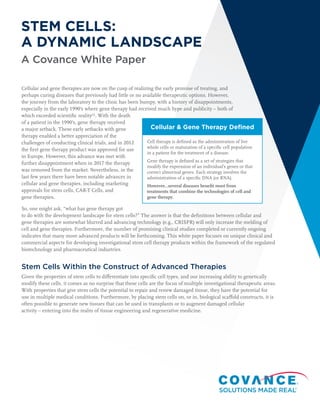
STEM CELLS:
A DYNAMIC LANDSCAPE
Cellular and gene therapies are now on the cusp of realizing the early promise of treating, and
perhaps curing diseases that previously had little or no available therapeutic options. However,
the journey from the laboratory to the clinic has been bumpy, with a history of disappointments,
especially in the early 1990’s where gene therapy had received much hype and publicity – both of
which exceeded scientific reality(1)
. With the death
of a patient in the 1990’s, gene therapy received
a major setback. These early setbacks with gene
therapy enabled a better appreciation of the
challenges of conducting clinical trials, and in 2012
the first gene therapy product was approved for use
in Europe. However, this advance was met with
further disappointment when in 2017 the therapy
was removed from the market. Nevertheless, in the
last few years there have been notable advances in
cellular and gene therapies, including marketing
approvals for stem cells, CAR-T Cells, and
gene therapies.
So, one might ask, “what has gene therapy got
to do with the development landscape for stem cells?” The answer is that the definitions between cellular and
gene therapies are somewhat blurred and advancing technology (e.g., CRISPR) will only increase the melding of
cell and gene therapies. Furthermore, the number of promising clinical studies completed or currently ongoing
indicates that many more advanced products will be forthcoming. This white paper focuses on unique clinical and
commercial aspects for developing investigational stem cell therapy products within the framework of the regulated
biotechnology and pharmaceutical industries.
Stem Cells Within the Construct of Advanced Therapies
Given the properties of stem cells to differentiate into specific cell types, and our increasing ability to genetically
modify these cells, it comes as no surprise that these cells are the focus of multiple investigational therapeutic areas.
With properties that give stem cells the potential to repair and renew damaged tissue, they have the potential for
use in multiple medical conditions. Furthermore, by placing stem cells on, or in, biological scaffold constructs, it is
often possible to generate new tissues that can be used in transplants or to augment damaged cellular
activity – entering into the realm of tissue engineering and regenerative medicine.
For global health authorities, development of
cellular and gene therapies has necessitated
a rapid progression of dynamic constructs to
best regulate their path to marketing approval.
In the U.S., passage of the 21st Century Cures
Act in December 2016 ushered in a number of
measures to accelerate development of advanced
therapies, including stem cell therapies. In
Japan, the Modernization Act dramatically
lowered the bar for marketing approval for
regenerative therapies, and in the EU there is a
mechanism for faster development through an
Advanced Therapy Medicinal Product (ATMP)
designation. Most other geographies have
similarly adopted pathways to accommodate the
rapidly growing fields of advanced therapies.
Manufacturing & Quality
Issues for Stem Cells
Production of stem cells falls under stringent quality control requirements. These requirements include validated
measurements of purity, potency, efficacy and stability. For stem cells these measures are not well defined.
Regulators continue to tweak manufacturing guidelines, but the industry as a whole sees these issues as major
financial burdens. Scale up from laboratory to commercial/clinical trial use is also a challenge. This is particularly so
for manufacturing differences for allogeneic cells between different geographies, but also raises serious commercial
issues for autologous stem cells.
Advancing Stem Cell Therapies to Market – Maximizing ROIC
Interestingly, health authorities on a global basis have already developed expedited development pathways for
important and lifesaving therapies. Such pathways include Fast Track and Breakthrough Therapy in the U.S.,
adaptive pathways in Europe, as well as opportunities to market the product using accelerated and conditional
approvals, followed by post-marketing commitments to attain full marketing approval. Such pathways have been
supplemented for regenerative medicine with such initiatives as the “Regenerative Medicine Advanced Therapy
(RMAT)” designation in the U.S. and the ATMP designation in Europe. All of these pathways are designed to provide
effective stem cell therapies to patients as quickly as possible – potentially they also enable generation revenue at an
earlier stage that will maximize the return on invested capital (ROIC). This can then be used to encourage further
research and development. For example, a number of stem cell products have been approved for marketing in Japan
under a conditional marketing approval with an expectation of confirmatory clinical studies during the post-approval
period. Interestingly, reimbursement for these stem cell therapies does not seem to be an issue following these
conditional marketing approvals.
Clinical Studies with Stem Cells
As with all biological therapies, a great deal of effort is applied to ensuring the purity, viability and stability of the
product. Furthermore, shipment of these products for clinical investigation usually requires refrigeration and
temperature measurements along the way to rule out excursions from the safe storage requirements. Many of these
Examples Stem Cell Sources
Stem cells are cells that can duplicate themselves and
differentiate into cell types found in the body.
Embryonic stem (ES) cells can transform into any
cell type found in the body and this gives rise to the
term, “pluripotent” cells. Human ES cells are obtained
from pre-implantation embryos, created using in vitro
fertilization.
Completely different pluripotent stem cells can be
derived from fully differentiated cells. These pluripotent
cells are called induced pluripotent stem cells (iPSC).
There are yet other cell types that only differentiate into
specific cell types, e.g. mesenchymal adult cells from
bone marrow, which differentiate into cartilage and other
connective tissues.
products require shipment at very cold temperatures (e.g., -80°C) so the logistics of providing clinical
trial material can be complex. In addition, stem cells product requires the overlap of GCP and GMP at
the site of administration. The impact of combining these two highly regulated activities becomes an
integral clinical protocol inclusion and requires careful training of clinical trial investigator.
Aside from ensuring the viability of the cells prior to administration, there is also an additional emphasis
on tracking the cells after administration. The ability of the cells to transform has on some occasions led to
tumor growth, although for cardiovascular studies (one of the major uses of stem cells) there appears to be
no evidence of this phenomenon. Fortunately, imaging technology and fluorescent biomarkers have enabled
substantial advances in this area. There can also be additional safety issues related to stem cell distribution
following administration (e.g., mesenchymal cells being trapped in lungs following intravenous administration).
Administration of stem cells to the desired site of action also appears to be an evolving issue in stem cell studies.
Many clinical studies have been conducted where the stem cells have been administered via a peripheral vein with the
expectation that the cells will migrate to the damaged tissue (2, 3)
. This now appears to have been an overly optimistic
approach. Indeed, a recent editorial suggested that this approach has led to many failures within the stem cell
therapeutic space. However, injection of stem cells directly into tissues (e.g., cardiac injection, or via portal vein in
damaged livers) appears to also be fraught with challenges. While detailed evidence is difficult to quantify, it seems that
many stem cells simply pour back through the needle track of cardiac tissue upon withdrawal of the needle, or in the
case of the liver, simply distribute throughout the body. The inability to place cells at the site of action with any degree
of consistency might be one reason that results have been positive in some studies and neutral in others. The advent of
bio-gels and scaffolds to keep stem cells where they are supposed to be is likely to be a useful development.
Another approach to confining stem cells within a location is by the use of bioprinting. With 3-D printing technology,
tissues are created outside of the body and then surgically implanted. Examples of 3-D printing with stem cells include
cartilage and bone, but there are many more tissues under investigation. These types of tissue-engineered products
derived from stem cells can be classified as biologics, devices, or combinations of both – a challenge for both regulators
and sponsors.
Pricing, Commercialization & Valuations
Stem cell therapy has the potential to treat the underlying cause of the disease – regrowth of neurons or repair of
damaged myocardium – which is very unlike many traditional drug products. But, what price for “cure”? To date this
has not proven to be a quantifiable paradigm since “cure” has not been achieved with stem cells. Perhaps we can take
examples from conditional approvals of stem cell products in Japan where efficacy has yet to be proven in post-approval
studies. However, even in these cases treatments are costing around $10,000 for a bag of infused cells or around $75,000
for a complete cycle of treatment. Another example would be from the recently approved CAR-T cell therapies in
oncology. While not stem cells, this form of cell therapy commands a cost of around $475,000 in the U.S.
Until we accumulate experience with more commercial stem cell products, it will be difficult to determine where
pricing will ultimately fall. However, until then, valuations for stem cell companies will continue to be approximated
based on contractual values from mergers and acquisitions(4)
. Needless to say, the market for stem cell companies with
promising products remains active, with large pharma and private equity investing billions of dollars. This trend seems
likely to continue.
Learn & Confirm…
In 1997 Sheiner published a seminal paper entitled, “Learning Versus Confirming in Clinical Drug
Development”(5)
. The subject of this paper related to the question of whether there was a better way of
conducting clinical trials. While the paper was not directed to clinical trials using stem cells, there is much
to be considered within this concept with regard to developing stem cells as therapies. Specifically for stem
cell development, one size will never fit all, and the successful development program will need to incorporate
contemporary viewpoints of all the stakeholders – scientists, regulators, patients, and payers. With explosive
growth in our knowledge of cell and gene therapies, it appears regenerative medicine products are reaching the
threshold for safely treating many serious unmet medical conditions - and that’s good news for patients.
References
Please note the following references are intended to be illustrative, and not exhaustive
1. McKay. Stem cells – hype and hope. 2000, Nature, 406;361-364
2. Nguyen et al. Potential strategies to address the major clinical barriers facing stem cell regenerative therapy
for cardiovascular disease. 2016, JAMA Cardiology, 1(18);953-962
3. Wang et al. Molecular imaging of stem cell transplantation for liver diseases: Monitoring, clinical translation,
and theranostics. 2016, Stem Cells International, Article ID 40586556, 8 pages
4. Caplan et al. The 3Rs of cell therapy. 2017, Stem Cell Translational Medicine, 6;17-21
5. Sheiner, LB. Learning versus confirming in clinical drug development. 1997. Clin Pharmacol Ther, 61(3);275-291
Our Advance Therapies Group
Covance has been involved in studies in cell and gene therapy for over 20 years. As a full spectrum drug development
company, these activities include studies in the nonclinical space as well as execution of clinical trials in multiple
therapeutic areas. With experienced strategic product development consultants, we also seek to maximize the value
of assets across global geographies. In addition Our Advanced Therapies Group (ATG) brings together subject matter
experts from across the entire Covance/LabCorp organization. This group has experience in academia, pharma, biotech
and the CRO industry – they understand the importance of time and flexibility in approach. The goal of the ATG is to
maximize the probability of success, create value and provide excellence in developing advanced therapies.
If you would like to discuss whether Covance’s Advanced Therapies Group can create value for your project, please contact:
Richard N. Williams, PhD, JD
Executive Strategist
Global Regulatory Affairs Clinical Strategy
940.205.9842
richard.williams@covance.com
Learn more about our drug development solutions at www.covance.com
Covance Inc., headquartered in Princeton, NJ, USA, is the drug development business of Laboratory
Corporation of America Holdings (LabCorp). COVANCE is a registered trademark and the
marketing name for Covance Inc. and its subsidiaries around the world.
The Americas +1.888.COVANCE (+1.888.268.2623)  +1.609.452.4440
Europe / Africa  +00.800.2682.2682 +44.1423.500888
Asia Pacific  +800.6568.3000 +65.6.5686588
© Copyright 2018 Covance Inc. WPCDS027-0118

Stem Cells: A Dynamic Landscape

  • 1.
    A Covance WhitePaper Cellular & Gene Therapy Defined Cell therapy is defined as the administration of live whole cells or maturation of a specific cell population in a patient for the treatment of a disease. Gene therapy is defined as a set of strategies that modify the expression of an individual’s genes or that correct abnormal genes. Each strategy involves the administration of a specific DNA (or RNA). However…several diseases benefit most from treatments that combine the technologies of cell and gene therapy. STEM CELLS: A DYNAMIC LANDSCAPE Cellular and gene therapies are now on the cusp of realizing the early promise of treating, and perhaps curing diseases that previously had little or no available therapeutic options. However, the journey from the laboratory to the clinic has been bumpy, with a history of disappointments, especially in the early 1990’s where gene therapy had received much hype and publicity – both of which exceeded scientific reality(1) . With the death of a patient in the 1990’s, gene therapy received a major setback. These early setbacks with gene therapy enabled a better appreciation of the challenges of conducting clinical trials, and in 2012 the first gene therapy product was approved for use in Europe. However, this advance was met with further disappointment when in 2017 the therapy was removed from the market. Nevertheless, in the last few years there have been notable advances in cellular and gene therapies, including marketing approvals for stem cells, CAR-T Cells, and gene therapies. So, one might ask, “what has gene therapy got to do with the development landscape for stem cells?” The answer is that the definitions between cellular and gene therapies are somewhat blurred and advancing technology (e.g., CRISPR) will only increase the melding of cell and gene therapies. Furthermore, the number of promising clinical studies completed or currently ongoing indicates that many more advanced products will be forthcoming. This white paper focuses on unique clinical and commercial aspects for developing investigational stem cell therapy products within the framework of the regulated biotechnology and pharmaceutical industries. Stem Cells Within the Construct of Advanced Therapies Given the properties of stem cells to differentiate into specific cell types, and our increasing ability to genetically modify these cells, it comes as no surprise that these cells are the focus of multiple investigational therapeutic areas. With properties that give stem cells the potential to repair and renew damaged tissue, they have the potential for use in multiple medical conditions. Furthermore, by placing stem cells on, or in, biological scaffold constructs, it is often possible to generate new tissues that can be used in transplants or to augment damaged cellular activity – entering into the realm of tissue engineering and regenerative medicine.
  • 2.
    For global healthauthorities, development of cellular and gene therapies has necessitated a rapid progression of dynamic constructs to best regulate their path to marketing approval. In the U.S., passage of the 21st Century Cures Act in December 2016 ushered in a number of measures to accelerate development of advanced therapies, including stem cell therapies. In Japan, the Modernization Act dramatically lowered the bar for marketing approval for regenerative therapies, and in the EU there is a mechanism for faster development through an Advanced Therapy Medicinal Product (ATMP) designation. Most other geographies have similarly adopted pathways to accommodate the rapidly growing fields of advanced therapies. Manufacturing & Quality Issues for Stem Cells Production of stem cells falls under stringent quality control requirements. These requirements include validated measurements of purity, potency, efficacy and stability. For stem cells these measures are not well defined. Regulators continue to tweak manufacturing guidelines, but the industry as a whole sees these issues as major financial burdens. Scale up from laboratory to commercial/clinical trial use is also a challenge. This is particularly so for manufacturing differences for allogeneic cells between different geographies, but also raises serious commercial issues for autologous stem cells. Advancing Stem Cell Therapies to Market – Maximizing ROIC Interestingly, health authorities on a global basis have already developed expedited development pathways for important and lifesaving therapies. Such pathways include Fast Track and Breakthrough Therapy in the U.S., adaptive pathways in Europe, as well as opportunities to market the product using accelerated and conditional approvals, followed by post-marketing commitments to attain full marketing approval. Such pathways have been supplemented for regenerative medicine with such initiatives as the “Regenerative Medicine Advanced Therapy (RMAT)” designation in the U.S. and the ATMP designation in Europe. All of these pathways are designed to provide effective stem cell therapies to patients as quickly as possible – potentially they also enable generation revenue at an earlier stage that will maximize the return on invested capital (ROIC). This can then be used to encourage further research and development. For example, a number of stem cell products have been approved for marketing in Japan under a conditional marketing approval with an expectation of confirmatory clinical studies during the post-approval period. Interestingly, reimbursement for these stem cell therapies does not seem to be an issue following these conditional marketing approvals. Clinical Studies with Stem Cells As with all biological therapies, a great deal of effort is applied to ensuring the purity, viability and stability of the product. Furthermore, shipment of these products for clinical investigation usually requires refrigeration and temperature measurements along the way to rule out excursions from the safe storage requirements. Many of these Examples Stem Cell Sources Stem cells are cells that can duplicate themselves and differentiate into cell types found in the body. Embryonic stem (ES) cells can transform into any cell type found in the body and this gives rise to the term, “pluripotent” cells. Human ES cells are obtained from pre-implantation embryos, created using in vitro fertilization. Completely different pluripotent stem cells can be derived from fully differentiated cells. These pluripotent cells are called induced pluripotent stem cells (iPSC). There are yet other cell types that only differentiate into specific cell types, e.g. mesenchymal adult cells from bone marrow, which differentiate into cartilage and other connective tissues.
  • 3.
    products require shipmentat very cold temperatures (e.g., -80°C) so the logistics of providing clinical trial material can be complex. In addition, stem cells product requires the overlap of GCP and GMP at the site of administration. The impact of combining these two highly regulated activities becomes an integral clinical protocol inclusion and requires careful training of clinical trial investigator. Aside from ensuring the viability of the cells prior to administration, there is also an additional emphasis on tracking the cells after administration. The ability of the cells to transform has on some occasions led to tumor growth, although for cardiovascular studies (one of the major uses of stem cells) there appears to be no evidence of this phenomenon. Fortunately, imaging technology and fluorescent biomarkers have enabled substantial advances in this area. There can also be additional safety issues related to stem cell distribution following administration (e.g., mesenchymal cells being trapped in lungs following intravenous administration). Administration of stem cells to the desired site of action also appears to be an evolving issue in stem cell studies. Many clinical studies have been conducted where the stem cells have been administered via a peripheral vein with the expectation that the cells will migrate to the damaged tissue (2, 3) . This now appears to have been an overly optimistic approach. Indeed, a recent editorial suggested that this approach has led to many failures within the stem cell therapeutic space. However, injection of stem cells directly into tissues (e.g., cardiac injection, or via portal vein in damaged livers) appears to also be fraught with challenges. While detailed evidence is difficult to quantify, it seems that many stem cells simply pour back through the needle track of cardiac tissue upon withdrawal of the needle, or in the case of the liver, simply distribute throughout the body. The inability to place cells at the site of action with any degree of consistency might be one reason that results have been positive in some studies and neutral in others. The advent of bio-gels and scaffolds to keep stem cells where they are supposed to be is likely to be a useful development. Another approach to confining stem cells within a location is by the use of bioprinting. With 3-D printing technology, tissues are created outside of the body and then surgically implanted. Examples of 3-D printing with stem cells include cartilage and bone, but there are many more tissues under investigation. These types of tissue-engineered products derived from stem cells can be classified as biologics, devices, or combinations of both – a challenge for both regulators and sponsors. Pricing, Commercialization & Valuations Stem cell therapy has the potential to treat the underlying cause of the disease – regrowth of neurons or repair of damaged myocardium – which is very unlike many traditional drug products. But, what price for “cure”? To date this has not proven to be a quantifiable paradigm since “cure” has not been achieved with stem cells. Perhaps we can take examples from conditional approvals of stem cell products in Japan where efficacy has yet to be proven in post-approval studies. However, even in these cases treatments are costing around $10,000 for a bag of infused cells or around $75,000 for a complete cycle of treatment. Another example would be from the recently approved CAR-T cell therapies in oncology. While not stem cells, this form of cell therapy commands a cost of around $475,000 in the U.S. Until we accumulate experience with more commercial stem cell products, it will be difficult to determine where pricing will ultimately fall. However, until then, valuations for stem cell companies will continue to be approximated based on contractual values from mergers and acquisitions(4) . Needless to say, the market for stem cell companies with promising products remains active, with large pharma and private equity investing billions of dollars. This trend seems likely to continue.
  • 4.
    Learn & Confirm… In1997 Sheiner published a seminal paper entitled, “Learning Versus Confirming in Clinical Drug Development”(5) . The subject of this paper related to the question of whether there was a better way of conducting clinical trials. While the paper was not directed to clinical trials using stem cells, there is much to be considered within this concept with regard to developing stem cells as therapies. Specifically for stem cell development, one size will never fit all, and the successful development program will need to incorporate contemporary viewpoints of all the stakeholders – scientists, regulators, patients, and payers. With explosive growth in our knowledge of cell and gene therapies, it appears regenerative medicine products are reaching the threshold for safely treating many serious unmet medical conditions - and that’s good news for patients. References Please note the following references are intended to be illustrative, and not exhaustive 1. McKay. Stem cells – hype and hope. 2000, Nature, 406;361-364 2. Nguyen et al. Potential strategies to address the major clinical barriers facing stem cell regenerative therapy for cardiovascular disease. 2016, JAMA Cardiology, 1(18);953-962 3. Wang et al. Molecular imaging of stem cell transplantation for liver diseases: Monitoring, clinical translation, and theranostics. 2016, Stem Cells International, Article ID 40586556, 8 pages 4. Caplan et al. The 3Rs of cell therapy. 2017, Stem Cell Translational Medicine, 6;17-21 5. Sheiner, LB. Learning versus confirming in clinical drug development. 1997. Clin Pharmacol Ther, 61(3);275-291 Our Advance Therapies Group Covance has been involved in studies in cell and gene therapy for over 20 years. As a full spectrum drug development company, these activities include studies in the nonclinical space as well as execution of clinical trials in multiple therapeutic areas. With experienced strategic product development consultants, we also seek to maximize the value of assets across global geographies. In addition Our Advanced Therapies Group (ATG) brings together subject matter experts from across the entire Covance/LabCorp organization. This group has experience in academia, pharma, biotech and the CRO industry – they understand the importance of time and flexibility in approach. The goal of the ATG is to maximize the probability of success, create value and provide excellence in developing advanced therapies. If you would like to discuss whether Covance’s Advanced Therapies Group can create value for your project, please contact: Richard N. Williams, PhD, JD Executive Strategist Global Regulatory Affairs Clinical Strategy 940.205.9842 richard.williams@covance.com Learn more about our drug development solutions at www.covance.com Covance Inc., headquartered in Princeton, NJ, USA, is the drug development business of Laboratory Corporation of America Holdings (LabCorp). COVANCE is a registered trademark and the marketing name for Covance Inc. and its subsidiaries around the world. The Americas +1.888.COVANCE (+1.888.268.2623)  +1.609.452.4440 Europe / Africa  +00.800.2682.2682 +44.1423.500888 Asia Pacific  +800.6568.3000 +65.6.5686588 © Copyright 2018 Covance Inc. WPCDS027-0118