CELL AND ITS
STRUCTURE
Mrs. Magarani Balachandar
INTRODUCTION
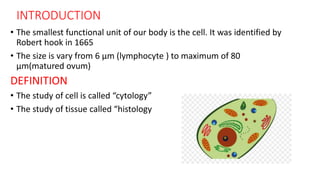
• The smallest functional unit of our body is the cell. It was identified by
Robert hook in 1665
• The size is vary from 6 µm (lymphocyte ) to maximum of 80
µm(matured ovum)
DEFINITION
• The study of cell is called “cytology”
• The study of tissue called “histology
STRUCTURE
1. A Cell membrane or plasma
2. A nucleus
3. Cytoplasm and the organelles
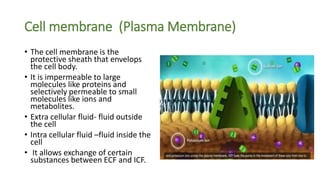
Cell membrane (Plasma Membrane)
• The cell membrane is the
protective sheath that envelops
the cell body.
• It is impermeable to large
molecules like proteins and
selectively permeable to small
molecules like ions and
metabolites.
• Extra cellular fluid- fluid outside
the cell
• Intra cellular fluid –fluid inside the
cell
• It allows exchange of certain
substances between ECF and ICF.
Composition of cell membrane
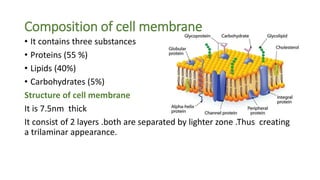
• It contains three substances
• Proteins (55 %)
• Lipids (40%)
• Carbohydrates (5%)
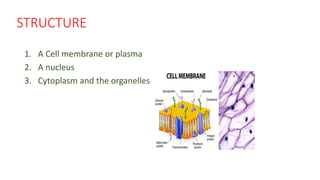
Structure of cell membrane
It is 7.5nm thick
It consist of 2 layers .both are separated by lighter zone .Thus creating
a trilaminar appearance.
Lipids in cell membrane
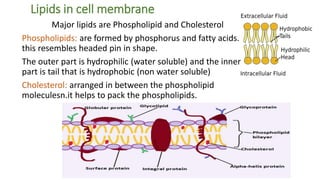
Major lipids are Phospholipid and Cholesterol
Phospholipids: are formed by phosphorus and fatty acids.
this resembles headed pin in shape.
The outer part is hydrophilic (water soluble) and the inner
part is tail that is hydrophobic (non water soluble)
Cholesterol: arranged in between the phospholipid
moleculesn.it helps to pack the phospholipids.
Functions of lipid layer
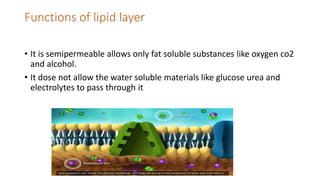
• It is semipermeable allows only fat soluble substances like oxygen co2
and alcohol.
• It dose not allow the water soluble materials like glucose urea and
electrolytes to pass through it
Protein in cell membrane.
• It is electron dense layer situated either side of
the central lipid layer. the protein substances
present in this layers are glycol protein .These
are classified into two
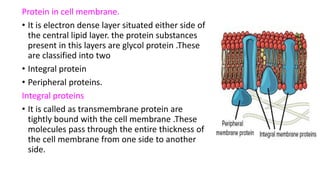
• Integral protein
• Peripheral proteins.
Integral proteins
• It is called as transmembrane protein are
tightly bound with the cell membrane .These
molecules pass through the entire thickness of
the cell membrane from one side to another
side.
Peripheral proteins
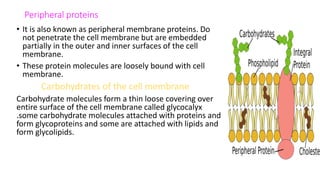
• It is also known as peripheral membrane proteins. Do
not penetrate the cell membrane but are embedded
partially in the outer and inner surfaces of the cell
membrane.
• These protein molecules are loosely bound with cell
membrane.
Carbohydrates of the cell membrane
Carbohydrate molecules form a thin loose covering over
entire surface of the cell membrane called glycocalyx
.some carbohydrate molecules attached with proteins and
form glycoproteins and some are attached with lipids and
form glycolipids.
Roll Of Cell Membrane In Transport Of Material
• Some molecules enter cells by passing through passive channels in
the cell membrane
Endocytosis
Pinocytosis
Phagocytosis
Endocytosis
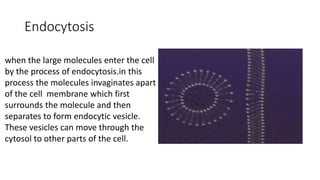
when the large molecules enter the cell
by the process of endocytosis.in this
process the molecules invaginates apart
of the cell membrane which first
surrounds the molecule and then
separates to form endocytic vesicle.
These vesicles can move through the
cytosol to other parts of the cell.
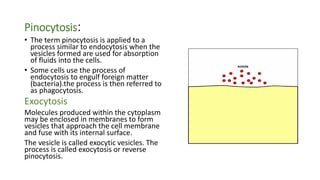
Pinocytosis:
• The term pinocytosis is applied to a
process similar to endocytosis when the
vesicles formed are used for absorption
of fluids into the cells.
• Some cells use the process of
endocytosis to engulf foreign matter
(bacteria).the process is then referred to
as phagocytosis.
Exocytosis
Molecules produced within the cytoplasm
may be enclosed in membranes to form
vesicles that approach the cell membrane
and fuse with its internal surface.
The vesicle is called exocytic vesicles. The
process is called exocytosis or reverse
pinocytosis.
Function of cell Membrane
• Protective function :cell membrane protects the cytoplasm and the
organelles present in the cytoplasm.
• Selective permeability: cell membrane act as a semipermeable
membrane which allows only some substances to pass through it and
act as barrier for other substances.
• Absorptive Function : Nutrients are absorbed into the cell through the
cell membrane.
• Excretory function :metabolites and other waste products from the
cell are excreted through this membrane
• Exchange of gases: oxygen enters the cell and carbon dioxide leaves
the cell and enters the blood .
• Shape and size of the cell: cell membrane responsible for maintaining
shape and size of the cell.
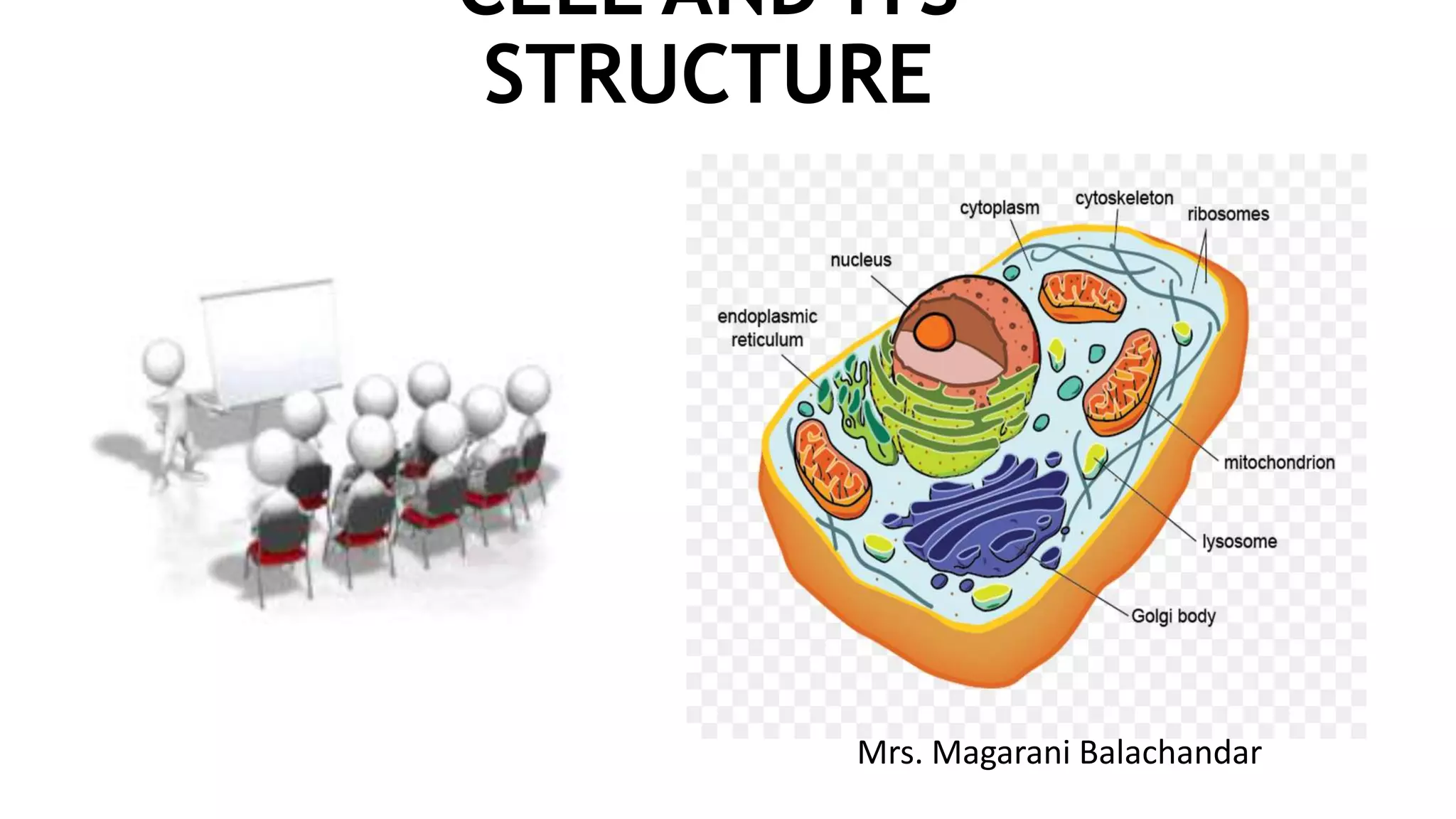
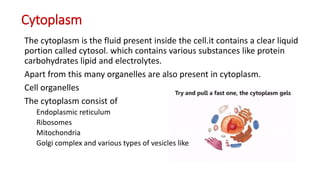
Cytoplasm
The cytoplasm is the fluid present inside the cell.it contains a clear liquid
portion called cytosol. which contains various substances like protein
carbohydrates lipid and electrolytes.
Apart from this many organelles are also present in cytoplasm.
Cell organelles
The cytoplasm consist of
Endoplasmic reticulum
Ribosomes
Mitochondria
Golgi complex and various types of vesicles like
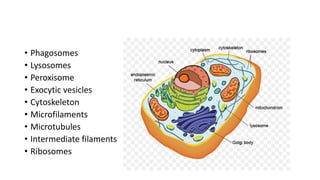
• Phagosomes
• Lysosomes
• Peroxisome
• Exocytic vesicles
• Cytoskeleton
• Microfilaments
• Microtubules
• Intermediate filaments
• Ribosomes
Endoplasmic Reticulum
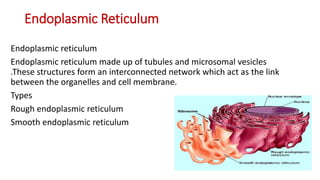
Endoplasmic reticulum
Endoplasmic reticulum made up of tubules and microsomal vesicles
.These structures form an interconnected network which act as the link
between the organelles and cell membrane.
Types
Rough endoplasmic reticulum
Smooth endoplasmic reticulum
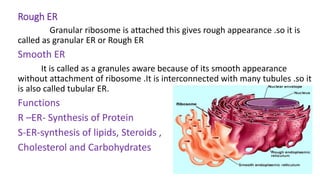
Rough ER
Granular ribosome is attached this gives rough appearance .so it is
called as granular ER or Rough ER
Smooth ER
It is called as a granules aware because of its smooth appearance
without attachment of ribosome .It is interconnected with many tubules .so it
is also called tubular ER.
Functions
R –ER- Synthesis of Protein
S-ER-synthesis of lipids, Steroids ,
Cholesterol and Carbohydrates
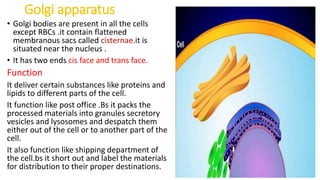
Golgi apparatus
• Golgi bodies are present in all the cells
except RBCs .it contain flattened
membranous sacs called cisternae.it is
situated near the nucleus .
• It has two ends cis face and trans face.
Function
It deliver certain substances like proteins and
lipids to different parts of the cell.
It function like post office .Bs it packs the
processed materials into granules secretory
vesicles and lysosomes and despatch them
either out of the cell or to another part of the
cell.
It also function like shipping department of
the cell.bs it short out and label the materials
for distribution to their proper destinations.
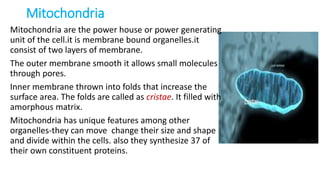
Mitochondria
Mitochondria are the power house or power generating
unit of the cell.it is membrane bound organelles.it
consist of two layers of membrane.
The outer membrane smooth it allows small molecules
through pores.
Inner membrane thrown into folds that increase the
surface area. The folds are called as cristae. It filled with
amorphous matrix.
Mitochondria has unique features among other
organelles-they can move change their size and shape
and divide within the cells. also they synthesize 37 of
their own constituent proteins.
Functions Of Mitochondria
• It is chief site of TCA cycle, electron transport chain and fatty acid
metabolism
• Release energy from ATP
• It concentrates ca .
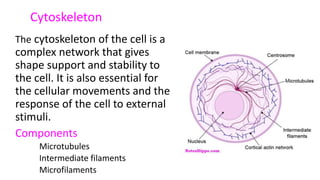
Cytoskeleton
The cytoskeleton of the cell is a
complex network that gives
shape support and stability to
the cell. It is also essential for
the cellular movements and the
response of the cell to external
stimuli.
Components
Microtubules
Intermediate filaments
Microfilaments
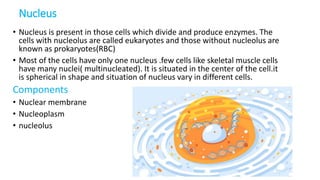
Nucleus
• Nucleus is present in those cells which divide and produce enzymes. The
cells with nucleolus are called eukaryotes and those without nucleolus are
known as prokaryotes(RBC)
• Most of the cells have only one nucleus .few cells like skeletal muscle cells
have many nuclei( multinucleated). It is situated in the center of the cell.it
is spherical in shape and situation of nucleus vary in different cells.
Components
• Nuclear membrane
• Nucleoplasm
• nucleolus
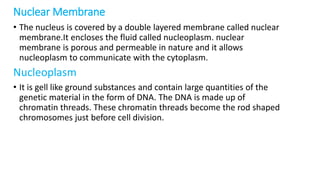
Nuclear Membrane
• The nucleus is covered by a double layered membrane called nuclear
membrane.It encloses the fluid called nucleoplasm. nuclear
membrane is porous and permeable in nature and it allows
nucleoplasm to communicate with the cytoplasm.
Nucleoplasm
• It is gell like ground substances and contain large quantities of the
genetic material in the form of DNA. The DNA is made up of
chromatin threads. These chromatin threads become the rod shaped
chromosomes just before cell division.
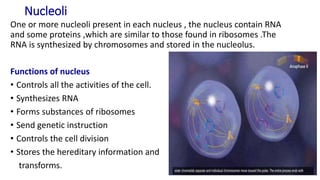
Nucleoli
One or more nucleoli present in each nucleus , the nucleus contain RNA
and some proteins ,which are similar to those found in ribosomes .The
RNA is synthesized by chromosomes and stored in the nucleolus.
Functions of nucleus
• Controls all the activities of the cell.
• Synthesizes RNA
• Forms substances of ribosomes
• Send genetic instruction
• Controls the cell division
• Stores the hereditary information and
transforms.
CELL STRUCTURE  AND ITS FUNCTION pptx

CELL STRUCTURE AND ITS FUNCTION pptx

  • 1.
    CELL AND ITS STRUCTURE Mrs.Magarani Balachandar
  • 2.
    INTRODUCTION • The smallestfunctional unit of our body is the cell. It was identified by Robert hook in 1665 • The size is vary from 6 µm (lymphocyte ) to maximum of 80 µm(matured ovum) DEFINITION • The study of cell is called “cytology” • The study of tissue called “histology
  • 3.
    STRUCTURE 1. A Cellmembrane or plasma 2. A nucleus 3. Cytoplasm and the organelles
  • 4.
    Cell membrane (PlasmaMembrane) • The cell membrane is the protective sheath that envelops the cell body. • It is impermeable to large molecules like proteins and selectively permeable to small molecules like ions and metabolites. • Extra cellular fluid- fluid outside the cell • Intra cellular fluid –fluid inside the cell • It allows exchange of certain substances between ECF and ICF.
  • 5.
    Composition of cellmembrane • It contains three substances • Proteins (55 %) • Lipids (40%) • Carbohydrates (5%) Structure of cell membrane It is 7.5nm thick It consist of 2 layers .both are separated by lighter zone .Thus creating a trilaminar appearance.
  • 6.
    Lipids in cellmembrane Major lipids are Phospholipid and Cholesterol Phospholipids: are formed by phosphorus and fatty acids. this resembles headed pin in shape. The outer part is hydrophilic (water soluble) and the inner part is tail that is hydrophobic (non water soluble) Cholesterol: arranged in between the phospholipid moleculesn.it helps to pack the phospholipids.
  • 7.
    Functions of lipidlayer • It is semipermeable allows only fat soluble substances like oxygen co2 and alcohol. • It dose not allow the water soluble materials like glucose urea and electrolytes to pass through it
  • 8.
    Protein in cellmembrane. • It is electron dense layer situated either side of the central lipid layer. the protein substances present in this layers are glycol protein .These are classified into two • Integral protein • Peripheral proteins. Integral proteins • It is called as transmembrane protein are tightly bound with the cell membrane .These molecules pass through the entire thickness of the cell membrane from one side to another side.
  • 9.
    Peripheral proteins • Itis also known as peripheral membrane proteins. Do not penetrate the cell membrane but are embedded partially in the outer and inner surfaces of the cell membrane. • These protein molecules are loosely bound with cell membrane. Carbohydrates of the cell membrane Carbohydrate molecules form a thin loose covering over entire surface of the cell membrane called glycocalyx .some carbohydrate molecules attached with proteins and form glycoproteins and some are attached with lipids and form glycolipids.
  • 10.
    Roll Of CellMembrane In Transport Of Material • Some molecules enter cells by passing through passive channels in the cell membrane Endocytosis Pinocytosis Phagocytosis
  • 11.
    Endocytosis when the largemolecules enter the cell by the process of endocytosis.in this process the molecules invaginates apart of the cell membrane which first surrounds the molecule and then separates to form endocytic vesicle. These vesicles can move through the cytosol to other parts of the cell.
  • 12.
    Pinocytosis: • The termpinocytosis is applied to a process similar to endocytosis when the vesicles formed are used for absorption of fluids into the cells. • Some cells use the process of endocytosis to engulf foreign matter (bacteria).the process is then referred to as phagocytosis. Exocytosis Molecules produced within the cytoplasm may be enclosed in membranes to form vesicles that approach the cell membrane and fuse with its internal surface. The vesicle is called exocytic vesicles. The process is called exocytosis or reverse pinocytosis.
  • 13.
    Function of cellMembrane • Protective function :cell membrane protects the cytoplasm and the organelles present in the cytoplasm. • Selective permeability: cell membrane act as a semipermeable membrane which allows only some substances to pass through it and act as barrier for other substances. • Absorptive Function : Nutrients are absorbed into the cell through the cell membrane. • Excretory function :metabolites and other waste products from the cell are excreted through this membrane • Exchange of gases: oxygen enters the cell and carbon dioxide leaves the cell and enters the blood . • Shape and size of the cell: cell membrane responsible for maintaining shape and size of the cell.
  • 14.
    Cytoplasm The cytoplasm isthe fluid present inside the cell.it contains a clear liquid portion called cytosol. which contains various substances like protein carbohydrates lipid and electrolytes. Apart from this many organelles are also present in cytoplasm. Cell organelles The cytoplasm consist of Endoplasmic reticulum Ribosomes Mitochondria Golgi complex and various types of vesicles like
  • 15.
    • Phagosomes • Lysosomes •Peroxisome • Exocytic vesicles • Cytoskeleton • Microfilaments • Microtubules • Intermediate filaments • Ribosomes
  • 16.
    Endoplasmic Reticulum Endoplasmic reticulum Endoplasmicreticulum made up of tubules and microsomal vesicles .These structures form an interconnected network which act as the link between the organelles and cell membrane. Types Rough endoplasmic reticulum Smooth endoplasmic reticulum
  • 17.
    Rough ER Granular ribosomeis attached this gives rough appearance .so it is called as granular ER or Rough ER Smooth ER It is called as a granules aware because of its smooth appearance without attachment of ribosome .It is interconnected with many tubules .so it is also called tubular ER. Functions R –ER- Synthesis of Protein S-ER-synthesis of lipids, Steroids , Cholesterol and Carbohydrates
  • 18.
    Golgi apparatus • Golgibodies are present in all the cells except RBCs .it contain flattened membranous sacs called cisternae.it is situated near the nucleus . • It has two ends cis face and trans face. Function It deliver certain substances like proteins and lipids to different parts of the cell. It function like post office .Bs it packs the processed materials into granules secretory vesicles and lysosomes and despatch them either out of the cell or to another part of the cell. It also function like shipping department of the cell.bs it short out and label the materials for distribution to their proper destinations.
  • 19.
    Mitochondria Mitochondria are thepower house or power generating unit of the cell.it is membrane bound organelles.it consist of two layers of membrane. The outer membrane smooth it allows small molecules through pores. Inner membrane thrown into folds that increase the surface area. The folds are called as cristae. It filled with amorphous matrix. Mitochondria has unique features among other organelles-they can move change their size and shape and divide within the cells. also they synthesize 37 of their own constituent proteins.
  • 20.
    Functions Of Mitochondria •It is chief site of TCA cycle, electron transport chain and fatty acid metabolism • Release energy from ATP • It concentrates ca .
  • 21.
    Cytoskeleton The cytoskeleton ofthe cell is a complex network that gives shape support and stability to the cell. It is also essential for the cellular movements and the response of the cell to external stimuli. Components Microtubules Intermediate filaments Microfilaments
  • 22.
    Nucleus • Nucleus ispresent in those cells which divide and produce enzymes. The cells with nucleolus are called eukaryotes and those without nucleolus are known as prokaryotes(RBC) • Most of the cells have only one nucleus .few cells like skeletal muscle cells have many nuclei( multinucleated). It is situated in the center of the cell.it is spherical in shape and situation of nucleus vary in different cells. Components • Nuclear membrane • Nucleoplasm • nucleolus
  • 23.
    Nuclear Membrane • Thenucleus is covered by a double layered membrane called nuclear membrane.It encloses the fluid called nucleoplasm. nuclear membrane is porous and permeable in nature and it allows nucleoplasm to communicate with the cytoplasm. Nucleoplasm • It is gell like ground substances and contain large quantities of the genetic material in the form of DNA. The DNA is made up of chromatin threads. These chromatin threads become the rod shaped chromosomes just before cell division.
  • 24.
    Nucleoli One or morenucleoli present in each nucleus , the nucleus contain RNA and some proteins ,which are similar to those found in ribosomes .The RNA is synthesized by chromosomes and stored in the nucleolus. Functions of nucleus • Controls all the activities of the cell. • Synthesizes RNA • Forms substances of ribosomes • Send genetic instruction • Controls the cell division • Stores the hereditary information and transforms.