What is cell signaling?
• All cells receive and respond to signals from their surroundings
• Communication between cells.
Hormone
Growth factor
Cytokine
Steroid
Polypeptide
Signal from where?
The ligand is the signaling molecule. ligand may be
Signaling molecules, which
are released by signal-
producing cells, reach and
transfer biological signals to
their target cells to initiate
specific cellular responses
CONDITION FOR SIGNALING
Receptor activated by ligand, the receptor
causes a change in the target cell in which
it is expressed
 Extracellular molecules
Protein, peptides, Hormone, cytokine
adrenaline, thyroxine .prostaglandin
 Intracellular molecules
CCa2+, carbohydrate, CAMP/CGMP
Intercellular signaling
Communication between cells
Intracellular signaling
Signaling chains within the cell
Intercellular signalling Controls
Metabolic fluxes
Cell division
Growth
Development
Processes sensory information
Differentiation
Cells communicate via
Messenger
substances
Gap junctions
Surface proteins
Electrical
signals
Hormones
As a Signal molecules
Binding with
Receptor
Activated Enzyme
Second
messenger
Transcription
Effect on
cellular
function
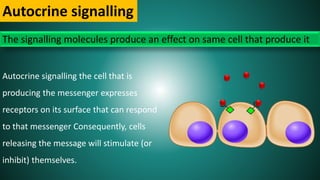
The signalling molecules produce an effect on same cell that produce it
Autocrine signalling
Autocrine signalling the cell that is
producing the messenger expresses
receptors on its surface that can respond
to that messenger Consequently, cells
releasing the message will stimulate (or
inhibit) themselves.
The cytokine interleukin-1 in monocytes.
When interleukin-1 is produced in
response to external stimuli, it can bind
to cell-surface receptors on the same cell
that produced it.
Activated T lymphocytes T lymphocyte
respond to antigenic stimulation by
synthesizing a growth factor that derives their
own proliferation, and there by increasing the
number of responsive T-Lymphocytes
Cancer development- Autocrine
signaling plays critical roles in cancer
activation and also in providing self-
sustaining growth signals tumors
EXAMPLES OF
AUTOCRINE SIGNALING
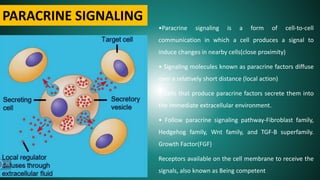
•Paracrine signaling is a form of cell-to-cell
communication in which a cell produces a signal to
induce changes in nearby cells(close proximity)
• Signaling molecules known as paracrine factors diffuse
over a relatively short distance (local action)
• Cells that produce paracrine factors secrete them into
the Immediate extracellular environment.
• Follow paracrine signaling pathway-Fibroblast family,
Hedgehog family, Wnt family, and TGF-B superfamily.
Growth Factor(FGF)
Receptors available on the cell membrane to receive the
signals, also known as Being competent
PARACRINE SIGNALING
• The signaling molecule act on target cells distantly
located from the Site of synthesis.
• It is a long range signaling and signal molecules is
transported by Blood streams.
The pancreas is an endocrine gland and produces the
hormone insulin, which regulates the uptake of glucose
in cells all over the body.
Hormones that function in an endocrine manner
include testosterone, progesterone and gonadotropins.
ENDOCRINE SIGNALING
EXAMPLES OF ENDOCRINE SIGNALING
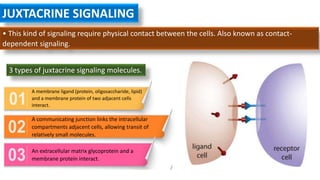
JUXTACRINE SIGNALING
• This kind of signaling require physical contact between the cells. Also known as contact-
dependent signaling.
A membrane ligand (protein, oligosaccharide, lipid)
and a membrane protein of two adjacent cells
interact.
A communicating junction links the intracellular
compartments adjacent cells, allowing transit of
relatively small molecules.
An extracellular matrix glycoprotein and a
membrane protein interact.
3 types of juxtacrine signaling molecules.
TYPES OF LIGANDS
1. Membrane bound signal molecule – signal molecule remain surface of the cell and mediate
contact dependent signaling.
2. Secretory signal molecules- secreted from signaling cell and binds to receptor.
Secretory signal molecules are extracellular and
divided in 3 categories depending on distance
1
2
3
Endocrine
Paracrine
Autocrine
Depending On The Nature Of Extracellular Signal
Molecules It Is Divided In 2 More Categories
LIPOPHILIC MOLECULES
HYDROPHILIC MOLECULES
EXAMPLE OF SIGNAL MOLECULES THAT INTRACT WITH CELL SURFACE RECEPTOR
Epinephrine
Glucagon
Insulin
Gastrin
Secretin
Adrenocorticotropic hormone
EXAMPLE OF SIGNAL MOLECULES THAT INTRACT WITH CYTOSOLIC OR NUCLEAR
RECEPTOR
Steroid hormones-
Progesterone, testosterone,
cortisol, aldosterone.
Non steroid hormones-
thyroid hormone and retinoic
acid.
• Receptors are protein molecules inside the target cell or on its surface that receive a chemical
signal.
• Chemical signals are released by signaling cells in the form of small, or soluble molecules called
ligands.
RECEPTOR AND LIGAND
Orphan receptor
Orphan receptor is a protein that has a similar structure to other identified
receptors but whose ligand has not yet been identified.
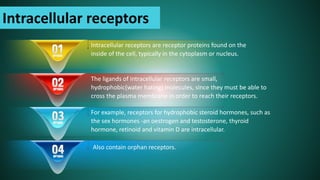
Intracellular receptors
Intracellular receptors are receptor proteins found on the
inside of the cell, typically in the cytoplasm or nucleus.
The ligands of intracellular receptors are small,
hydrophobic{water hating) molecules, since they must be able to
cross the plasma membrane in order to reach their receptors.
For example, receptors for hydrophobic steroid hormones, such as
the sex hormones -an oestrogen and testosterone, thyroid
hormone, retinoid and vitamin D are intracellular.
Also contain orphan receptors.
Intracellular receptors
Intracellular receptor belongs to Nuclear
receptor superfamily
Nuclear receptor superfamily is a family of highly
conserved transcription factors that regulates transcription
in response to small lipophilic signal molecules.
Members of the Nuclear receptor superfamily can
both positively and Negatively regulate transcription.
Nuclear receptor superfamily
N-terminal activation
domain, called the A/B
region,
A central DNA binding
domain(DBD) and
A C-terminal ligand
binding domain (LBD)
Example Steroid hormone receptor
Location-cytosol
Homodimer receptor
In cytosol= receptor +HSP - INACTIVE
In cytosol= receptor+ligand receptor-ligand complex
• It can be homodimer-example ----steroid receptor
• It can be heterodimer- example--- retinoic acid receptor, thyroid
hormone receptor, vitamin D receptor and orphan receptor
Nuclear receptor
Thyroid hormone receptor
Heterodimer receptor
Location of receptor= nucleus
Cell-surface receptors
Cell-surface receptors, also known as
transmembrane receptors, are
proteins that are found attached to
the cell membrane.
These receptors bind to external
ligand molecules because ligands
do not travel across the cell
membrane.
This type of receptor spans the
plasma membrane and performs
signal transduction, in which an
extracellular signal is Converted into
an intercellular signal.
Cell-surface receptors are also called
cell-specific proteins or markers
because they are specific to
individual cell types.
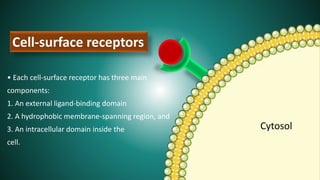
Cytosol
• Each cell-surface receptor has three main
components:
1. An external ligand-binding domain
2. A hydrophobic membrane-spanning region, and
3. An intracellular domain inside the
cell.
Cell-surface receptors

Cell signaling Part-1

  • 1.
    What is cellsignaling? • All cells receive and respond to signals from their surroundings • Communication between cells. Hormone Growth factor Cytokine Steroid Polypeptide Signal from where? The ligand is the signaling molecule. ligand may be Signaling molecules, which are released by signal- producing cells, reach and transfer biological signals to their target cells to initiate specific cellular responses
  • 2.
    CONDITION FOR SIGNALING Receptoractivated by ligand, the receptor causes a change in the target cell in which it is expressed  Extracellular molecules Protein, peptides, Hormone, cytokine adrenaline, thyroxine .prostaglandin  Intracellular molecules CCa2+, carbohydrate, CAMP/CGMP Intercellular signaling Communication between cells Intracellular signaling Signaling chains within the cell
  • 3.
    Intercellular signalling Controls Metabolicfluxes Cell division Growth Development Processes sensory information Differentiation Cells communicate via Messenger substances Gap junctions Surface proteins Electrical signals
  • 4.
    Hormones As a Signalmolecules Binding with Receptor Activated Enzyme Second messenger Transcription Effect on cellular function
  • 5.
    The signalling moleculesproduce an effect on same cell that produce it Autocrine signalling Autocrine signalling the cell that is producing the messenger expresses receptors on its surface that can respond to that messenger Consequently, cells releasing the message will stimulate (or inhibit) themselves.
  • 6.
    The cytokine interleukin-1in monocytes. When interleukin-1 is produced in response to external stimuli, it can bind to cell-surface receptors on the same cell that produced it. Activated T lymphocytes T lymphocyte respond to antigenic stimulation by synthesizing a growth factor that derives their own proliferation, and there by increasing the number of responsive T-Lymphocytes Cancer development- Autocrine signaling plays critical roles in cancer activation and also in providing self- sustaining growth signals tumors EXAMPLES OF AUTOCRINE SIGNALING
  • 7.
    •Paracrine signaling isa form of cell-to-cell communication in which a cell produces a signal to induce changes in nearby cells(close proximity) • Signaling molecules known as paracrine factors diffuse over a relatively short distance (local action) • Cells that produce paracrine factors secrete them into the Immediate extracellular environment. • Follow paracrine signaling pathway-Fibroblast family, Hedgehog family, Wnt family, and TGF-B superfamily. Growth Factor(FGF) Receptors available on the cell membrane to receive the signals, also known as Being competent PARACRINE SIGNALING
  • 8.
    • The signalingmolecule act on target cells distantly located from the Site of synthesis. • It is a long range signaling and signal molecules is transported by Blood streams. The pancreas is an endocrine gland and produces the hormone insulin, which regulates the uptake of glucose in cells all over the body. Hormones that function in an endocrine manner include testosterone, progesterone and gonadotropins. ENDOCRINE SIGNALING EXAMPLES OF ENDOCRINE SIGNALING
  • 9.
    JUXTACRINE SIGNALING • Thiskind of signaling require physical contact between the cells. Also known as contact- dependent signaling. A membrane ligand (protein, oligosaccharide, lipid) and a membrane protein of two adjacent cells interact. A communicating junction links the intracellular compartments adjacent cells, allowing transit of relatively small molecules. An extracellular matrix glycoprotein and a membrane protein interact. 3 types of juxtacrine signaling molecules.
  • 10.
    TYPES OF LIGANDS 1.Membrane bound signal molecule – signal molecule remain surface of the cell and mediate contact dependent signaling. 2. Secretory signal molecules- secreted from signaling cell and binds to receptor. Secretory signal molecules are extracellular and divided in 3 categories depending on distance 1 2 3 Endocrine Paracrine Autocrine Depending On The Nature Of Extracellular Signal Molecules It Is Divided In 2 More Categories LIPOPHILIC MOLECULES HYDROPHILIC MOLECULES
  • 11.
    EXAMPLE OF SIGNALMOLECULES THAT INTRACT WITH CELL SURFACE RECEPTOR Epinephrine Glucagon Insulin Gastrin Secretin Adrenocorticotropic hormone
  • 12.
    EXAMPLE OF SIGNALMOLECULES THAT INTRACT WITH CYTOSOLIC OR NUCLEAR RECEPTOR Steroid hormones- Progesterone, testosterone, cortisol, aldosterone. Non steroid hormones- thyroid hormone and retinoic acid.
  • 13.
    • Receptors areprotein molecules inside the target cell or on its surface that receive a chemical signal. • Chemical signals are released by signaling cells in the form of small, or soluble molecules called ligands. RECEPTOR AND LIGAND Orphan receptor Orphan receptor is a protein that has a similar structure to other identified receptors but whose ligand has not yet been identified.
  • 14.
    Intracellular receptors Intracellular receptorsare receptor proteins found on the inside of the cell, typically in the cytoplasm or nucleus. The ligands of intracellular receptors are small, hydrophobic{water hating) molecules, since they must be able to cross the plasma membrane in order to reach their receptors. For example, receptors for hydrophobic steroid hormones, such as the sex hormones -an oestrogen and testosterone, thyroid hormone, retinoid and vitamin D are intracellular. Also contain orphan receptors.
  • 15.
    Intracellular receptors Intracellular receptorbelongs to Nuclear receptor superfamily Nuclear receptor superfamily is a family of highly conserved transcription factors that regulates transcription in response to small lipophilic signal molecules. Members of the Nuclear receptor superfamily can both positively and Negatively regulate transcription.
  • 16.
    Nuclear receptor superfamily N-terminalactivation domain, called the A/B region, A central DNA binding domain(DBD) and A C-terminal ligand binding domain (LBD)
  • 17.
    Example Steroid hormonereceptor Location-cytosol Homodimer receptor In cytosol= receptor +HSP - INACTIVE In cytosol= receptor+ligand receptor-ligand complex • It can be homodimer-example ----steroid receptor • It can be heterodimer- example--- retinoic acid receptor, thyroid hormone receptor, vitamin D receptor and orphan receptor Nuclear receptor Thyroid hormone receptor Heterodimer receptor Location of receptor= nucleus
  • 18.
    Cell-surface receptors Cell-surface receptors,also known as transmembrane receptors, are proteins that are found attached to the cell membrane. These receptors bind to external ligand molecules because ligands do not travel across the cell membrane. This type of receptor spans the plasma membrane and performs signal transduction, in which an extracellular signal is Converted into an intercellular signal. Cell-surface receptors are also called cell-specific proteins or markers because they are specific to individual cell types.
  • 19.
    Cytosol • Each cell-surfacereceptor has three main components: 1. An external ligand-binding domain 2. A hydrophobic membrane-spanning region, and 3. An intracellular domain inside the cell. Cell-surface receptors