Cell MembranesOsmosis and Diffusion
PREFIX – SUFFIX ADDITIONS Hypo – under, beneath, lacking Hyper – over, above, excess Iso –  equal Tonic – stretching, tone
Functions of Membranes1.  Protect cell2.  Control incoming and outgoing substancesMaintain ion concentrations of various substancesFLASH CARD ALERT!!! 4.  SELECTIVELY PERMEABLE - allows some molecules in, others are kept out
Phospholipid Bilayer
Fluid Mosaic Model
SolutionsSolutions are made of solute and a solventFLASH CARD ALERT!!!! SOLVENT - the liquid into which the solute is poured and dissolved. We will use water as our solvent in Lab #4SOLUTE - substance that is dissolved or put into the solvent. Salt and sucrose are solutes.
Methods of Transport Across Membranes1.  Diffusion2.  Osmosis3.  Facilitated Diffusion4.  Active Transport
FLASH CARD ALERT!!! 1.  DIFFUSION -passive transport of molecules - no  energy expended2.  OSMOSIS- Passive transport of WATER			 across membrane3.  FACILITATED DIFFUSION- Use of carrier proteins to carry polar molecules or ions across membrane4.  ACTIVE TRANSPORT requires energy to transport molecules AGAINST A CONCENTRATION GRADIENT. energy is in the form of  ATP
Where does that ATP come from?
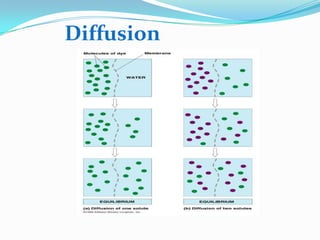
DiffusionMovement of molecules from an area of high concentration to an area of low concentration.DIFFUSION = MOVEMENT OF MOLECULESOSMOSIS = MOVEMENT OF WATER.
Diffusion
Facilitated Diffusion
Passive – Does not require energy 	Uses carrier proteins Molecules combine with carrier proteins. These molecules speed up the passage over the membrane. Glucose
Osmosis
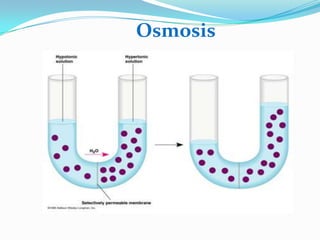
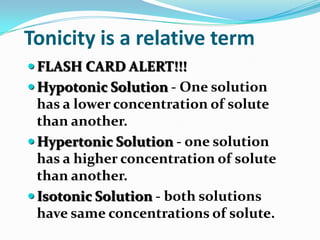
Tonicity is a relative termFLASH CARD ALERT!!! Hypotonic Solution - One solution has a lower concentration of solute than another.Hypertonic Solution - one solution has a higher concentration of solute than another.Isotonic Solution - both solutions have same concentrations of solute.
Plant and Animal Cells put into 	   various solutions
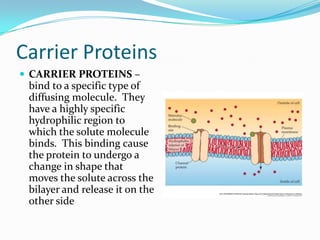
Carrier Proteins CARRIER PROTEINS – bind to a specific type of diffusing molecule.  They have a highly specific hydrophilic region to which the solute molecule binds.  This binding cause the protein to undergo a change in shape that moves the solute across the bilayer and release it on the other side
Active Transport Active transport is the transport of molecules by carrier proteins AGAINST  a concentration gradient.REQUIRES ENERGY IN THE FORM OF ATP
Types of Transport
http://www.youtube.com/watch?v=sdiJtDRJQEc&safety_mode=true&persist_safety_mode=1&safe=active

Cell membranes

  • 1.
  • 2.
    PREFIX – SUFFIXADDITIONS Hypo – under, beneath, lacking Hyper – over, above, excess Iso – equal Tonic – stretching, tone
  • 3.
    Functions of Membranes1. Protect cell2. Control incoming and outgoing substancesMaintain ion concentrations of various substancesFLASH CARD ALERT!!! 4. SELECTIVELY PERMEABLE - allows some molecules in, others are kept out
  • 4.
  • 5.
  • 6.
    SolutionsSolutions are madeof solute and a solventFLASH CARD ALERT!!!! SOLVENT - the liquid into which the solute is poured and dissolved. We will use water as our solvent in Lab #4SOLUTE - substance that is dissolved or put into the solvent. Salt and sucrose are solutes.
  • 7.
    Methods of TransportAcross Membranes1. Diffusion2. Osmosis3. Facilitated Diffusion4. Active Transport
  • 8.
    FLASH CARD ALERT!!!1. DIFFUSION -passive transport of molecules - no energy expended2. OSMOSIS- Passive transport of WATER across membrane3. FACILITATED DIFFUSION- Use of carrier proteins to carry polar molecules or ions across membrane4. ACTIVE TRANSPORT requires energy to transport molecules AGAINST A CONCENTRATION GRADIENT. energy is in the form of ATP
  • 9.
    Where does thatATP come from?
  • 10.
    DiffusionMovement of moleculesfrom an area of high concentration to an area of low concentration.DIFFUSION = MOVEMENT OF MOLECULESOSMOSIS = MOVEMENT OF WATER.
  • 11.
  • 12.
  • 13.
    Passive – Doesnot require energy Uses carrier proteins Molecules combine with carrier proteins. These molecules speed up the passage over the membrane. Glucose
  • 14.
  • 15.
    Tonicity is arelative termFLASH CARD ALERT!!! Hypotonic Solution - One solution has a lower concentration of solute than another.Hypertonic Solution - one solution has a higher concentration of solute than another.Isotonic Solution - both solutions have same concentrations of solute.
  • 16.
    Plant and AnimalCells put into various solutions
  • 17.
    Carrier Proteins CARRIERPROTEINS – bind to a specific type of diffusing molecule. They have a highly specific hydrophilic region to which the solute molecule binds. This binding cause the protein to undergo a change in shape that moves the solute across the bilayer and release it on the other side
  • 18.
    Active Transport Activetransport is the transport of molecules by carrier proteins AGAINST a concentration gradient.REQUIRES ENERGY IN THE FORM OF ATP
  • 19.
  • 20.