Cell Membrane Potential
GIDEON ROBERT UNIVERSITY
ANATOMY AND PHYSIOLOGY
NSWANA CHING’AMBU
Cell Membrane Potential
• What is cell membrane potential
• Types of ion channels
• Operations of ion channels
• Stages of action potential
Electric Current and the Body
• Potential energy generated by separated
charges is called voltage.
• Reflects the flow of ions rather than
electrons
• There is a potential on either side of
membranes when the number of ions is
different across the membrane
Role of Ion Channels
• Types:
1. Passive or leakage channels – always open
2. Chemically gated channels – open w/
binding of specific neurotransmitter/chemical
3. Voltage-gated channels – open & close in
response to membrane potential
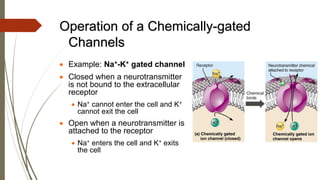
Operation of a Chemically-gated
Channels
• Example: Na+-K+ gated channel
• Closed when a neurotransmitter
is not bound to the extracellular
receptor
• Na+ cannot enter the cell and K+
cannot exit the cell
• Open when a neurotransmitter is
attached to the receptor
• Na+ enters the cell and K+ exits
the cell
Operation of a Voltage-gated Channels
• Example: Na+ channel
• Closed when the intracellular
environment is negative
• Na+ cannot enter the cell
• Open when the intracellular
environment is positive
• Na+ can enter the cell
Gated Channels
• When gated channels are open:
• Ions move along chemical gradients, diffusion from
high concentration to low concentration.
• Ions move along electrical gradients, towards the
opposite charge.
• Together they are called the Electrochemical Gradient
• An electrical current and Voltage changes are created
across the membrane
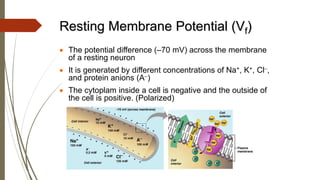
Resting Membrane Potential (Vf)
• The potential difference (–70 mV) across the membrane
of a resting neuron
• It is generated by different concentrations of Na+, K+, Cl−,
and protein anions (A−)
• The cytoplam inside a cell is negative and the outside of
the cell is positive. (Polarized)
Membrane Potentials: Signals
• Used to integrate, send, and receive information
• Membrane potential changes are produced by:
• Changes in membrane permeability to ions
• Alterations of ion concentrations across the
membrane
Changes in Membrane Potential
• Changes are caused by three events
• Depolarization – the inside of the membrane
becomes less negative
• Repolarization – the membrane returns to its resting
membrane potential
• Hyperpolarization – the inside of the membrane
becomes more negative than the resting potential
Changes in Membrane Potential
Action Potential (AP)
• A brief change in membrane potential from -
70mV(resting) to +30mV (hyperpolarization)
• Action potentials are only generated by muscle
cells and neurons
• They do not decrease in strength over distance
• An action potential in the axon of a neuron is a
nerve impulse
Threshold & Action Potential
• Threshold – membrane is depolarized by 15 to 20 mV
• Established by the total amount of current flowing
through the membrane
• Weak (subthreshold) stimuli are not relayed into action
potentials
• Strong (threshold) stimuli are relayed into action
potentials
• All-or-none phenomenon – action potentials either
happen completely, or not at all
AP: Stage 1 Resting Stage
• Cell has resting membrane potential (-70mV)
• Na+ and K+ channels are closed
• Leakage accounts for small movements of Na+ and K+
AP: Stage 2 Depolarization Phase
• The local depolarization current flips open the sodium
gate and Na+ rushes in.
• Threshold: when enough
Na+ is inside to reach a
critical level of depolarization
(-55 to -50 mV) threshold,
depolarization becomes
self-generating.
AP: Stage 2 Continues
• Na+ will continue to rush
in making the inside less
and less negative and
actually overshoots the
0mV (balanced) mark to
about +30mV.
AP: Stage 3 Repolarization Phase
• After 1 ms enough Na+ has entered that positive
charges resist entering the cell.
• Sodium channel closes and membrane permeability to
Na+ declines to resting levels
• As sodium gates close, voltage-sensitive K+ gates
open
• K+ exits the cell and
internal negativity
of the resting neuron
is restored
AP: Stage 4 Hyperpolarization Phase
• Potassium gates are slow and remain open, causing
an excessive efflux of K+
• This efflux causes hyperpolarization of the membrane
(undershoot)
• The neuron is
insensitive to
stimulus and
depolarization
during this time
Phases of Action Potential
1. Resting state
2. Depolarization phase
3. Repolarization phase
4. Hyperpolarization
Propagation of Action Potential
• When one area of the cell membrane has begun to
return to resting, the positivity has opened the Na+
gates of the next area of the neuron and the whole
process starts over
• A current is created that depolarizes the adjacent
membrane in a forward direction
• The impulse propagates away from its point of origin
Propagation of Action Potential
Cell membrane potential.pdf

Cell membrane potential.pdf

  • 1.
    Cell Membrane Potential GIDEONROBERT UNIVERSITY ANATOMY AND PHYSIOLOGY NSWANA CHING’AMBU
  • 2.
    Cell Membrane Potential •What is cell membrane potential • Types of ion channels • Operations of ion channels • Stages of action potential
  • 3.
    Electric Current andthe Body • Potential energy generated by separated charges is called voltage. • Reflects the flow of ions rather than electrons • There is a potential on either side of membranes when the number of ions is different across the membrane
  • 4.
    Role of IonChannels • Types: 1. Passive or leakage channels – always open 2. Chemically gated channels – open w/ binding of specific neurotransmitter/chemical 3. Voltage-gated channels – open & close in response to membrane potential
  • 5.
    Operation of aChemically-gated Channels • Example: Na+-K+ gated channel • Closed when a neurotransmitter is not bound to the extracellular receptor • Na+ cannot enter the cell and K+ cannot exit the cell • Open when a neurotransmitter is attached to the receptor • Na+ enters the cell and K+ exits the cell
  • 6.
    Operation of aVoltage-gated Channels • Example: Na+ channel • Closed when the intracellular environment is negative • Na+ cannot enter the cell • Open when the intracellular environment is positive • Na+ can enter the cell
  • 7.
    Gated Channels • Whengated channels are open: • Ions move along chemical gradients, diffusion from high concentration to low concentration. • Ions move along electrical gradients, towards the opposite charge. • Together they are called the Electrochemical Gradient • An electrical current and Voltage changes are created across the membrane
  • 8.
    Resting Membrane Potential(Vf) • The potential difference (–70 mV) across the membrane of a resting neuron • It is generated by different concentrations of Na+, K+, Cl−, and protein anions (A−) • The cytoplam inside a cell is negative and the outside of the cell is positive. (Polarized)
  • 9.
    Membrane Potentials: Signals •Used to integrate, send, and receive information • Membrane potential changes are produced by: • Changes in membrane permeability to ions • Alterations of ion concentrations across the membrane
  • 10.
    Changes in MembranePotential • Changes are caused by three events • Depolarization – the inside of the membrane becomes less negative • Repolarization – the membrane returns to its resting membrane potential • Hyperpolarization – the inside of the membrane becomes more negative than the resting potential
  • 11.
  • 12.
    Action Potential (AP) •A brief change in membrane potential from - 70mV(resting) to +30mV (hyperpolarization) • Action potentials are only generated by muscle cells and neurons • They do not decrease in strength over distance • An action potential in the axon of a neuron is a nerve impulse
  • 13.
    Threshold & ActionPotential • Threshold – membrane is depolarized by 15 to 20 mV • Established by the total amount of current flowing through the membrane • Weak (subthreshold) stimuli are not relayed into action potentials • Strong (threshold) stimuli are relayed into action potentials • All-or-none phenomenon – action potentials either happen completely, or not at all
  • 14.
    AP: Stage 1Resting Stage • Cell has resting membrane potential (-70mV) • Na+ and K+ channels are closed • Leakage accounts for small movements of Na+ and K+
  • 15.
    AP: Stage 2Depolarization Phase • The local depolarization current flips open the sodium gate and Na+ rushes in. • Threshold: when enough Na+ is inside to reach a critical level of depolarization (-55 to -50 mV) threshold, depolarization becomes self-generating.
  • 16.
    AP: Stage 2Continues • Na+ will continue to rush in making the inside less and less negative and actually overshoots the 0mV (balanced) mark to about +30mV.
  • 17.
    AP: Stage 3Repolarization Phase • After 1 ms enough Na+ has entered that positive charges resist entering the cell. • Sodium channel closes and membrane permeability to Na+ declines to resting levels • As sodium gates close, voltage-sensitive K+ gates open • K+ exits the cell and internal negativity of the resting neuron is restored
  • 18.
    AP: Stage 4Hyperpolarization Phase • Potassium gates are slow and remain open, causing an excessive efflux of K+ • This efflux causes hyperpolarization of the membrane (undershoot) • The neuron is insensitive to stimulus and depolarization during this time
  • 19.
    Phases of ActionPotential 1. Resting state 2. Depolarization phase 3. Repolarization phase 4. Hyperpolarization
  • 20.
    Propagation of ActionPotential • When one area of the cell membrane has begun to return to resting, the positivity has opened the Na+ gates of the next area of the neuron and the whole process starts over • A current is created that depolarizes the adjacent membrane in a forward direction • The impulse propagates away from its point of origin
  • 21.