Pt. Ravishankar Shukla University
" Action potential"
Presented by:-
Diksha Chandrakar msc
biochemistry 2nd sem.
Guided by:-
Dr. Aarti parganiha
Dr. Gyanchandra sahu
Action potential:-
** Nerve signals are transmitted by Action potential.
**Action potential is defined as a sudden , fast , transitory and propagating change of
the resting membrane potential.
** Action potential being with a sudden change from normal resting negative
membrane potential to a positive potential and end with an almost equally rapid change
back to negative potential.
** The duration of nerve action potential is 0.3 ms.
**The action potential arises at the trigger zone ( here , at the junction of the axon
hillock and the initial segment and then propagates along the axon to the axon
terminal.
( action potential will Change the membrane polarity)
5 steps of action potential:-
1. Resting membrane potential ( resting stage)
2. Threshold ( early de polarization)
3. De polarization phage
4. Re polarization phage
5. Hyperpolarization phage
1. Resting membrane potential ( resting phage):-
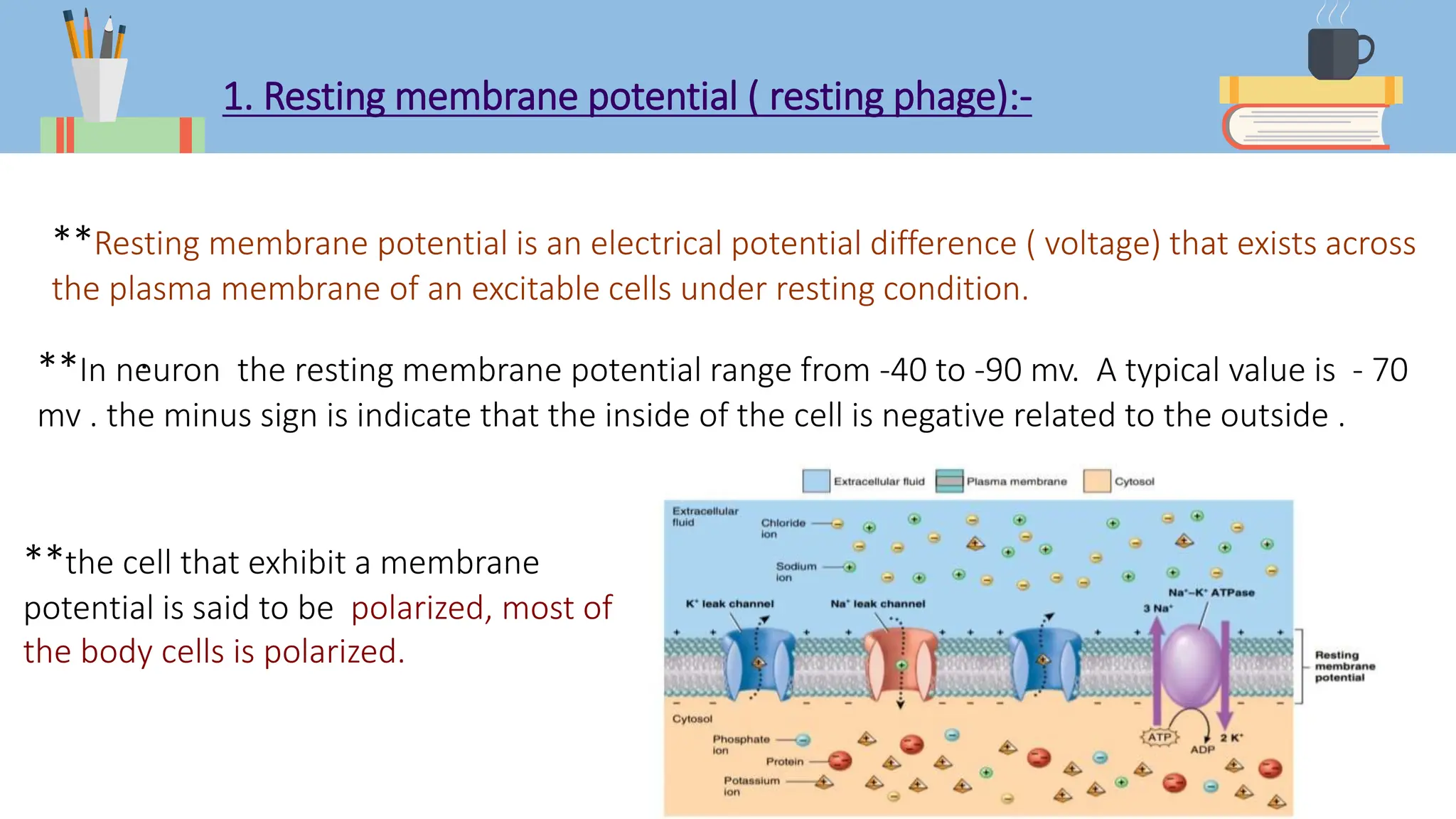
**Resting membrane potential is an electrical potential difference ( voltage) that exists across
the plasma membrane of an excitable cells under resting condition.
**In neuron the resting membrane potential range from -40 to -90 mv. A typical value is - 70
mv . the minus sign is indicate that the inside of the cell is negative related to the outside .
.
**the cell that exhibit a membrane
potential is said to be polarized, most of
the body cells is polarized.
1.
3.
2.
** three factors that contribute to the resting
membrane potential:-
BECAUSE the plasma membrane has more k+ leaky channels than Na+ leaky channels
, the number of k+ ion leave the cell is greater then the number of Na+ ion that enter
the cell.
As more and more k+ ions leave the cell, the inside of the membrane become
increasingly negative (-) and the outside of the membrane become increasingly
positive (+)..
Trapped anion cannot follow k+ out of the cell because they are attached to the
nondiffusible molecules such as ATP and large protein.
The electrogenic Na+ k+ ATPase ( pump) expels 3Na+ ion fir every 2k+ ion
imported.
Threshold:-
** An action potential occur in the membrane of the axon of neuron when depolarization
reached a certain level termed the threshold ( about - 55mv ) .
**when the depolarization reaches about -55mv a neuron will fire an action potential . This is
the threshold . If the neuron does not reache this critical threshold level then no action
potential will starts
** in this step some voltage gated Na+ channel open which cause Na+ to move through the
channel into the cell due to stimulus. Remember Na+ has +ve charge , so the inside of the
neuron becomes more positive and out side of the membrane becomes more negative
** Depolarization phage:-
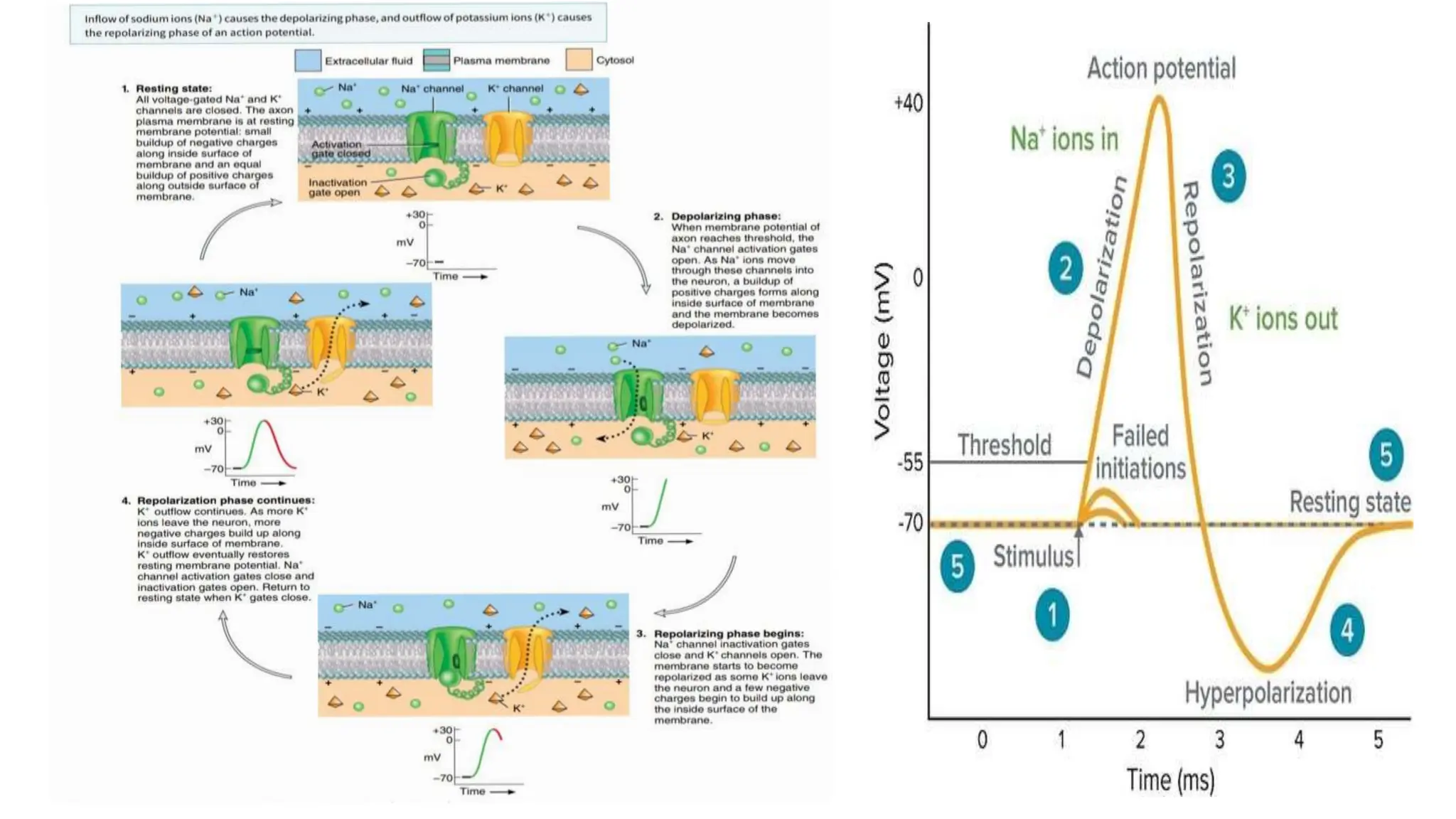
** when membrane potential of axon reached threshold . Voltage gated Na+ channel
open rapidly.
**the inflow of Na+ change the membrane potential from -55mv to +30 mv.
**at the peak of action potential the inside of the membrane is 30mv more positive then the
outside.
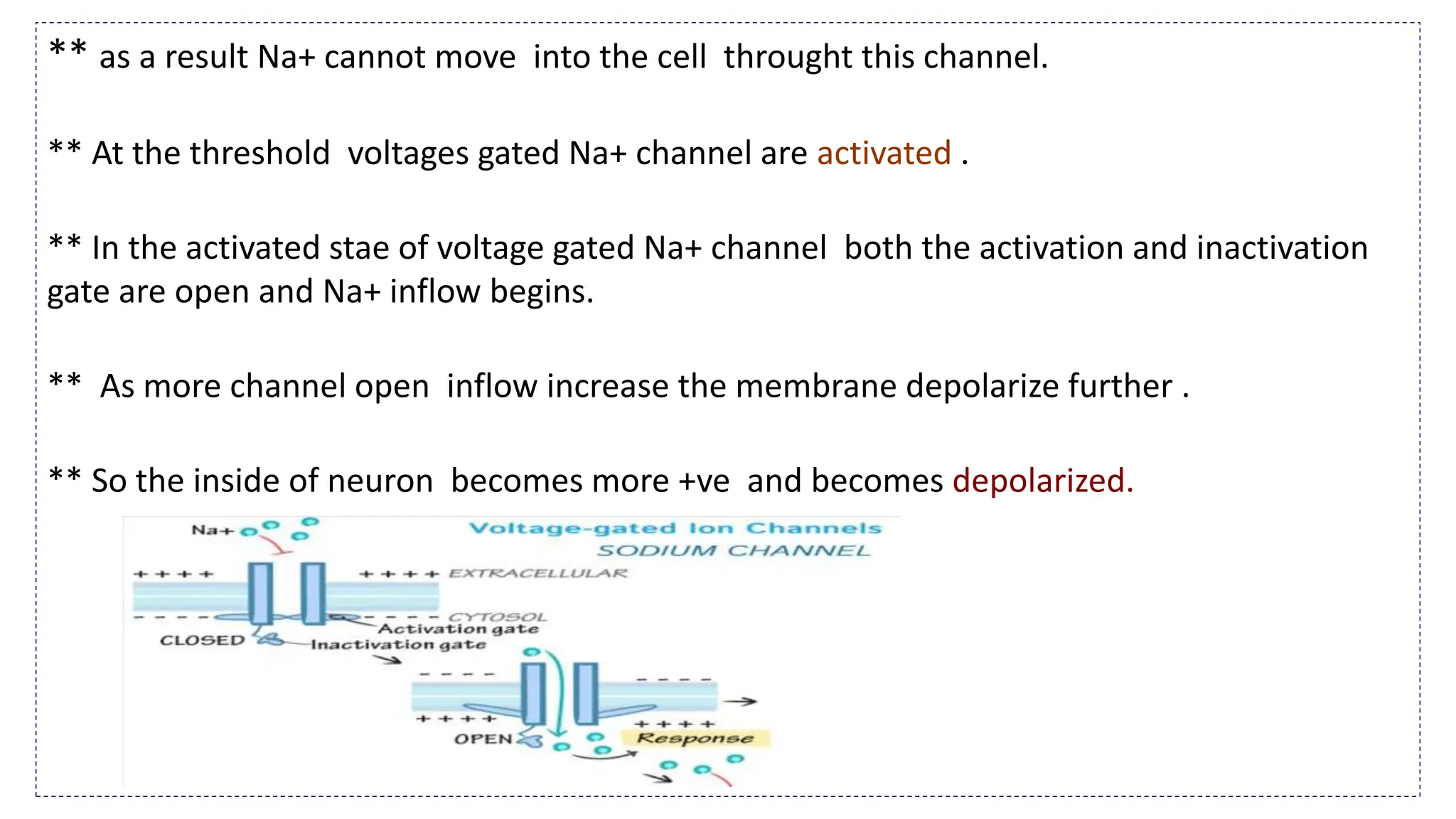
** each voltage gated Na+ channel has two seperate gates an activation gate and an
inactivation gate
**in the resting sate of voltage gated Na+ channel , the inactivation gate is open but
activation gate is closed.
** as a result Na+ cannot move into the cell throught this channel.
** At the threshold voltages gated Na+ channel are activated .
** In the activated stae of voltage gated Na+ channel both the activation and inactivation
gate are open and Na+ inflow begins.
** As more channel open inflow increase the membrane depolarize further .
** So the inside of neuron becomes more +ve and becomes depolarized.
Repolarization phage:-
**after the activation gates. Of the voltage gated Na+ channel open, the inactivation gates
is close. Now the voltage gated Na+ channel is in an inactivated state.
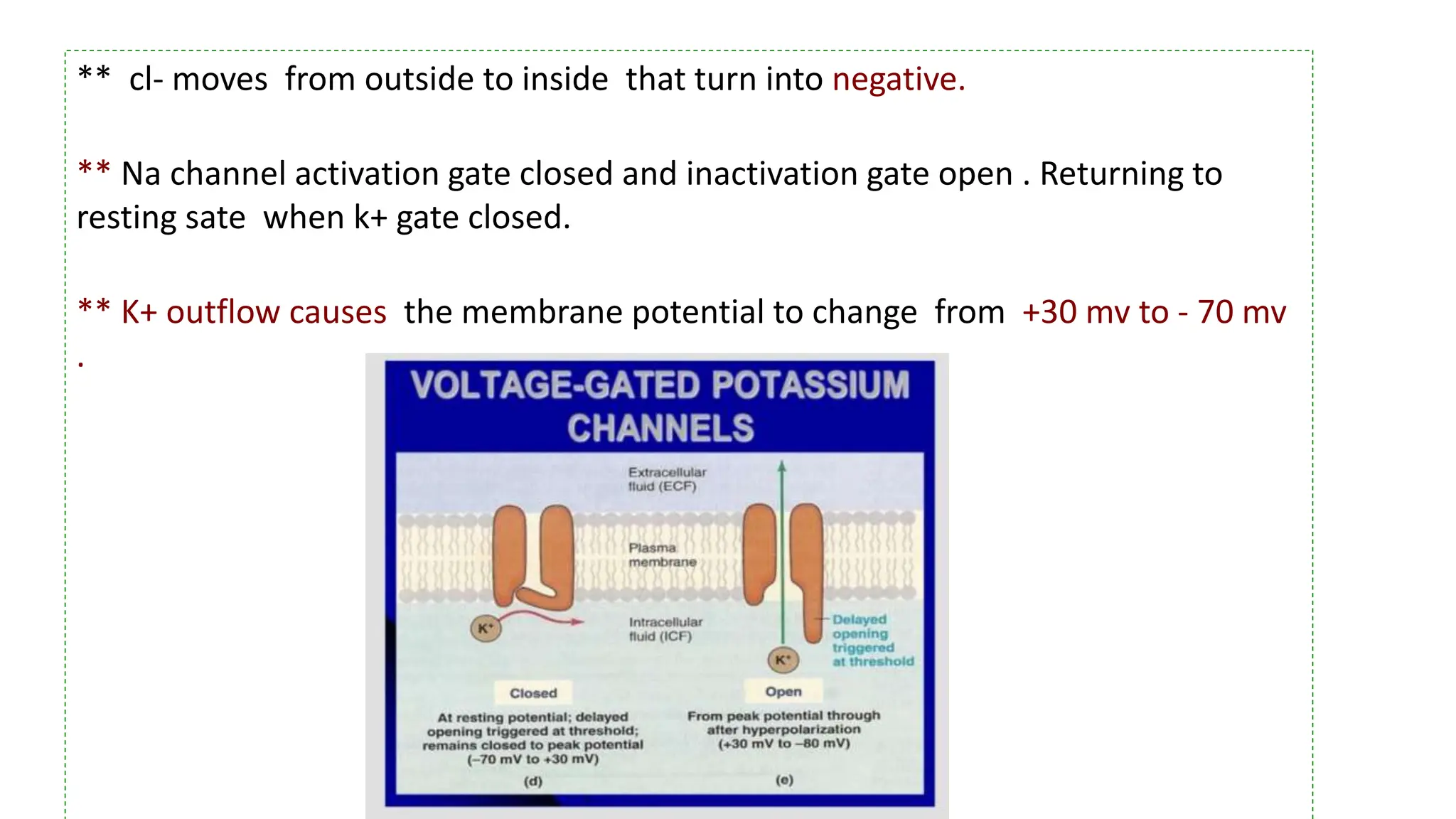
** in addition to opening voltage gated Na+ channel , threshold level depolarization also open
voltage gated k+ channel.
** voltage gated k+ channel open slowly , their opening occur at about the same time
the voltage gated Na channel are closed.
**
**The membrane start to become repolarized as some k+ Ion leave the neuron . So the
outside of the neuron becomes more positive and becomes repolarized.
** cl- moves from outside to inside that turn into negative.
** Na channel activation gate closed and inactivation gate open . Returning to
resting sate when k+ gate closed.
** K+ outflow causes the membrane potential to change from +30 mv to - 70 mv
.
Hyperpolarization phage :-
** the voltage gated k+ channel stay open a little longer outflow of k+ maybe Large
enough to cause a hyperpolarization.
**the membrane potential becomes more negative -90mv.
**As the voltage gated k+ channel close , the membrane potential return to the resting
level of -70 mv.
Refractory period :-
** the period of time after an action potential begins during which an excitable cells cannot
generate another action potential in response to a normal threshold stimulus is called the -
Refractory period.
** During refractory period interestingly Na+/k+ pump are activated by the ATP molecules.
**in Na+/k+ pump , 2k+ move inside the cell in exchange of 3k+ outside. That results into
reaching resting membrane potential.
Reference:-
** Tortora ,G. J. And Derrickson B. (2014) , principal of anatomy and
physiology. 14th edition.
Thank you for listening to

action_potentials_.pptx - phases of action potentials 1) resting phase 2) de polarization phase 3) re polarization phase 4) hyperpolarisation phase

  • 1.
    Pt. Ravishankar ShuklaUniversity " Action potential" Presented by:- Diksha Chandrakar msc biochemistry 2nd sem. Guided by:- Dr. Aarti parganiha Dr. Gyanchandra sahu
  • 2.
    Action potential:- ** Nervesignals are transmitted by Action potential. **Action potential is defined as a sudden , fast , transitory and propagating change of the resting membrane potential. ** Action potential being with a sudden change from normal resting negative membrane potential to a positive potential and end with an almost equally rapid change back to negative potential. ** The duration of nerve action potential is 0.3 ms. **The action potential arises at the trigger zone ( here , at the junction of the axon hillock and the initial segment and then propagates along the axon to the axon terminal. ( action potential will Change the membrane polarity)
  • 3.
    5 steps ofaction potential:- 1. Resting membrane potential ( resting stage) 2. Threshold ( early de polarization) 3. De polarization phage 4. Re polarization phage 5. Hyperpolarization phage
  • 4.
    1. Resting membranepotential ( resting phage):- **Resting membrane potential is an electrical potential difference ( voltage) that exists across the plasma membrane of an excitable cells under resting condition. **In neuron the resting membrane potential range from -40 to -90 mv. A typical value is - 70 mv . the minus sign is indicate that the inside of the cell is negative related to the outside . . **the cell that exhibit a membrane potential is said to be polarized, most of the body cells is polarized.
  • 5.
    1. 3. 2. ** three factorsthat contribute to the resting membrane potential:- BECAUSE the plasma membrane has more k+ leaky channels than Na+ leaky channels , the number of k+ ion leave the cell is greater then the number of Na+ ion that enter the cell. As more and more k+ ions leave the cell, the inside of the membrane become increasingly negative (-) and the outside of the membrane become increasingly positive (+).. Trapped anion cannot follow k+ out of the cell because they are attached to the nondiffusible molecules such as ATP and large protein. The electrogenic Na+ k+ ATPase ( pump) expels 3Na+ ion fir every 2k+ ion imported.
  • 6.
    Threshold:- ** An actionpotential occur in the membrane of the axon of neuron when depolarization reached a certain level termed the threshold ( about - 55mv ) . **when the depolarization reaches about -55mv a neuron will fire an action potential . This is the threshold . If the neuron does not reache this critical threshold level then no action potential will starts ** in this step some voltage gated Na+ channel open which cause Na+ to move through the channel into the cell due to stimulus. Remember Na+ has +ve charge , so the inside of the neuron becomes more positive and out side of the membrane becomes more negative
  • 7.
    ** Depolarization phage:- **when membrane potential of axon reached threshold . Voltage gated Na+ channel open rapidly. **the inflow of Na+ change the membrane potential from -55mv to +30 mv. **at the peak of action potential the inside of the membrane is 30mv more positive then the outside. ** each voltage gated Na+ channel has two seperate gates an activation gate and an inactivation gate **in the resting sate of voltage gated Na+ channel , the inactivation gate is open but activation gate is closed.
  • 8.
    ** as aresult Na+ cannot move into the cell throught this channel. ** At the threshold voltages gated Na+ channel are activated . ** In the activated stae of voltage gated Na+ channel both the activation and inactivation gate are open and Na+ inflow begins. ** As more channel open inflow increase the membrane depolarize further . ** So the inside of neuron becomes more +ve and becomes depolarized.
  • 9.
    Repolarization phage:- **after theactivation gates. Of the voltage gated Na+ channel open, the inactivation gates is close. Now the voltage gated Na+ channel is in an inactivated state. ** in addition to opening voltage gated Na+ channel , threshold level depolarization also open voltage gated k+ channel. ** voltage gated k+ channel open slowly , their opening occur at about the same time the voltage gated Na channel are closed. ** **The membrane start to become repolarized as some k+ Ion leave the neuron . So the outside of the neuron becomes more positive and becomes repolarized.
  • 10.
    ** cl- movesfrom outside to inside that turn into negative. ** Na channel activation gate closed and inactivation gate open . Returning to resting sate when k+ gate closed. ** K+ outflow causes the membrane potential to change from +30 mv to - 70 mv .
  • 11.
    Hyperpolarization phage :- **the voltage gated k+ channel stay open a little longer outflow of k+ maybe Large enough to cause a hyperpolarization. **the membrane potential becomes more negative -90mv. **As the voltage gated k+ channel close , the membrane potential return to the resting level of -70 mv.
  • 12.
    Refractory period :- **the period of time after an action potential begins during which an excitable cells cannot generate another action potential in response to a normal threshold stimulus is called the - Refractory period. ** During refractory period interestingly Na+/k+ pump are activated by the ATP molecules. **in Na+/k+ pump , 2k+ move inside the cell in exchange of 3k+ outside. That results into reaching resting membrane potential.
  • 14.
    Reference:- ** Tortora ,G.J. And Derrickson B. (2014) , principal of anatomy and physiology. 14th edition.
  • 15.
    Thank you forlistening to