Tissues: Connective Tissue
GIDEON ROBERT UNIVERSITY
ANATOMY AND PHYSIOLOGY
NSWANA CHING’AMBU
Connective Tissue
• Know
• Characteristics of connective tissue
• Cells of the connective tissue
• Classification & types of connective tissue
• Types of connective tissue proper
• Types of cartilages
• Bone
• Blood
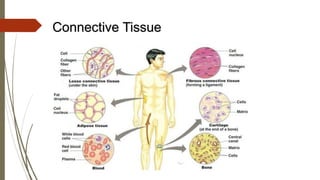
Connective Tissue
• Found everywhere in the body
• Includes the most abundant and widely
distributed tissues
• Functions
• Binds body tissues together
• Supports the body
• Provides protection
Connective Tissue
• Found everywhere in the body
• Includes the most abundant and widely
distributed tissues
• Functions
• Binds body tissues together
• Supports the body
• Provides protection
Connective Tissue Characteristics
• Consists of two basic elements -
extracellular matrix and cells.
• Extracellular matrix is non living thing
surrounding cells
• Variations in blood supply
• Some tissue types are well vascularized
• Some have poor blood supply or are avascular
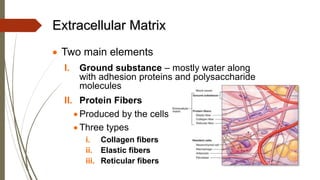
Extracellular Matrix
• Two main elements
I. Ground substance – mostly water along
with adhesion proteins and polysaccharide
molecules
II. Protein Fibers
• Produced by the cells
• Three types
i. Collagen fibers
ii. Elastic fibers
iii. Reticular fibers
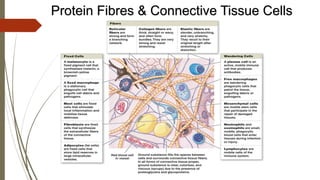
Protein Fibres & Connective Tissue Cells
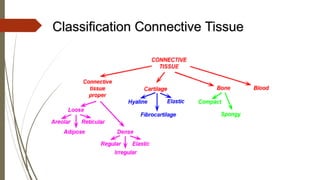
Classification Connective Tissue
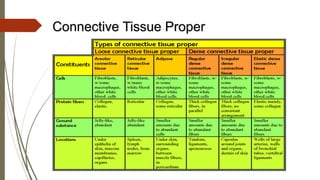
Connective Tissue Proper
Loose Connective Tissue Proper
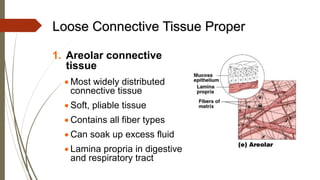
1. Areolar connective
tissue
• Most widely distributed
connective tissue
• Soft, pliable tissue
• Contains all fiber types
• Can soak up excess fluid
• Lamina propria in digestive
and respiratory tract
Loose Connective Tissue Proper
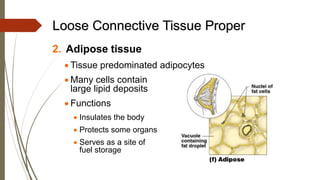
2. Adipose tissue
• Tissue predominated adipocytes
• Many cells contain
large lipid deposits
• Functions
• Insulates the body
• Protects some organs
• Serves as a site of
fuel storage
Loose Connective Tissue Proper
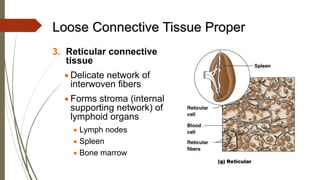
3. Reticular connective
tissue
• Delicate network of
interwoven fibers
• Forms stroma (internal
supporting network) of
lymphoid organs
• Lymph nodes
• Spleen
• Bone marrow
Dense Connective Tissue Proper
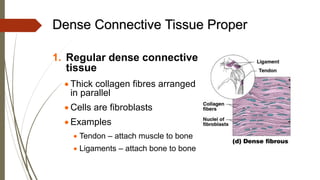
1. Regular dense connective
tissue
• Thick collagen fibres arranged
in parallel
• Cells are fibroblasts
• Examples
• Tendon – attach muscle to bone
• Ligaments – attach bone to bone
Dense Connective Tissue Proper
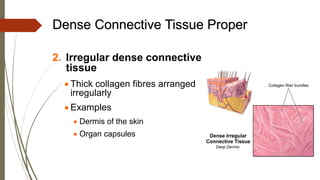
2. Irregular dense connective
tissue
• Thick collagen fibres arranged
irregularly
• Examples
• Dermis of the skin
• Organ capsules
Dense Connective Tissue Proper
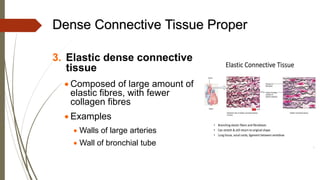
3. Elastic dense connective
tissue
• Composed of large amount of
elastic fibres, with fewer
collagen fibres
• Examples
• Walls of large arteries
• Wall of bronchial tube
Cartilage
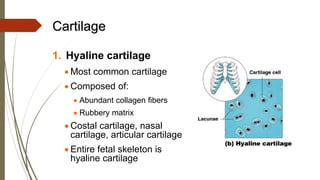
1. Hyaline cartilage
• Most common cartilage
• Composed of:
• Abundant collagen fibers
• Rubbery matrix
• Costal cartilage, nasal
cartilage, articular cartilage
• Entire fetal skeleton is
hyaline cartilage
Cartilage
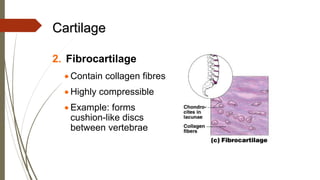
2. Fibrocartilage
• Contain collagen fibres
• Highly compressible
• Example: forms
cushion-like discs
between vertebrae
Connective Tissue Types
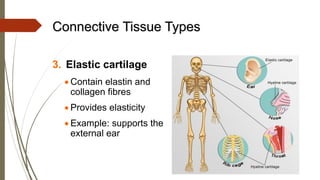
3. Elastic cartilage
• Contain elastin and
collagen fibres
• Provides elasticity
• Example: supports the
external ear
Bone
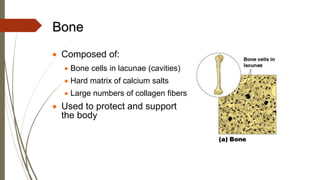
• Composed of:
• Bone cells in lacunae (cavities)
• Hard matrix of calcium salts
• Large numbers of collagen fibers
• Used to protect and support
the body
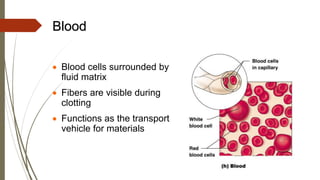
Blood
• Blood cells surrounded by
fluid matrix
• Fibers are visible during
clotting
• Functions as the transport
vehicle for materials
Tissues (connective tissue).pdf

Tissues (connective tissue).pdf

  • 1.
    Tissues: Connective Tissue GIDEONROBERT UNIVERSITY ANATOMY AND PHYSIOLOGY NSWANA CHING’AMBU
  • 2.
    Connective Tissue • Know •Characteristics of connective tissue • Cells of the connective tissue • Classification & types of connective tissue • Types of connective tissue proper • Types of cartilages • Bone • Blood
  • 3.
    Connective Tissue • Foundeverywhere in the body • Includes the most abundant and widely distributed tissues • Functions • Binds body tissues together • Supports the body • Provides protection
  • 4.
    Connective Tissue • Foundeverywhere in the body • Includes the most abundant and widely distributed tissues • Functions • Binds body tissues together • Supports the body • Provides protection
  • 5.
    Connective Tissue Characteristics •Consists of two basic elements - extracellular matrix and cells. • Extracellular matrix is non living thing surrounding cells • Variations in blood supply • Some tissue types are well vascularized • Some have poor blood supply or are avascular
  • 6.
    Extracellular Matrix • Twomain elements I. Ground substance – mostly water along with adhesion proteins and polysaccharide molecules II. Protein Fibers • Produced by the cells • Three types i. Collagen fibers ii. Elastic fibers iii. Reticular fibers
  • 7.
    Protein Fibres &Connective Tissue Cells
  • 8.
  • 9.
  • 10.
    Loose Connective TissueProper 1. Areolar connective tissue • Most widely distributed connective tissue • Soft, pliable tissue • Contains all fiber types • Can soak up excess fluid • Lamina propria in digestive and respiratory tract
  • 11.
    Loose Connective TissueProper 2. Adipose tissue • Tissue predominated adipocytes • Many cells contain large lipid deposits • Functions • Insulates the body • Protects some organs • Serves as a site of fuel storage
  • 12.
    Loose Connective TissueProper 3. Reticular connective tissue • Delicate network of interwoven fibers • Forms stroma (internal supporting network) of lymphoid organs • Lymph nodes • Spleen • Bone marrow
  • 13.
    Dense Connective TissueProper 1. Regular dense connective tissue • Thick collagen fibres arranged in parallel • Cells are fibroblasts • Examples • Tendon – attach muscle to bone • Ligaments – attach bone to bone
  • 14.
    Dense Connective TissueProper 2. Irregular dense connective tissue • Thick collagen fibres arranged irregularly • Examples • Dermis of the skin • Organ capsules
  • 15.
    Dense Connective TissueProper 3. Elastic dense connective tissue • Composed of large amount of elastic fibres, with fewer collagen fibres • Examples • Walls of large arteries • Wall of bronchial tube
  • 16.
    Cartilage 1. Hyaline cartilage •Most common cartilage • Composed of: • Abundant collagen fibers • Rubbery matrix • Costal cartilage, nasal cartilage, articular cartilage • Entire fetal skeleton is hyaline cartilage
  • 17.
    Cartilage 2. Fibrocartilage • Containcollagen fibres • Highly compressible • Example: forms cushion-like discs between vertebrae
  • 18.
    Connective Tissue Types 3.Elastic cartilage • Contain elastin and collagen fibres • Provides elasticity • Example: supports the external ear
  • 19.
    Bone • Composed of: •Bone cells in lacunae (cavities) • Hard matrix of calcium salts • Large numbers of collagen fibers • Used to protect and support the body
  • 20.
    Blood • Blood cellssurrounded by fluid matrix • Fibers are visible during clotting • Functions as the transport vehicle for materials