The Language of Anatomy
GIDEON ROBERT UNIVERSITY
ANATOMY AND PHYSIOLOGY
NSWANA CHING’AMBU
• Know
• Orientation & directional terms
• Body landmarks
• Body planes & sections
• Body cavities
• Abdominopelvic regions
• Abdominopelvic quadrants
Introduction
• Special terminology is used to prevent
misunderstanding
• Exact terms are used for:
• Position
• Direction
• Regions
• Structures
Introduction
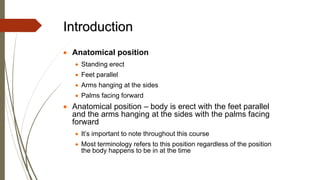
• Anatomical position
• Standing erect
• Feet parallel
• Arms hanging at the sides
• Palms facing forward
• Anatomical position – body is erect with the feet parallel
and the arms hanging at the sides with the palms facing
forward
• It’s important to note throughout this course
• Most terminology refers to this position regardless of the position
the body happens to be in at the time
Introduction
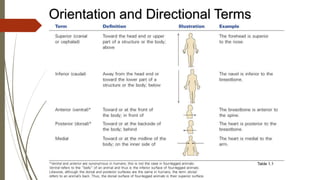
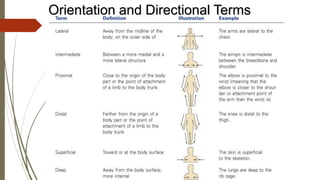
Orientation and Directional Terms
Table 1.1
Orientation and Directional Terms
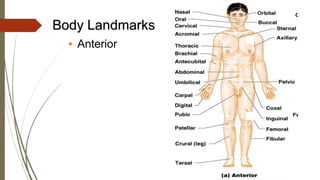
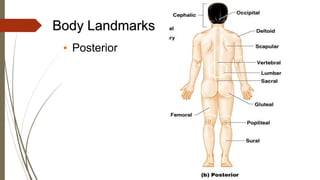
• There are many visible landmarks on the surface
of the body:
• Anterior body landmarks
• Posterior body landmarks
Regional Terms
Body Landmarks
• Anterior
Body Landmarks
• Posterior
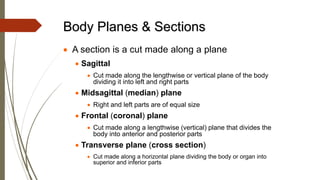
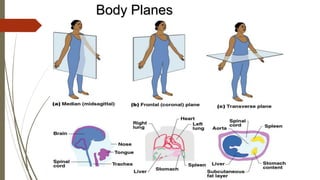
• A section is a cut made along a plane
• Sagittal
• Cut made along the lengthwise or vertical plane of the body
dividing it into left and right parts
• Midsagittal (median) plane
• Right and left parts are of equal size
• Frontal (coronal) plane
• Cut made along a lengthwise (vertical) plane that divides the
body into anterior and posterior parts
• Transverse plane (cross section)
• Cut made along a horizontal plane dividing the body or organ into
superior and inferior parts
Body Planes & Sections
Body Planes
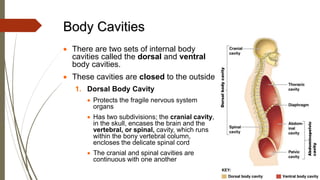
• There are two sets of internal body
cavities called the dorsal and ventral
body cavities.
• These cavities are closed to the outside
1. Dorsal Body Cavity
• Protects the fragile nervous system
organs
• Has two subdivisions; the cranial cavity,
in the skull, encases the brain and the
vertebral, or spinal, cavity, which runs
within the bony vertebral column,
encloses the delicate spinal cord
• The cranial and spinal cavities are
continuous with one another
Body Cavities
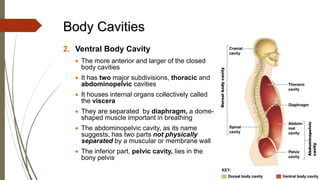
2. Ventral Body Cavity
• The more anterior and larger of the closed
body cavities
• It has two major subdivisions, thoracic and
abdominopelvic cavities
• It houses internal organs collectively called
the viscera
• They are separated by diaphragm, a dome-
shaped muscle important in breathing
• The abdominopelvic cavity, as its name
suggests, has two parts not physically
separated by a muscular or membrane wall
• The inferior part, pelvic cavity, lies in the
bony pelvis
Body Cavities
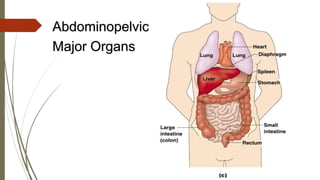
Abdominopelvic
Major Organs
• Because the abdominopelvic cavity is large and contains several
organs, it helps to divide it into smaller areas for study
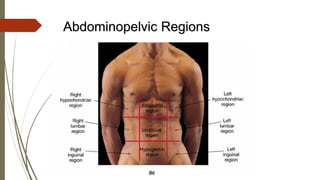
• One division method used primarily by anatomists, uses two
transverse and two parasagittal planes. These planes, divide the
cavity into nine regions
1. Epigastric region - located superior to the umbilical region (epi = upon,
above; gastri = belly)
2. Hypochondriac regions (right and left) - flank the epigastric region
laterally (chondro = cartilage)
3. Umbilical region - the centermost region deep to and surrounding the
umbilicus (navel)
4. Lumbar regions (right and left) - lie lateral to the umbilical region
(lumbus = loin)
5. Hypogastric (pubic) region - located inferior to the umbilical region
(hypo = below)
6. Inguinal or iliac regions (right and left) - located lateral to the
hypogastric region (iliac = superior part of the hip bone)
Abdominopelvic Regions
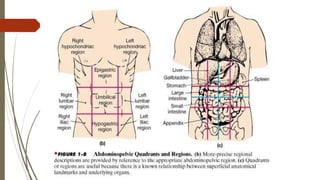
• A simpler scheme to localize the
abdominopelvic cavity organs is to
imagine one transverse and one
median sagittal plane pass through
the umbilicus at right angles
• Four quadrants are formed
1. Right upper quadrant (RUQ)
2. Left upper quadrant (LUQ)
3. Right lower quadrant (RLQ)
4. Left lower quadrant (LLQ)
Abdominopelvic Quadrants
The language of anatomy.pdf

The language of anatomy.pdf

  • 1.
    The Language ofAnatomy GIDEON ROBERT UNIVERSITY ANATOMY AND PHYSIOLOGY NSWANA CHING’AMBU
  • 2.
    • Know • Orientation& directional terms • Body landmarks • Body planes & sections • Body cavities • Abdominopelvic regions • Abdominopelvic quadrants Introduction
  • 3.
    • Special terminologyis used to prevent misunderstanding • Exact terms are used for: • Position • Direction • Regions • Structures Introduction
  • 4.
    • Anatomical position •Standing erect • Feet parallel • Arms hanging at the sides • Palms facing forward • Anatomical position – body is erect with the feet parallel and the arms hanging at the sides with the palms facing forward • It’s important to note throughout this course • Most terminology refers to this position regardless of the position the body happens to be in at the time Introduction
  • 5.
  • 6.
  • 7.
    • There aremany visible landmarks on the surface of the body: • Anterior body landmarks • Posterior body landmarks Regional Terms
  • 8.
  • 9.
  • 10.
    • A sectionis a cut made along a plane • Sagittal • Cut made along the lengthwise or vertical plane of the body dividing it into left and right parts • Midsagittal (median) plane • Right and left parts are of equal size • Frontal (coronal) plane • Cut made along a lengthwise (vertical) plane that divides the body into anterior and posterior parts • Transverse plane (cross section) • Cut made along a horizontal plane dividing the body or organ into superior and inferior parts Body Planes & Sections
  • 11.
  • 12.
    • There aretwo sets of internal body cavities called the dorsal and ventral body cavities. • These cavities are closed to the outside 1. Dorsal Body Cavity • Protects the fragile nervous system organs • Has two subdivisions; the cranial cavity, in the skull, encases the brain and the vertebral, or spinal, cavity, which runs within the bony vertebral column, encloses the delicate spinal cord • The cranial and spinal cavities are continuous with one another Body Cavities
  • 13.
    2. Ventral BodyCavity • The more anterior and larger of the closed body cavities • It has two major subdivisions, thoracic and abdominopelvic cavities • It houses internal organs collectively called the viscera • They are separated by diaphragm, a dome- shaped muscle important in breathing • The abdominopelvic cavity, as its name suggests, has two parts not physically separated by a muscular or membrane wall • The inferior part, pelvic cavity, lies in the bony pelvis Body Cavities
  • 14.
  • 15.
    • Because theabdominopelvic cavity is large and contains several organs, it helps to divide it into smaller areas for study • One division method used primarily by anatomists, uses two transverse and two parasagittal planes. These planes, divide the cavity into nine regions 1. Epigastric region - located superior to the umbilical region (epi = upon, above; gastri = belly) 2. Hypochondriac regions (right and left) - flank the epigastric region laterally (chondro = cartilage) 3. Umbilical region - the centermost region deep to and surrounding the umbilicus (navel) 4. Lumbar regions (right and left) - lie lateral to the umbilical region (lumbus = loin) 5. Hypogastric (pubic) region - located inferior to the umbilical region (hypo = below) 6. Inguinal or iliac regions (right and left) - located lateral to the hypogastric region (iliac = superior part of the hip bone) Abdominopelvic Regions
  • 16.
  • 17.
    • A simplerscheme to localize the abdominopelvic cavity organs is to imagine one transverse and one median sagittal plane pass through the umbilicus at right angles • Four quadrants are formed 1. Right upper quadrant (RUQ) 2. Left upper quadrant (LUQ) 3. Right lower quadrant (RLQ) 4. Left lower quadrant (LLQ) Abdominopelvic Quadrants