Chapter 10: Cell Growth
and Division
Growth , Development and
Reproduction
10.1: Cell Growth, Division and
Reproduction
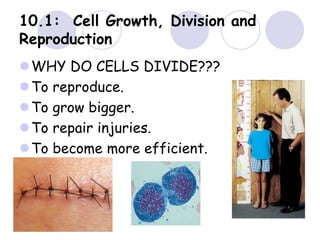
WHY DO CELLS DIVIDE???
To reproduce.
To grow bigger.
To repair injuries.
To become more efficient.
A. Limits of Cell Growth
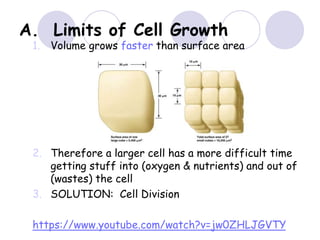
1. Volume grows faster than surface area
2. Therefore a larger cell has a more difficult time
getting stuff into (oxygen & nutrients) and out of
(wastes) the cell
3. SOLUTION: Cell Division
https://www.youtube.com/watch?v=jw0ZHLJGVTY
B. Rates of Cell Growth
1. Vary depending on cell type
2. E. Coli every 30 minutes
3. Some cells take much longer to divide or
“stop” dividing for a while
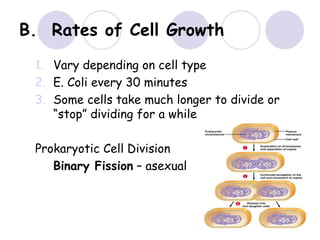
Prokaryotic Cell Division
Binary Fission – asexual
Section 10.2
Chromosomes
1. Chromosomes:
o “colored body”
o seen only when the cell divides
o contain genetic info in the form of
DNA
o are coiled chromatin
2. Composition of Chromatin
o Make up chromosomes
o Composed of DNA and protein called
histones (helps to condense the
DNA)
o DNA in a chromosome is 10,000x
longer than the chromosome itself
o Nucleosome: DNA coiled around
histones (“ball with string”)
o Nucleosomes coil into supercoils –
then into chromosomes
o Must condense in order to separate
correctly during mitosis
3. Chromosome Structure
o Can only see chromosomes
during division
o Each chromosome replicates
and is paired as sister
chromatids joined at a
centromere
o Human cell = 46 chromosomes
(2n)
1. “n” number = 23 = “haploid”
2. 2n = 46 = “diploid”
3. 4n = 92 (during interphase)
4. Body cells (aka somatic cells)
= 2n = 46 MITOSIS
5. Sex cells (aka eggs & sperm)
= n = 23 MEIOSIS
10.2 Cell Division: Mitosis & Cytokinesis
Define mitosis and cytokinesis.
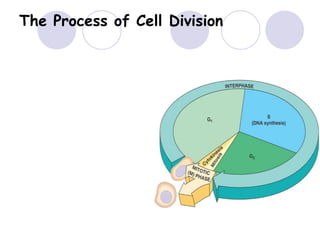
Describe the cell cycle and the changes
that take place during interphase.
Discuss the events and significance of
mitosis.
The Process of Cell Division
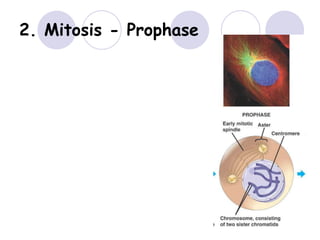
2. Mitosis - Prophase
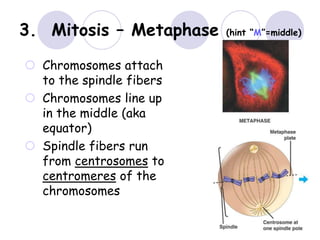
3. Mitosis – Metaphase (hint “M”=middle)
 Chromosomes attach
to the spindle fibers
 Chromosomes line up
in the middle (aka
equator)
 Spindle fibers run
from centrosomes to
centromeres of the
chromosomes
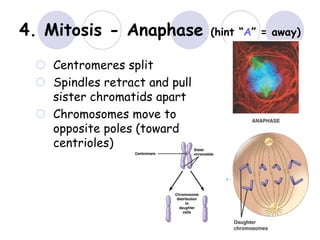
4. Mitosis - Anaphase (hint “A” = away)
 Centromeres split
 Spindles retract and pull
sister chromatids apart
 Chromosomes move to
opposite poles (toward
centrioles)
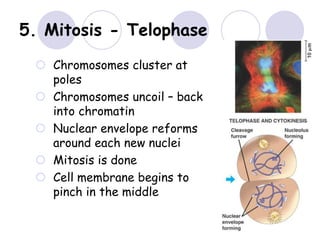
5. Mitosis - Telophase
 Chromosomes cluster at
poles
 Chromosomes uncoil – back
into chromatin
 Nuclear envelope reforms
around each new nuclei
 Mitosis is done
 Cell membrane begins to
pinch in the middle
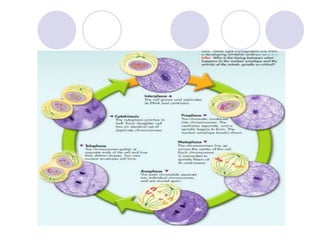
6. Cytokinesis
 Cell membrane moves inward and pinches in the middle forming
two identical cells
 In plant cells – a cell plate (eventually becomes the cell wall)
and cell membrane appear separating the 2 new cells
 There are now 2 identical cells – same DNA, etc.
Mitosis Animations
 http://media.pearsoncmg.com/bc/bc_campbell_c
oncepts_5/media/assets/interactivemedia/activit
yshared/ActivityLoader.html?c6e&12&03&8B%2
0Mitosis%20and%20Cytokinesis%20Animation
 http://media.pearsoncmg.com/bc/bc_campbell_c
oncepts_5/media/assets/videos/AnimalMitosis-
V.html
 http://www.stolaf.edu/people/giannini/flashanima
t/celldivision/crome3.swf
 Mitosis:
AP Text Animation
AP Bioflix - Mitosis
Bozeman - Mitosis
McGraw Hill - Simple Mitosis Summary
 http://www.youtube.com/watch?v=pOsAbTi9tHw Mitosis Song
 http://www.youtube.com/watch?v=1TAzsL8qQeU Scene from Twilight

Meiosis:
Meiosis Squaredance (Long)
AP Text Animation
AP Bioflix - Meiosis
Bozeman - Meiosis
Bozeman - Mitosis vs. Meiosis
Bozeman - Mitosis vs. Meiosis Simulation
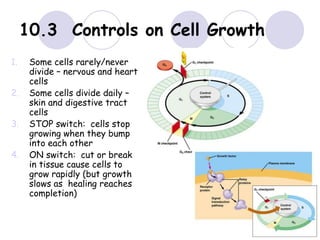
10.3 Controls on Cell Growth
1. Some cells rarely/never
divide – nervous and heart
cells
2. Some cells divide daily –
skin and digestive tract
cells
3. STOP switch: cells stop
growing when they bump
into each other
4. ON switch: cut or break
in tissue cause cells to
grow rapidly (but growth
slows as healing reaches
completion)
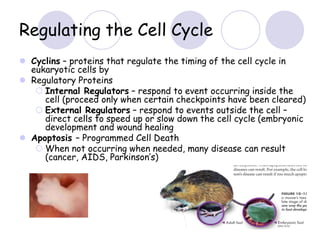
Regulating the Cell Cycle
 Cyclins – proteins that regulate the timing of the cell cycle in
eukaryotic cells by
 Regulatory Proteins
 Internal Regulators – respond to event occurring inside the
cell (proceed only when certain checkpoints have been cleared)
 External Regulators – respond to events outside the cell –
direct cells to speed up or slow down the cell cycle (embryonic
development and wound healing
 Apoptosis – Programmed Cell Death
 When not occurring when needed, many disease can result
(cancer, AIDS, Parkinson’s)
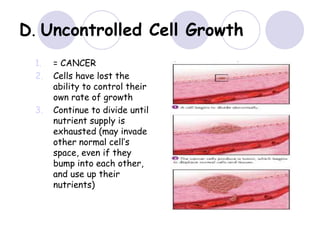
D. Uncontrolled Cell Growth
1. = CANCER
2. Cells have lost the
ability to control their
own rate of growth
3. Continue to divide until
nutrient supply is
exhausted (may invade
other normal cell’s
space, even if they
bump into each other,
and use up their
nutrients)
Cancer
 Tumor – mass of cells NOT responding to
“stop” signals
Benign – does not spread to healthy surrounding
tissue
Malignant – cancerous tumors which spread to and
destroy healthy surround tissue
Metastasis – spreading
 Causes
Genetic Defects
Can be caused by lots of different factors (smoking,
TANNING, radiation exposure, viral infections,
defective genes…)
 Treatment Options …
10.4 Cell Differentiation
 Differentiation – process by which cells become
specialized and differentiate into many different
types of cells
 Stem Cells – cells that are totipotent (able to develop
into any type of cell in the body – fertilized egg and
cells produced by first few cell divisions)
 Embryonic stem cells are considered pluripotent b/c they
produce the cells in the early embryo, can develop into
many different types, but not all types of cells
 Adult stem cells are considered multipotent b/c they can
develop into many different types of differentiated cells
(bone marrow cells can make different types of blood
cells, brain cells make neurons or nerve cells)
Pop Quiz????
1. What is the main goal of cell division?
2. What are the 3 phases of interphase?
3. What are the 4 phases of mitosis?
4. A cell has 12 chromosomes. At the end of
cell division how many cells will there be?
5. A cell has 12 chromosomes. At the end of
cell division how many chromosomes will
there be in each cell?

Chapter 10_mitosisNB.ppt

  • 1.
    Chapter 10: CellGrowth and Division Growth , Development and Reproduction
  • 2.
    10.1: Cell Growth,Division and Reproduction WHY DO CELLS DIVIDE??? To reproduce. To grow bigger. To repair injuries. To become more efficient.
  • 3.
    A. Limits ofCell Growth 1. Volume grows faster than surface area 2. Therefore a larger cell has a more difficult time getting stuff into (oxygen & nutrients) and out of (wastes) the cell 3. SOLUTION: Cell Division https://www.youtube.com/watch?v=jw0ZHLJGVTY
  • 9.
    B. Rates ofCell Growth 1. Vary depending on cell type 2. E. Coli every 30 minutes 3. Some cells take much longer to divide or “stop” dividing for a while Prokaryotic Cell Division Binary Fission – asexual
  • 10.
    Section 10.2 Chromosomes 1. Chromosomes: o“colored body” o seen only when the cell divides o contain genetic info in the form of DNA o are coiled chromatin 2. Composition of Chromatin o Make up chromosomes o Composed of DNA and protein called histones (helps to condense the DNA) o DNA in a chromosome is 10,000x longer than the chromosome itself o Nucleosome: DNA coiled around histones (“ball with string”) o Nucleosomes coil into supercoils – then into chromosomes o Must condense in order to separate correctly during mitosis
  • 14.
    3. Chromosome Structure oCan only see chromosomes during division o Each chromosome replicates and is paired as sister chromatids joined at a centromere o Human cell = 46 chromosomes (2n) 1. “n” number = 23 = “haploid” 2. 2n = 46 = “diploid” 3. 4n = 92 (during interphase) 4. Body cells (aka somatic cells) = 2n = 46 MITOSIS 5. Sex cells (aka eggs & sperm) = n = 23 MEIOSIS
  • 15.
    10.2 Cell Division:Mitosis & Cytokinesis Define mitosis and cytokinesis. Describe the cell cycle and the changes that take place during interphase. Discuss the events and significance of mitosis.
  • 16.
    The Process ofCell Division
  • 18.
    2. Mitosis -Prophase
  • 19.
    3. Mitosis –Metaphase (hint “M”=middle)  Chromosomes attach to the spindle fibers  Chromosomes line up in the middle (aka equator)  Spindle fibers run from centrosomes to centromeres of the chromosomes
  • 20.
    4. Mitosis -Anaphase (hint “A” = away)  Centromeres split  Spindles retract and pull sister chromatids apart  Chromosomes move to opposite poles (toward centrioles)
  • 21.
    5. Mitosis -Telophase  Chromosomes cluster at poles  Chromosomes uncoil – back into chromatin  Nuclear envelope reforms around each new nuclei  Mitosis is done  Cell membrane begins to pinch in the middle
  • 22.
    6. Cytokinesis  Cellmembrane moves inward and pinches in the middle forming two identical cells  In plant cells – a cell plate (eventually becomes the cell wall) and cell membrane appear separating the 2 new cells  There are now 2 identical cells – same DNA, etc.
  • 24.
    Mitosis Animations  http://media.pearsoncmg.com/bc/bc_campbell_c oncepts_5/media/assets/interactivemedia/activit yshared/ActivityLoader.html?c6e&12&03&8B%2 0Mitosis%20and%20Cytokinesis%20Animation http://media.pearsoncmg.com/bc/bc_campbell_c oncepts_5/media/assets/videos/AnimalMitosis- V.html  http://www.stolaf.edu/people/giannini/flashanima t/celldivision/crome3.swf
  • 25.
     Mitosis: AP TextAnimation AP Bioflix - Mitosis Bozeman - Mitosis McGraw Hill - Simple Mitosis Summary  http://www.youtube.com/watch?v=pOsAbTi9tHw Mitosis Song  http://www.youtube.com/watch?v=1TAzsL8qQeU Scene from Twilight  Meiosis: Meiosis Squaredance (Long) AP Text Animation AP Bioflix - Meiosis Bozeman - Meiosis Bozeman - Mitosis vs. Meiosis Bozeman - Mitosis vs. Meiosis Simulation
  • 26.
    10.3 Controls onCell Growth 1. Some cells rarely/never divide – nervous and heart cells 2. Some cells divide daily – skin and digestive tract cells 3. STOP switch: cells stop growing when they bump into each other 4. ON switch: cut or break in tissue cause cells to grow rapidly (but growth slows as healing reaches completion)
  • 27.
    Regulating the CellCycle  Cyclins – proteins that regulate the timing of the cell cycle in eukaryotic cells by  Regulatory Proteins  Internal Regulators – respond to event occurring inside the cell (proceed only when certain checkpoints have been cleared)  External Regulators – respond to events outside the cell – direct cells to speed up or slow down the cell cycle (embryonic development and wound healing  Apoptosis – Programmed Cell Death  When not occurring when needed, many disease can result (cancer, AIDS, Parkinson’s)
  • 28.
    D. Uncontrolled CellGrowth 1. = CANCER 2. Cells have lost the ability to control their own rate of growth 3. Continue to divide until nutrient supply is exhausted (may invade other normal cell’s space, even if they bump into each other, and use up their nutrients)
  • 29.
    Cancer  Tumor –mass of cells NOT responding to “stop” signals Benign – does not spread to healthy surrounding tissue Malignant – cancerous tumors which spread to and destroy healthy surround tissue Metastasis – spreading  Causes Genetic Defects Can be caused by lots of different factors (smoking, TANNING, radiation exposure, viral infections, defective genes…)  Treatment Options …
  • 30.
    10.4 Cell Differentiation Differentiation – process by which cells become specialized and differentiate into many different types of cells  Stem Cells – cells that are totipotent (able to develop into any type of cell in the body – fertilized egg and cells produced by first few cell divisions)  Embryonic stem cells are considered pluripotent b/c they produce the cells in the early embryo, can develop into many different types, but not all types of cells  Adult stem cells are considered multipotent b/c they can develop into many different types of differentiated cells (bone marrow cells can make different types of blood cells, brain cells make neurons or nerve cells)
  • 31.
    Pop Quiz???? 1. Whatis the main goal of cell division? 2. What are the 3 phases of interphase? 3. What are the 4 phases of mitosis? 4. A cell has 12 chromosomes. At the end of cell division how many cells will there be? 5. A cell has 12 chromosomes. At the end of cell division how many chromosomes will there be in each cell?