 The Gateway cloning System, invented and
commercialized by Invitrogen life
technologies since the late 1990s.
 It is a molecular biology method that enables
researchers to efficiently transfer DNA-
fragments between plasmids using an
appropriate set of recombination sequences,
the "Gateway att" sites, and two proprietary
enzyme mixes, called "LR Clonase", and "BP
Clonase"
 Gateway cloning is universal cloning method,
based upon site-specific recombination
properties of bacteriophage lambda which
facilitates the integration of lambda into E.
coli chromosome and switches between lytic
and lysogenic pathways.
 Gateway technology provides a rapid,
efficient, accurate way of moving DNA
sequences into multiple vectors for
functional analysis and protein expression.
 Gateway technology is totally based upon
recombination reaction.
 RECOMBINATION COMPONENT:
Lambda based recombination involves two
components:
1. The DNA recombination sequences (att
sites) four att sites.
2. Enzyme that mediate recombination
reaction(i.e. clonase enzyme mix)
From
lambda
From Ecoli
or
produces
in PCR-
Product
By
combination
of attB and
attP
By
combination
of attB and
attP
 Recombination reaction:
There are two types of recombination
reaction.
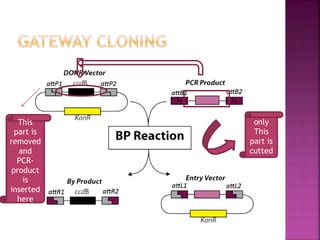
1.BP reaction:
attB * attP BP Clonae mix attL * attR
only
This
part is
cutted
This
part is
removed
and
PCR-
product
is
inserted
here
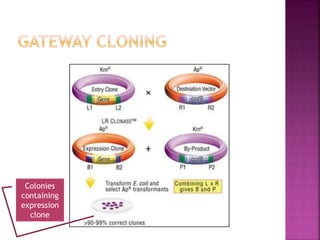
2. LR reaction
attL * attR LR clonase mix attB * attP
Colonies
containing
expression
clone
 Features of recombination reaction.
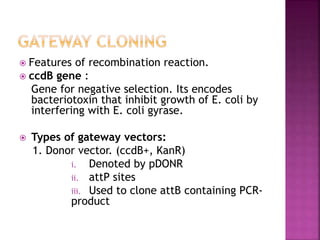
 ccdB gene :
Gene for negative selection. Its encodes
bacteriotoxin that inhibit growth of E. coli by
interfering with E. coli gyrase.
 Types of gateway vectors:
1. Donor vector. (ccdB+, KanR)
i. Denoted by pDONR
ii. attP sites
iii. Used to clone attB containing PCR-
product
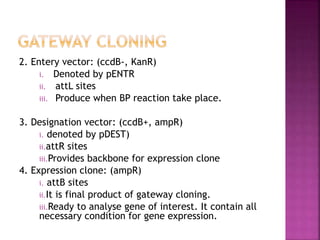
2. Entery vector: (ccdB-, KanR)
i. Denoted by pENTR
ii. attL sites
iii. Produce when BP reaction take place.
3. Designation vector: (ccdB+, ampR)
i. denoted by pDEST)
ii.attR sites
iii.Provides backbone for expression clone
4. Expression clone: (ampR)
i. attB sites
ii.It is final product of gateway cloning.
iii.Ready to analyse gene of interest. It contain all
necessary condition for gene expression.
 Features of vector.
1. Two att sites.
2. ccdB gene
3. Resistance gene
 Process of gateway cloning
a. Insert gene of insert (entry clone form)
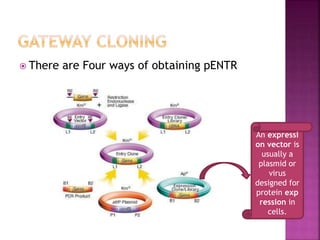
 There are Four ways of obtaining pENTR
An expressi
on vector is
usually a
plasmid or
virus
designed for
protein exp
ression in
cells.
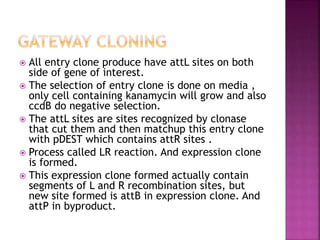
 All entry clone produce have attL sites on both
side of gene of interest.
 The selection of entry clone is done on media ,
only cell containing kanamycin will grow and also
ccdB do negative selection.
 The attL sites are sites recognized by clonase
that cut them and then matchup this entry clone
with pDEST which contains attR sites .
 Process called LR reaction. And expression clone
is formed.
 This expression clone formed actually contain
segments of L and R recombination sites, but
new site formed is attB in expression clone. And
attP in byproduct.
 This process is reversible.
 Selection media is used to select expression
clone.
 Ampcilin is added to media so, only cell
containing ampcilin will grow.
 The clone obtain in this way are 90-99%
correct.
Colonies
containing
expression
clone
APPLICATIONS:
 99% cloning efficiency delivers the clone you
need
 Maintain orientation and reading frame
throughout cloning process
 Efficient cloning of single fragments into
multiple vectors simultaneously
 Flexibility to clone multiple gene fragments into
a single construct
 Allows sub-cloning from one vector backbone to
another.
 Supports site specific recombination.
 It saves your time.

gateway cloning

  • 2.
     The Gatewaycloning System, invented and commercialized by Invitrogen life technologies since the late 1990s.  It is a molecular biology method that enables researchers to efficiently transfer DNA- fragments between plasmids using an appropriate set of recombination sequences, the "Gateway att" sites, and two proprietary enzyme mixes, called "LR Clonase", and "BP Clonase"
  • 3.
     Gateway cloningis universal cloning method, based upon site-specific recombination properties of bacteriophage lambda which facilitates the integration of lambda into E. coli chromosome and switches between lytic and lysogenic pathways.  Gateway technology provides a rapid, efficient, accurate way of moving DNA sequences into multiple vectors for functional analysis and protein expression.
  • 4.
     Gateway technologyis totally based upon recombination reaction.  RECOMBINATION COMPONENT: Lambda based recombination involves two components: 1. The DNA recombination sequences (att sites) four att sites. 2. Enzyme that mediate recombination reaction(i.e. clonase enzyme mix)
  • 5.
    From lambda From Ecoli or produces in PCR- Product By combination ofattB and attP By combination of attB and attP
  • 6.
     Recombination reaction: Thereare two types of recombination reaction. 1.BP reaction: attB * attP BP Clonae mix attL * attR
  • 7.
  • 8.
    2. LR reaction attL* attR LR clonase mix attB * attP Colonies containing expression clone
  • 9.
     Features ofrecombination reaction.  ccdB gene : Gene for negative selection. Its encodes bacteriotoxin that inhibit growth of E. coli by interfering with E. coli gyrase.  Types of gateway vectors: 1. Donor vector. (ccdB+, KanR) i. Denoted by pDONR ii. attP sites iii. Used to clone attB containing PCR- product
  • 10.
    2. Entery vector:(ccdB-, KanR) i. Denoted by pENTR ii. attL sites iii. Produce when BP reaction take place. 3. Designation vector: (ccdB+, ampR) i. denoted by pDEST) ii.attR sites iii.Provides backbone for expression clone 4. Expression clone: (ampR) i. attB sites ii.It is final product of gateway cloning. iii.Ready to analyse gene of interest. It contain all necessary condition for gene expression.
  • 11.
     Features ofvector. 1. Two att sites. 2. ccdB gene 3. Resistance gene  Process of gateway cloning a. Insert gene of insert (entry clone form)
  • 12.
     There areFour ways of obtaining pENTR An expressi on vector is usually a plasmid or virus designed for protein exp ression in cells.
  • 13.
     All entryclone produce have attL sites on both side of gene of interest.  The selection of entry clone is done on media , only cell containing kanamycin will grow and also ccdB do negative selection.  The attL sites are sites recognized by clonase that cut them and then matchup this entry clone with pDEST which contains attR sites .  Process called LR reaction. And expression clone is formed.  This expression clone formed actually contain segments of L and R recombination sites, but new site formed is attB in expression clone. And attP in byproduct.
  • 14.
     This processis reversible.  Selection media is used to select expression clone.  Ampcilin is added to media so, only cell containing ampcilin will grow.  The clone obtain in this way are 90-99% correct.
  • 15.
  • 16.
    APPLICATIONS:  99% cloningefficiency delivers the clone you need  Maintain orientation and reading frame throughout cloning process  Efficient cloning of single fragments into multiple vectors simultaneously  Flexibility to clone multiple gene fragments into a single construct  Allows sub-cloning from one vector backbone to another.  Supports site specific recombination.  It saves your time.