Cells and Batteries
Made by
Imran Yunus
Ibadul Haq Siddiqui
PortaBle Power
• A mobile phone, a laptop, an MP3 player and
a hearing aid all depend on small portable
sources of electricity: cells and batteries.
• Here we examine a range of common
commercial galvanic cells to see how they use
chemical reactions to produce electricity.
Primary Cells
Cells that can not be recharged are called
primary cells.
They go flat when the cell reaction reaches
equilibrium and you have to buy a replacement.
The products slowly migrate away from the
electrodes and are consumed by side reactions
occurring in the cell.
the zinC-CarBon dry Cell
• The first mass-produced and
widely used small-scale
source of electrical energy.
• Has changed very little in the
last 100 years.
• An electrolyte composed of
a moist paste of zinc chloride
and ammonium chloride
plays the same role as the
salt bridge.
the zinC-CarBon dry Cell
At the anode (-) oxidation of the zinc case
produces electrons:
Zn(s) → Zn2+
(aq) + 2e-
At the cathode (+) Manganese dioxide is
reduced in a complicated reaction that is
thought to be:
2MnO2(s) + 2NH4
+
(aq) + 2e-
→ Mn2O3(s) + 2NH3(aq) + H2O(l)
the zinC-CarBon dry Cell
A new cell produces about 1.5 volts, but this
diminishes significantly during use.
To maintain a net forward reaction, the soluble
reaction products must migrate away from the
electrodes.
During use the build up of products around the
electrodes slows and can even stop the forward
reaction.
This is known as polarisation. If the cell is allowed
to rest, the products migrate away from the
electrodes and the cell can recover.
alkaline Cells
• The alkaline cell is
optimised for
performance and
longevity.
• The alkaline cell is
designed for more
high capacity use
appliances than the
zinc- carbon dry cell.
AlkAline cells
• At the anode Zinc powder around the central
metal rod is oxidised:
Zn(s) → Zn2+
(aq) + 2e-
• Once formed, Zn2+
reacts immediately with OH-
ions in the electrolyte to form zinc hydroxide. The
overall reaction at the anode is therefore written
as:
Zn(s) + 2OH-
(aq) → Zn(OH)2(s) + 2e-
• At the cathode Manganese dioxide is reduced:
2MnO2(s) + H2O(l) + 2e-
→ Mn2O3(s) + 2OH-
(aq)
AlkAline cells
• They have about 5 times the life of a zinc-
carbon dry cell.
• There is no build up of electrolyte so no ‘rest’
time is needed.
• They are slightly more expensive but offer
better value for money.
Button cells
• Used in very small devices such as watches, some
calculators and remote car locks.
• There are two main types: silver-zinc cells and
lithium cells.
• Both are relatively expensive because of their
small size and the materials used to make them.
• Lithium cells produce about 3 volts during
discharge and silver-zinc cells give an almost
constant 1.6 volts.
RechARgeABle cells And BAtteRies
• Rechargeable cells, such as lithium ion cells,
are known as secondary cells or accumulators.
• To recharge a cell, the products of the
reaction must be converted back into the
original reactants: the cell reaction must occur
in reverse.
• This is done by connecting the cell to a ‘charger,’
a source of electrical energy, which has a
potential difference greater than the potential
difference of a cell.
• Electrical energy supplied by the charger is
converted into chemical energy in the cell.
• In order for it to be possible to regenerate the
reactants, the products formed in the cell during
discharge must remain in contact with the
electrodes in a convertible form.
RechARgeABle cells And BAtteRies
• Lead-acid batteries are the most widely used
type of secondary cell.
• They are relatively cheap and reliable, provide
high currents, and have a long lifetime.
• These are commonly known as car batteries,
these are used to start a car’s engine and operate
the car’s electrical accessories when the engine is
not running.
• An alternator provides electrical energy when the
car is running.
cAR BAtteRies
leAd-Acid BAtteRies
• Comprised of six separate cells connected together in
series.
• In a typical car battery each cell contains three positive
electrodes sandwiched between four negative
electrodes.
• Contact between the electrodes is prevented by the
presence of a porous separator.
• The positive electrodes consist of a lead grid packed
with PbO2, while the negative electrodes consist of a
lead grid packed with powdered lead.
• A solution of sulfuric acid (about 4M) acts as the
electrolyte.
Lead-acid batteries
• Each cell has a potential
difference of just over 2
volts.
• A car battery has six of
these cells connected in
series giving a total
potential difference of
about 12 volts.
Lead-acid batteries
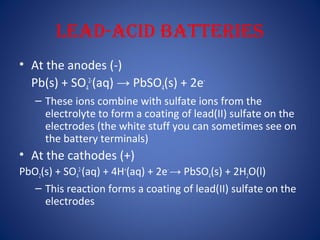
• At the anodes (-)
Pb(s) + SO4
2-
(aq) → PbSO4(s) + 2e-
– These ions combine with sulfate ions from the
electrolyte to form a coating of lead(II) sulfate on the
electrodes (the white stuff you can sometimes see on
the battery terminals)
• At the cathodes (+)
PbO2(s) + SO4
2-
(aq) + 4H+
(aq) + 2e-
→ PbSO4(s) + 2H2O(l)
– This reaction forms a coating of lead(II) sulfate on the
electrodes
Lead-acid batteries
• The two half equations can be combined as an
overall equations:
Pb(s) + PbO2(s) + 2SO4
2-
(aq) + 4H+
(aq)→ 2PbSO4(s)
+ 2H2O(l)
• The product of both electrode reactions,
lead(II) sulfate, forms as a solid on the surface
of the electrodes. This enables the battery to
be recharged.
recharging
• To recharge the battery, the electrode reactions are
reversed.
• The alternator, with a potential difference of about
14V, is used to force the electrons into the batteries
negative terminal and draw them out at the positive
terminal.
• In effect driving a spontaneous reaction backwards.
• The recharging process converts electrical energy into
chemical energy.
• What is the overall equation fro the reaction as it
recharges?
FueL ceLLs
• The major limitations of the cells we have
examined so far is that they contain relativley
small amounts of reactants.
• When the reaction reaches equilibrium, they
must either be recharged or discarded.
• Cells can be constructed in which the
reactants are supplied continuously, allowing
constant production of electrical energy.
• These devices are called fuel cells.
FueL ceLLs
• They transform chemical energy directly into electrical
energy.
• This enables efficient use to be made of the energy
released by spontaneous redox reactions.
• Energy losses such as those that occur in a coal-fired
power station are avoided.
• They are up to 80% efficient compared with 30-40%
for thermal power stations.
• In addition modern designs for fuel cells employ the
waste heat that they produce to make steam.
• This steam can be sued for heating or to operate a
turbine.
FueL ceLLs
• The fuel cell used in the
Apollo program used pure
oxygen and hydrogen gas
as reactants.
• Potassium hydroxide
solution was used as the
electrolyte and the cell
operated at about 250°C.
• This is commonly referred
to as an alkaline fuel cell.
AlkAline fuel cells
• At the anode (-):
– Hydrogen gas reacts with hydroxide ions from the
electrolyte
H2(g) + 2OH-
(aq) → 2H2O(l) + 2e-
• At the cathode (+):
O2(g) + 2H2O(l) + 4e-
→ 4OH-
(aq)
• The overall equation is:
2H2(g) + O2(g) → 2H2O(l)
fuel cells
• Each cell produces about one volt.
• Higher voltages are obtained by connecting a number
of fuel cells in series to form a battery.
• The only by-products are water and heat.
• The nature of the electrodes is crucial to successful
operation of the cell as the function as catalysts for the
reaction, and the size of the current depends on their
surface area.
• Scientists are striving to reduce the overall costs of
cells and to improve the current that can be drawn by
increasing the rate of reaction at the electrodes.
TrAnsporT
• Most major vehicle manufacturers are
investigating the use of fuel cells as an
alternative to the internal combustion engine.
• There are a number of buses that use
hydrogen-powered fuel cells.
• The use of fuel cells improves fuel efficiency
and reduces greenhouse gases and other
emissions as well as our reliance on oil.
• Look at page 438 for some other fuel cells
cell and batteries

cell and batteries

  • 1.
    Cells and Batteries Madeby Imran Yunus Ibadul Haq Siddiqui
  • 2.
    PortaBle Power • Amobile phone, a laptop, an MP3 player and a hearing aid all depend on small portable sources of electricity: cells and batteries. • Here we examine a range of common commercial galvanic cells to see how they use chemical reactions to produce electricity.
  • 3.
    Primary Cells Cells thatcan not be recharged are called primary cells. They go flat when the cell reaction reaches equilibrium and you have to buy a replacement. The products slowly migrate away from the electrodes and are consumed by side reactions occurring in the cell.
  • 4.
    the zinC-CarBon dryCell • The first mass-produced and widely used small-scale source of electrical energy. • Has changed very little in the last 100 years. • An electrolyte composed of a moist paste of zinc chloride and ammonium chloride plays the same role as the salt bridge.
  • 5.
    the zinC-CarBon dryCell At the anode (-) oxidation of the zinc case produces electrons: Zn(s) → Zn2+ (aq) + 2e- At the cathode (+) Manganese dioxide is reduced in a complicated reaction that is thought to be: 2MnO2(s) + 2NH4 + (aq) + 2e- → Mn2O3(s) + 2NH3(aq) + H2O(l)
  • 6.
    the zinC-CarBon dryCell A new cell produces about 1.5 volts, but this diminishes significantly during use. To maintain a net forward reaction, the soluble reaction products must migrate away from the electrodes. During use the build up of products around the electrodes slows and can even stop the forward reaction. This is known as polarisation. If the cell is allowed to rest, the products migrate away from the electrodes and the cell can recover.
  • 7.
    alkaline Cells • Thealkaline cell is optimised for performance and longevity. • The alkaline cell is designed for more high capacity use appliances than the zinc- carbon dry cell.
  • 8.
    AlkAline cells • Atthe anode Zinc powder around the central metal rod is oxidised: Zn(s) → Zn2+ (aq) + 2e- • Once formed, Zn2+ reacts immediately with OH- ions in the electrolyte to form zinc hydroxide. The overall reaction at the anode is therefore written as: Zn(s) + 2OH- (aq) → Zn(OH)2(s) + 2e- • At the cathode Manganese dioxide is reduced: 2MnO2(s) + H2O(l) + 2e- → Mn2O3(s) + 2OH- (aq)
  • 9.
    AlkAline cells • Theyhave about 5 times the life of a zinc- carbon dry cell. • There is no build up of electrolyte so no ‘rest’ time is needed. • They are slightly more expensive but offer better value for money.
  • 10.
    Button cells • Usedin very small devices such as watches, some calculators and remote car locks. • There are two main types: silver-zinc cells and lithium cells. • Both are relatively expensive because of their small size and the materials used to make them. • Lithium cells produce about 3 volts during discharge and silver-zinc cells give an almost constant 1.6 volts.
  • 11.
    RechARgeABle cells AndBAtteRies • Rechargeable cells, such as lithium ion cells, are known as secondary cells or accumulators. • To recharge a cell, the products of the reaction must be converted back into the original reactants: the cell reaction must occur in reverse.
  • 12.
    • This isdone by connecting the cell to a ‘charger,’ a source of electrical energy, which has a potential difference greater than the potential difference of a cell. • Electrical energy supplied by the charger is converted into chemical energy in the cell. • In order for it to be possible to regenerate the reactants, the products formed in the cell during discharge must remain in contact with the electrodes in a convertible form. RechARgeABle cells And BAtteRies
  • 13.
    • Lead-acid batteriesare the most widely used type of secondary cell. • They are relatively cheap and reliable, provide high currents, and have a long lifetime. • These are commonly known as car batteries, these are used to start a car’s engine and operate the car’s electrical accessories when the engine is not running. • An alternator provides electrical energy when the car is running. cAR BAtteRies
  • 14.
    leAd-Acid BAtteRies • Comprisedof six separate cells connected together in series. • In a typical car battery each cell contains three positive electrodes sandwiched between four negative electrodes. • Contact between the electrodes is prevented by the presence of a porous separator. • The positive electrodes consist of a lead grid packed with PbO2, while the negative electrodes consist of a lead grid packed with powdered lead. • A solution of sulfuric acid (about 4M) acts as the electrolyte.
  • 15.
    Lead-acid batteries • Eachcell has a potential difference of just over 2 volts. • A car battery has six of these cells connected in series giving a total potential difference of about 12 volts.
  • 16.
    Lead-acid batteries • Atthe anodes (-) Pb(s) + SO4 2- (aq) → PbSO4(s) + 2e- – These ions combine with sulfate ions from the electrolyte to form a coating of lead(II) sulfate on the electrodes (the white stuff you can sometimes see on the battery terminals) • At the cathodes (+) PbO2(s) + SO4 2- (aq) + 4H+ (aq) + 2e- → PbSO4(s) + 2H2O(l) – This reaction forms a coating of lead(II) sulfate on the electrodes
  • 17.
    Lead-acid batteries • Thetwo half equations can be combined as an overall equations: Pb(s) + PbO2(s) + 2SO4 2- (aq) + 4H+ (aq)→ 2PbSO4(s) + 2H2O(l) • The product of both electrode reactions, lead(II) sulfate, forms as a solid on the surface of the electrodes. This enables the battery to be recharged.
  • 18.
    recharging • To rechargethe battery, the electrode reactions are reversed. • The alternator, with a potential difference of about 14V, is used to force the electrons into the batteries negative terminal and draw them out at the positive terminal. • In effect driving a spontaneous reaction backwards. • The recharging process converts electrical energy into chemical energy. • What is the overall equation fro the reaction as it recharges?
  • 19.
    FueL ceLLs • Themajor limitations of the cells we have examined so far is that they contain relativley small amounts of reactants. • When the reaction reaches equilibrium, they must either be recharged or discarded. • Cells can be constructed in which the reactants are supplied continuously, allowing constant production of electrical energy. • These devices are called fuel cells.
  • 20.
    FueL ceLLs • Theytransform chemical energy directly into electrical energy. • This enables efficient use to be made of the energy released by spontaneous redox reactions. • Energy losses such as those that occur in a coal-fired power station are avoided. • They are up to 80% efficient compared with 30-40% for thermal power stations. • In addition modern designs for fuel cells employ the waste heat that they produce to make steam. • This steam can be sued for heating or to operate a turbine.
  • 21.
    FueL ceLLs • Thefuel cell used in the Apollo program used pure oxygen and hydrogen gas as reactants. • Potassium hydroxide solution was used as the electrolyte and the cell operated at about 250°C. • This is commonly referred to as an alkaline fuel cell.
  • 22.
    AlkAline fuel cells •At the anode (-): – Hydrogen gas reacts with hydroxide ions from the electrolyte H2(g) + 2OH- (aq) → 2H2O(l) + 2e- • At the cathode (+): O2(g) + 2H2O(l) + 4e- → 4OH- (aq) • The overall equation is: 2H2(g) + O2(g) → 2H2O(l)
  • 23.
    fuel cells • Eachcell produces about one volt. • Higher voltages are obtained by connecting a number of fuel cells in series to form a battery. • The only by-products are water and heat. • The nature of the electrodes is crucial to successful operation of the cell as the function as catalysts for the reaction, and the size of the current depends on their surface area. • Scientists are striving to reduce the overall costs of cells and to improve the current that can be drawn by increasing the rate of reaction at the electrodes.
  • 24.
    TrAnsporT • Most majorvehicle manufacturers are investigating the use of fuel cells as an alternative to the internal combustion engine. • There are a number of buses that use hydrogen-powered fuel cells. • The use of fuel cells improves fuel efficiency and reduces greenhouse gases and other emissions as well as our reliance on oil. • Look at page 438 for some other fuel cells