Dr. B. Santosh Kumar
Electrochemical Energy Systems
- I
By
Dr. B. Santosh Kumar
Introduction to battery
Classification of batteries
Primary batteries
Dry/Leclanche battery
Zn-HgO battery
Zn-Ag2O battery
Secondary batteries
Ni-Cd Battery
TOPICS
Battery is an electrochemical cell or several
electrochemical cells connected in series to produce an
electric current.
An electrochemical cell is a device that can generate
electrical energy from the chemical reactions occurring in
it, or use the electrical energy supplied to it to facilitate
chemical reactions in it. These devices are capable of
converting chemical energy into electrical energy, or vice
versa.
A battery is a device that stores chemical energy and
converts it to electrical energy. Any galvanic cell could be
used as a battery.
Introduction
Batteries are mainly classified into 3 types.
Primary batteries
Secondary Batteries
Fuel cells
Classification
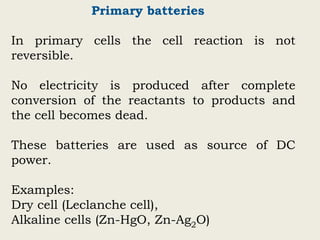
Primary batteries
In primary cells the cell reaction is not
reversible.
No electricity is produced after complete
conversion of the reactants to products and
the cell becomes dead.
These batteries are used as source of DC
power.
Examples:
Dry cell (Leclanche cell),
Alkaline cells (Zn-HgO, Zn-Ag2O)
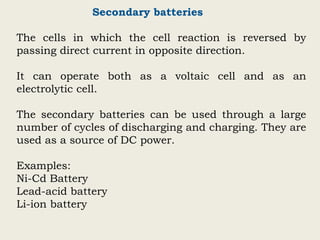
Secondary batteries
The cells in which the cell reaction is reversed by
passing direct current in opposite direction.
It can operate both as a voltaic cell and as an
electrolytic cell.
The secondary batteries can be used through a large
number of cycles of discharging and charging. They are
used as a source of DC power.
Examples:
Ni-Cd Battery
Lead-acid battery
Li-ion battery
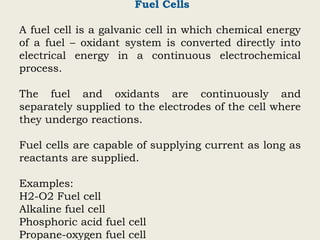
Fuel Cells
A fuel cell is a galvanic cell in which chemical energy
of a fuel – oxidant system is converted directly into
electrical energy in a continuous electrochemical
process.
The fuel and oxidants are continuously and
separately supplied to the electrodes of the cell where
they undergo reactions.
Fuel cells are capable of supplying current as long as
reactants are supplied.
Examples:
H2-O2 Fuel cell
Alkaline fuel cell
Phosphoric acid fuel cell
Propane-oxygen fuel cell
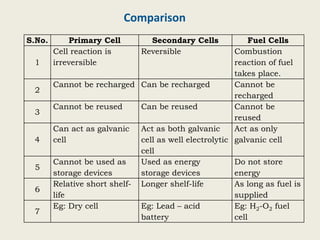
S.No. Primary Cell Secondary Cells Fuel Cells
1
Cell reaction is
irreversible
Reversible Combustion
reaction of fuel
takes place.
2
Cannot be recharged Can be recharged Cannot be
recharged
3
Cannot be reused Can be reused Cannot be
reused
4
Can act as galvanic
cell
Act as both galvanic
cell as well electrolytic
cell
Act as only
galvanic cell
5
Cannot be used as
storage devices
Used as energy
storage devices
Do not store
energy
6
Relative short shelf-
life
Longer shelf-life As long as fuel is
supplied
7
Eg: Dry cell Eg: Lead – acid
battery
Eg: H2-O2 fuel
cell
Comparison
Mechanism of working
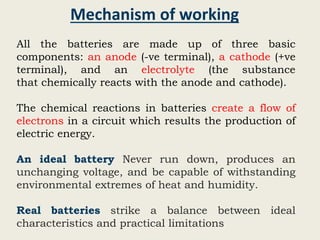
All the batteries are made up of three basic
components: an anode (-ve terminal), a cathode (+ve
terminal), and an electrolyte (the substance
that chemically reacts with the anode and cathode).
The chemical reactions in batteries create a flow of
electrons in a circuit which results the production of
electric energy.
An ideal battery Never run down, produces an
unchanging voltage, and be capable of withstanding
environmental extremes of heat and humidity.
Real batteries strike a balance between ideal
characteristics and practical limitations
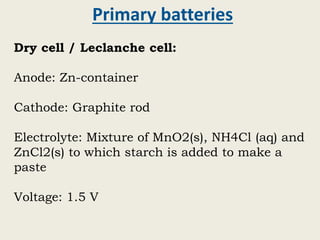
Primary batteries
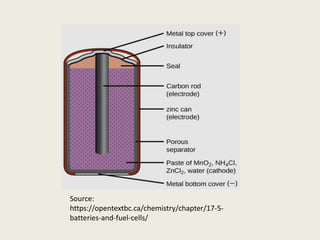
Dry cell / Leclanche cell:
Anode: Zn-container
Cathode: Graphite rod
Electrolyte: Mixture of MnO2(s), NH4Cl (aq) and
ZnCl2(s) to which starch is added to make a
paste
Voltage: 1.5 V
Source:
https://opentextbc.ca/chemistry/chapter/17-5-
batteries-and-fuel-cells/
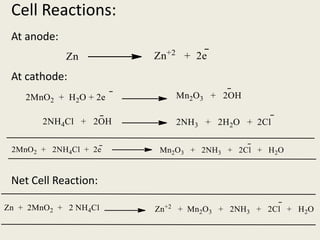
Cell Reactions:
At anode:
At cathode:
Net Cell Reaction:
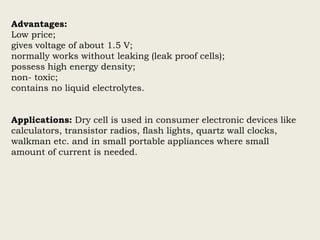
Advantages:
Low price;
gives voltage of about 1.5 V;
normally works without leaking (leak proof cells);
possess high energy density;
non- toxic;
contains no liquid electrolytes.
Applications: Dry cell is used in consumer electronic devices like
calculators, transistor radios, flash lights, quartz wall clocks,
walkman etc. and in small portable appliances where small
amount of current is needed.
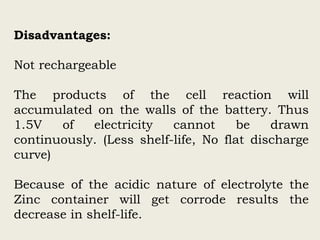
Disadvantages:
Not rechargeable
The products of the cell reaction will
accumulated on the walls of the battery. Thus
1.5V of electricity cannot be drawn
continuously. (Less shelf-life, No flat discharge
curve)
Because of the acidic nature of electrolyte the
Zinc container will get corrode results the
decrease in shelf-life.
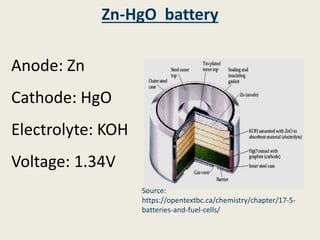
Zn-HgO battery
Anode: Zn
Cathode: HgO
Electrolyte: KOH
Voltage: 1.34V
Source:
https://opentextbc.ca/chemistry/chapter/17-5-
batteries-and-fuel-cells/
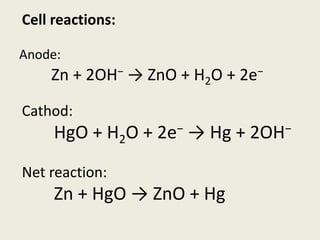
Anode:
Zn + 2OH− → ZnO + H2O + 2e−
Cathod:
HgO + H2O + 2e− → Hg + 2OH−
Net reaction:
Zn + HgO → ZnO + Hg
Cell reactions:
Advantages:
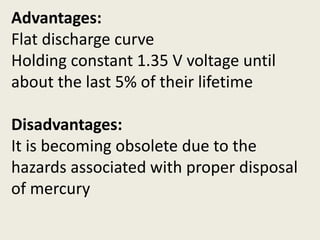
Flat discharge curve
Holding constant 1.35 V voltage until
about the last 5% of their lifetime
Disadvantages:
It is becoming obsolete due to the
hazards associated with proper disposal
of mercury
Zn-Ag2O battery
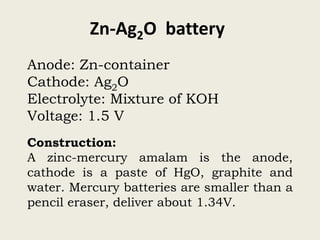
Anode: Zn-container
Cathode: Ag2O
Electrolyte: Mixture of KOH
Voltage: 1.5 V
Construction:
A zinc-mercury amalam is the anode,
cathode is a paste of HgO, graphite and
water. Mercury batteries are smaller than a
pencil eraser, deliver about 1.34V.
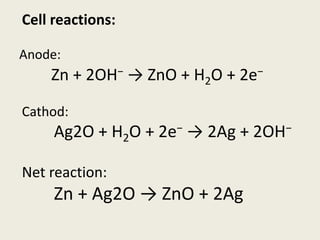
Anode:
Zn + 2OH− → ZnO + H2O + 2e−
Cathod:
Ag2O + H2O + 2e− → 2Ag + 2OH−
Net reaction:
Zn + Ag2O → ZnO + 2Ag
Cell reactions:
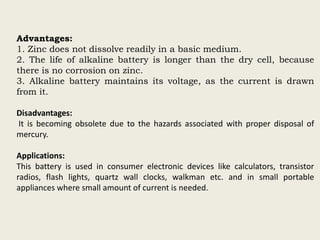
Advantages:
1. Zinc does not dissolve readily in a basic medium.
2. The life of alkaline battery is longer than the dry cell, because
there is no corrosion on zinc.
3. Alkaline battery maintains its voltage, as the current is drawn
from it.
Disadvantages:
It is becoming obsolete due to the hazards associated with proper disposal of
mercury.
Applications:
This battery is used in consumer electronic devices like calculators, transistor
radios, flash lights, quartz wall clocks, walkman etc. and in small portable
appliances where small amount of current is needed.
Secondary Batteries
Ni-Cd Battery:
Anode: Cd (s)
Cathode: NiO(OH) (s),
Electrolyte: aqueous KOH
Voltage: 1.4 V
It can be prepared by the reaction of nickel(II) hydroxide with
aqueous potassium hydroxide and bromine as the oxidant:
2 Ni(OH)2 + 2 KOH + Br2 → 2 KBr + 2 H2O + 2 NiO(OH).
The oxidation state of nickel is 3+.
Construction
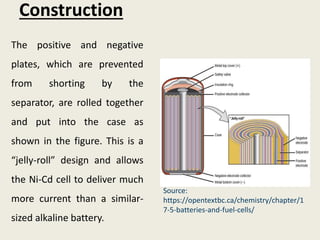
The positive and negative
plates, which are prevented
from shorting by the
separator, are rolled together
and put into the case as
shown in the figure. This is a
“jelly-roll” design and allows
the Ni-Cd cell to deliver much
more current than a similar-
sized alkaline battery.
Source:
https://opentextbc.ca/chemistry/chapter/1
7-5-batteries-and-fuel-cells/
Cell Reactions:
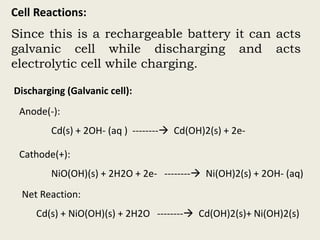
Since this is a rechargeable battery it can acts
galvanic cell while discharging and acts
electrolytic cell while charging.
Discharging (Galvanic cell):
Anode(-):
Cd(s) + 2OH- (aq ) -------- Cd(OH)2(s) + 2e-
Cathode(+):
NiO(OH)(s) + 2H2O + 2e- -------- Ni(OH)2(s) + 2OH- (aq)
Net Reaction:
Cd(s) + NiO(OH)(s) + 2H2O -------- Cd(OH)2(s)+ Ni(OH)2(s)
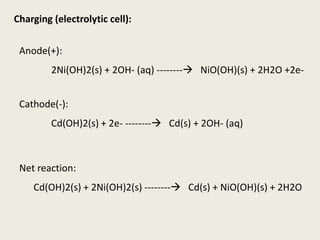
Charging (electrolytic cell):
Anode(+):
2Ni(OH)2(s) + 2OH- (aq) -------- NiO(OH)(s) + 2H2O +2e-
Cathode(-):
Cd(OH)2(s) + 2e- -------- Cd(s) + 2OH- (aq)
Net reaction:
Cd(OH)2(s) + 2Ni(OH)2(s) -------- Cd(s) + NiO(OH)(s) + 2H2O
Advantages:
1. This battery discharges about 1.2 V to 1.25 V of
voltage
2. When properly treated, a Ni-Cd battery can be
recharged about 1000 times.
3. Cadmium is a toxic heavy metal so Ni-Cd batteries
should never be opened or put into the regular
trash.
Applications:
1. It is used - in flash lights, photoflash units and
portable electronic equipments.
2. Emergency lighting systems, alarm systems.
3. Aircrafts and space satellite power systems.
4. For starting large diesel engines and gas turbines etc.

Electrochemical energy systems.pptx

  • 1.
  • 2.
    Electrochemical Energy Systems -I By Dr. B. Santosh Kumar
  • 3.
    Introduction to battery Classificationof batteries Primary batteries Dry/Leclanche battery Zn-HgO battery Zn-Ag2O battery Secondary batteries Ni-Cd Battery TOPICS
  • 4.
    Battery is anelectrochemical cell or several electrochemical cells connected in series to produce an electric current. An electrochemical cell is a device that can generate electrical energy from the chemical reactions occurring in it, or use the electrical energy supplied to it to facilitate chemical reactions in it. These devices are capable of converting chemical energy into electrical energy, or vice versa. A battery is a device that stores chemical energy and converts it to electrical energy. Any galvanic cell could be used as a battery. Introduction
  • 5.
    Batteries are mainlyclassified into 3 types. Primary batteries Secondary Batteries Fuel cells Classification
  • 6.
    Primary batteries In primarycells the cell reaction is not reversible. No electricity is produced after complete conversion of the reactants to products and the cell becomes dead. These batteries are used as source of DC power. Examples: Dry cell (Leclanche cell), Alkaline cells (Zn-HgO, Zn-Ag2O)
  • 7.
    Secondary batteries The cellsin which the cell reaction is reversed by passing direct current in opposite direction. It can operate both as a voltaic cell and as an electrolytic cell. The secondary batteries can be used through a large number of cycles of discharging and charging. They are used as a source of DC power. Examples: Ni-Cd Battery Lead-acid battery Li-ion battery
  • 8.
    Fuel Cells A fuelcell is a galvanic cell in which chemical energy of a fuel – oxidant system is converted directly into electrical energy in a continuous electrochemical process. The fuel and oxidants are continuously and separately supplied to the electrodes of the cell where they undergo reactions. Fuel cells are capable of supplying current as long as reactants are supplied. Examples: H2-O2 Fuel cell Alkaline fuel cell Phosphoric acid fuel cell Propane-oxygen fuel cell
  • 9.
    S.No. Primary CellSecondary Cells Fuel Cells 1 Cell reaction is irreversible Reversible Combustion reaction of fuel takes place. 2 Cannot be recharged Can be recharged Cannot be recharged 3 Cannot be reused Can be reused Cannot be reused 4 Can act as galvanic cell Act as both galvanic cell as well electrolytic cell Act as only galvanic cell 5 Cannot be used as storage devices Used as energy storage devices Do not store energy 6 Relative short shelf- life Longer shelf-life As long as fuel is supplied 7 Eg: Dry cell Eg: Lead – acid battery Eg: H2-O2 fuel cell Comparison
  • 10.
    Mechanism of working Allthe batteries are made up of three basic components: an anode (-ve terminal), a cathode (+ve terminal), and an electrolyte (the substance that chemically reacts with the anode and cathode). The chemical reactions in batteries create a flow of electrons in a circuit which results the production of electric energy. An ideal battery Never run down, produces an unchanging voltage, and be capable of withstanding environmental extremes of heat and humidity. Real batteries strike a balance between ideal characteristics and practical limitations
  • 11.
    Primary batteries Dry cell/ Leclanche cell: Anode: Zn-container Cathode: Graphite rod Electrolyte: Mixture of MnO2(s), NH4Cl (aq) and ZnCl2(s) to which starch is added to make a paste Voltage: 1.5 V
  • 12.
  • 13.
    Cell Reactions: At anode: Atcathode: Net Cell Reaction:
  • 14.
    Advantages: Low price; gives voltageof about 1.5 V; normally works without leaking (leak proof cells); possess high energy density; non- toxic; contains no liquid electrolytes. Applications: Dry cell is used in consumer electronic devices like calculators, transistor radios, flash lights, quartz wall clocks, walkman etc. and in small portable appliances where small amount of current is needed.
  • 15.
    Disadvantages: Not rechargeable The productsof the cell reaction will accumulated on the walls of the battery. Thus 1.5V of electricity cannot be drawn continuously. (Less shelf-life, No flat discharge curve) Because of the acidic nature of electrolyte the Zinc container will get corrode results the decrease in shelf-life.
  • 16.
    Zn-HgO battery Anode: Zn Cathode:HgO Electrolyte: KOH Voltage: 1.34V Source: https://opentextbc.ca/chemistry/chapter/17-5- batteries-and-fuel-cells/
  • 17.
    Anode: Zn + 2OH−→ ZnO + H2O + 2e− Cathod: HgO + H2O + 2e− → Hg + 2OH− Net reaction: Zn + HgO → ZnO + Hg Cell reactions:
  • 18.
    Advantages: Flat discharge curve Holdingconstant 1.35 V voltage until about the last 5% of their lifetime Disadvantages: It is becoming obsolete due to the hazards associated with proper disposal of mercury
  • 19.
    Zn-Ag2O battery Anode: Zn-container Cathode:Ag2O Electrolyte: Mixture of KOH Voltage: 1.5 V Construction: A zinc-mercury amalam is the anode, cathode is a paste of HgO, graphite and water. Mercury batteries are smaller than a pencil eraser, deliver about 1.34V.
  • 20.
    Anode: Zn + 2OH−→ ZnO + H2O + 2e− Cathod: Ag2O + H2O + 2e− → 2Ag + 2OH− Net reaction: Zn + Ag2O → ZnO + 2Ag Cell reactions:
  • 21.
    Advantages: 1. Zinc doesnot dissolve readily in a basic medium. 2. The life of alkaline battery is longer than the dry cell, because there is no corrosion on zinc. 3. Alkaline battery maintains its voltage, as the current is drawn from it. Disadvantages: It is becoming obsolete due to the hazards associated with proper disposal of mercury. Applications: This battery is used in consumer electronic devices like calculators, transistor radios, flash lights, quartz wall clocks, walkman etc. and in small portable appliances where small amount of current is needed.
  • 22.
    Secondary Batteries Ni-Cd Battery: Anode:Cd (s) Cathode: NiO(OH) (s), Electrolyte: aqueous KOH Voltage: 1.4 V It can be prepared by the reaction of nickel(II) hydroxide with aqueous potassium hydroxide and bromine as the oxidant: 2 Ni(OH)2 + 2 KOH + Br2 → 2 KBr + 2 H2O + 2 NiO(OH). The oxidation state of nickel is 3+.
  • 23.
    Construction The positive andnegative plates, which are prevented from shorting by the separator, are rolled together and put into the case as shown in the figure. This is a “jelly-roll” design and allows the Ni-Cd cell to deliver much more current than a similar- sized alkaline battery. Source: https://opentextbc.ca/chemistry/chapter/1 7-5-batteries-and-fuel-cells/
  • 24.
    Cell Reactions: Since thisis a rechargeable battery it can acts galvanic cell while discharging and acts electrolytic cell while charging. Discharging (Galvanic cell): Anode(-): Cd(s) + 2OH- (aq ) -------- Cd(OH)2(s) + 2e- Cathode(+): NiO(OH)(s) + 2H2O + 2e- -------- Ni(OH)2(s) + 2OH- (aq) Net Reaction: Cd(s) + NiO(OH)(s) + 2H2O -------- Cd(OH)2(s)+ Ni(OH)2(s)
  • 25.
    Charging (electrolytic cell): Anode(+): 2Ni(OH)2(s)+ 2OH- (aq) -------- NiO(OH)(s) + 2H2O +2e- Cathode(-): Cd(OH)2(s) + 2e- -------- Cd(s) + 2OH- (aq) Net reaction: Cd(OH)2(s) + 2Ni(OH)2(s) -------- Cd(s) + NiO(OH)(s) + 2H2O
  • 26.
    Advantages: 1. This batterydischarges about 1.2 V to 1.25 V of voltage 2. When properly treated, a Ni-Cd battery can be recharged about 1000 times. 3. Cadmium is a toxic heavy metal so Ni-Cd batteries should never be opened or put into the regular trash.
  • 27.
    Applications: 1. It isused - in flash lights, photoflash units and portable electronic equipments. 2. Emergency lighting systems, alarm systems. 3. Aircrafts and space satellite power systems. 4. For starting large diesel engines and gas turbines etc.