Chaithanya Bharathi Institute of Technology
Dr. M. Rama Devi
Assistant Professor
Chemistry Department
UNIT-II- USE OF FREE ENERGY IN CHEMICAL EQUILIBRIUM
Topic: Introduction on batteries, construction working and
applications of Li-ion batteries
Date: 10-5-2021
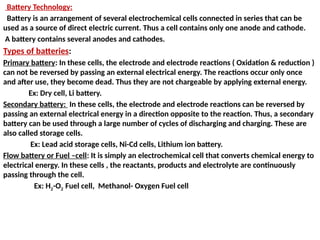
Battery Technology:
Battery is an arrangement of several electrochemical cells connected in series that can be
used as a source of direct electric current. Thus a cell contains only one anode and cathode.
A battery contains several anodes and cathodes.
Types of batteries:
Primary battery: In these cells, the electrode and electrode reactions ( Oxidation & reduction )
can not be reversed by passing an external electrical energy. The reactions occur only once
and after use, they become dead. Thus they are not chargeable by applying external energy.
Ex: Dry cell, Li battery.
Secondary battery: In these cells, the electrode and electrode reactions can be reversed by
passing an external electrical energy in a direction opposite to the reaction. Thus, a secondary
battery can be used through a large number of cycles of discharging and charging. These are
also called storage cells.
Ex: Lead acid storage cells, Ni-Cd cells, Lithium ion battery.
Flow battery or Fuel –cell: It is simply an electrochemical cell that converts chemical energy to
electrical energy. In these cells , the reactants, products and electrolyte are continuously
passing through the cell.
Ex: H2-O2 Fuel cell, Methanol- Oxygen Fuel cell
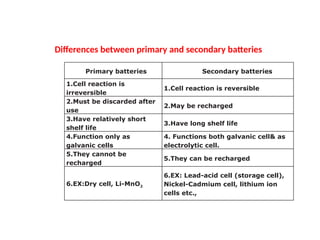
Primary batteries Secondary batteries
1.Cell reaction is
irreversible
1.Cell reaction is reversible
2.Must be discarded after
use
2.May be recharged
3.Have relatively short
shelf life
3.Have long shelf life
4.Function only as
galvanic cells
4. Functions both galvanic cell& as
electrolytic cell.
5.They cannot be
recharged
5.They can be recharged
6.EX:Dry cell, Li-MnO2
6.EX: Lead-acid cell (storage cell),
Nickel-Cadmium cell, lithium ion
cells etc.,
Differences between primary and secondary batteries
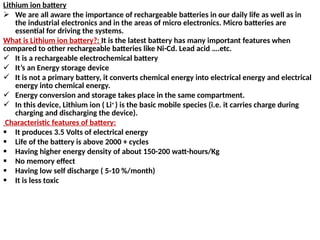
Lithium ion battery
 We are all aware the importance of rechargeable batteries in our daily life as well as in
the industrial electronics and in the areas of micro electronics. Micro batteries are
essential for driving the systems.
What is Lithium ion battery?: It is the latest battery has many important features when
compared to other rechargeable batteries like Ni-Cd. Lead acid ….etc.
 It is a rechargeable electrochemical battery
 It’s an Energy storage device
 It is not a primary battery, it converts chemical energy into electrical energy and electrical
energy into chemical energy.
 Energy conversion and storage takes place in the same compartment.
 In this device, Lithium ion ( Li+
) is the basic mobile species (i.e. it carries charge during
charging and discharging the device).
Characteristic features of battery:
 It produces 3.5 Volts of electrical energy
 Life of the battery is above 2000 + cycles
 Having higher energy density of about 150-200 watt-hours/Kg
 No memory effect
 Having low self discharge ( 5-10 %/month)
 It is less toxic
Construction:
Lithium ion battery consists of anode ,cathode and a liquid electrolyte is packed in
between the electrodes. The electrolyte permits the passage of Li+
ions from anode to
cathode and from cathode to anode through electrolyte during charging and discharging.
Functional Materials used in lithium ion battery:
 Both anode and cathode are Lithium intercalated materials with sufficient electronic
conductivity.
 Anode ( solid) : Lithium intercalated graphite, LiC6
 Cathode ( solid): lithium intercalated LiCoO2 (LixCoO2)
 Electrolyte ( liquid): Alkyl Carbonate + LiPF6 ( i.e solution of LiPF6 in a mixture of
Ethylene Carbonate & Di Methyl Carbonate ( EC- DMC) )
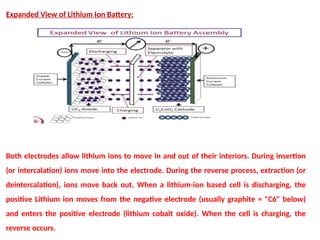
Expanded View of Lithium Ion Battery:
Both electrodes allow lithium ions to move in and out of their interiors. During insertion
(or intercalation) ions move into the electrode. During the reverse process, extraction (or
deintercalation), ions move back out. When a lithium-ion based cell is discharging, the
positive Lithium ion moves from the negative electrode (usually graphite = "C6" below)
and enters the positive electrode (lithium cobalt oxide). When the cell is charging, the
reverse occurs.
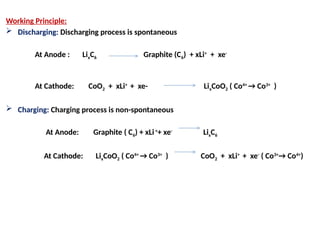
Working Principle:
 Discharging: Discharging process is spontaneous
At Anode : LixC6 Graphite (C6) + xLi+
+ xe-
At Cathode: CoO2 + xLi+
+ xe- LixCoO2 ( Co4+
→ Co3+
)
 Charging: Charging process is non-spontaneous
At Anode: Graphite ( C6) + xLi+
+ xe-
LixC6
At Cathode: LixCoO2 ( Co4+
→ Co3+
) CoO2 + xLi+
+ xe-
( Co3+
→ Co4+
)
Applications:
1) Lithium-ion batteries are common in consumer electronics
2) They are one of the most popular types of rechargeable batteries for
portable electronics, with a High energy density, small memory effect, and
only a low loss of charge when not in use
3) They are also growing in popularity for military, battery electric vehicle
and aerospace applications
Advantages: Portable and rechargeable
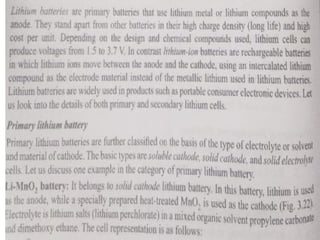
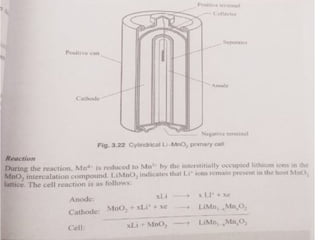
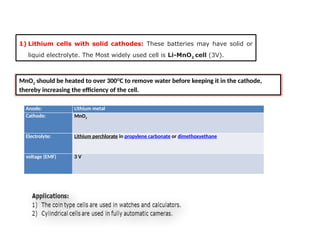
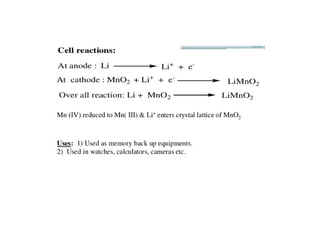
1) Lithium cells with solid cathodes: These batteries may have solid or
liquid electrolyte. The Most widely used cell is Li-MnO2 cell (3V).
Anode: Lithium metal
Cathode: MnO2
Electrolyte: Lithium perchlorate in propylene carbonate or dimethoxyethane
voltage (EMF) 3 V
MnO2 should be heated to over 300O
C to remove water before keeping it in the cathode,
thereby increasing the efficiency of the cell.
Fuelcells: Thedeviceinwhich chemicalenergyoffuel-oxidantsystemconvertedintoelectricalenergy
is known as fuel cell.
Principle: The basic principle of the fuel cell is same as that of an electrochemical cell. The fuel cell
operates like a galvanic cell. The only difference is that the fuel and oxidant stored outside of the cell.
Fuelandoxidantaresuppliedcontinuouslyandseparatelytotheelectrodesatwhichtheyundergoredox
reactions.
Fuel + oxidant Oxidation product + Electricity.
Examples: 1) Hydrogen – oxygen fuel cell 2) Methanol-oxygen fuel cell
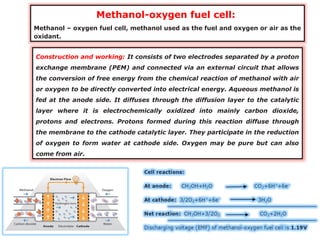
Methanol-oxygen fuel cell:
Methanol – oxygen fuel cell, methanol used as the fuel and oxygen or air as the
oxidant.
Construction and working: It consists of two electrodes separated by a proton
exchange membrane (PEM) and connected via an external circuit that allows
the conversion of free energy from the chemical reaction of methanol with air
or oxygen to be directly converted into electrical energy. Aqueous methanol is
fed at the anode side. It diffuses through the diffusion layer to the catalytic
layer where it is electrochemically oxidized into mainly carbon dioxide,
protons and electrons. Protons formed during this reaction diffuse through
the membrane to the cathode catalytic layer. They participate in the reduction
of oxygen to form water at cathode side. Oxygen may be pure but can also
come from air.
Applications:
1. Space craft applications
2. Fuel cell vehicles.
Limitations:
1) During the methanol oxidation reaction, CO2 is formed which is strongly absorbed on to platinum
catalyst, reducing the surface area and lowering the performance.
2) Methanol is toxic and flammable.
3) Limited in the power supply.

Lithium ion battery (1) -------unit.pptx

  • 1.
    Chaithanya Bharathi Instituteof Technology Dr. M. Rama Devi Assistant Professor Chemistry Department UNIT-II- USE OF FREE ENERGY IN CHEMICAL EQUILIBRIUM Topic: Introduction on batteries, construction working and applications of Li-ion batteries Date: 10-5-2021
  • 2.
    Battery Technology: Battery isan arrangement of several electrochemical cells connected in series that can be used as a source of direct electric current. Thus a cell contains only one anode and cathode. A battery contains several anodes and cathodes. Types of batteries: Primary battery: In these cells, the electrode and electrode reactions ( Oxidation & reduction ) can not be reversed by passing an external electrical energy. The reactions occur only once and after use, they become dead. Thus they are not chargeable by applying external energy. Ex: Dry cell, Li battery. Secondary battery: In these cells, the electrode and electrode reactions can be reversed by passing an external electrical energy in a direction opposite to the reaction. Thus, a secondary battery can be used through a large number of cycles of discharging and charging. These are also called storage cells. Ex: Lead acid storage cells, Ni-Cd cells, Lithium ion battery. Flow battery or Fuel –cell: It is simply an electrochemical cell that converts chemical energy to electrical energy. In these cells , the reactants, products and electrolyte are continuously passing through the cell. Ex: H2-O2 Fuel cell, Methanol- Oxygen Fuel cell
  • 3.
    Primary batteries Secondarybatteries 1.Cell reaction is irreversible 1.Cell reaction is reversible 2.Must be discarded after use 2.May be recharged 3.Have relatively short shelf life 3.Have long shelf life 4.Function only as galvanic cells 4. Functions both galvanic cell& as electrolytic cell. 5.They cannot be recharged 5.They can be recharged 6.EX:Dry cell, Li-MnO2 6.EX: Lead-acid cell (storage cell), Nickel-Cadmium cell, lithium ion cells etc., Differences between primary and secondary batteries
  • 4.
    Lithium ion battery We are all aware the importance of rechargeable batteries in our daily life as well as in the industrial electronics and in the areas of micro electronics. Micro batteries are essential for driving the systems. What is Lithium ion battery?: It is the latest battery has many important features when compared to other rechargeable batteries like Ni-Cd. Lead acid ….etc.  It is a rechargeable electrochemical battery  It’s an Energy storage device  It is not a primary battery, it converts chemical energy into electrical energy and electrical energy into chemical energy.  Energy conversion and storage takes place in the same compartment.  In this device, Lithium ion ( Li+ ) is the basic mobile species (i.e. it carries charge during charging and discharging the device). Characteristic features of battery:  It produces 3.5 Volts of electrical energy  Life of the battery is above 2000 + cycles  Having higher energy density of about 150-200 watt-hours/Kg  No memory effect  Having low self discharge ( 5-10 %/month)  It is less toxic
  • 5.
    Construction: Lithium ion batteryconsists of anode ,cathode and a liquid electrolyte is packed in between the electrodes. The electrolyte permits the passage of Li+ ions from anode to cathode and from cathode to anode through electrolyte during charging and discharging. Functional Materials used in lithium ion battery:  Both anode and cathode are Lithium intercalated materials with sufficient electronic conductivity.  Anode ( solid) : Lithium intercalated graphite, LiC6  Cathode ( solid): lithium intercalated LiCoO2 (LixCoO2)  Electrolyte ( liquid): Alkyl Carbonate + LiPF6 ( i.e solution of LiPF6 in a mixture of Ethylene Carbonate & Di Methyl Carbonate ( EC- DMC) )
  • 6.
    Expanded View ofLithium Ion Battery: Both electrodes allow lithium ions to move in and out of their interiors. During insertion (or intercalation) ions move into the electrode. During the reverse process, extraction (or deintercalation), ions move back out. When a lithium-ion based cell is discharging, the positive Lithium ion moves from the negative electrode (usually graphite = "C6" below) and enters the positive electrode (lithium cobalt oxide). When the cell is charging, the reverse occurs.
  • 7.
    Working Principle:  Discharging:Discharging process is spontaneous At Anode : LixC6 Graphite (C6) + xLi+ + xe- At Cathode: CoO2 + xLi+ + xe- LixCoO2 ( Co4+ → Co3+ )  Charging: Charging process is non-spontaneous At Anode: Graphite ( C6) + xLi+ + xe- LixC6 At Cathode: LixCoO2 ( Co4+ → Co3+ ) CoO2 + xLi+ + xe- ( Co3+ → Co4+ )
  • 8.
    Applications: 1) Lithium-ion batteriesare common in consumer electronics 2) They are one of the most popular types of rechargeable batteries for portable electronics, with a High energy density, small memory effect, and only a low loss of charge when not in use 3) They are also growing in popularity for military, battery electric vehicle and aerospace applications Advantages: Portable and rechargeable
  • 11.
    1) Lithium cellswith solid cathodes: These batteries may have solid or liquid electrolyte. The Most widely used cell is Li-MnO2 cell (3V). Anode: Lithium metal Cathode: MnO2 Electrolyte: Lithium perchlorate in propylene carbonate or dimethoxyethane voltage (EMF) 3 V MnO2 should be heated to over 300O C to remove water before keeping it in the cathode, thereby increasing the efficiency of the cell.
  • 13.
    Fuelcells: Thedeviceinwhich chemicalenergyoffuel-oxidantsystemconvertedintoelectricalenergy isknown as fuel cell. Principle: The basic principle of the fuel cell is same as that of an electrochemical cell. The fuel cell operates like a galvanic cell. The only difference is that the fuel and oxidant stored outside of the cell. Fuelandoxidantaresuppliedcontinuouslyandseparatelytotheelectrodesatwhichtheyundergoredox reactions. Fuel + oxidant Oxidation product + Electricity. Examples: 1) Hydrogen – oxygen fuel cell 2) Methanol-oxygen fuel cell
  • 14.
    Methanol-oxygen fuel cell: Methanol– oxygen fuel cell, methanol used as the fuel and oxygen or air as the oxidant. Construction and working: It consists of two electrodes separated by a proton exchange membrane (PEM) and connected via an external circuit that allows the conversion of free energy from the chemical reaction of methanol with air or oxygen to be directly converted into electrical energy. Aqueous methanol is fed at the anode side. It diffuses through the diffusion layer to the catalytic layer where it is electrochemically oxidized into mainly carbon dioxide, protons and electrons. Protons formed during this reaction diffuse through the membrane to the cathode catalytic layer. They participate in the reduction of oxygen to form water at cathode side. Oxygen may be pure but can also come from air.
  • 15.
    Applications: 1. Space craftapplications 2. Fuel cell vehicles. Limitations: 1) During the methanol oxidation reaction, CO2 is formed which is strongly absorbed on to platinum catalyst, reducing the surface area and lowering the performance. 2) Methanol is toxic and flammable. 3) Limited in the power supply.