INTRODUCTION TO
BIOCHEMISTRY
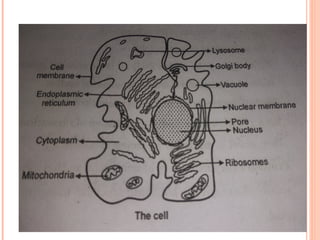
The cell
1. Plasma membrane (plasmolemma)
2. Nucleus & Nucleolus
3. Mitochondria
4. Golgi apparatus
5. Endoplasmic reticulum & Ribosomes
6. Lysosomes
7. Microtubules
8. Microfilaments
Metabolism
1. Catabolism
2. Anabolism
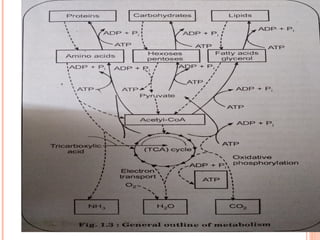
Overall view of Metabolism
1. Carbohydrate
2. Protein
3. Fat
INTRODUCTION
The study dealing with the chemistry of living
system is known as biochemistry.
The term ‘biochemistry’ was introduced by German
chemist Carl Newberg in 1903.
The basic goal of biochemistry is to determine &
explain how a collection of inanimate molecular
interact with each other to maintain life.
The knowledge of biochemistry is used to control
diseases, abnormal metabolism, & treatment of
deficiency.
In the field of pharmacy, the knowledge of Biochemistry
explain drug action, drug synthesis, & prevention of
disease.
The living cell is made up of few basic elements that
combine to form a great variety of molecules. These
molecules are called Biomolecules.
Importance of Biochemistry:
It play very important role in present century.
It deals with study of nature & working of nature &
working of biomolecules like protein, carbohydrate,
lipids & nucleic acid.
It help in study of various deficiency disease such as
scury, rickets, beriberi & pellagra due to deficiency of
various vitamins.
It is helpful in diagnosis of various metabolic disorders
like diabetic mellitus, phenylketouria, etc.
It help in synthesizing various new biomolecules for
treatment like insulin, erythropoietin, hormones, etc.
It is language of medicine, its principle & experimental
methods, all the basis of drug action, drug synthesis, &
prevention of disease.
THE CELL
Fundamental unit of biological system was recognised as
cell.
Cell is a structural & functional unit of living organisms.
They are natural setting of most biochemical reactions &
capable of carrying out various processes of life
independently
Functioning of cell & co-ordination of all biochemical
process were studied with the help of modern technique
such as electron microscope, & no. of biophysical
method
It is not simply a collection of organelles, but it illustrate
functioning of cell & metabolic co-ordination between
cell organelles.
Basic unit of cell:
DNA: It is a genetic material which occur in
chromosomes. It is made up of deoxyribonucleotide.
RNA: It is made up of ribonusleotide.They serve as
messenger for protein synthesis.
Protein: They are made up of amino acids & has
numerous activity like enzymatic, hormonal, structural,
transporting & visual.
Polysaccharide : They are storage form of energy, whose
basic unit is glucose.
Lipids : It is the membrane component & serve as long
term storage of energy.
Eg- Triacylglycerol
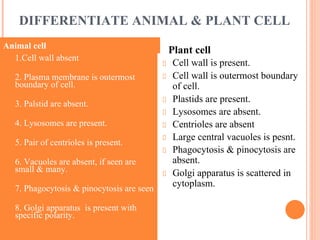
DIFFERENTIATE ANIMAL & PLANT CELL
Plant cell
Cell wall is present.
Cell wall is outermost boundary
of cell.
Plastids are present.
Lysosomes are absent.
Centrioles are absent
Large central vacuoles is pesnt.
Phagocytosis & pinocytosis are
absent.
Golgi apparatus is scattered in
cytoplasm.
Animal cell
● 1.Cell wall absent
● 2. Plasma membrane is outermost
boundary of cell.
● 3. Palstid are absent.
● 4. Lysosomes are present.
● 5. Pair of centrioles is present.
● 6. Vacuoles are absent, if seen are
small & many.
● 7. Phagocytosis & pinocytosis are seen
● 8. Golgi apparatus is present with
specific polarity.
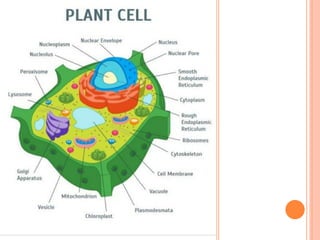
PLANT CELL
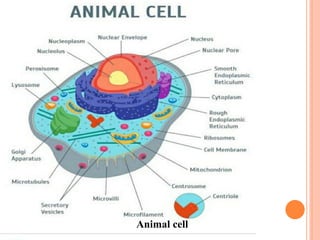
Animal cell
The structure & Functioning of each cell organelle in
short:
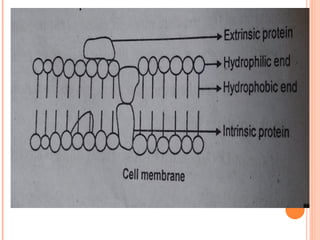
1. Plasma membrane (plasmolemma): Animal cell
bounded by a thin membrane known as Plasma
membrane/ Cell membrane.
It consist of protein & lipid.
It is having thickness of 75oA.
The principle lipid are phospholipid, sphingolipid, &
cholesterol.
The lipid is arranged in bilayer system in which
hydrophilic part is exposed to aqueous media both
outside & inside the cell.
While protein are interspread in the different section of
membrane are of two type:
Outer layer is made up of proteins & polysaccharides;
Middle layer consisit of & phospholipids & cholesterol
level
Inner layer contain protein
It is semi permeable & enclose cytoplasm which contain
important organelle.
A) Intrinsic (integral) protein: The protein which are
present inside the cell membrane is called intrinsic
protein.
B) Extrinsic ( peripheral): protein which are present
outside or attached to outer side of cell membrane is
called extrinsic protein .
Function:
1. Protect the inner part of cell.
2. Serve as selective barrier to outside, permitting entrance
of essential nutrient.
3. Secretes waste product.
4. It keep out toxic substance.
5. It prevent loss of needed substance from the cell
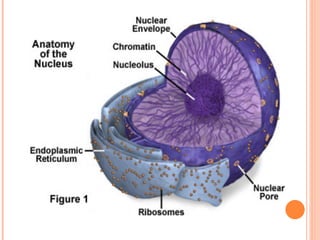
2. NUCLEUS & NUCLEOLUS:
A dense spherical structure called nucleus is present in
the center of cell.
It has double layered nuclear membrane called nuclear
envelop. The two layer are separated as outer layer &
inner layer & the space between them are called
perinuclear space.
The outer layer is covered with ribosomes & continued
with endoplasmic reticulum.
At some places two membrane are fuse to each other to
form pore for exchange of materials.
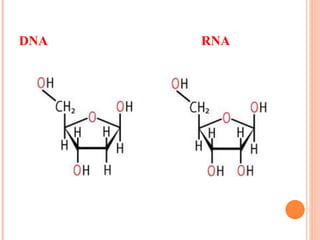
Nucleolus is composed of two important nucleic acid
1.Deoxyribonucleic acid (DNA)[ it is in chromosomes
form]
2.Ribonucleic Acid (RNA)[it is in granular form]
DNA RNA
The nucleolus is aggregation of portion of chromosomes
which are responsible for the the secretion of ribosomes.
Within nucleus, a single or more spherical bodies called
nucleoli are present.
The living matter nucleoplasm present inside the nuclear
membrane.
Nuclear membrane is double layered, porous & which
may continue with the membrane of endoplasmic
reticulum.
Functions:
1. It is a site of chromosomes &DNA directed RNA
synthesis which is involved in protein synthesis.
2. It control overall metabolic process of a cell by involving
itself in production of hormones & enzymes.
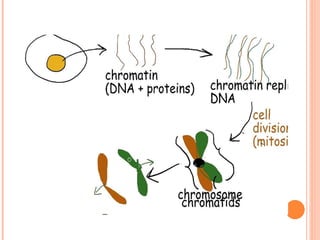
3. Nucleus contain chromatin (thread like structure) an
important component. These chromatin are distributed
in nucleus & contain DNA.
- Before cell division chromatin organize themselves in
small thread like structure called as chromosomes, this
are equally distributed to form daughter cell.
- After cell division these chromosomes are converted into
the chromatin by uncoiling.
3. Mitochondria:
They are smaller granular or elongated bodies which are
double layered present within the cytoplasm.
They are power house of the cell.
They are composed of 20% protien of liver cell & 25%
lipids which are phospholipid which contain tubular or
paired lamellae called cristae.
They vary in shape( spherical, filamentous, sausage
shape).
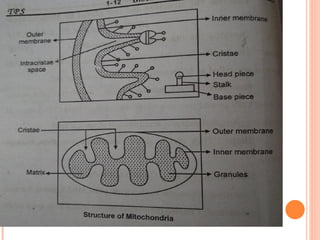
It has 2 membrane separated by 50-100oA
I. Outer membrane is half lipid & half protein.
II. The inner membrane is denser strutcure contain 75% of
protein & 25% of lipid, & it is folded to form shelf like
structure called as ccristae which are extended into
matrix.
Thus 2 spaces are distinguished
I. -Intracristaespace
II. -Matrix space
There are elementary bodies on the cristae composed of
spherical head/ knob, stalk & base piece.
Function:
1. It is power house of cell.
2. It is responsible for the conversion of chemical energy
into biological energy in the form of ATP.
3. All enzyme involved in Kreb’s cycle are present in it.
4. It is major component of animal & plant cell that are
engaged in oxidative metabolism.
5. It contain enzyme which are involved in oxidative
metabolism.
6. Many of its enzyme are involved in transportation of
electron in respiratory chain.
7. It also contain enzyme that control synthesis of lipid.
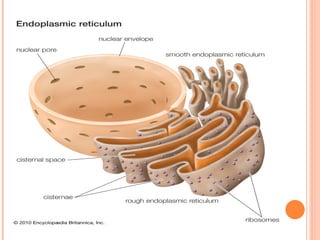
4. Endoplasmic Reticulum(ER)
The extensive network of membrane arranged in plates
& tubules in cytoplasm is called ER
These are of two type :
1. Rough ER: The ER with ribosomes on thin surface are
called RER
2. Smooth ER: The ER without ribosomes are called SER.
The interior of ER is connected to perinuclear space.
Function:
1. RER is involved in protein synthesis while SER is
concerned with lipid & glycogen synthesis.
2. The cisternae plays a role in exchange of material
between cell & extracellular fluid.
1. The exchange of material take place by the process of
diffusion , active transport & phagocytosis /
pinocytosis.
2. It is site for biochemical synthesis (protein) &
intracellular transport of molecules.
3. It is involved in cellular metabolism.
4. Give mechanical support to cell.
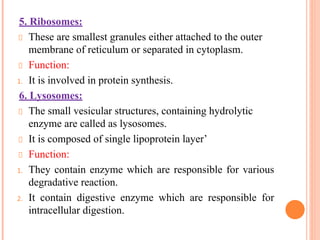
5. Ribosomes:
These are smallest granules either attached to the outer
membrane of reticulum or separated in cytoplasm.
Function:
1. It is involved in protein synthesis.
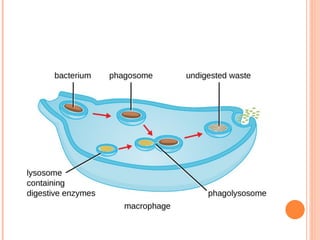
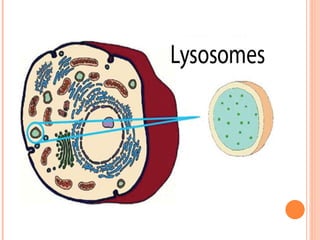
6. Lysosomes:
The small vesicular structures, containing hydrolytic
enzyme are called as lysosomes.
It is composed of single lipoprotein layer’
Function:
1. They contain enzyme which are responsible for various
degradative reaction.
2. It contain digestive enzyme which are responsible for
intracellular digestion.
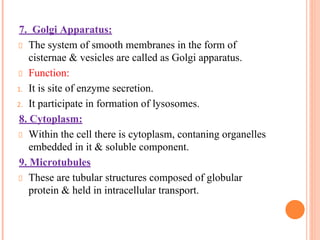
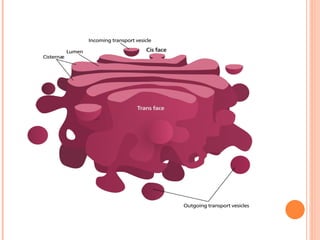
7. Golgi Apparatus:
The system of smooth membranes in the form of
cisternae & vesicles are called as Golgi apparatus.
Function:
1. It is site of enzyme secretion.
2. It participate in formation of lysosomes.
8. Cytoplasm:
Within the cell there is cytoplasm, contaning organelles
embedded in it & soluble component.
9. Microtubules
These are tubular structures composed of globular
protein & held in intracellular transport.
11. Microfilaments
These are protein filament in the cell meant for
contraction & mobility of the cell.
Animall cell is responsible to perform functions like
motility, digestion, metabolism, growth, reproduction &
irrtability.
Metabolism:
The chemical energy is tranformed to biological one, this
transformation is called metabolism.
Biochemical transformation of nutrients or chemical
substances to synthesize important biomolecule &
degrade for energy purpose is known as metabolism.
It consist of two part:
1. Catabolism
2. Anabolism
Catablism: The process in which foodstuff is degraded to
genrate energy & metabolite which are required for
anabolism is called catabolism
Eg: Oxidation of carbohydrate, amino acid, fats to
carbon dioxide & water
Anabolism : The process in which formation of new
molecules, new cells & structural & functional unit of
cell require energy & metabolite occurs. It is called
anabolism.
Eg: Amino acid Protein
Sugars polysaccharides
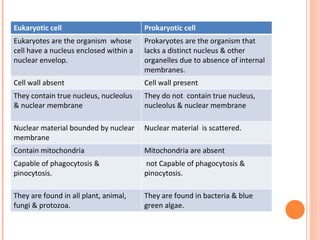
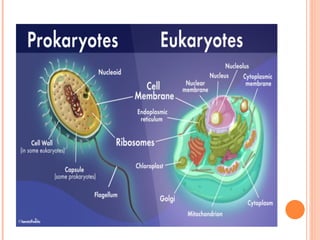
Eukaryotic cell Prokaryotic cell
Eukaryotes are the organism whose
cell have a nucleus enclosed within a
nuclear envelop.
Prokaryotes are the organism that
lacks a distinct nucleus & other
organelles due to absence of internal
membranes.
Cell wall absent Cell wall present
They contain true nucleus, nucleolus
& nuclear membrane
They do not contain true nucleus,
nucleolus & nuclear membrane
Nuclear material bounded by nuclear
membrane
Nuclear material is scattered.
Contain mitochondria Mitochondria are absent
Capable of phagocytosis &
pinocytosis.
not Capable of phagocytosis &
pinocytosis.
They are found in all plant, animal,
fungi & protozoa.
They are found in bacteria & blue
green algae.
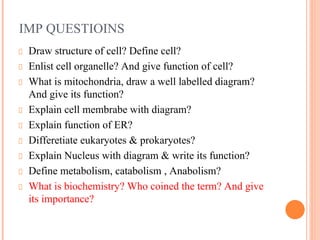
IMP QUESTIOINS
Draw structure of cell? Define cell?
Enlist cell organelle? And give function of cell?
What is mitochondria, draw a well labelled diagram?
And give its function?
Explain cell membrabe with diagram?
Explain function of ER?
Differetiate eukaryotes & prokaryotes?
Explain Nucleus with diagram & write its function?
Define metabolism, catabolism , Anabolism?
What is biochemistry? Who coined the term? And give
its importance?