Celiac Disease
And the Digestive System
Story
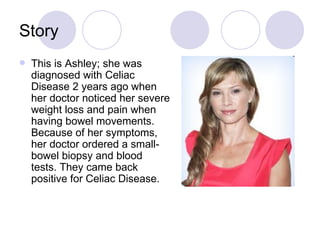
   This is Ashley; she was
    diagnosed with Celiac
    Disease 2 years ago when
    her doctor noticed her severe
    weight loss and pain when
    having bowel movements.
    Because of her symptoms,
    her doctor ordered a small-
    bowel biopsy and blood
    tests. They came back
    positive for Celiac Disease.
Celiac Disease Symptoms
   There are no typical signs and symptoms of celiac
    disease. Most people with the disease have these
    general symptoms:
       Diarrhea, either constant or off and on
       Abdominal pain
       Bloating
   Other celiac disease symptoms maybe also include:
       Irritability or depression
       Stomach upset
       Joint pain
       Muscle cramps
       Skin rash
       Mouth sores
       Dental and bone disorders (such as osteoporosis)
       Tingling in the legs and feet (neuropathy)
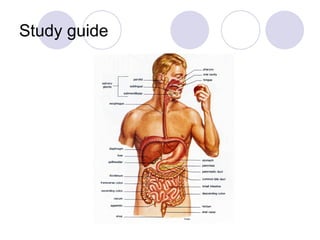
How it impacts the digestive system
   Celiac disease is a digestive condition
    triggered by consumption of the protein
    gluten, which is primarily found in foods
    containing wheat, barley or rye. People
    with celiac disease who eat foods
    containing gluten experience an immune
    reaction in their small intestines, causing
    damage to the inner surface of the small
    intestine and an inability to absorb certain
    nutrients.
How common is it and who tends to have it.
    According to National Institute of Diabetes and Digestive
     and Kidney Diseases, celiac disease affects people in all
     parts of the world. More than 2 million people in the
     United States have the disease, or about 1 in 133
     people.
    According to Mayo Clinic, celiac disease can affect
     anyone, but it tends to be more common in people who
     have:
        Type 1 diabetes
        Autoimmune thyroid disease
        Down syndrome
        Microscopic colitis
        Females
        Relatives who have it
        European ancestry
        9 to 18 months.
Risk factors if left untreated
   Left untreated, celiac disease can lead to
    several complications:
     Malnutrition

     Loss of calcium and bone density
     Lactose intolerance

     Cancer

     Neurological complications

     Lower immune system
Treatment
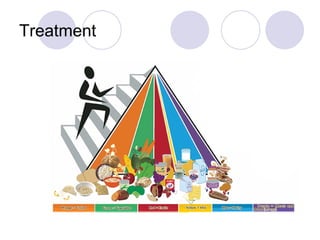
   Celiac disease has no cure, but you can effectively
    manage the disease through changing your diet. To
    manage the disease and prevent complications, it's
    crucial that you avoid all foods that contain gluten,
    including:
       Barley
       Bulgur
       Durum
       Farina
       Graham flour
       Rye
       Semolina
       Spelt (a form of wheat)
       Triticale
       Wheat
   Your doctor may refer you to a dietitian, who can help
    you plan a healthy gluten-free diet.
Treatment
Treatment & their side effects
   If you accidentally eat a product that contains gluten, you
    may experience abdominal pain and diarrhea. Some
    people experience no signs or symptoms after eating
    gluten, but this doesn't mean it's not harmful. Even trace
    amounts of gluten in your diet can be damaging, whether
    or not they cause signs or symptoms.
   In cases of severe inflammation in the small intestine,
    your doctor may recommend medications steroids to
    control inflammation. Steroids may be used to give you
    relief from severe signs and symptoms until the effects of
    a gluten-free diet begin to become apparent.
Treatment & their side effects
   If nutritional deficiencies are severe, a person may need
    to take vitamin and mineral supplements recommended
    by a doctor or dietitian to help correct these deficiencies.
    The doctor may recommend supplements to increase
    your levels of:
       Calcium
       Folate
       Iron
       Vitamin B-12
       Vitamin D
       Vitamin K
   Vitamin supplements can be taken in pill form. But in
    some situations, the digestive tract may have trouble
    absorbing vitamins. In these cases, the doctor may give
    the vitamins by injection.
Only treatment & how well it works
   This is the only way to treat Celia disease.
    It works well to stop the problems Celia
    disease causes, but it is hard to maintain
    this diet.
Clinical Trials
   There are three clinical trails going on right now.
   One of the clinical trials, is trying to figure out a way to
    prevent it. They are doing this by identifying children at
    high genetic risk (around 10%) and in a follow-up study
    to define:
   Are the age, dose of gluten and presence of
    simultaneous breast feeding at the introduction of gluten
    associated with the risk of celiac disease?
   Is it possible to decrease the frequency of celiac disease
    by nutritional counseling?
   Is it possible to predict development of celiac disease by
    immunological tests before the development of mucosal
    lesion
Clinical Trials
   The second clinical trail is trying to figure if intestinal
    parasites from humans in developed countries may be
    responsible for the upsurge in many diseases including
    Celiac Disease.
   The last clinical trial is a biotechnology company
    developing an immunotherapeutic vaccine. The
    therapeutic vaccine combines three proprietary peptides
    that draw out an immune response in patients with celiac
    disease. The Nexvax2 immunotherapy is designed to
    desensitize celiac disease patients to the toxic effects of
    gluten.
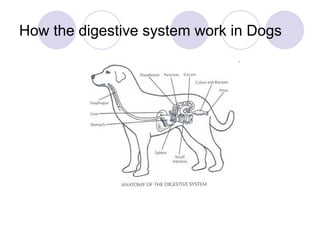
How the digestive system work in Dogs
   The digestive system of a dog consists of the teeth, esophagus,
    stomach, small intestine, and large intestine. The liver and
    pancreas also aid in digestion although food does not actually enter
    either organ. Food enters the digestive tract through the mouth
    where food is chewed before passing into the esophagus. The
    esophagus leads to the stomach and has thick, elastic walls that
    allow the dog to swallow large items. Glands in the stomach
    produce acid and enzymes which aid digestion. The stomach also
    holds food until it is ready to pass through the pyloric sphincter into
    the duodenum, the first part of the small intestine. Peristalsis moves
    food through the small intestine where it is mixed with enzymes from
    the liver and pancreas. Nutrients are absorbed from the small
    intestine into the bloodstream. Fluid is absorbed in the large
    intestine. The large intestine also contains bacteria which help to
    break down wastes which are then excreted
How the digestive system work in Dogs
Study guide
Works Cited
   "Celiac disease." Pubmed health. PubMed HealthD,
    2010. Web. 30 Jan 2012.
    <http://www.ncbi.nlm.nih.gov/pubmedhealth/PMH000128
    0/>.
   Mayo Clinic Staff, Celiac disease. N.p., 2011. Web. 30
    Jan 2012. <http://www.mayoclinic.com/health/celiac-
    disease/DS00319>.
   National Institute of Diabetes and Digestive and Kidney
    Diseases , . "Celiac Disease." National digestive
    diseases information clearinghouse (nddic). National
    Digestive Diseases Information Clearingho, 2008. Web.
    30 Jan 2012.
    <http://digestive.niddk.nih.gov/ddiseases/pubs/celiac/>.
Works Cited Continued.
 "Phase 1 Clinical Trial of Celiac Disease Vaccine Shows Promising
  Results." National Foundation for Celiac Disease. NFCA, 5/10/2011.
  Web. 30 Jan 2012. <http://www.celiaccentral.org/News/News-
  Feeds/View-Research-News/Celiac-Disease-
  Research/134/vobid--5443/>.
 "General Physiology of Dogs." Thermoregulation in Dogs. Davidson
  College, n.d. Web. 30 Jan 2012.
  <http://www.bio.davidson.edu/Courses/anphys/2000/Hatfield/Hatfiel
  d2.htm>.
 Matthew. "Photos." FrontPoint Systems. medwonders
    networking for health, 2012. Web. 31 Jan 2012.
    <http://www.medwonders.com/member/Matthew/view-
    photo/82>.
   "Health Matters." Tigertail Foods. Tigertail Foods, 2008. Web. 31
    Jan 2012. <https://tigertailfoods.com/health-matters-may-11.php>.

Celiac disease

  • 1.
    Celiac Disease And theDigestive System
  • 2.
    Story  This is Ashley; she was diagnosed with Celiac Disease 2 years ago when her doctor noticed her severe weight loss and pain when having bowel movements. Because of her symptoms, her doctor ordered a small- bowel biopsy and blood tests. They came back positive for Celiac Disease.
  • 3.
    Celiac Disease Symptoms  There are no typical signs and symptoms of celiac disease. Most people with the disease have these general symptoms:  Diarrhea, either constant or off and on  Abdominal pain  Bloating  Other celiac disease symptoms maybe also include:  Irritability or depression  Stomach upset  Joint pain  Muscle cramps  Skin rash  Mouth sores  Dental and bone disorders (such as osteoporosis)  Tingling in the legs and feet (neuropathy)
  • 4.
    How it impactsthe digestive system  Celiac disease is a digestive condition triggered by consumption of the protein gluten, which is primarily found in foods containing wheat, barley or rye. People with celiac disease who eat foods containing gluten experience an immune reaction in their small intestines, causing damage to the inner surface of the small intestine and an inability to absorb certain nutrients.
  • 5.
    How common isit and who tends to have it.  According to National Institute of Diabetes and Digestive and Kidney Diseases, celiac disease affects people in all parts of the world. More than 2 million people in the United States have the disease, or about 1 in 133 people.  According to Mayo Clinic, celiac disease can affect anyone, but it tends to be more common in people who have:  Type 1 diabetes  Autoimmune thyroid disease  Down syndrome  Microscopic colitis  Females  Relatives who have it  European ancestry  9 to 18 months.
  • 6.
    Risk factors ifleft untreated  Left untreated, celiac disease can lead to several complications:  Malnutrition  Loss of calcium and bone density  Lactose intolerance  Cancer  Neurological complications  Lower immune system
  • 7.
    Treatment  Celiac disease has no cure, but you can effectively manage the disease through changing your diet. To manage the disease and prevent complications, it's crucial that you avoid all foods that contain gluten, including:  Barley  Bulgur  Durum  Farina  Graham flour  Rye  Semolina  Spelt (a form of wheat)  Triticale  Wheat  Your doctor may refer you to a dietitian, who can help you plan a healthy gluten-free diet.
  • 8.
  • 9.
    Treatment & theirside effects  If you accidentally eat a product that contains gluten, you may experience abdominal pain and diarrhea. Some people experience no signs or symptoms after eating gluten, but this doesn't mean it's not harmful. Even trace amounts of gluten in your diet can be damaging, whether or not they cause signs or symptoms.  In cases of severe inflammation in the small intestine, your doctor may recommend medications steroids to control inflammation. Steroids may be used to give you relief from severe signs and symptoms until the effects of a gluten-free diet begin to become apparent.
  • 10.
    Treatment & theirside effects  If nutritional deficiencies are severe, a person may need to take vitamin and mineral supplements recommended by a doctor or dietitian to help correct these deficiencies. The doctor may recommend supplements to increase your levels of:  Calcium  Folate  Iron  Vitamin B-12  Vitamin D  Vitamin K  Vitamin supplements can be taken in pill form. But in some situations, the digestive tract may have trouble absorbing vitamins. In these cases, the doctor may give the vitamins by injection.
  • 11.
    Only treatment &how well it works  This is the only way to treat Celia disease. It works well to stop the problems Celia disease causes, but it is hard to maintain this diet.
  • 12.
    Clinical Trials  There are three clinical trails going on right now.  One of the clinical trials, is trying to figure out a way to prevent it. They are doing this by identifying children at high genetic risk (around 10%) and in a follow-up study to define:  Are the age, dose of gluten and presence of simultaneous breast feeding at the introduction of gluten associated with the risk of celiac disease?  Is it possible to decrease the frequency of celiac disease by nutritional counseling?  Is it possible to predict development of celiac disease by immunological tests before the development of mucosal lesion
  • 13.
    Clinical Trials  The second clinical trail is trying to figure if intestinal parasites from humans in developed countries may be responsible for the upsurge in many diseases including Celiac Disease.  The last clinical trial is a biotechnology company developing an immunotherapeutic vaccine. The therapeutic vaccine combines three proprietary peptides that draw out an immune response in patients with celiac disease. The Nexvax2 immunotherapy is designed to desensitize celiac disease patients to the toxic effects of gluten.
  • 14.
    How the digestivesystem work in Dogs  The digestive system of a dog consists of the teeth, esophagus, stomach, small intestine, and large intestine. The liver and pancreas also aid in digestion although food does not actually enter either organ. Food enters the digestive tract through the mouth where food is chewed before passing into the esophagus. The esophagus leads to the stomach and has thick, elastic walls that allow the dog to swallow large items. Glands in the stomach produce acid and enzymes which aid digestion. The stomach also holds food until it is ready to pass through the pyloric sphincter into the duodenum, the first part of the small intestine. Peristalsis moves food through the small intestine where it is mixed with enzymes from the liver and pancreas. Nutrients are absorbed from the small intestine into the bloodstream. Fluid is absorbed in the large intestine. The large intestine also contains bacteria which help to break down wastes which are then excreted
  • 15.
    How the digestivesystem work in Dogs
  • 16.
  • 17.
    Works Cited  "Celiac disease." Pubmed health. PubMed HealthD, 2010. Web. 30 Jan 2012. <http://www.ncbi.nlm.nih.gov/pubmedhealth/PMH000128 0/>.  Mayo Clinic Staff, Celiac disease. N.p., 2011. Web. 30 Jan 2012. <http://www.mayoclinic.com/health/celiac- disease/DS00319>.  National Institute of Diabetes and Digestive and Kidney Diseases , . "Celiac Disease." National digestive diseases information clearinghouse (nddic). National Digestive Diseases Information Clearingho, 2008. Web. 30 Jan 2012. <http://digestive.niddk.nih.gov/ddiseases/pubs/celiac/>.
  • 18.
    Works Cited Continued. "Phase 1 Clinical Trial of Celiac Disease Vaccine Shows Promising Results." National Foundation for Celiac Disease. NFCA, 5/10/2011. Web. 30 Jan 2012. <http://www.celiaccentral.org/News/News- Feeds/View-Research-News/Celiac-Disease- Research/134/vobid--5443/>.  "General Physiology of Dogs." Thermoregulation in Dogs. Davidson College, n.d. Web. 30 Jan 2012. <http://www.bio.davidson.edu/Courses/anphys/2000/Hatfield/Hatfiel d2.htm>.  Matthew. "Photos." FrontPoint Systems. medwonders networking for health, 2012. Web. 31 Jan 2012. <http://www.medwonders.com/member/Matthew/view- photo/82>.  "Health Matters." Tigertail Foods. Tigertail Foods, 2008. Web. 31 Jan 2012. <https://tigertailfoods.com/health-matters-may-11.php>.

Editor's Notes

  • #15 Human’s and dog’s digestive system work in the same way.