Malabsorption Syndromes
Prepared by
Tarek Sheta
Lecturer of internal medicine
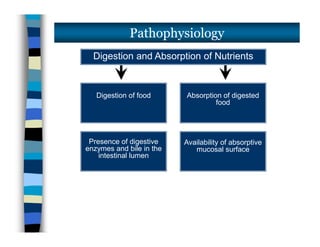
Pathophysiology
Digestion and Absorption of Nutrients
Digestion of food Absorption of digested
food
Presence of digestive
enzymes and bile in the
intestinal lumen
Availability of absorptive
mucosal surface
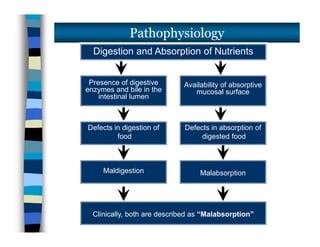
Pathophysiology
Defects in digestion of
food
Defects in absorption of
digested food
Presence of digestive
enzymes and bile in the
intestinal lumen
Availability of absorptive
mucosal surface
Digestion and Absorption of Nutrients
Maldigestion Malabsorption
Defects in digestion of
food
Defects in absorption of
digested food
Clinically, both are described as “Malabsorption”
Clinical Presentation
 Malabsorption may involve:
– a broad range of nutrients i.e. panmalabsorption.
– only a single nutrient or a class of nutrients i.e.
specific malabsorption.
 Symptoms and signs of the disease depend
on the deficiency of the nutrient(s) that is
malabsorbed.
 Malabsorption may involve:
– a broad range of nutrients i.e. panmalabsorption.
– only a single nutrient or a class of nutrients i.e.
specific malabsorption.
 Symptoms and signs of the disease depend
on the deficiency of the nutrient(s) that is
malabsorbed.
 Steatorrhea: bulky,
floating, malodorous
stool-difficult to flush.
 Weight loss.
 Flatulence.
 Weakness and
fatigue.
 Paresthesias.
 Tetany.
 Diffuse abdominal
pain.
 Symptoms of anemia.
 Bone aches.
 Abnormal bruising.
 Milk intolerance.
 Night blindness.
 Amenorrhea &
infertility.
Symptoms
 Steatorrhea: bulky,
floating, malodorous
stool-difficult to flush.
 Weight loss.
 Flatulence.
 Weakness and
fatigue.
 Paresthesias.
 Tetany.
 Diffuse abdominal
pain.
 Symptoms of anemia.
 Bone aches.
 Abnormal bruising.
 Milk intolerance.
 Night blindness.
 Amenorrhea &
infertility.
Signs
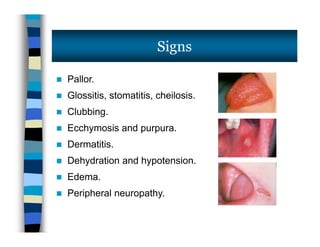
 Pallor.
 Glossitis, stomatitis, cheilosis.
 Clubbing.
 Ecchymosis and purpura.
 Dermatitis.
 Dehydration and hypotension.
 Edema.
 Peripheral neuropathy.
 Pallor.
 Glossitis, stomatitis, cheilosis.
 Clubbing.
 Ecchymosis and purpura.
 Dermatitis.
 Dehydration and hypotension.
 Edema.
 Peripheral neuropathy.
 Blood Screening Tests
– Hemoglobin: low.
– Serum levels of calcium, albumin, iron, vitamin
B12, folate, carotene, cholesterol:low.
– Prothrombin time (PT): prolonged.
 Quantitative fecal fat:
- Patient should be on daily diet containing 80-100
gms of fat.
- Fecal fat estimated on 72 H collection.
- 6 grams or more of fat/day is abnormal.
- May be due to: - Pancreatic
- Small intestinal
- Hepatobiliary disease
Investigations
 Blood Screening Tests
– Hemoglobin: low.
– Serum levels of calcium, albumin, iron, vitamin
B12, folate, carotene, cholesterol:low.
– Prothrombin time (PT): prolonged.
 Quantitative fecal fat:
- Patient should be on daily diet containing 80-100
gms of fat.
- Fecal fat estimated on 72 H collection.
- 6 grams or more of fat/day is abnormal.
- May be due to: - Pancreatic
- Small intestinal
- Hepatobiliary disease
 D-xylose Absorption Test:
- Normally, afer oral digestion of 25 gm.
Xylose, at least 1/5 the amount (5 gm.)
passes in urine.
- If > 5gm. passes in urine: Maldigestion.
- If < 5gm. passes in urine: Malabsorption.
 Small bowel biopsy
 Tests for pancreatic structure and
function
Investigations
 D-xylose Absorption Test:
- Normally, afer oral digestion of 25 gm.
Xylose, at least 1/5 the amount (5 gm.)
passes in urine.
- If > 5gm. passes in urine: Maldigestion.
- If < 5gm. passes in urine: Malabsorption.
 Small bowel biopsy
 Tests for pancreatic structure and
function
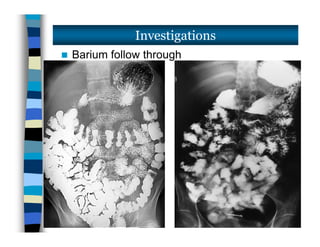
 Barium follow through
Investigations
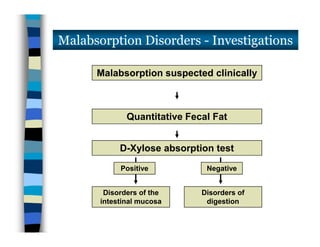
Malabsorption Disorders - Investigations
Malabsorption suspected clinically
Quantitative Fecal Fat
D-Xylose absorption test
Disorders of the
intestinal mucosa
Positive Negative
Disorders of
digestion
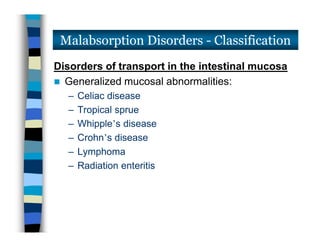
Disorders of transport in the intestinal mucosa
 Generalized mucosal abnormalities:
– Celiac disease
– Tropical sprue
– Whipple’s disease
– Crohn’s disease
– Lymphoma
– Radiation enteritis
Malabsorption Disorders - Classification
Disorders of transport in the intestinal mucosa
 Generalized mucosal abnormalities:
– Celiac disease
– Tropical sprue
– Whipple’s disease
– Crohn’s disease
– Lymphoma
– Radiation enteritis
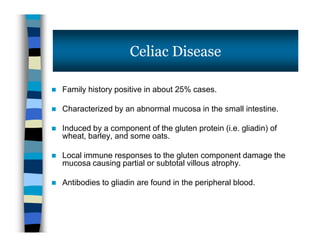
 Family history positive in about 25% cases.
 Characterized by an abnormal mucosa in the small intestine.
 Induced by a component of the gluten protein (i.e. gliadin) of
wheat, barley, and some oats.
 Local immune responses to the gluten component damage the
mucosa causing partial or subtotal villous atrophy.
 Antibodies to gliadin are found in the peripheral blood.
Celiac Disease
 Family history positive in about 25% cases.
 Characterized by an abnormal mucosa in the small intestine.
 Induced by a component of the gluten protein (i.e. gliadin) of
wheat, barley, and some oats.
 Local immune responses to the gluten component damage the
mucosa causing partial or subtotal villous atrophy.
 Antibodies to gliadin are found in the peripheral blood.
 The disease usually presents in children under 2
years of age and within 6 months of starting cereals.
The child ceases to thrive and becomes irritable.
 Less commonly the disorder manifests in adult life
and occasionally even in the elderly.
 There is often association with other auto-immune
diseases like type 1 diabetes, auto-immune thyroid
disease, vitiligo, etc.
Celiac Disease – Clinical Presentation
 The disease usually presents in children under 2
years of age and within 6 months of starting cereals.
The child ceases to thrive and becomes irritable.
 Less commonly the disorder manifests in adult life
and occasionally even in the elderly.
 There is often association with other auto-immune
diseases like type 1 diabetes, auto-immune thyroid
disease, vitiligo, etc.
 Symptoms range from
mild anemia and
fatigue to florid
malabsorptive state
developing rapidly
over a period of
weeks.
 Diarrhea/steatorrhea.
 Weight loss.
 Anemia.
 Peripheral neuropathy.
 Vitamin deficiency.
 Edema.
 Bone pain.
 Tetany.
 Clubbing.
 Glossitis & stomatitis.
 Amenorrhea & infertility.
Celiac Disease – Clinical Presentation
 Symptoms range from
mild anemia and
fatigue to florid
malabsorptive state
developing rapidly
over a period of
weeks.
 Diarrhea/steatorrhea.
 Weight loss.
 Anemia.
 Peripheral neuropathy.
 Vitamin deficiency.
 Edema.
 Bone pain.
 Tetany.
 Clubbing.
 Glossitis & stomatitis.
 Amenorrhea & infertility.
 An abnormal small bowel biopsy and a
good clinical response to gluten free diet
are sufficient for the diagnosis.
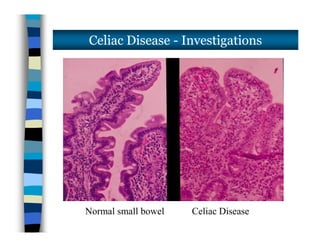
 Biopsy of the small bowel shows a
reduced height of the epithelial cells,
increased number of plasma cells in the
lamina propria and intraepithelial
lymphocytes.
Celiac Disease - Investigations
 An abnormal small bowel biopsy and a
good clinical response to gluten free diet
are sufficient for the diagnosis.
 Biopsy of the small bowel shows a
reduced height of the epithelial cells,
increased number of plasma cells in the
lamina propria and intraepithelial
lymphocytes.
Celiac Disease - Investigations
Normal small bowel Celiac Disease
 Endomysial (EMA) and Tissue transglutaminase (t-TG)
antibodies (IgA for both) are highly sensitivite and specific for
the diagnosis of untreated celiac disease.
 These antibodies can also be used as screening tests.
 In the presence of a typical clinical picture and the presence of
these antibodies, a confirmatory small bowel biopsy may not
always be required.
 Anti-reticulin antibodies (ARA) are also very sensitive but not
so specific, as they are seen in other gastrointestinal
conditions (e.g. Crohn's disease).
 Anti-gliadin antibodies (AGA) are less sensitive.
Celiac Disease - Investigations
 Endomysial (EMA) and Tissue transglutaminase (t-TG)
antibodies (IgA for both) are highly sensitivite and specific for
the diagnosis of untreated celiac disease.
 These antibodies can also be used as screening tests.
 In the presence of a typical clinical picture and the presence of
these antibodies, a confirmatory small bowel biopsy may not
always be required.
 Anti-reticulin antibodies (ARA) are also very sensitive but not
so specific, as they are seen in other gastrointestinal
conditions (e.g. Crohn's disease).
 Anti-gliadin antibodies (AGA) are less sensitive.
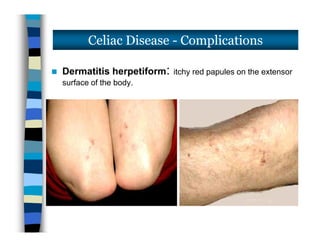
 Dermatitis herpetiform: itchy red papules on the extensor
surface of the body.
Celiac Disease - Complications
 Lymphoma and carcinoma:
– T cell Lymphoma of the small intestine is a
recognized complication of celiac disease.
– There is also a higher risk of small bowel
carcinoma.
 Ulcerative jejuno-ileitis:
– Patients develop multiple ulcers in the intestine
which may bleed or perforate.
Celiac Disease - Complications
 Lymphoma and carcinoma:
– T cell Lymphoma of the small intestine is a
recognized complication of celiac disease.
– There is also a higher risk of small bowel
carcinoma.
 Ulcerative jejuno-ileitis:
– Patients develop multiple ulcers in the intestine
which may bleed or perforate.
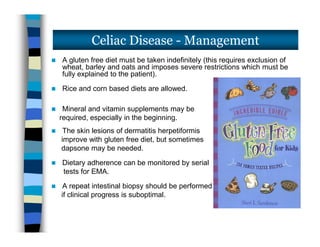
 A gluten free diet must be taken indefinitely (this requires exclusion of
wheat, barley and oats and imposes severe restrictions which must be
fully explained to the patient).
 Rice and corn based diets are allowed.
 Mineral and vitamin supplements may be
required, especially in the beginning.
 The skin lesions of dermatitis herpetiformis
improve with gluten free diet, but sometimes
dapsone may be needed.
 Dietary adherence can be monitored by serial
tests for EMA.
 A repeat intestinal biopsy should be performed
if clinical progress is suboptimal.
Celiac Disease - Management
 A gluten free diet must be taken indefinitely (this requires exclusion of
wheat, barley and oats and imposes severe restrictions which must be
fully explained to the patient).
 Rice and corn based diets are allowed.
 Mineral and vitamin supplements may be
required, especially in the beginning.
 The skin lesions of dermatitis herpetiformis
improve with gluten free diet, but sometimes
dapsone may be needed.
 Dietary adherence can be monitored by serial
tests for EMA.
 A repeat intestinal biopsy should be performed
if clinical progress is suboptimal.
 Malabsorption due to small intestinal disease in a
patient in or from the tropics.
 There has to be an absence of other intestinal
disease or parasites.
 Its manifestations resemble those of celiac disease.
Tropical Sprue
 Malabsorption due to small intestinal disease in a
patient in or from the tropics.
 There has to be an absence of other intestinal
disease or parasites.
 Its manifestations resemble those of celiac disease.
 The prevalence of tropical sprue is in certain well
defined tropical countries and localities such as West
Indies, Asia, Southern India, Sri Lanka, Malaysia and
Indonesia.
 Its epidemiological pattern, including occasional
epidemics, suggests that an infective agent or agents
may be involved.
 It is thought that this agent may be toxigenic E. coli
 The small bowel histological changes closely
resemble Celiac disease, although partial villous
atrophy rather than subtotal villous is the usual
lesion.
Tropical Sprue
 The prevalence of tropical sprue is in certain well
defined tropical countries and localities such as West
Indies, Asia, Southern India, Sri Lanka, Malaysia and
Indonesia.
 Its epidemiological pattern, including occasional
epidemics, suggests that an infective agent or agents
may be involved.
 It is thought that this agent may be toxigenic E. coli
 The small bowel histological changes closely
resemble Celiac disease, although partial villous
atrophy rather than subtotal villous is the usual
lesion.
Tropical Sprue – Clinical Features
 Diarrhea
 Abdominal distention
 Anorexia
 Fatigue
 Weight loss
 Edema
 Glossitis & stomatitis
 Anemia
 In visitors to the tropics,
the onset of diarrhea
may be sudden and
accompanied by fever.
 Remissions and
relapses may occur.
 Diarrhea
 Abdominal distention
 Anorexia
 Fatigue
 Weight loss
 Edema
 Glossitis & stomatitis
 Anemia
 In visitors to the tropics,
the onset of diarrhea
may be sudden and
accompanied by fever.
 Remissions and
relapses may occur.
 Dehydration and electrolyte deficiencies must be
corrected in severe diarrhea.
 Tetracycline 1 g daily in divided doses for 28 days.
 Folic acid and Vitamin B12 supplementation are given
as this relieves folate deficiency and improves
absorption.
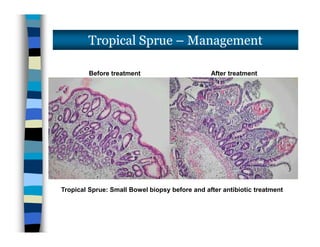
 The small bowel mucosa soon returns to normal.
Tropical Sprue – Management
 Dehydration and electrolyte deficiencies must be
corrected in severe diarrhea.
 Tetracycline 1 g daily in divided doses for 28 days.
 Folic acid and Vitamin B12 supplementation are given
as this relieves folate deficiency and improves
absorption.
 The small bowel mucosa soon returns to normal.
Tropical Sprue – Management
Before treatment After treatment
Tropical Sprue: Small Bowel biopsy before and after antibiotic treatment
 Due to exocrine pancreatic insufficiency.
 Common causes are:
– Chronic pancreatitis.
– Cystic fibrosis.
– Carcinoma of pancreas.
 Steatorrhea with Fecal fat > 7 g/ 24 hrs.
 Management is with exogenous pancreatic enzyme
supplementation.
Pancreatic Insufficiency
 Due to exocrine pancreatic insufficiency.
 Common causes are:
– Chronic pancreatitis.
– Cystic fibrosis.
– Carcinoma of pancreas.
 Steatorrhea with Fecal fat > 7 g/ 24 hrs.
 Management is with exogenous pancreatic enzyme
supplementation.
 Deficiency of enzyme Lactase in the brush border.
 Lactose cannot be hydrolyzed and passes into the
colon where it is converted to short chain fatty acids,
H2 and CO2 which cause discomfort and diarrhea.
 Patients complain of colic, abdominal distention,
increased flatus and sometimes diarrhea after
ingesting milk or milk products.
Lactose Intolerance
 Deficiency of enzyme Lactase in the brush border.
 Lactose cannot be hydrolyzed and passes into the
colon where it is converted to short chain fatty acids,
H2 and CO2 which cause discomfort and diarrhea.
 Patients complain of colic, abdominal distention,
increased flatus and sometimes diarrhea after
ingesting milk or milk products.
 In primary lactase deficiency, the small bowel biopsy
is normal.
 Secondary lactase deficiency can occur in small
bowel diseases like celiac disease, tropical sprue and
Crohn’s disease.
 A lactose free or lactose restricted diet is
recommended depending on the severity of
symptoms.
Lactose Intolerance
 In primary lactase deficiency, the small bowel biopsy
is normal.
 Secondary lactase deficiency can occur in small
bowel diseases like celiac disease, tropical sprue and
Crohn’s disease.
 A lactose free or lactose restricted diet is
recommended depending on the severity of
symptoms.
 Also known as:
– Contaminated bowel syndrome.
– Blind loop syndrome.
– Small intestine stasis syndrome.
 It is an intestinal abnormality associated with
bacterial overgrowth in the small intestine and
causing steatorrhea and Vitamin B12 malabsorption.
 These abnormalities improve with administration of
oral broad spectrum antibiotics.
Bacterial Overgrowth Syndrome
 Also known as:
– Contaminated bowel syndrome.
– Blind loop syndrome.
– Small intestine stasis syndrome.
 It is an intestinal abnormality associated with
bacterial overgrowth in the small intestine and
causing steatorrhea and Vitamin B12 malabsorption.
 These abnormalities improve with administration of
oral broad spectrum antibiotics.
 The bacterial overgrowth syndrome is caused by:
– Conditions that impair normal physiological
mechanisms controlling bacterial proliferation in the
intestine such as gastric acidity, intestinal motility and
antibodies to the bacteria in the intestinal juice.
– Structural abnormalities which deliver colonic bacteria
to the small intestine (fistulas), or which provide a
secluded haven away from the main peristaltic stream
(blind loops, diverticula etc).
Bacterial Overgrowth Syndrome
 The bacterial overgrowth syndrome is caused by:
– Conditions that impair normal physiological
mechanisms controlling bacterial proliferation in the
intestine such as gastric acidity, intestinal motility and
antibodies to the bacteria in the intestinal juice.
– Structural abnormalities which deliver colonic bacteria
to the small intestine (fistulas), or which provide a
secluded haven away from the main peristaltic stream
(blind loops, diverticula etc).
 Bacterial deconjugation of bile acids limiting micelle
formation and fat malabsorption.
 Mucosal damage from bacterial toxins and toxin
effects of free bile acids leads to malabsorption of
fats, carbohydrates and proteins.
 The bacteria also compete for nutrients like Vitamin
B12 leading to malabsorption.
Bacterial Overgrowth Syndrome - Mechanism
 Bacterial deconjugation of bile acids limiting micelle
formation and fat malabsorption.
 Mucosal damage from bacterial toxins and toxin
effects of free bile acids leads to malabsorption of
fats, carbohydrates and proteins.
 The bacteria also compete for nutrients like Vitamin
B12 leading to malabsorption.
 Diarrhea and steatorrhea
 Anemia because of Vitamin B12 deficiency
 Weight loss
 Muscle loss
 Symptoms from the underlying intestinal lesions
Bacterial Overgrowth Syndrome - Clinical Features
 Diarrhea and steatorrhea
 Anemia because of Vitamin B12 deficiency
 Weight loss
 Muscle loss
 Symptoms from the underlying intestinal lesions
Specific Causes
 Jejunal Diverticula
 Intestinal obstruction
 Strictures
 Gastrocolic or enterocolic fistulas
 Afferent loop syndrome
 Diabetes
 Progressive systemic sclerosis
 Acquired hypogammaglobulinemia
Bacterial Overgrowth Syndrome
Specific Causes
 Jejunal Diverticula
 Intestinal obstruction
 Strictures
 Gastrocolic or enterocolic fistulas
 Afferent loop syndrome
 Diabetes
 Progressive systemic sclerosis
 Acquired hypogammaglobulinemia
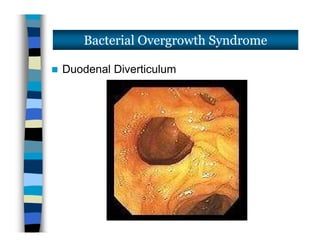
 Duodenal Diverticulum
Bacterial Overgrowth Syndrome
 Duodenal Diverticulum
 Antibiotic therapy for 1 – 2 weeks:
– Tetracycline
– Amoxicillin/clavulinic acid
– Cephalosporins
– Metronidazole
– Ciprofloxacin
 Patients may have to be retreated if symptoms recur
 Correct any anatomical abnormality if possible
Bacterial Overgrowth Syndrome - Treatment
 Antibiotic therapy for 1 – 2 weeks:
– Tetracycline
– Amoxicillin/clavulinic acid
– Cephalosporins
– Metronidazole
– Ciprofloxacin
 Patients may have to be retreated if symptoms recur
 Correct any anatomical abnormality if possible
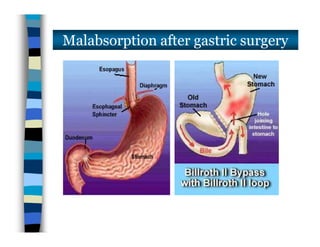
 Malabsorption is multifactorial:
– Loss of stomach reservoir.
– Food reaches jejunum before bile is mixed with it.
– Stasis and bacterial overgrowth 2ry to vagotomy.
 Billroth II surgery causes significant
malabsorption of Ca++ and Fe++.
 There is diarrhea but usually steatorrhea is mild.
 Treatment consists of antibiotics, antidiarrheals
and antiperistaltic agent.
Malabsorption after gastric surgery
 Malabsorption is multifactorial:
– Loss of stomach reservoir.
– Food reaches jejunum before bile is mixed with it.
– Stasis and bacterial overgrowth 2ry to vagotomy.
 Billroth II surgery causes significant
malabsorption of Ca++ and Fe++.
 There is diarrhea but usually steatorrhea is mild.
 Treatment consists of antibiotics, antidiarrheals
and antiperistaltic agent.
Malabsorption after gastric surgery
Malabsorption occurs because of:
 Extensive direct mucosal involvement.
 Stricture formation and bacterial
overgrowth.
 Fistula formation leading to bacterial
overgrowth.
 Surgical resection of the small bowel.
Crohn’s Disease
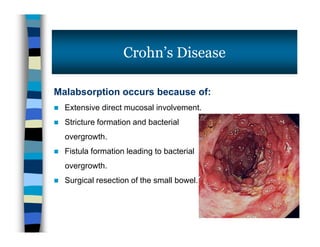
Malabsorption occurs because of:
 Extensive direct mucosal involvement.
 Stricture formation and bacterial
overgrowth.
 Fistula formation leading to bacterial
overgrowth.
 Surgical resection of the small bowel.
 Radiation can cause damage to:
– Small bowel :- Radiation enteritis
– Colon :- Radiation colitis
– Rectum :- Radiation proctitis
 Radiation injury can be divided into:
– Acute phase – within days
• Mucosal injury – resolves as mucosa regenerates
– Chronic phase – after years
• Extensive direct mucosal involvement
• Stricture formation and bacterial overgrowth
• Fistula formation leading to bacterial overgrowth
Radiation Enteritis
 Radiation can cause damage to:
– Small bowel :- Radiation enteritis
– Colon :- Radiation colitis
– Rectum :- Radiation proctitis
 Radiation injury can be divided into:
– Acute phase – within days
• Mucosal injury – resolves as mucosa regenerates
– Chronic phase – after years
• Extensive direct mucosal involvement
• Stricture formation and bacterial overgrowth
• Fistula formation leading to bacterial overgrowth
 Diagnosis
– Depends on careful history and typical radiological findings.
 Management
– There is no specific treatment.
– Diarrhea in the acute phase is treated with antidiarrheals.
– Antibiotics may help if there is bacterial overgrowth.
– Dietary manipulations may improve nutrition.
Radiation Enteritis
 Diagnosis
– Depends on careful history and typical radiological findings.
 Management
– There is no specific treatment.
– Diarrhea in the acute phase is treated with antidiarrheals.
– Antibiotics may help if there is bacterial overgrowth.
– Dietary manipulations may improve nutrition.
 Several types of lymphomas involve the
small bowel.
 The most common are diffuse large cell
lymphoma and small non-cleaved lymphoma.
 Malabsorption occurs because of bacterial
overgrowth and terminal ileal involvement.
Small Bowel Lymphoma
 Several types of lymphomas involve the
small bowel.
 The most common are diffuse large cell
lymphoma and small non-cleaved lymphoma.
 Malabsorption occurs because of bacterial
overgrowth and terminal ileal involvement.
 Resection of the small bowel, sometimes
extensive, may be necessary in Crohn’s
disease and bowel gangrene from vascular
insufficiency.
 Ileal resection is associated with significant
consequences than jejunal resection.
 There is severe diarrhea with fluid and
electrolyte loss.
Small Bowel Resection
 Resection of the small bowel, sometimes
extensive, may be necessary in Crohn’s
disease and bowel gangrene from vascular
insufficiency.
 Ileal resection is associated with significant
consequences than jejunal resection.
 There is severe diarrhea with fluid and
electrolyte loss.
Management
 Parenteral fluids and nutrition may be necessary
initially.
 Antidiarrheal medications as loperamide and
diphenoxylate are sometimes helpful.
 Antisecretory medications (H2 Blockers and PPI) may
reduce gastric secretions.
 Cholestyramine may help bind bile salts and prevent
their cathartic effects in the colon.
 Some patients may require life long parenteral
nutrition.
Small Bowel Resection
Management
 Parenteral fluids and nutrition may be necessary
initially.
 Antidiarrheal medications as loperamide and
diphenoxylate are sometimes helpful.
 Antisecretory medications (H2 Blockers and PPI) may
reduce gastric secretions.
 Cholestyramine may help bind bile salts and prevent
their cathartic effects in the colon.
 Some patients may require life long parenteral
nutrition.
 An uncommon chronic bacterial infection with
multisystem involvement caused by a gram
positive organism Trophyrema whippelli.
 There is infiltration of the intestinal mucosa
with foamy macrophages containing periodic
acid-Schiff (PAS) positive material.
 Electron microscopy shows numerous
intracellular bacilliform bodies.
Whipple’s Disease
 An uncommon chronic bacterial infection with
multisystem involvement caused by a gram
positive organism Trophyrema whippelli.
 There is infiltration of the intestinal mucosa
with foamy macrophages containing periodic
acid-Schiff (PAS) positive material.
 Electron microscopy shows numerous
intracellular bacilliform bodies.
Whipple’s Disease
Low magnification view (2x) of the small bowel mucosa.
The lamina propria is expanded by aggregates and sheets
of foamy histiocytes.
High power view (40x)of the small bowel
mucosa demonstrated
sheets of foamy histiocytes in the lamina propria
Low magnification view (2x) of the small bowel mucosa.
The lamina propria is expanded by aggregates and sheets
of foamy histiocytes.
High power view (40x)of the small bowel
mucosa demonstrated
sheets of foamy histiocytes in the lamina propria
PAS stain of the small bowel mucosa demonstrates numerous
round sickle shaped bacilli within histiocytes. The
appearance is characteristic of Whipples disease.
 Antibiotic therapy provides an excellent
response in most patients:
- Penicillin - Ampicillin
- Tetracycline - Erythromycin
- TMP-SMX - Chloramphenicol
 Therapy must be taken for a long time
(months to years).
 Relapses are common.
Whipple’s Disease – Management
 Antibiotic therapy provides an excellent
response in most patients:
- Penicillin - Ampicillin
- Tetracycline - Erythromycin
- TMP-SMX - Chloramphenicol
 Therapy must be taken for a long time
(months to years).
 Relapses are common.
THANK
YOU…

Malabsorption syndromes

  • 1.
    Malabsorption Syndromes Prepared by TarekSheta Lecturer of internal medicine
  • 2.
    Pathophysiology Digestion and Absorptionof Nutrients Digestion of food Absorption of digested food Presence of digestive enzymes and bile in the intestinal lumen Availability of absorptive mucosal surface
  • 3.
    Pathophysiology Defects in digestionof food Defects in absorption of digested food Presence of digestive enzymes and bile in the intestinal lumen Availability of absorptive mucosal surface Digestion and Absorption of Nutrients Maldigestion Malabsorption Defects in digestion of food Defects in absorption of digested food Clinically, both are described as “Malabsorption”
  • 4.
    Clinical Presentation  Malabsorptionmay involve: – a broad range of nutrients i.e. panmalabsorption. – only a single nutrient or a class of nutrients i.e. specific malabsorption.  Symptoms and signs of the disease depend on the deficiency of the nutrient(s) that is malabsorbed.  Malabsorption may involve: – a broad range of nutrients i.e. panmalabsorption. – only a single nutrient or a class of nutrients i.e. specific malabsorption.  Symptoms and signs of the disease depend on the deficiency of the nutrient(s) that is malabsorbed.
  • 5.
     Steatorrhea: bulky, floating,malodorous stool-difficult to flush.  Weight loss.  Flatulence.  Weakness and fatigue.  Paresthesias.  Tetany.  Diffuse abdominal pain.  Symptoms of anemia.  Bone aches.  Abnormal bruising.  Milk intolerance.  Night blindness.  Amenorrhea & infertility. Symptoms  Steatorrhea: bulky, floating, malodorous stool-difficult to flush.  Weight loss.  Flatulence.  Weakness and fatigue.  Paresthesias.  Tetany.  Diffuse abdominal pain.  Symptoms of anemia.  Bone aches.  Abnormal bruising.  Milk intolerance.  Night blindness.  Amenorrhea & infertility.
  • 6.
    Signs  Pallor.  Glossitis,stomatitis, cheilosis.  Clubbing.  Ecchymosis and purpura.  Dermatitis.  Dehydration and hypotension.  Edema.  Peripheral neuropathy.  Pallor.  Glossitis, stomatitis, cheilosis.  Clubbing.  Ecchymosis and purpura.  Dermatitis.  Dehydration and hypotension.  Edema.  Peripheral neuropathy.
  • 7.
     Blood ScreeningTests – Hemoglobin: low. – Serum levels of calcium, albumin, iron, vitamin B12, folate, carotene, cholesterol:low. – Prothrombin time (PT): prolonged.  Quantitative fecal fat: - Patient should be on daily diet containing 80-100 gms of fat. - Fecal fat estimated on 72 H collection. - 6 grams or more of fat/day is abnormal. - May be due to: - Pancreatic - Small intestinal - Hepatobiliary disease Investigations  Blood Screening Tests – Hemoglobin: low. – Serum levels of calcium, albumin, iron, vitamin B12, folate, carotene, cholesterol:low. – Prothrombin time (PT): prolonged.  Quantitative fecal fat: - Patient should be on daily diet containing 80-100 gms of fat. - Fecal fat estimated on 72 H collection. - 6 grams or more of fat/day is abnormal. - May be due to: - Pancreatic - Small intestinal - Hepatobiliary disease
  • 8.
     D-xylose AbsorptionTest: - Normally, afer oral digestion of 25 gm. Xylose, at least 1/5 the amount (5 gm.) passes in urine. - If > 5gm. passes in urine: Maldigestion. - If < 5gm. passes in urine: Malabsorption.  Small bowel biopsy  Tests for pancreatic structure and function Investigations  D-xylose Absorption Test: - Normally, afer oral digestion of 25 gm. Xylose, at least 1/5 the amount (5 gm.) passes in urine. - If > 5gm. passes in urine: Maldigestion. - If < 5gm. passes in urine: Malabsorption.  Small bowel biopsy  Tests for pancreatic structure and function
  • 9.
     Barium followthrough Investigations
  • 10.
    Malabsorption Disorders -Investigations Malabsorption suspected clinically Quantitative Fecal Fat D-Xylose absorption test Disorders of the intestinal mucosa Positive Negative Disorders of digestion
  • 11.
    Disorders of transportin the intestinal mucosa  Generalized mucosal abnormalities: – Celiac disease – Tropical sprue – Whipple’s disease – Crohn’s disease – Lymphoma – Radiation enteritis Malabsorption Disorders - Classification Disorders of transport in the intestinal mucosa  Generalized mucosal abnormalities: – Celiac disease – Tropical sprue – Whipple’s disease – Crohn’s disease – Lymphoma – Radiation enteritis
  • 12.
     Family historypositive in about 25% cases.  Characterized by an abnormal mucosa in the small intestine.  Induced by a component of the gluten protein (i.e. gliadin) of wheat, barley, and some oats.  Local immune responses to the gluten component damage the mucosa causing partial or subtotal villous atrophy.  Antibodies to gliadin are found in the peripheral blood. Celiac Disease  Family history positive in about 25% cases.  Characterized by an abnormal mucosa in the small intestine.  Induced by a component of the gluten protein (i.e. gliadin) of wheat, barley, and some oats.  Local immune responses to the gluten component damage the mucosa causing partial or subtotal villous atrophy.  Antibodies to gliadin are found in the peripheral blood.
  • 13.
     The diseaseusually presents in children under 2 years of age and within 6 months of starting cereals. The child ceases to thrive and becomes irritable.  Less commonly the disorder manifests in adult life and occasionally even in the elderly.  There is often association with other auto-immune diseases like type 1 diabetes, auto-immune thyroid disease, vitiligo, etc. Celiac Disease – Clinical Presentation  The disease usually presents in children under 2 years of age and within 6 months of starting cereals. The child ceases to thrive and becomes irritable.  Less commonly the disorder manifests in adult life and occasionally even in the elderly.  There is often association with other auto-immune diseases like type 1 diabetes, auto-immune thyroid disease, vitiligo, etc.
  • 14.
     Symptoms rangefrom mild anemia and fatigue to florid malabsorptive state developing rapidly over a period of weeks.  Diarrhea/steatorrhea.  Weight loss.  Anemia.  Peripheral neuropathy.  Vitamin deficiency.  Edema.  Bone pain.  Tetany.  Clubbing.  Glossitis & stomatitis.  Amenorrhea & infertility. Celiac Disease – Clinical Presentation  Symptoms range from mild anemia and fatigue to florid malabsorptive state developing rapidly over a period of weeks.  Diarrhea/steatorrhea.  Weight loss.  Anemia.  Peripheral neuropathy.  Vitamin deficiency.  Edema.  Bone pain.  Tetany.  Clubbing.  Glossitis & stomatitis.  Amenorrhea & infertility.
  • 15.
     An abnormalsmall bowel biopsy and a good clinical response to gluten free diet are sufficient for the diagnosis.  Biopsy of the small bowel shows a reduced height of the epithelial cells, increased number of plasma cells in the lamina propria and intraepithelial lymphocytes. Celiac Disease - Investigations  An abnormal small bowel biopsy and a good clinical response to gluten free diet are sufficient for the diagnosis.  Biopsy of the small bowel shows a reduced height of the epithelial cells, increased number of plasma cells in the lamina propria and intraepithelial lymphocytes.
  • 16.
    Celiac Disease -Investigations Normal small bowel Celiac Disease
  • 17.
     Endomysial (EMA)and Tissue transglutaminase (t-TG) antibodies (IgA for both) are highly sensitivite and specific for the diagnosis of untreated celiac disease.  These antibodies can also be used as screening tests.  In the presence of a typical clinical picture and the presence of these antibodies, a confirmatory small bowel biopsy may not always be required.  Anti-reticulin antibodies (ARA) are also very sensitive but not so specific, as they are seen in other gastrointestinal conditions (e.g. Crohn's disease).  Anti-gliadin antibodies (AGA) are less sensitive. Celiac Disease - Investigations  Endomysial (EMA) and Tissue transglutaminase (t-TG) antibodies (IgA for both) are highly sensitivite and specific for the diagnosis of untreated celiac disease.  These antibodies can also be used as screening tests.  In the presence of a typical clinical picture and the presence of these antibodies, a confirmatory small bowel biopsy may not always be required.  Anti-reticulin antibodies (ARA) are also very sensitive but not so specific, as they are seen in other gastrointestinal conditions (e.g. Crohn's disease).  Anti-gliadin antibodies (AGA) are less sensitive.
  • 18.
     Dermatitis herpetiform:itchy red papules on the extensor surface of the body. Celiac Disease - Complications
  • 19.
     Lymphoma andcarcinoma: – T cell Lymphoma of the small intestine is a recognized complication of celiac disease. – There is also a higher risk of small bowel carcinoma.  Ulcerative jejuno-ileitis: – Patients develop multiple ulcers in the intestine which may bleed or perforate. Celiac Disease - Complications  Lymphoma and carcinoma: – T cell Lymphoma of the small intestine is a recognized complication of celiac disease. – There is also a higher risk of small bowel carcinoma.  Ulcerative jejuno-ileitis: – Patients develop multiple ulcers in the intestine which may bleed or perforate.
  • 20.
     A glutenfree diet must be taken indefinitely (this requires exclusion of wheat, barley and oats and imposes severe restrictions which must be fully explained to the patient).  Rice and corn based diets are allowed.  Mineral and vitamin supplements may be required, especially in the beginning.  The skin lesions of dermatitis herpetiformis improve with gluten free diet, but sometimes dapsone may be needed.  Dietary adherence can be monitored by serial tests for EMA.  A repeat intestinal biopsy should be performed if clinical progress is suboptimal. Celiac Disease - Management  A gluten free diet must be taken indefinitely (this requires exclusion of wheat, barley and oats and imposes severe restrictions which must be fully explained to the patient).  Rice and corn based diets are allowed.  Mineral and vitamin supplements may be required, especially in the beginning.  The skin lesions of dermatitis herpetiformis improve with gluten free diet, but sometimes dapsone may be needed.  Dietary adherence can be monitored by serial tests for EMA.  A repeat intestinal biopsy should be performed if clinical progress is suboptimal.
  • 21.
     Malabsorption dueto small intestinal disease in a patient in or from the tropics.  There has to be an absence of other intestinal disease or parasites.  Its manifestations resemble those of celiac disease. Tropical Sprue  Malabsorption due to small intestinal disease in a patient in or from the tropics.  There has to be an absence of other intestinal disease or parasites.  Its manifestations resemble those of celiac disease.
  • 22.
     The prevalenceof tropical sprue is in certain well defined tropical countries and localities such as West Indies, Asia, Southern India, Sri Lanka, Malaysia and Indonesia.  Its epidemiological pattern, including occasional epidemics, suggests that an infective agent or agents may be involved.  It is thought that this agent may be toxigenic E. coli  The small bowel histological changes closely resemble Celiac disease, although partial villous atrophy rather than subtotal villous is the usual lesion. Tropical Sprue  The prevalence of tropical sprue is in certain well defined tropical countries and localities such as West Indies, Asia, Southern India, Sri Lanka, Malaysia and Indonesia.  Its epidemiological pattern, including occasional epidemics, suggests that an infective agent or agents may be involved.  It is thought that this agent may be toxigenic E. coli  The small bowel histological changes closely resemble Celiac disease, although partial villous atrophy rather than subtotal villous is the usual lesion.
  • 23.
    Tropical Sprue –Clinical Features  Diarrhea  Abdominal distention  Anorexia  Fatigue  Weight loss  Edema  Glossitis & stomatitis  Anemia  In visitors to the tropics, the onset of diarrhea may be sudden and accompanied by fever.  Remissions and relapses may occur.  Diarrhea  Abdominal distention  Anorexia  Fatigue  Weight loss  Edema  Glossitis & stomatitis  Anemia  In visitors to the tropics, the onset of diarrhea may be sudden and accompanied by fever.  Remissions and relapses may occur.
  • 24.
     Dehydration andelectrolyte deficiencies must be corrected in severe diarrhea.  Tetracycline 1 g daily in divided doses for 28 days.  Folic acid and Vitamin B12 supplementation are given as this relieves folate deficiency and improves absorption.  The small bowel mucosa soon returns to normal. Tropical Sprue – Management  Dehydration and electrolyte deficiencies must be corrected in severe diarrhea.  Tetracycline 1 g daily in divided doses for 28 days.  Folic acid and Vitamin B12 supplementation are given as this relieves folate deficiency and improves absorption.  The small bowel mucosa soon returns to normal.
  • 25.
    Tropical Sprue –Management Before treatment After treatment Tropical Sprue: Small Bowel biopsy before and after antibiotic treatment
  • 26.
     Due toexocrine pancreatic insufficiency.  Common causes are: – Chronic pancreatitis. – Cystic fibrosis. – Carcinoma of pancreas.  Steatorrhea with Fecal fat > 7 g/ 24 hrs.  Management is with exogenous pancreatic enzyme supplementation. Pancreatic Insufficiency  Due to exocrine pancreatic insufficiency.  Common causes are: – Chronic pancreatitis. – Cystic fibrosis. – Carcinoma of pancreas.  Steatorrhea with Fecal fat > 7 g/ 24 hrs.  Management is with exogenous pancreatic enzyme supplementation.
  • 27.
     Deficiency ofenzyme Lactase in the brush border.  Lactose cannot be hydrolyzed and passes into the colon where it is converted to short chain fatty acids, H2 and CO2 which cause discomfort and diarrhea.  Patients complain of colic, abdominal distention, increased flatus and sometimes diarrhea after ingesting milk or milk products. Lactose Intolerance  Deficiency of enzyme Lactase in the brush border.  Lactose cannot be hydrolyzed and passes into the colon where it is converted to short chain fatty acids, H2 and CO2 which cause discomfort and diarrhea.  Patients complain of colic, abdominal distention, increased flatus and sometimes diarrhea after ingesting milk or milk products.
  • 28.
     In primarylactase deficiency, the small bowel biopsy is normal.  Secondary lactase deficiency can occur in small bowel diseases like celiac disease, tropical sprue and Crohn’s disease.  A lactose free or lactose restricted diet is recommended depending on the severity of symptoms. Lactose Intolerance  In primary lactase deficiency, the small bowel biopsy is normal.  Secondary lactase deficiency can occur in small bowel diseases like celiac disease, tropical sprue and Crohn’s disease.  A lactose free or lactose restricted diet is recommended depending on the severity of symptoms.
  • 29.
     Also knownas: – Contaminated bowel syndrome. – Blind loop syndrome. – Small intestine stasis syndrome.  It is an intestinal abnormality associated with bacterial overgrowth in the small intestine and causing steatorrhea and Vitamin B12 malabsorption.  These abnormalities improve with administration of oral broad spectrum antibiotics. Bacterial Overgrowth Syndrome  Also known as: – Contaminated bowel syndrome. – Blind loop syndrome. – Small intestine stasis syndrome.  It is an intestinal abnormality associated with bacterial overgrowth in the small intestine and causing steatorrhea and Vitamin B12 malabsorption.  These abnormalities improve with administration of oral broad spectrum antibiotics.
  • 30.
     The bacterialovergrowth syndrome is caused by: – Conditions that impair normal physiological mechanisms controlling bacterial proliferation in the intestine such as gastric acidity, intestinal motility and antibodies to the bacteria in the intestinal juice. – Structural abnormalities which deliver colonic bacteria to the small intestine (fistulas), or which provide a secluded haven away from the main peristaltic stream (blind loops, diverticula etc). Bacterial Overgrowth Syndrome  The bacterial overgrowth syndrome is caused by: – Conditions that impair normal physiological mechanisms controlling bacterial proliferation in the intestine such as gastric acidity, intestinal motility and antibodies to the bacteria in the intestinal juice. – Structural abnormalities which deliver colonic bacteria to the small intestine (fistulas), or which provide a secluded haven away from the main peristaltic stream (blind loops, diverticula etc).
  • 31.
     Bacterial deconjugationof bile acids limiting micelle formation and fat malabsorption.  Mucosal damage from bacterial toxins and toxin effects of free bile acids leads to malabsorption of fats, carbohydrates and proteins.  The bacteria also compete for nutrients like Vitamin B12 leading to malabsorption. Bacterial Overgrowth Syndrome - Mechanism  Bacterial deconjugation of bile acids limiting micelle formation and fat malabsorption.  Mucosal damage from bacterial toxins and toxin effects of free bile acids leads to malabsorption of fats, carbohydrates and proteins.  The bacteria also compete for nutrients like Vitamin B12 leading to malabsorption.
  • 32.
     Diarrhea andsteatorrhea  Anemia because of Vitamin B12 deficiency  Weight loss  Muscle loss  Symptoms from the underlying intestinal lesions Bacterial Overgrowth Syndrome - Clinical Features  Diarrhea and steatorrhea  Anemia because of Vitamin B12 deficiency  Weight loss  Muscle loss  Symptoms from the underlying intestinal lesions
  • 33.
    Specific Causes  JejunalDiverticula  Intestinal obstruction  Strictures  Gastrocolic or enterocolic fistulas  Afferent loop syndrome  Diabetes  Progressive systemic sclerosis  Acquired hypogammaglobulinemia Bacterial Overgrowth Syndrome Specific Causes  Jejunal Diverticula  Intestinal obstruction  Strictures  Gastrocolic or enterocolic fistulas  Afferent loop syndrome  Diabetes  Progressive systemic sclerosis  Acquired hypogammaglobulinemia
  • 34.
     Duodenal Diverticulum BacterialOvergrowth Syndrome  Duodenal Diverticulum
  • 35.
     Antibiotic therapyfor 1 – 2 weeks: – Tetracycline – Amoxicillin/clavulinic acid – Cephalosporins – Metronidazole – Ciprofloxacin  Patients may have to be retreated if symptoms recur  Correct any anatomical abnormality if possible Bacterial Overgrowth Syndrome - Treatment  Antibiotic therapy for 1 – 2 weeks: – Tetracycline – Amoxicillin/clavulinic acid – Cephalosporins – Metronidazole – Ciprofloxacin  Patients may have to be retreated if symptoms recur  Correct any anatomical abnormality if possible
  • 36.
     Malabsorption ismultifactorial: – Loss of stomach reservoir. – Food reaches jejunum before bile is mixed with it. – Stasis and bacterial overgrowth 2ry to vagotomy.  Billroth II surgery causes significant malabsorption of Ca++ and Fe++.  There is diarrhea but usually steatorrhea is mild.  Treatment consists of antibiotics, antidiarrheals and antiperistaltic agent. Malabsorption after gastric surgery  Malabsorption is multifactorial: – Loss of stomach reservoir. – Food reaches jejunum before bile is mixed with it. – Stasis and bacterial overgrowth 2ry to vagotomy.  Billroth II surgery causes significant malabsorption of Ca++ and Fe++.  There is diarrhea but usually steatorrhea is mild.  Treatment consists of antibiotics, antidiarrheals and antiperistaltic agent.
  • 37.
  • 38.
    Malabsorption occurs becauseof:  Extensive direct mucosal involvement.  Stricture formation and bacterial overgrowth.  Fistula formation leading to bacterial overgrowth.  Surgical resection of the small bowel. Crohn’s Disease Malabsorption occurs because of:  Extensive direct mucosal involvement.  Stricture formation and bacterial overgrowth.  Fistula formation leading to bacterial overgrowth.  Surgical resection of the small bowel.
  • 39.
     Radiation cancause damage to: – Small bowel :- Radiation enteritis – Colon :- Radiation colitis – Rectum :- Radiation proctitis  Radiation injury can be divided into: – Acute phase – within days • Mucosal injury – resolves as mucosa regenerates – Chronic phase – after years • Extensive direct mucosal involvement • Stricture formation and bacterial overgrowth • Fistula formation leading to bacterial overgrowth Radiation Enteritis  Radiation can cause damage to: – Small bowel :- Radiation enteritis – Colon :- Radiation colitis – Rectum :- Radiation proctitis  Radiation injury can be divided into: – Acute phase – within days • Mucosal injury – resolves as mucosa regenerates – Chronic phase – after years • Extensive direct mucosal involvement • Stricture formation and bacterial overgrowth • Fistula formation leading to bacterial overgrowth
  • 40.
     Diagnosis – Dependson careful history and typical radiological findings.  Management – There is no specific treatment. – Diarrhea in the acute phase is treated with antidiarrheals. – Antibiotics may help if there is bacterial overgrowth. – Dietary manipulations may improve nutrition. Radiation Enteritis  Diagnosis – Depends on careful history and typical radiological findings.  Management – There is no specific treatment. – Diarrhea in the acute phase is treated with antidiarrheals. – Antibiotics may help if there is bacterial overgrowth. – Dietary manipulations may improve nutrition.
  • 41.
     Several typesof lymphomas involve the small bowel.  The most common are diffuse large cell lymphoma and small non-cleaved lymphoma.  Malabsorption occurs because of bacterial overgrowth and terminal ileal involvement. Small Bowel Lymphoma  Several types of lymphomas involve the small bowel.  The most common are diffuse large cell lymphoma and small non-cleaved lymphoma.  Malabsorption occurs because of bacterial overgrowth and terminal ileal involvement.
  • 42.
     Resection ofthe small bowel, sometimes extensive, may be necessary in Crohn’s disease and bowel gangrene from vascular insufficiency.  Ileal resection is associated with significant consequences than jejunal resection.  There is severe diarrhea with fluid and electrolyte loss. Small Bowel Resection  Resection of the small bowel, sometimes extensive, may be necessary in Crohn’s disease and bowel gangrene from vascular insufficiency.  Ileal resection is associated with significant consequences than jejunal resection.  There is severe diarrhea with fluid and electrolyte loss.
  • 43.
    Management  Parenteral fluidsand nutrition may be necessary initially.  Antidiarrheal medications as loperamide and diphenoxylate are sometimes helpful.  Antisecretory medications (H2 Blockers and PPI) may reduce gastric secretions.  Cholestyramine may help bind bile salts and prevent their cathartic effects in the colon.  Some patients may require life long parenteral nutrition. Small Bowel Resection Management  Parenteral fluids and nutrition may be necessary initially.  Antidiarrheal medications as loperamide and diphenoxylate are sometimes helpful.  Antisecretory medications (H2 Blockers and PPI) may reduce gastric secretions.  Cholestyramine may help bind bile salts and prevent their cathartic effects in the colon.  Some patients may require life long parenteral nutrition.
  • 44.
     An uncommonchronic bacterial infection with multisystem involvement caused by a gram positive organism Trophyrema whippelli.  There is infiltration of the intestinal mucosa with foamy macrophages containing periodic acid-Schiff (PAS) positive material.  Electron microscopy shows numerous intracellular bacilliform bodies. Whipple’s Disease  An uncommon chronic bacterial infection with multisystem involvement caused by a gram positive organism Trophyrema whippelli.  There is infiltration of the intestinal mucosa with foamy macrophages containing periodic acid-Schiff (PAS) positive material.  Electron microscopy shows numerous intracellular bacilliform bodies.
  • 45.
    Whipple’s Disease Low magnificationview (2x) of the small bowel mucosa. The lamina propria is expanded by aggregates and sheets of foamy histiocytes. High power view (40x)of the small bowel mucosa demonstrated sheets of foamy histiocytes in the lamina propria Low magnification view (2x) of the small bowel mucosa. The lamina propria is expanded by aggregates and sheets of foamy histiocytes. High power view (40x)of the small bowel mucosa demonstrated sheets of foamy histiocytes in the lamina propria PAS stain of the small bowel mucosa demonstrates numerous round sickle shaped bacilli within histiocytes. The appearance is characteristic of Whipples disease.
  • 46.
     Antibiotic therapyprovides an excellent response in most patients: - Penicillin - Ampicillin - Tetracycline - Erythromycin - TMP-SMX - Chloramphenicol  Therapy must be taken for a long time (months to years).  Relapses are common. Whipple’s Disease – Management  Antibiotic therapy provides an excellent response in most patients: - Penicillin - Ampicillin - Tetracycline - Erythromycin - TMP-SMX - Chloramphenicol  Therapy must be taken for a long time (months to years).  Relapses are common.
  • 47.