Sandy Cash

Professor Bouchard

ENG 132

Thoughts on “Advice to My Son,”

March 25, 2012

                             Thoughts on “Advice to My Son,”

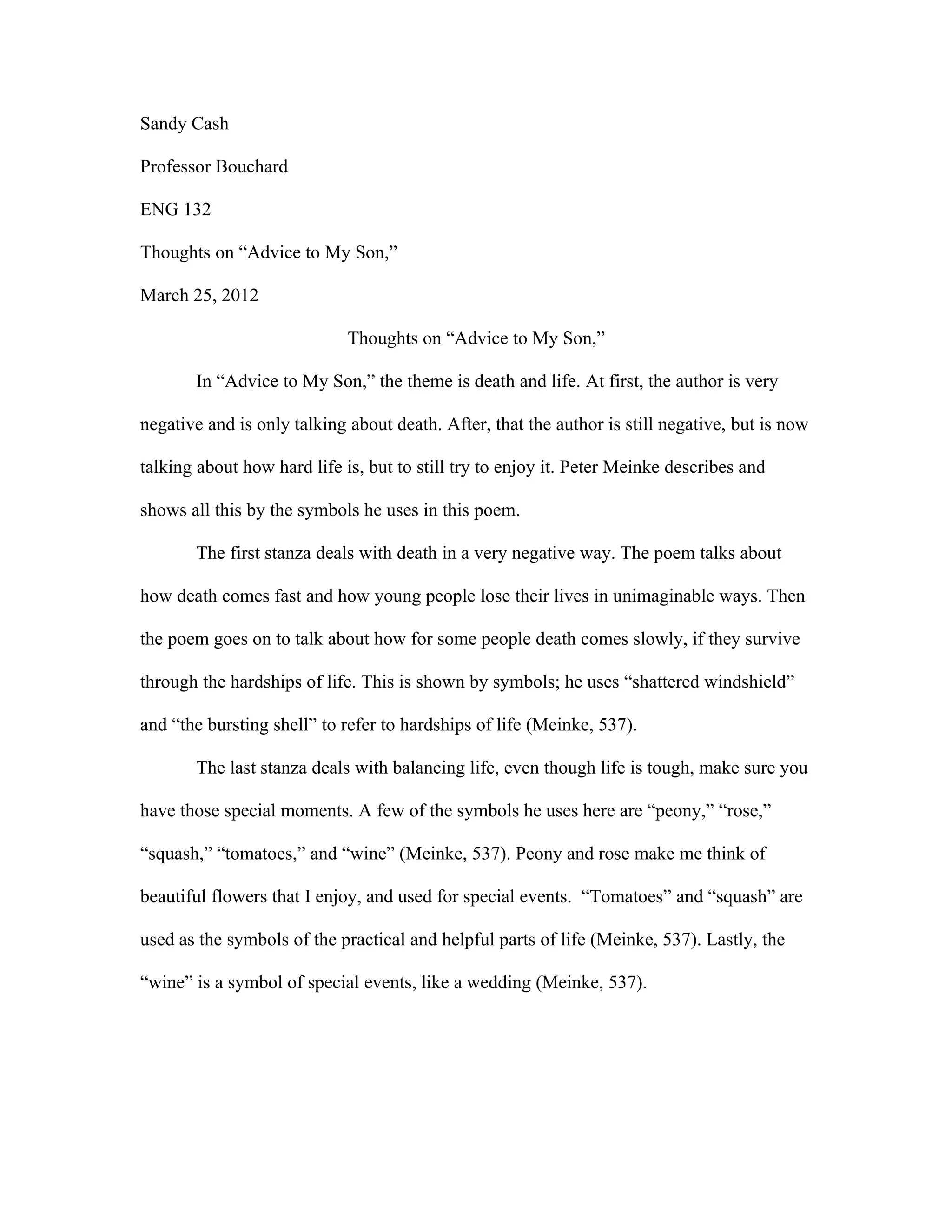
       In “Advice to My Son,” the theme is death and life. At first, the author is very

negative and is only talking about death. After, that the author is still negative, but is now

talking about how hard life is, but to still try to enjoy it. Peter Meinke describes and

shows all this by the symbols he uses in this poem.

       The first stanza deals with death in a very negative way. The poem talks about

how death comes fast and how young people lose their lives in unimaginable ways. Then

the poem goes on to talk about how for some people death comes slowly, if they survive

through the hardships of life. This is shown by symbols; he uses “shattered windshield”

and “the bursting shell” to refer to hardships of life (Meinke, 537).

       The last stanza deals with balancing life, even though life is tough, make sure you

have those special moments. A few of the symbols he uses here are “peony,” “rose,”

“squash,” “tomatoes,” and “wine” (Meinke, 537). Peony and rose make me think of

beautiful flowers that I enjoy, and used for special events. “Tomatoes” and “squash” are

used as the symbols of the practical and helpful parts of life (Meinke, 537). Lastly, the

“wine” is a symbol of special events, like a wedding (Meinke, 537).
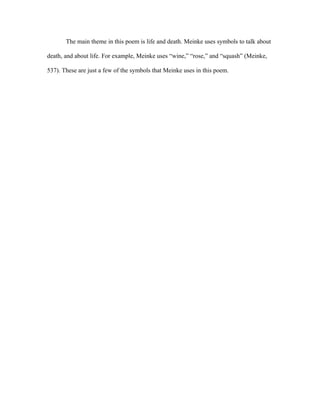
The main theme in this poem is life and death. Meinke uses symbols to talk about

death, and about life. For example, Meinke uses “wine,” “rose,” and “squash” (Meinke,

537). These are just a few of the symbols that Meinke uses in this poem.
Works Cited
    Meinke, Peter. "Advice to My Son." DiYanni, Robert. Literature: Approaches to

    Fictioin, Poetry, and Drama. Boston: McGraw Hill, 2008. 536-537.
Sandy Cash

Professor Bouchard

ENG 132

Thoughts on “Because I Could Not Stop for Death”

March 25, 2012

                   Thoughts on “Because I Could Not Stop for Death”

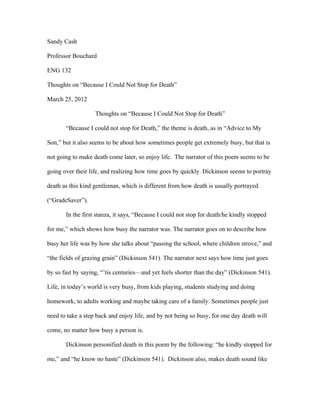
       “Because I could not stop for Death,” the theme is death, as in “Advice to My

Son,” but it also seems to be about how sometimes people get extremely busy, but that is

not going to make death come later, so enjoy life. The narrator of this poem seems to be

going over their life, and realizing how time goes by quickly. Dickinson seems to portray

death as this kind gentleman, which is different from how death is usually portrayed

(“GradeSaver”).

       In the first stanza, it says, “Because I could not stop for death/he kindly stopped

for me,” which shows how busy the narrator was. The narrator goes on to describe how

busy her life was by how she talks about “passing the school, where children strove,” and

“the fields of grazing grain” (Dickinson 541). The narrator next says how time just goes

by so fast by saying, “’tis centuries—and yet feels shorter than the day” (Dickinson 541).

Life, in today’s world is very busy, from kids playing, students studying and doing

homework, to adults working and maybe taking care of a family. Sometimes people just

need to take a step back and enjoy life, and by not being so busy, for one day death will

come, no matter how busy a person is.

       Dickinson personified death in this poem by the following: “he kindly stopped for

me,” and “he know no haste” (Dickinson 541). Dickinson also, makes death sound like
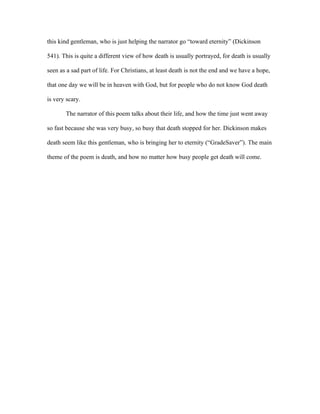
this kind gentleman, who is just helping the narrator go “toward eternity” (Dickinson

541). This is quite a different view of how death is usually portrayed, for death is usually

seen as a sad part of life. For Christians, at least death is not the end and we have a hope,

that one day we will be in heaven with God, but for people who do not know God death

is very scary.

       The narrator of this poem talks about their life, and how the time just went away

so fast because she was very busy, so busy that death stopped for her. Dickinson makes

death seem like this gentleman, who is bringing her to eternity (“GradeSaver”). The main

theme of the poem is death, and how no matter how busy people get death will come.
Works Cited
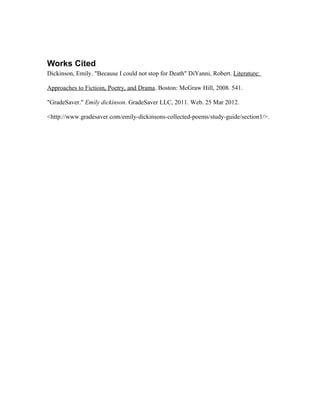
Dickinson, Emily. "Because I could not stop for Death" DiYanni, Robert. Literature:

Approaches to Fictioin, Poetry, and Drama. Boston: McGraw Hill, 2008. 541.

"GradeSaver." Emily dickinson. GradeSaver LLC, 2011. Web. 25 Mar 2012.

<http://www.gradesaver.com/emily-dickinsons-collected-poems/study-guide/section1/>.

Paper #7 thoughts on poems

  • 1.
    Sandy Cash Professor Bouchard ENG132 Thoughts on “Advice to My Son,” March 25, 2012 Thoughts on “Advice to My Son,” In “Advice to My Son,” the theme is death and life. At first, the author is very negative and is only talking about death. After, that the author is still negative, but is now talking about how hard life is, but to still try to enjoy it. Peter Meinke describes and shows all this by the symbols he uses in this poem. The first stanza deals with death in a very negative way. The poem talks about how death comes fast and how young people lose their lives in unimaginable ways. Then the poem goes on to talk about how for some people death comes slowly, if they survive through the hardships of life. This is shown by symbols; he uses “shattered windshield” and “the bursting shell” to refer to hardships of life (Meinke, 537). The last stanza deals with balancing life, even though life is tough, make sure you have those special moments. A few of the symbols he uses here are “peony,” “rose,” “squash,” “tomatoes,” and “wine” (Meinke, 537). Peony and rose make me think of beautiful flowers that I enjoy, and used for special events. “Tomatoes” and “squash” are used as the symbols of the practical and helpful parts of life (Meinke, 537). Lastly, the “wine” is a symbol of special events, like a wedding (Meinke, 537).
  • 2.
    The main themein this poem is life and death. Meinke uses symbols to talk about death, and about life. For example, Meinke uses “wine,” “rose,” and “squash” (Meinke, 537). These are just a few of the symbols that Meinke uses in this poem.
  • 3.
    Works Cited Meinke, Peter. "Advice to My Son." DiYanni, Robert. Literature: Approaches to Fictioin, Poetry, and Drama. Boston: McGraw Hill, 2008. 536-537.
  • 4.
    Sandy Cash Professor Bouchard ENG132 Thoughts on “Because I Could Not Stop for Death” March 25, 2012 Thoughts on “Because I Could Not Stop for Death” “Because I could not stop for Death,” the theme is death, as in “Advice to My Son,” but it also seems to be about how sometimes people get extremely busy, but that is not going to make death come later, so enjoy life. The narrator of this poem seems to be going over their life, and realizing how time goes by quickly. Dickinson seems to portray death as this kind gentleman, which is different from how death is usually portrayed (“GradeSaver”). In the first stanza, it says, “Because I could not stop for death/he kindly stopped for me,” which shows how busy the narrator was. The narrator goes on to describe how busy her life was by how she talks about “passing the school, where children strove,” and “the fields of grazing grain” (Dickinson 541). The narrator next says how time just goes by so fast by saying, “’tis centuries—and yet feels shorter than the day” (Dickinson 541). Life, in today’s world is very busy, from kids playing, students studying and doing homework, to adults working and maybe taking care of a family. Sometimes people just need to take a step back and enjoy life, and by not being so busy, for one day death will come, no matter how busy a person is. Dickinson personified death in this poem by the following: “he kindly stopped for me,” and “he know no haste” (Dickinson 541). Dickinson also, makes death sound like
  • 5.
    this kind gentleman,who is just helping the narrator go “toward eternity” (Dickinson 541). This is quite a different view of how death is usually portrayed, for death is usually seen as a sad part of life. For Christians, at least death is not the end and we have a hope, that one day we will be in heaven with God, but for people who do not know God death is very scary. The narrator of this poem talks about their life, and how the time just went away so fast because she was very busy, so busy that death stopped for her. Dickinson makes death seem like this gentleman, who is bringing her to eternity (“GradeSaver”). The main theme of the poem is death, and how no matter how busy people get death will come.
  • 6.
    Works Cited Dickinson, Emily."Because I could not stop for Death" DiYanni, Robert. Literature: Approaches to Fictioin, Poetry, and Drama. Boston: McGraw Hill, 2008. 541. "GradeSaver." Emily dickinson. GradeSaver LLC, 2011. Web. 25 Mar 2012. <http://www.gradesaver.com/emily-dickinsons-collected-poems/study-guide/section1/>.