Gluten Sensitivity
A Systems Medicine Approach


     Keith Berndtson, MD
What is gluten?


A. A protein mainly found in wheat, rye, and barley.
B. A chain of peptides including gliadins and glutenins.
C. A substance that gives bread a pleasant texture, and
    lends dough more versatility.
D. An additive used to stabilize processed foods.
E. A potentially lethal substance.
F. All of the above.
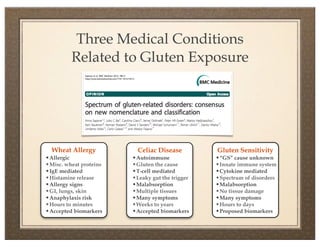
Three Medical Conditions
         Related to Gluten Exposure


  Wheat Allergy           Celiac Disease         Gluten Sensitivity
•Allergic               •Autoimmune              •“GS” cause unknown
•Misc. wheat proteins   •Gluten the cause        •Innate immune system
•IgE mediated           •T-cell mediated         •Cytokine mediated
•Histamine release      •Leaky gut the trigger   •Spectrum of disorders
•Allergy signs          •Malabsorption           •Malabsorption
•GI, lungs, skin        •Multiple tissues        •No tissue damage
•Anaphylaxis risk       •Many symptoms           •Many symptoms
•Hours to minutes       •Weeks to years          •Hours to days
•Accepted biomarkers    •Accepted biomarkers     •Proposed biomarkers
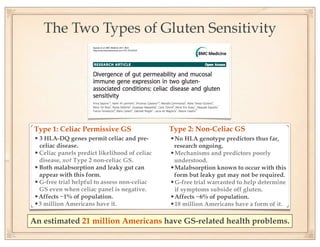
The Two Types of Gluten Sensitivity


Type 1: Celiac Permissive GS                   Type 2: Non-Celiac GS
• 3 HLA-DQ genes permit celiac and pre-        •No HLA genotype predictors thus far,
  celiac disease.                               research ongoing.
• Celiac panels predict likelihood of celiac   •Mechanisms and predictors poorly
  disease, not Type 2 non-celiac GS.            understood.
• Both malabsorption and leaky gut can         •Malabsorption known to occur with this
  appear with this form.                        form but leaky gut may not be required.
• G-free trial helpful to assess non-celiac    •G-free trial warranted to help determine
  GS even when celiac panel is negative.        if symptoms subside off gluten.
•Affects ~1% of population.                    •Affects ~6% of population.
•3 million Americans have it.                  •18 million Americans have a form of it.

An estimated 21 million Americans have GS-related health problems.
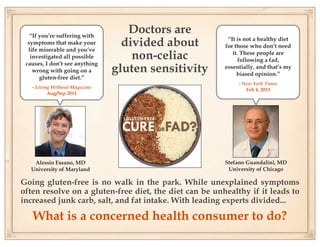
“If you’re suffering with
                                   Doctors are
  symptoms that make your
  life miserable and you’ve
                                  divided about          “It is not a healthy diet
                                                        for those who don’t need
   investigated all possible        non-celiac             it. These people are
                                                              following a fad,
 causes, I don’t see anything
    wrong with going on a       gluten sensitivity      essentially, and that’s my
                                                             biased opinion.”
       gluten-free diet.”
                                                             - New York Times
   - Living Without Magazine                                    Feb 4, 2013
          Aug/Sep 2011


    Alessio Fasano, MD                                  Stefano Guandalini, MD
   University of Maryland                                University of Chicago

Going gluten-free is no walk in the park. While unexplained symptoms
often resolve on a gluten-free diet, the diet can be unhealthy if it leads to
increased junk carb, salt, and fat intake. With leading experts divided...

   What is a concerned health consumer to do?
When the scientific evidence
        is blurry...


          seek a
systems medicine approach.
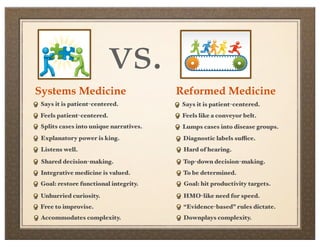
vs.
Systems Medicine                       Reformed Medicine
Says it is patient-centered.            Says it is patient-centered.
Feels patient-centered.                 Feels like a conveyor belt.
Splits cases into unique narratives.    Lumps cases into disease groups.
 Explanatory power is king.             Diagnostic labels suffice.
 Listens well.                          Hard of hearing.
 Shared decision-making.                Top-down decision-making.
 Integrative medicine is valued.        To be determined.
 Goal: restore functional integrity.    Goal: hit productivity targets.
 Unhurried curiosity.                   HMO-like need for speed.
Free to improvise.                      “Evidence-based” rules dictate.
 Accommodates complexity.               Downplays complexity.
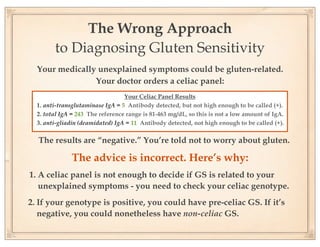
The Wrong Approach
        to Diagnosing Gluten Sensitivity
  Your medically unexplained symptoms could be gluten-related.
                Your doctor orders a celiac panel:
                                  Your Celiac Panel Results
  1. anti-transglutaminase IgA = 5 Antibody detected, but not high enough to be called (+).
  2. total IgA = 243 The reference range is 81-463 mg/dL, so this is not a low amount of IgA.
  3. anti-gliadin (deamidated) IgA = 11 Antibody detected, not high enough to be called (+).

  The results are “negative.” You’re told not to worry about gluten.

              The advice is incorrect. Here’s why:
1. A celiac panel is not enough to decide if GS is related to your
   unexplained symptoms - you need to check your celiac genotype.
2. If your genotype is positive, you could have pre-celiac GS. If it’s
   negative, you could nonetheless have non-celiac GS.
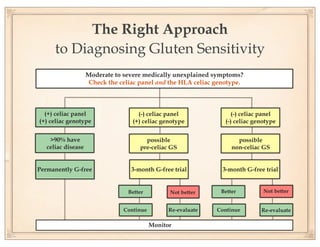
The Right Approach
      to Diagnosing Gluten Sensitivity
                    Moderate to severe medically unexplained symptoms?
                     Check the celiac panel and the HLA celiac genotype.


  (+) celiac panel                   (-) celiac panel                (-) celiac panel
(+) celiac genotype                (+) celiac genotype            (-) celiac genotype


    >90% have                           possible                      possible
   celiac disease                     pre-celiac GS                 non-celiac GS


Permanently G-free                 3-month G-free trial          3-month G-free trial


                                  Better         Not better     Better          Not better


                                Continue         Re-evaluate   Continue        Re-evaluate

                                           Monitor
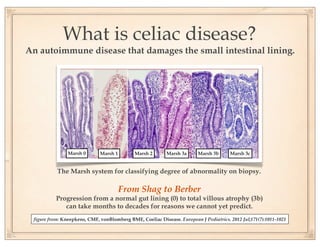
What is celiac disease?
An autoimmune disease that damages the small intestinal lining.


                Marsh 0       Marsh 1        Marsh 2       Marsh 3a      Marsh 3b      Marsh 3c


           The Marsh system for classifying degree of abnormality on biopsy.

                                        From Shag to Berber
          Progression from a normal gut lining (0) to total villous atrophy (3b)
             can take months to decades for reasons we cannot yet predict.
 figure from: Kneepkens, CMF, vonBlomberg BME, Coeliac Disease. European J Pediatrics. 2012 Jul;171(7):1011-1021
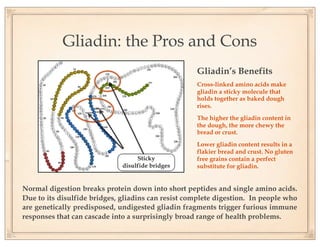
Gliadin: the Pros and Cons
                                                    Gliadin’s Benefits
                                                    Cross-linked amino acids make
                                                    gliadin a sticky molecule that
                                                    holds together as baked dough
                                                    rises.
                                                    The higher the gliadin content in
                                                    the dough, the more chewy the
                                                    bread or crust.
                                                    Lower gliadin content results in a
                                                    flakier bread and crust. No gluten
                                   Sticky           free grains contain a perfect
                              disulfide bridges     substitute for gliadin.


Normal digestion breaks protein down into short peptides and single amino acids.
Due to its disulfide bridges, gliadins can resist complete digestion. In people who
are genetically predisposed, undigested gliadin fragments trigger furious immune
responses that can cascade into a surprisingly broad range of health problems.
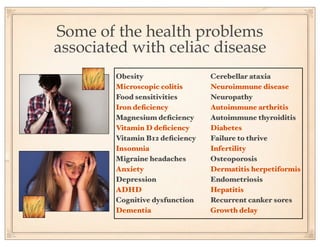
Some of the health problems
associated with celiac disease
        Obesity                 Cerebellar ataxia
        Microscopic colitis     Neuroimmune disease
        Food sensitivities      Neuropathy
        Iron deficiency          Autoimmune arthritis
        Magnesium deficiency     Autoimmune thyroiditis
        Vitamin D deficiency     Diabetes
        Vitamin B12 deficiency   Failure to thrive
        Insomnia                Infertility
        Migraine headaches      Osteoporosis
        Anxiety                 Dermatitis herpetiformis
        Depression              Endometriosis
        ADHD                    Hepatitis
        Cognitive dysfunction   Recurrent canker sores
        Dementia                Growth delay
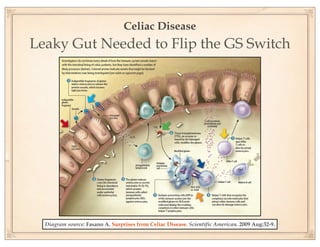
Celiac Disease
Leaky Gut Needed to Flip the GS Switch


  Diagram source: Fasano A. Surprises from Celiac Disease. Scientific American. 2009 Aug:32-9.
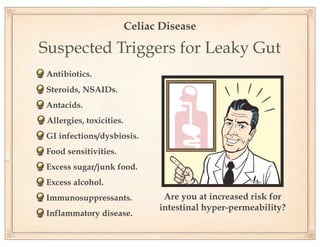
Celiac Disease

Suspected Triggers for Leaky Gut
Antibiotics.
Steroids, NSAIDs.
Antacids.
 Allergies, toxicities.
GI infections/dysbiosis.
Food sensitivities.
Excess sugar/junk food.
Excess alcohol.
Immunosuppressants.              Are you at increased risk for
                                intestinal hyper-permeability?
Inflammatory disease.
Celiac Disease

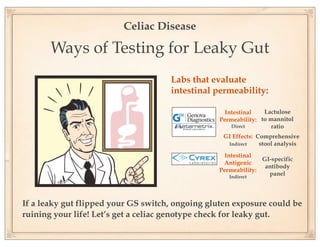
       Ways of Testing for Leaky Gut
                                     Labs that evaluate
                                     intestinal permeability:

                                                    Intestinal   Lactulose
                                                  Permeability: to mannitol
                                                      Direct        ratio
                                                   GI Effects: Comprehensive
                                                    Indirect    stool analysis
                                                   Intestinal
                                                               GI-specific
                                                  Antigenic
                                                                antibody
                                                 Permeability:
                                                     Indirect
                                                                 panel


If a leaky gut flipped your GS switch, ongoing gluten exposure could be
ruining your life! Let’s get a celiac genotype check for leaky gut.
Celiac Disease
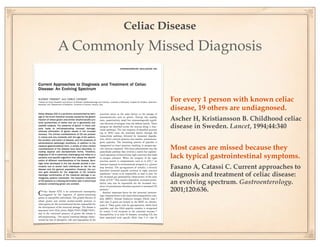
A Commonly Missed Diagnosis


                 For every 1 person with known celiac
                 disease, 19 others are undiagnosed.
                 Ascher H, Kristiansson B. Childhood celiac
                 disease in Sweden. Lancet, 1994;44:340


                 Most cases are missed because they
                 lack typical gastrointestinal symptoms.
                 Fasano A, Catassi C. Current approaches to
                 diagnosis and treatment of celiac disease:
                 an evolving spectrum. Gastroenterology.
                 2001;120:636.
Celiac Disease
                                 Global Prevalence


       Kamin DS, Furuta GT. The iceberg cometh: establishing the
       prevalence of celiac disease in the United States and Finland.
       Gastroenterology. 2003;126(1):359.


In 1980, celiac disease was thought to exist in 1 of 10,000 people. Today the global
prevalence of celiac disease is 1 in 130 - as high as 1 in 30 to 40 in people of Irish or Italian
descent. The prevalence has increased 100-fold because we’re diagnosing more cases, but
also because more cases are occurring as a result of increasing exposure to gluten,
unhealthy lifestyles, and more triggers for leaky gut.
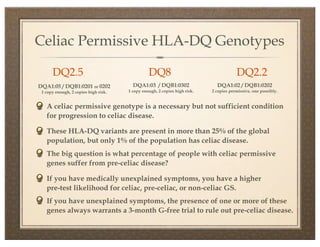
Celiac Permissive HLA-DQ Genotypes

      DQ2.5                                     DQ8                                    DQ2.2
DQA1:05 / DQB1:0201 or 0202             DQA1:03 / DQB1:0302                  DQA1:02 / DQB1:0202
 1 copy enough, 2 copies high risk.   1 copy enough, 2 copies high risk.   2 copies permissive, one possibly.


   A celiac permissive genotype is a necessary but not sufficient condition
   for progression to celiac disease.

   These HLA-DQ variants are present in more than 25% of the global
   population, but only 1% of the population has celiac disease.
   The big question is what percentage of people with celiac permissive
   genes suffer from pre-celiac disease?

   If you have medically unexplained symptoms, you have a higher
   pre-test likelihood for celiac, pre-celiac, or non-celiac GS.
   If you have unexplained symptoms, the presence of one or more of these
   genes always warrants a 3-month G-free trial to rule out pre-celiac disease.
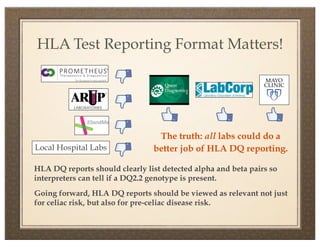
HLA Test Reporting Format Matters!


                                 The truth: all labs could do a
Local Hospital Labs             better job of HLA DQ reporting.

HLA DQ reports should clearly list detected alpha and beta pairs so
interpreters can tell if a DQ2.2 genotype is present.
Going forward, HLA DQ reports should be viewed as relevant not just
for celiac risk, but also for pre-celiac disease risk.
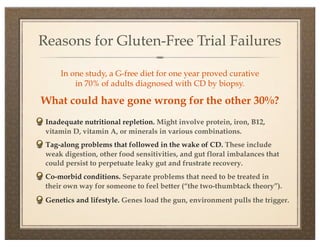
Reasons for Gluten-Free Trial Failures

     In one study, a G-free diet for one year proved curative
         in 70% of adults diagnosed with CD by biopsy.

What could have gone wrong for the other 30%?
 Inadequate nutritional repletion. Might involve protein, iron, B12,
 vitamin D, vitamin A, or minerals in various combinations.
 Tag-along problems that followed in the wake of CD. These include
 weak digestion, other food sensitivities, and gut floral imbalances that
 could persist to perpetuate leaky gut and frustrate recovery.
 Co-morbid conditions. Separate problems that need to be treated in
 their own way for someone to feel better (“the two-thumbtack theory”).
 Genetics and lifestyle. Genes load the gun, environment pulls the trigger.
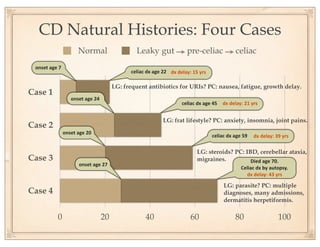
CD Natural Histories: Four Cases
                              Normal                          Leaky gut                          pre-celiac                       celiac
 onset	
  age	
  7
                                                           celiac	
  dx	
  age	
  22 dx	
  delay:	
  15	
  yrs

                                                    LG: frequent antibiotics for URIs? PC: nausea, fatigue, growth delay.
Case 1
                          onset	
  age	
  24
                                                                                             celiac	
  dx	
  age	
  45   dx	
  delay:	
  21	
  yrs


                                                                                LG: frat lifestyle? PC: anxiety, insomnia, joint pains.
Case 2
                     onset	
  age	
  20
                                                                                                                  celiac	
  dx	
  age	
  59    dx	
  delay:	
  39	
  yrs

                                                                                                       LG: steroids? PC: IBD, cerebellar ataxia,
Case 3                                                                                                 migraines.          Died	
  age	
  70.
                               onset	
  age	
  27
                                                                                                                                      Celiac	
  dx	
  by	
  autopsy.
                                                                                                                                        dx	
  delay:	
  43	
  yrs

                                                                                                                          LG: parasite? PC: multiple
Case 4                                                                                                                    diagnoses, many admissions,
                                                                                                                          dermatitis herpetiformis.

               0                               20                   40                             60                             80                            100
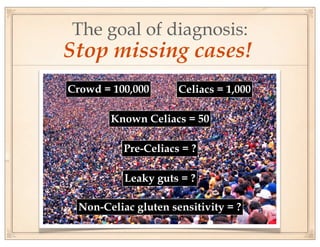
The goal of diagnosis:
Stop missing cases!
Crowd = 100,000      Celiacs = 1,000

       Known Celiacs = 50

          Pre-Celiacs = ?

          Leaky guts = ?

 Non-Celiac gluten sensitivity = ?
Clearing the Hurdles
So, you’ve been advised
 to go gluten free and
   you’re thinking...


        OMIGOD!

   Where do I start?
What have I done?
Clearing the Hurdles


     With Gluten                             Gluten-free
   light, airy, and springy                 dense and crumbly

An initial hurdle for many people who’ve been advised to begin a
gluten free lifestyle is finding a satisfying gluten free bread. Such
people routinely clear the hurdle through trial and error and with help
from friends, support groups, and online resources.
Some fan favorites
Clearing the Hurdles
                                Certain people with GS also suffer from
                                tag-along food sensitivities.

                                    These sensitivities commonly include
                                    dairy and sugar, but can include any
   GF-grains     Meats, nuts        number of foods.
 fruits, healthy  legumes,
      carbs         dairy            To get well, such people may need to
                                     identify and restrict exposure to tag-
                                     along reactive foods.

   Vegetables                       Tag-along reactive food restriction is
                                    almost always temporary (less than 6
                                    months).

                               Still, some will find that for certain foods,
                               long-term avoidance works best.


The G-free Plate Method
Congratulations!
You’ve learned a systems medicine approach to gluten sensitivity.

                Treat yourself to a gluten-free feast!
 An app
        et
 with no izer                        G-free
        bre                                 t:
  and G-f ad                         desser
         ree
  breadin
          g:


                           refills!
                      Free


 An entree
   with
  G-free
  bread:

                                                                to ward off
                                                   A cup of Joe             a?
                                                              ing food com
                                                 your impend

   Yes, a G-free diet can be unhealthy - but that’s up to you.
You can take control of your health!
 Now that you know how to solve the gluten puzzle...


and where to find any help you may need along the way.
Patient-centered
                                    systems medicine.


     15 N. Prospect
  Park Ridge, IL 60068
       847-232-9800
(for nutrition consults by phone)
www.parkridgemultimed.com

Gluten Sensitivity

  • 1.
    Gluten Sensitivity A SystemsMedicine Approach Keith Berndtson, MD
  • 2.
    What is gluten? A.A protein mainly found in wheat, rye, and barley. B. A chain of peptides including gliadins and glutenins. C. A substance that gives bread a pleasant texture, and lends dough more versatility. D. An additive used to stabilize processed foods. E. A potentially lethal substance. F. All of the above.
  • 3.
    Three Medical Conditions Related to Gluten Exposure Wheat Allergy Celiac Disease Gluten Sensitivity •Allergic •Autoimmune •“GS” cause unknown •Misc. wheat proteins •Gluten the cause •Innate immune system •IgE mediated •T-cell mediated •Cytokine mediated •Histamine release •Leaky gut the trigger •Spectrum of disorders •Allergy signs •Malabsorption •Malabsorption •GI, lungs, skin •Multiple tissues •No tissue damage •Anaphylaxis risk •Many symptoms •Many symptoms •Hours to minutes •Weeks to years •Hours to days •Accepted biomarkers •Accepted biomarkers •Proposed biomarkers
  • 4.
    The Two Typesof Gluten Sensitivity Type 1: Celiac Permissive GS Type 2: Non-Celiac GS • 3 HLA-DQ genes permit celiac and pre- •No HLA genotype predictors thus far, celiac disease. research ongoing. • Celiac panels predict likelihood of celiac •Mechanisms and predictors poorly disease, not Type 2 non-celiac GS. understood. • Both malabsorption and leaky gut can •Malabsorption known to occur with this appear with this form. form but leaky gut may not be required. • G-free trial helpful to assess non-celiac •G-free trial warranted to help determine GS even when celiac panel is negative. if symptoms subside off gluten. •Affects ~1% of population. •Affects ~6% of population. •3 million Americans have it. •18 million Americans have a form of it. An estimated 21 million Americans have GS-related health problems.
  • 5.
    “If you’re sufferingwith Doctors are symptoms that make your life miserable and you’ve divided about “It is not a healthy diet for those who don’t need investigated all possible non-celiac it. These people are following a fad, causes, I don’t see anything wrong with going on a gluten sensitivity essentially, and that’s my biased opinion.” gluten-free diet.” - New York Times - Living Without Magazine Feb 4, 2013 Aug/Sep 2011 Alessio Fasano, MD Stefano Guandalini, MD University of Maryland University of Chicago Going gluten-free is no walk in the park. While unexplained symptoms often resolve on a gluten-free diet, the diet can be unhealthy if it leads to increased junk carb, salt, and fat intake. With leading experts divided... What is a concerned health consumer to do?
  • 6.
    When the scientificevidence is blurry... seek a systems medicine approach.
  • 7.
    vs. Systems Medicine Reformed Medicine Says it is patient-centered. Says it is patient-centered. Feels patient-centered. Feels like a conveyor belt. Splits cases into unique narratives. Lumps cases into disease groups. Explanatory power is king. Diagnostic labels suffice. Listens well. Hard of hearing. Shared decision-making. Top-down decision-making. Integrative medicine is valued. To be determined. Goal: restore functional integrity. Goal: hit productivity targets. Unhurried curiosity. HMO-like need for speed. Free to improvise. “Evidence-based” rules dictate. Accommodates complexity. Downplays complexity.
  • 8.
    The Wrong Approach to Diagnosing Gluten Sensitivity Your medically unexplained symptoms could be gluten-related. Your doctor orders a celiac panel: Your Celiac Panel Results 1. anti-transglutaminase IgA = 5 Antibody detected, but not high enough to be called (+). 2. total IgA = 243 The reference range is 81-463 mg/dL, so this is not a low amount of IgA. 3. anti-gliadin (deamidated) IgA = 11 Antibody detected, not high enough to be called (+). The results are “negative.” You’re told not to worry about gluten. The advice is incorrect. Here’s why: 1. A celiac panel is not enough to decide if GS is related to your unexplained symptoms - you need to check your celiac genotype. 2. If your genotype is positive, you could have pre-celiac GS. If it’s negative, you could nonetheless have non-celiac GS.
  • 9.
    The Right Approach to Diagnosing Gluten Sensitivity Moderate to severe medically unexplained symptoms? Check the celiac panel and the HLA celiac genotype. (+) celiac panel (-) celiac panel (-) celiac panel (+) celiac genotype (+) celiac genotype (-) celiac genotype >90% have possible possible celiac disease pre-celiac GS non-celiac GS Permanently G-free 3-month G-free trial 3-month G-free trial Better Not better Better Not better Continue Re-evaluate Continue Re-evaluate Monitor
  • 10.
    What is celiacdisease? An autoimmune disease that damages the small intestinal lining. Marsh 0 Marsh 1 Marsh 2 Marsh 3a Marsh 3b Marsh 3c The Marsh system for classifying degree of abnormality on biopsy. From Shag to Berber Progression from a normal gut lining (0) to total villous atrophy (3b) can take months to decades for reasons we cannot yet predict. figure from: Kneepkens, CMF, vonBlomberg BME, Coeliac Disease. European J Pediatrics. 2012 Jul;171(7):1011-1021
  • 11.
    Gliadin: the Prosand Cons Gliadin’s Benefits Cross-linked amino acids make gliadin a sticky molecule that holds together as baked dough rises. The higher the gliadin content in the dough, the more chewy the bread or crust. Lower gliadin content results in a flakier bread and crust. No gluten Sticky free grains contain a perfect disulfide bridges substitute for gliadin. Normal digestion breaks protein down into short peptides and single amino acids. Due to its disulfide bridges, gliadins can resist complete digestion. In people who are genetically predisposed, undigested gliadin fragments trigger furious immune responses that can cascade into a surprisingly broad range of health problems.
  • 12.
    Some of thehealth problems associated with celiac disease Obesity Cerebellar ataxia Microscopic colitis Neuroimmune disease Food sensitivities Neuropathy Iron deficiency Autoimmune arthritis Magnesium deficiency Autoimmune thyroiditis Vitamin D deficiency Diabetes Vitamin B12 deficiency Failure to thrive Insomnia Infertility Migraine headaches Osteoporosis Anxiety Dermatitis herpetiformis Depression Endometriosis ADHD Hepatitis Cognitive dysfunction Recurrent canker sores Dementia Growth delay
  • 13.
    Celiac Disease Leaky GutNeeded to Flip the GS Switch Diagram source: Fasano A. Surprises from Celiac Disease. Scientific American. 2009 Aug:32-9.
  • 14.
    Celiac Disease Suspected Triggersfor Leaky Gut Antibiotics. Steroids, NSAIDs. Antacids. Allergies, toxicities. GI infections/dysbiosis. Food sensitivities. Excess sugar/junk food. Excess alcohol. Immunosuppressants. Are you at increased risk for intestinal hyper-permeability? Inflammatory disease.
  • 15.
    Celiac Disease Ways of Testing for Leaky Gut Labs that evaluate intestinal permeability: Intestinal Lactulose Permeability: to mannitol Direct ratio GI Effects: Comprehensive Indirect stool analysis Intestinal GI-specific Antigenic antibody Permeability: Indirect panel If a leaky gut flipped your GS switch, ongoing gluten exposure could be ruining your life! Let’s get a celiac genotype check for leaky gut.
  • 16.
    Celiac Disease A CommonlyMissed Diagnosis For every 1 person with known celiac disease, 19 others are undiagnosed. Ascher H, Kristiansson B. Childhood celiac disease in Sweden. Lancet, 1994;44:340 Most cases are missed because they lack typical gastrointestinal symptoms. Fasano A, Catassi C. Current approaches to diagnosis and treatment of celiac disease: an evolving spectrum. Gastroenterology. 2001;120:636.
  • 17.
    Celiac Disease Global Prevalence Kamin DS, Furuta GT. The iceberg cometh: establishing the prevalence of celiac disease in the United States and Finland. Gastroenterology. 2003;126(1):359. In 1980, celiac disease was thought to exist in 1 of 10,000 people. Today the global prevalence of celiac disease is 1 in 130 - as high as 1 in 30 to 40 in people of Irish or Italian descent. The prevalence has increased 100-fold because we’re diagnosing more cases, but also because more cases are occurring as a result of increasing exposure to gluten, unhealthy lifestyles, and more triggers for leaky gut.
  • 18.
    Celiac Permissive HLA-DQGenotypes DQ2.5 DQ8 DQ2.2 DQA1:05 / DQB1:0201 or 0202 DQA1:03 / DQB1:0302 DQA1:02 / DQB1:0202 1 copy enough, 2 copies high risk. 1 copy enough, 2 copies high risk. 2 copies permissive, one possibly. A celiac permissive genotype is a necessary but not sufficient condition for progression to celiac disease. These HLA-DQ variants are present in more than 25% of the global population, but only 1% of the population has celiac disease. The big question is what percentage of people with celiac permissive genes suffer from pre-celiac disease? If you have medically unexplained symptoms, you have a higher pre-test likelihood for celiac, pre-celiac, or non-celiac GS. If you have unexplained symptoms, the presence of one or more of these genes always warrants a 3-month G-free trial to rule out pre-celiac disease.
  • 19.
    HLA Test ReportingFormat Matters! The truth: all labs could do a Local Hospital Labs better job of HLA DQ reporting. HLA DQ reports should clearly list detected alpha and beta pairs so interpreters can tell if a DQ2.2 genotype is present. Going forward, HLA DQ reports should be viewed as relevant not just for celiac risk, but also for pre-celiac disease risk.
  • 20.
    Reasons for Gluten-FreeTrial Failures In one study, a G-free diet for one year proved curative in 70% of adults diagnosed with CD by biopsy. What could have gone wrong for the other 30%? Inadequate nutritional repletion. Might involve protein, iron, B12, vitamin D, vitamin A, or minerals in various combinations. Tag-along problems that followed in the wake of CD. These include weak digestion, other food sensitivities, and gut floral imbalances that could persist to perpetuate leaky gut and frustrate recovery. Co-morbid conditions. Separate problems that need to be treated in their own way for someone to feel better (“the two-thumbtack theory”). Genetics and lifestyle. Genes load the gun, environment pulls the trigger.
  • 21.
    CD Natural Histories:Four Cases Normal Leaky gut pre-celiac celiac onset  age  7 celiac  dx  age  22 dx  delay:  15  yrs LG: frequent antibiotics for URIs? PC: nausea, fatigue, growth delay. Case 1 onset  age  24 celiac  dx  age  45 dx  delay:  21  yrs LG: frat lifestyle? PC: anxiety, insomnia, joint pains. Case 2 onset  age  20 celiac  dx  age  59 dx  delay:  39  yrs LG: steroids? PC: IBD, cerebellar ataxia, Case 3 migraines. Died  age  70. onset  age  27 Celiac  dx  by  autopsy. dx  delay:  43  yrs LG: parasite? PC: multiple Case 4 diagnoses, many admissions, dermatitis herpetiformis. 0 20 40 60 80 100
  • 22.
    The goal ofdiagnosis: Stop missing cases! Crowd = 100,000 Celiacs = 1,000 Known Celiacs = 50 Pre-Celiacs = ? Leaky guts = ? Non-Celiac gluten sensitivity = ?
  • 23.
    Clearing the Hurdles So,you’ve been advised to go gluten free and you’re thinking... OMIGOD! Where do I start? What have I done?
  • 24.
    Clearing the Hurdles With Gluten Gluten-free light, airy, and springy dense and crumbly An initial hurdle for many people who’ve been advised to begin a gluten free lifestyle is finding a satisfying gluten free bread. Such people routinely clear the hurdle through trial and error and with help from friends, support groups, and online resources.
  • 25.
  • 26.
    Clearing the Hurdles Certain people with GS also suffer from tag-along food sensitivities. These sensitivities commonly include dairy and sugar, but can include any GF-grains Meats, nuts number of foods. fruits, healthy legumes, carbs dairy To get well, such people may need to identify and restrict exposure to tag- along reactive foods. Vegetables Tag-along reactive food restriction is almost always temporary (less than 6 months). Still, some will find that for certain foods, long-term avoidance works best. The G-free Plate Method
  • 27.
    Congratulations! You’ve learned asystems medicine approach to gluten sensitivity. Treat yourself to a gluten-free feast! An app et with no izer G-free bre t: and G-f ad desser ree breadin g: refills! Free An entree with G-free bread: to ward off A cup of Joe a? ing food com your impend Yes, a G-free diet can be unhealthy - but that’s up to you.
  • 28.
    You can takecontrol of your health! Now that you know how to solve the gluten puzzle... and where to find any help you may need along the way.
  • 29.
    Patient-centered systems medicine. 15 N. Prospect Park Ridge, IL 60068 847-232-9800 (for nutrition consults by phone) www.parkridgemultimed.com