Cash | 1


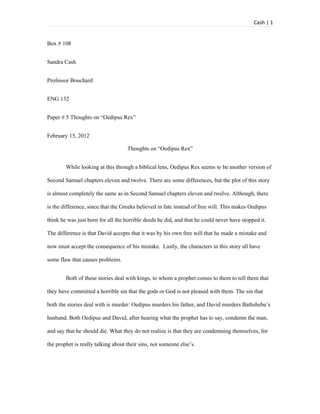
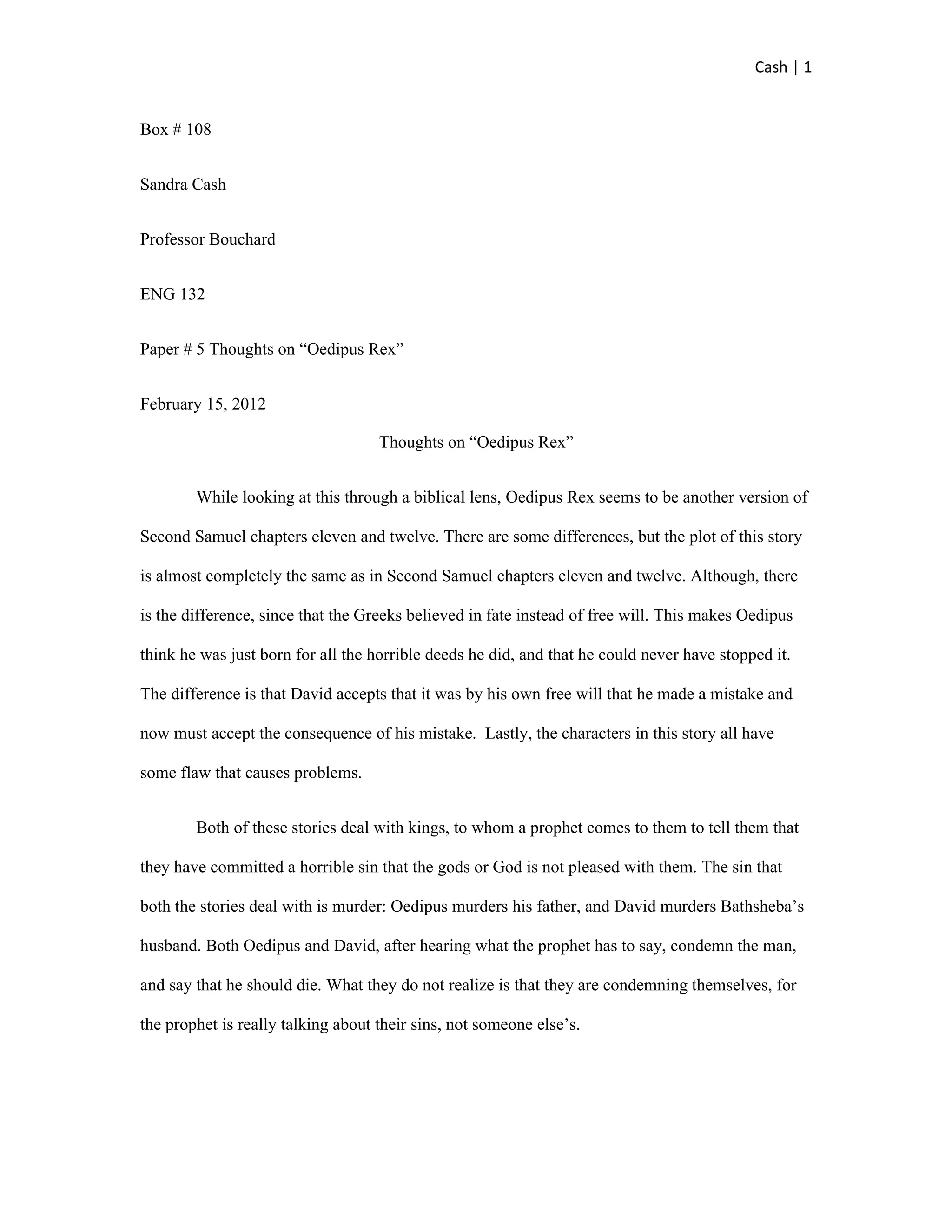
Box # 108


Sandra Cash


Professor Bouchard


ENG 132


Paper # 5 Thoughts on “Oedipus Rex”


February 15, 2012

                                    Thoughts on “Oedipus Rex”


        While looking at this through a biblical lens, Oedipus Rex seems to be another version of

Second Samuel chapters eleven and twelve. There are some differences, but the plot of this story

is almost completely the same as in Second Samuel chapters eleven and twelve. Although, there

is the difference, since that the Greeks believed in fate instead of free will. This makes Oedipus

think he was just born for all the horrible deeds he did, and that he could never have stopped it.

The difference is that David accepts that it was by his own free will that he made a mistake and

now must accept the consequence of his mistake. Lastly, the characters in this story all have

some flaw that causes problems.


        Both of these stories deal with kings, to whom a prophet comes to them to tell them that

they have committed a horrible sin that the gods or God is not pleased with them. The sin that

both the stories deal with is murder: Oedipus murders his father, and David murders Bathsheba’s

husband. Both Oedipus and David, after hearing what the prophet has to say, condemn the man,

and say that he should die. What they do not realize is that they are condemning themselves, for

the prophet is really talking about their sins, not someone else’s.
Cash | 2


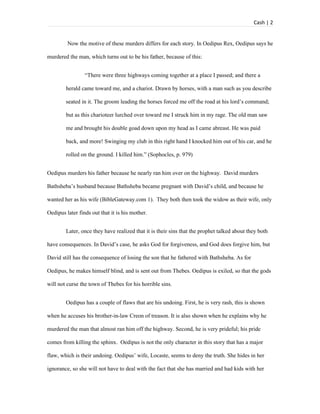
         Now the motive of these murders differs for each story. In Oedipus Rex, Oedipus says he

murdered the man, which turns out to be his father, because of this:


                 “There were three highways coming together at a place I passed; and there a

        herald came toward me, and a chariot. Drawn by horses, with a man such as you describe

        seated in it. The groom leading the horses forced me off the road at his lord’s command;

        but as this charioteer lurched over toward me I struck him in my rage. The old man saw

        me and brought his double goad down upon my head as I came abreast. He was paid

        back, and more! Swinging my club in this right hand I knocked him out of his car, and he

        rolled on the ground. I killed him.” (Sophocles, p. 979)


Oedipus murders his father because he nearly ran him over on the highway. David murders

Bathsheba’s husband because Bathsheba became pregnant with David’s child, and because he

wanted her as his wife (BibleGateway.com 1). They both then took the widow as their wife, only

Oedipus later finds out that it is his mother.


        Later, once they have realized that it is their sins that the prophet talked about they both

have consequences. In David’s case, he asks God for forgiveness, and God does forgive him, but

David still has the consequence of losing the son that he fathered with Bathsheba. As for

Oedipus, he makes himself blind, and is sent out from Thebes. Oedipus is exiled, so that the gods

will not curse the town of Thebes for his horrible sins.


        Oedipus has a couple of flaws that are his undoing. First, he is very rash, this is shown

when he accuses his brother-in-law Creon of treason. It is also shown when he explains why he

murdered the man that almost ran him off the highway. Second, he is very prideful; his pride

comes from killing the sphinx. Oedipus is not the only character in this story that has a major

flaw, which is their undoing. Oedipus’ wife, Locaste, seems to deny the truth. She hides in her

ignorance, so she will not have to deal with the fact that she has married and had kids with her
Cash | 3


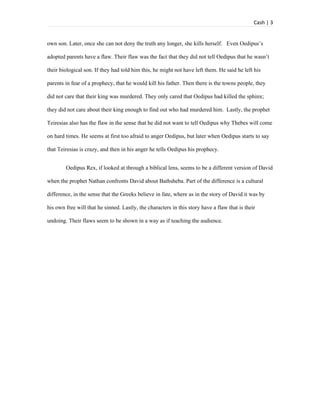
own son. Later, once she can not deny the truth any longer, she kills herself. Even Oedipus’s

adopted parents have a flaw. Their flaw was the fact that they did not tell Oedipus that he wasn’t

their biological son. If they had told him this, he might not have left them. He said he left his

parents in fear of a prophecy, that he would kill his father. Then there is the towns people, they

did not care that their king was murdered. They only cared that Oedipus had killed the sphinx;

they did not care about their king enough to find out who had murdered him. Lastly, the prophet

Teiresias also has the flaw in the sense that he did not want to tell Oedipus why Thebes will come

on hard times. He seems at first too afraid to anger Oedipus, but later when Oedipus starts to say

that Teiresias is crazy, and then in his anger he tells Oedipus his prophecy.


        Oedipus Rex, if looked at through a biblical lens, seems to be a different version of David

when the prophet Nathan confronts David about Bathsheba. Part of the difference is a cultural

difference, in the sense that the Greeks believe in fate, where as in the story of David it was by

his own free will that he sinned. Lastly, the characters in this story have a flaw that is their

undoing. Their flaws seem to be shown in a way as if teaching the audience.
Cash | 4


Works Cited
    BibleGateway.com. n.d. 16 February 2012 <http://www.biblegateway.com/passage/?

    search=2%20Samuel+11&version=NIV>.


    BibleGateway.com. n.d. 16 February 2012


    <http://www.biblegateway.com/passage/?search=2%20Samuel%2012%20&ersion=NI>.


    Sophocles. "Oedipus Rex." DiYanni, Robert. Literature: Approaches to Fictioin, Poetry,

    and Drama. Boston: McGraw Hill, 2008. 959-998.

Paper # 5 thoughts on oedipus rex

  • 1.
    Cash | 1 Box# 108 Sandra Cash Professor Bouchard ENG 132 Paper # 5 Thoughts on “Oedipus Rex” February 15, 2012 Thoughts on “Oedipus Rex” While looking at this through a biblical lens, Oedipus Rex seems to be another version of Second Samuel chapters eleven and twelve. There are some differences, but the plot of this story is almost completely the same as in Second Samuel chapters eleven and twelve. Although, there is the difference, since that the Greeks believed in fate instead of free will. This makes Oedipus think he was just born for all the horrible deeds he did, and that he could never have stopped it. The difference is that David accepts that it was by his own free will that he made a mistake and now must accept the consequence of his mistake. Lastly, the characters in this story all have some flaw that causes problems. Both of these stories deal with kings, to whom a prophet comes to them to tell them that they have committed a horrible sin that the gods or God is not pleased with them. The sin that both the stories deal with is murder: Oedipus murders his father, and David murders Bathsheba’s husband. Both Oedipus and David, after hearing what the prophet has to say, condemn the man, and say that he should die. What they do not realize is that they are condemning themselves, for the prophet is really talking about their sins, not someone else’s.
  • 2.
    Cash | 2 Now the motive of these murders differs for each story. In Oedipus Rex, Oedipus says he murdered the man, which turns out to be his father, because of this: “There were three highways coming together at a place I passed; and there a herald came toward me, and a chariot. Drawn by horses, with a man such as you describe seated in it. The groom leading the horses forced me off the road at his lord’s command; but as this charioteer lurched over toward me I struck him in my rage. The old man saw me and brought his double goad down upon my head as I came abreast. He was paid back, and more! Swinging my club in this right hand I knocked him out of his car, and he rolled on the ground. I killed him.” (Sophocles, p. 979) Oedipus murders his father because he nearly ran him over on the highway. David murders Bathsheba’s husband because Bathsheba became pregnant with David’s child, and because he wanted her as his wife (BibleGateway.com 1). They both then took the widow as their wife, only Oedipus later finds out that it is his mother. Later, once they have realized that it is their sins that the prophet talked about they both have consequences. In David’s case, he asks God for forgiveness, and God does forgive him, but David still has the consequence of losing the son that he fathered with Bathsheba. As for Oedipus, he makes himself blind, and is sent out from Thebes. Oedipus is exiled, so that the gods will not curse the town of Thebes for his horrible sins. Oedipus has a couple of flaws that are his undoing. First, he is very rash, this is shown when he accuses his brother-in-law Creon of treason. It is also shown when he explains why he murdered the man that almost ran him off the highway. Second, he is very prideful; his pride comes from killing the sphinx. Oedipus is not the only character in this story that has a major flaw, which is their undoing. Oedipus’ wife, Locaste, seems to deny the truth. She hides in her ignorance, so she will not have to deal with the fact that she has married and had kids with her
  • 3.
    Cash | 3 ownson. Later, once she can not deny the truth any longer, she kills herself. Even Oedipus’s adopted parents have a flaw. Their flaw was the fact that they did not tell Oedipus that he wasn’t their biological son. If they had told him this, he might not have left them. He said he left his parents in fear of a prophecy, that he would kill his father. Then there is the towns people, they did not care that their king was murdered. They only cared that Oedipus had killed the sphinx; they did not care about their king enough to find out who had murdered him. Lastly, the prophet Teiresias also has the flaw in the sense that he did not want to tell Oedipus why Thebes will come on hard times. He seems at first too afraid to anger Oedipus, but later when Oedipus starts to say that Teiresias is crazy, and then in his anger he tells Oedipus his prophecy. Oedipus Rex, if looked at through a biblical lens, seems to be a different version of David when the prophet Nathan confronts David about Bathsheba. Part of the difference is a cultural difference, in the sense that the Greeks believe in fate, where as in the story of David it was by his own free will that he sinned. Lastly, the characters in this story have a flaw that is their undoing. Their flaws seem to be shown in a way as if teaching the audience.
  • 4.
    Cash | 4 WorksCited BibleGateway.com. n.d. 16 February 2012 <http://www.biblegateway.com/passage/? search=2%20Samuel+11&version=NIV>. BibleGateway.com. n.d. 16 February 2012 <http://www.biblegateway.com/passage/?search=2%20Samuel%2012%20&ersion=NI>. Sophocles. "Oedipus Rex." DiYanni, Robert. Literature: Approaches to Fictioin, Poetry, and Drama. Boston: McGraw Hill, 2008. 959-998.