CELIAC DISEASE
Ruth Blackburn, Kristin Gunderson and Jill Richter
What is Celiac Disease?
■ “A disorder characterized by intestinal inflammation on exposure to the
dietary protein gluten”
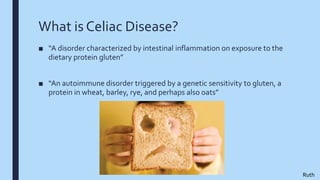
■ “An autoimmune disorder triggered by a genetic sensitivity to gluten, a
protein in wheat, barley, rye, and perhaps also oats”
Ruth
Etiology
■ Often due to genetic predispositions.
■ Chances of developing celiac disease are increased with other
autoimmune diseases such as type 1 diabetes, rhematiod arthritis,
autoimmune thyroid or liver disease.
■ Genetic disorders such as down syndrome or turners syndrome increase
chances of celiac disease.
■ Environmental factors may contribute to disease: includes childbirth,
pregnancy, severe stress, surgery and illness.
■ May lead to other disorders including: infertility, reduced bone density,
neurological disorders, cancer and other autoimmune diseases.
Kristin
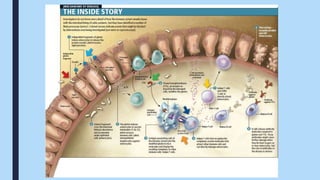
■ When gluten is ingested, it causes an immune respond in the small intestine in which
the immune systems attacks the cells of the intestine, therefore inhibiting digestion
and absorption of nutrients
■ Immune system mistakes healthy cells and substances for harmful ones and produces
antibodies to fight them.
– In celiac, your immune system mistakes one of the substances that makes up gluten,
called gliadin, as a threat to the body.
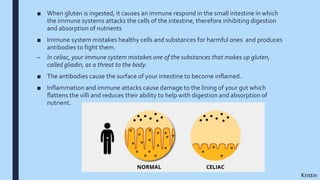
■ The antibodies cause the surface of your intestine to become inflamed.
■ Inflammation and immune attacks cause damage to the lining of your gut which
flattens the villi and reduces their ability to help with digestion and absorption of
nutrient.
Kristin
Symptoms
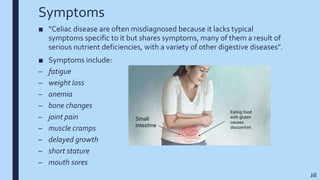
■ “Celiac disease are often misdiagnosed because it lacks typical
symptoms specific to it but shares symptoms, many of them a result of
serious nutrient deficiencies, with a variety of other digestive diseases”.
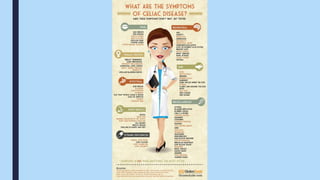
■ Symptoms include:
– fatigue
– weight loss
– anemia
– bone changes
– joint pain
– muscle cramps
– delayed growth
– short stature
– mouth sores
Jill
Risk Factors
■ Risk of having this disease increase if a direct family member has it also.
■ People who have celiac often do not know they have he disease until a
trigger causes the disease to flare and cause major issues. Some triggers
may include severe stress, childbirth, infection or physical injuries.
■ Nutrition deficiencies are common due to the flaring of small intestine
lining which inhibits nutrient absorption.
■ Deficiencies include: iron, B12, calcium, vitamin D, zinc and copper.
■ Low vitamin and mineral levels can cause issues such as bone density
decrease and fatigue.
Ruth
Statistics
■ About 1/100 people have celiac disease, about 1% of the population.
■ Affects about 3 million Americans.
■ Estimated about 83% of Americans with celiac are undiagnosed or
misdiagnosed with other digestive disorders.
■ 6-10 years is the amount of time needed to properly diagnose a celiac
patient.
■ 5-22% of people with celiac disease have an immediate family member
who has had celiac disease.
■ People have a 1/22 chance of developing celiac disease if a parent or
sibling has the condition
■ Gluten free sales reached more than $2.6 billion by the end of 2010 and
are expected to excede more than $5 billion by 2016
Kristin
Testing for Celiac
■ Physical examination
■ Blood test to check for elevated antibody levels.
■ Blood test to detect nutritional deficiencies, specifically iron levels which would
indicate anemia if too low.
■ Stool sample to test for fatty stool since celiac patients are often unable to absorb fat
from food.
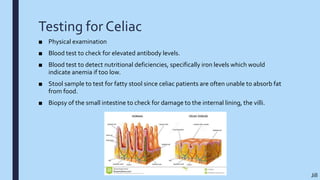
■ Biopsy of the small intestine to check for damage to the internal lining, the villi.
Jill
Treatment
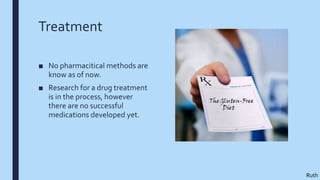
■ No pharmacitical methods are
know as of now.
■ Research for a drug treatment
is in the process, however
there are no successful
medications developed yet.
Ruth
Role of Nutrition
■ 100% gluten free diet is the only way to eliminate symptoms of this disease
■ Treatment for celiac disease requires elimination of the storage proteins
(gluten) found in wheat, rye, and barley.
■ The inclusion of oats and wheat starch is controversial as they do not contain
gluten themselves but may be processed in a gluten containing factory.
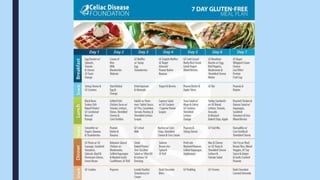
■ Acceptable foods: beans, gluten free cereal (oats), fruits, vegetables, meat,
poultry, fish, seafood, eggs, dairy, legumes, nuts, soups, sauces (if gluten free),
most juices and soda, alcohol (including wine and hard liquor, no beer).
■ Grains include: rice, cassava, corn, soy, potatoes, tapioca, sorghum, quinoa,
millet, buckwheat, arrowroot, amaranth, teff, flax, chia, yucca, gluten-free
oats and nut flour.
■ Diet and gluten-free products are often low in B vitamins, calcium, vitamin D,
iron, zinc, magnesium, and fiber. Few gluten-free products are enriched or
fortified, adding to the risk of nutrient deficiencies.
Ruth
Lifestyle Prescription
■ Eating a gluten free diet yet seeking alternate carbohydrate sources to
maintain a balanced meal plan.
■ Some patients may need to supplement certain vitamins and minerals
which cannot be adequately consumed in their daily diet.
■ Avoiding gluten in environment as it may trigger an immune response.
■ Avoiding high stress situations as it may increase autoimmune flares.
■ Maintain an active lifestyles with a healthy body weight and sufficient
eating pattern.
Kristin
Gluten Free for the General Population?
■ A gluten free diet has become a growing trend within the past few years
as people view it as being a healthier alternative to a normal balanced
eating style.
■ Gluten free diets will do no good for people who are not gluten
sensitive, in fact they often contain more calories, sugar and cost more.
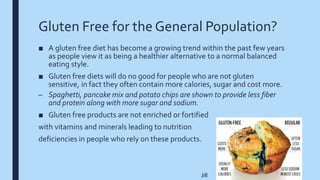
– Spaghetti, pancake mix and potato chips are shown to provide less fiber
and protein along with more sugar and sodium.
■ Gluten free products are not enriched or fortified
with vitamins and minerals leading to nutrition
deficiencies in people who rely on these products.
Jill
Works Cited
■ Allen, Patricia Jackson. "Primary Care Approaches.Gluten-Related Disorders: Celiac Disease, Gluten
Allergy, Non-Celiac Gluten Sensitivity." Pediatric Nursing 41.3 (2015): 146-150 5p. CINAHL Complete.
Web. 7 Mar. 2016.
■ Alzaben,Abeer S., et al. "Assessing Nutritional Quality AndAdherenceToTheGluten-Free Diet In
ChildrenAndAdolescentsWith Celiac Disease." CanadianJournalOf Dietetic Practice & Research 76.2
(2015): 56-63 8p. CINAHL Complete.Web. 7 Mar. 2016.
■ "Celiac Disease: Fast Facts." Celiac Disease: Fast Facts. N.p., n.d.Web. 07 Mar. 2016.
■ "Celiac Disease Foundation -." Celiac Disease Foundation. N.p., n.d.Web. 07 Mar. 2016.
■ "Celiac Disease." Funk &Wagnalls NewWorld Encyclopedia (2015): 1p. 1. Funk &Wagnalls NewWorld
Encyclopedia.Web. 7 Mar. 2016.
■ "Celiac Disease (Gluten Intolerance)." Healthline. N.p., n.d.Web. 07 Mar. 2016.
■ "Celiac Disease." National Center for Biotechnology Information. U.S. National Library of Medicine, n.d.
Web. 07 Mar. 2016.
■ "Celiac Disease." SpringerReference (n.d.): n. pag.Web.
■ "Coeliac Disease - Causes ." Coeliac Disease. N.p., n.d.Web. 07 Mar. 2016.
■ Hamilton, Eva May Nunnelley., and Eleanor Noss.Whitney. Nutrition,Concepts andControversies.St.
Paul:West Pub., 1982. Print.
■ "WhatCan I Eat? - Celiac Disease Foundation." Celiac Disease Foundation. N.p., n.d.Web. 07 Mar.
2016.

Celiac Disease

  • 1.
    CELIAC DISEASE Ruth Blackburn,Kristin Gunderson and Jill Richter
  • 2.
    What is CeliacDisease? ■ “A disorder characterized by intestinal inflammation on exposure to the dietary protein gluten” ■ “An autoimmune disorder triggered by a genetic sensitivity to gluten, a protein in wheat, barley, rye, and perhaps also oats” Ruth
  • 3.
    Etiology ■ Often dueto genetic predispositions. ■ Chances of developing celiac disease are increased with other autoimmune diseases such as type 1 diabetes, rhematiod arthritis, autoimmune thyroid or liver disease. ■ Genetic disorders such as down syndrome or turners syndrome increase chances of celiac disease. ■ Environmental factors may contribute to disease: includes childbirth, pregnancy, severe stress, surgery and illness. ■ May lead to other disorders including: infertility, reduced bone density, neurological disorders, cancer and other autoimmune diseases. Kristin
  • 4.
    ■ When glutenis ingested, it causes an immune respond in the small intestine in which the immune systems attacks the cells of the intestine, therefore inhibiting digestion and absorption of nutrients ■ Immune system mistakes healthy cells and substances for harmful ones and produces antibodies to fight them. – In celiac, your immune system mistakes one of the substances that makes up gluten, called gliadin, as a threat to the body. ■ The antibodies cause the surface of your intestine to become inflamed. ■ Inflammation and immune attacks cause damage to the lining of your gut which flattens the villi and reduces their ability to help with digestion and absorption of nutrient. Kristin
  • 6.
    Symptoms ■ “Celiac diseaseare often misdiagnosed because it lacks typical symptoms specific to it but shares symptoms, many of them a result of serious nutrient deficiencies, with a variety of other digestive diseases”. ■ Symptoms include: – fatigue – weight loss – anemia – bone changes – joint pain – muscle cramps – delayed growth – short stature – mouth sores Jill
  • 8.
    Risk Factors ■ Riskof having this disease increase if a direct family member has it also. ■ People who have celiac often do not know they have he disease until a trigger causes the disease to flare and cause major issues. Some triggers may include severe stress, childbirth, infection or physical injuries. ■ Nutrition deficiencies are common due to the flaring of small intestine lining which inhibits nutrient absorption. ■ Deficiencies include: iron, B12, calcium, vitamin D, zinc and copper. ■ Low vitamin and mineral levels can cause issues such as bone density decrease and fatigue. Ruth
  • 9.
    Statistics ■ About 1/100people have celiac disease, about 1% of the population. ■ Affects about 3 million Americans. ■ Estimated about 83% of Americans with celiac are undiagnosed or misdiagnosed with other digestive disorders. ■ 6-10 years is the amount of time needed to properly diagnose a celiac patient. ■ 5-22% of people with celiac disease have an immediate family member who has had celiac disease. ■ People have a 1/22 chance of developing celiac disease if a parent or sibling has the condition ■ Gluten free sales reached more than $2.6 billion by the end of 2010 and are expected to excede more than $5 billion by 2016 Kristin
  • 10.
    Testing for Celiac ■Physical examination ■ Blood test to check for elevated antibody levels. ■ Blood test to detect nutritional deficiencies, specifically iron levels which would indicate anemia if too low. ■ Stool sample to test for fatty stool since celiac patients are often unable to absorb fat from food. ■ Biopsy of the small intestine to check for damage to the internal lining, the villi. Jill
  • 11.
    Treatment ■ No pharmaciticalmethods are know as of now. ■ Research for a drug treatment is in the process, however there are no successful medications developed yet. Ruth
  • 12.
    Role of Nutrition ■100% gluten free diet is the only way to eliminate symptoms of this disease ■ Treatment for celiac disease requires elimination of the storage proteins (gluten) found in wheat, rye, and barley. ■ The inclusion of oats and wheat starch is controversial as they do not contain gluten themselves but may be processed in a gluten containing factory. ■ Acceptable foods: beans, gluten free cereal (oats), fruits, vegetables, meat, poultry, fish, seafood, eggs, dairy, legumes, nuts, soups, sauces (if gluten free), most juices and soda, alcohol (including wine and hard liquor, no beer). ■ Grains include: rice, cassava, corn, soy, potatoes, tapioca, sorghum, quinoa, millet, buckwheat, arrowroot, amaranth, teff, flax, chia, yucca, gluten-free oats and nut flour. ■ Diet and gluten-free products are often low in B vitamins, calcium, vitamin D, iron, zinc, magnesium, and fiber. Few gluten-free products are enriched or fortified, adding to the risk of nutrient deficiencies. Ruth
  • 16.
    Lifestyle Prescription ■ Eatinga gluten free diet yet seeking alternate carbohydrate sources to maintain a balanced meal plan. ■ Some patients may need to supplement certain vitamins and minerals which cannot be adequately consumed in their daily diet. ■ Avoiding gluten in environment as it may trigger an immune response. ■ Avoiding high stress situations as it may increase autoimmune flares. ■ Maintain an active lifestyles with a healthy body weight and sufficient eating pattern. Kristin
  • 17.
    Gluten Free forthe General Population? ■ A gluten free diet has become a growing trend within the past few years as people view it as being a healthier alternative to a normal balanced eating style. ■ Gluten free diets will do no good for people who are not gluten sensitive, in fact they often contain more calories, sugar and cost more. – Spaghetti, pancake mix and potato chips are shown to provide less fiber and protein along with more sugar and sodium. ■ Gluten free products are not enriched or fortified with vitamins and minerals leading to nutrition deficiencies in people who rely on these products. Jill
  • 18.
    Works Cited ■ Allen,Patricia Jackson. "Primary Care Approaches.Gluten-Related Disorders: Celiac Disease, Gluten Allergy, Non-Celiac Gluten Sensitivity." Pediatric Nursing 41.3 (2015): 146-150 5p. CINAHL Complete. Web. 7 Mar. 2016. ■ Alzaben,Abeer S., et al. "Assessing Nutritional Quality AndAdherenceToTheGluten-Free Diet In ChildrenAndAdolescentsWith Celiac Disease." CanadianJournalOf Dietetic Practice & Research 76.2 (2015): 56-63 8p. CINAHL Complete.Web. 7 Mar. 2016. ■ "Celiac Disease: Fast Facts." Celiac Disease: Fast Facts. N.p., n.d.Web. 07 Mar. 2016. ■ "Celiac Disease Foundation -." Celiac Disease Foundation. N.p., n.d.Web. 07 Mar. 2016. ■ "Celiac Disease." Funk &Wagnalls NewWorld Encyclopedia (2015): 1p. 1. Funk &Wagnalls NewWorld Encyclopedia.Web. 7 Mar. 2016. ■ "Celiac Disease (Gluten Intolerance)." Healthline. N.p., n.d.Web. 07 Mar. 2016. ■ "Celiac Disease." National Center for Biotechnology Information. U.S. National Library of Medicine, n.d. Web. 07 Mar. 2016. ■ "Celiac Disease." SpringerReference (n.d.): n. pag.Web. ■ "Coeliac Disease - Causes ." Coeliac Disease. N.p., n.d.Web. 07 Mar. 2016. ■ Hamilton, Eva May Nunnelley., and Eleanor Noss.Whitney. Nutrition,Concepts andControversies.St. Paul:West Pub., 1982. Print. ■ "WhatCan I Eat? - Celiac Disease Foundation." Celiac Disease Foundation. N.p., n.d.Web. 07 Mar. 2016.