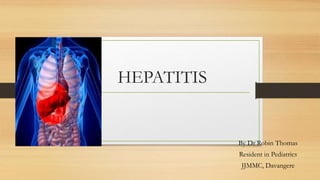
HEPATITIS
By Dr Robin Thomas
Resident in Pediatrics
JJMMC, Davangere
Introduction
• Acute hepatitis- Inflammatory disorder of liver, usually associated with complete clinical &
histological recovery within 4 to 6 weeks.
• Children most commonly caused by hepatotrophic viruses, followed by drugs & metabolic
liver diseases.
• Acute viral hepatitis- self limited mild disease, does not require any active treatment.
• Sometimes leads to fulminant hepatitis & may need liver transplantation.
• Infection with Hepatotropic viruses [HAV, HBV, HCV, HDV, HEV].
• Non Hepatotropic viruses- mumps, measles, rubella, CMV, HSV, VZV, Dengue virus.
• Salmonella typhi, Plasmodium.
• Drugs- ATT, Antiepileptics, Halothane.
• Autoimmune Hepatitis.
• Acute viral hepatitis- HAV, HEV.
• Chronic viral hepatitis- [>6months]- HBV,HCV,HDV.
Epidemiology
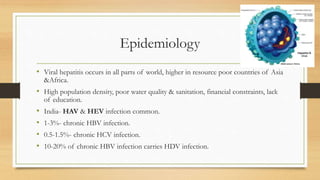
• Viral hepatitis occurs in all parts of world, higher in resource poor countries of Asia
&Africa.
• High population density, poor water quality & sanitation, financial constraints, lack
of education.
• India- HAV & HEV infection common.
• 1-3%- chronic HBV infection.
• 0.5-1.5%- chronic HCV infection.
• 10-20% of chronic HBV infection carries HDV infection.
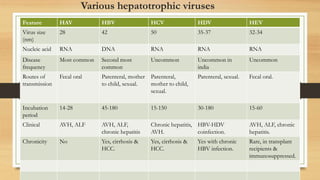
Various hepatotrophic viruses
Feature HAV HBV HCV HDV HEV
Virus size
(nm)
28 42 50 35-37 32-34
Nucleic acid RNA DNA RNA RNA RNA
Disease
frequency
Most common Second most
common
Uncommon Uncommon in
india
Uncommon
Routes of
transmission
Fecal oral Parenteral, mother
to child, sexual.
Parenteral,
mother to child,
sexual.
Parenteral, sexual. Fecal oral.
Incubation
period
14-28 45-180 15-150 30-180 15-60
Clinical AVH, ALF AVH, ALF,
chronic hepatitis
Chronic hepatitis,
AVH.
HBV-HDV
coinfection.
AVH, ALF, chronic
hepatitis.
Chronicity No Yes, cirrhosis &
HCC.
Yes, cirrhosis &
HCC.
Yes with chronic
HBV infection.
Rare, in transplant
recipients &
immunosuppressed.
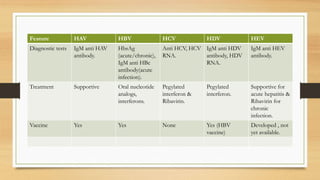
Feature HAV HBV HCV HDV HEV
Diagnostic tests IgM anti HAV
antibody.
HbsAg
(acute/chronic),
IgM anti HBc
antibody(acute
infection).
Anti HCV, HCV
RNA.
IgM anti HDV
antibody, HDV
RNA.
IgM anti HEV
antibody.
Treatment Supportive Oral nucleotide
analogs,
interferons.
Pegylated
interferon &
Ribavirin.
Pegylated
interferon.
Supportive for
acute hepatitis &
Ribavirin for
chronic
infection.
Vaccine Yes Yes None Yes (HBV
vaccine)
Developed , not
yet available.
Etiology
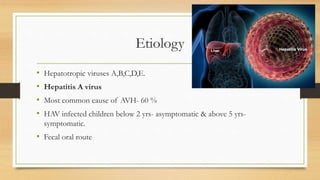
• Hepatotropic viruses A,B,C,D,E.
• Hepatitis A virus
• Most common cause of AVH- 60 %
• HAV infected children below 2 yrs- asymptomatic & above 5 yrs-
symptomatic.
• Fecal oral route
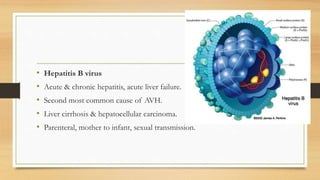
• Hepatitis B virus
• Acute & chronic hepatitis, acute liver failure.
• Second most common cause of AVH.
• Liver cirrhosis & hepatocellular carcinoma.
• Parenteral, mother to infant, sexual transmission.
• Hepatitis C virus
• Hepatitis D virus
• Hepatitis E virus
Pathogenesis
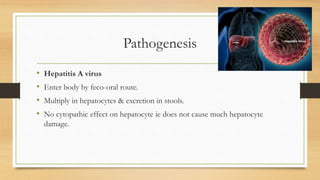
• Hepatitis A virus
• Enter body by feco-oral route.
• Multiply in hepatocytes & excretion in stools.
• No cytopathic effect on hepatocyte ie does not cause much hepatocyte
damage.
• Hepatitis B virus
• HBV[ DNA virus ], enters into hepatocyte nucleus .
• Integrates with host DNA- forms covalently closed circular DNA
(cccDNA).
• cccDNA remains inside the body for rest of life- Chronic HBV
infection.
• Hepatitis C virus
• 70% leads to chronic infection.
• High degree of genetic variability & mutations.
• Histopathology- chronic viral hepatitis
• Inflammatory cells (lymphocytes).
• Necro inflammation.
• Liver fibrosis.
• Regenerating nodules.
• Cirrhosis.
Clinical features
• Hepatotropic viruses- 3 possible courses-
• 1.Acute viral hepatitis
• 2.Chronic viral hepatitis.
• 3.Acute liver failure.
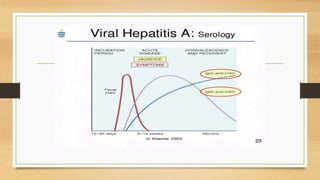
• Acute viral hepatitis- runs a triphasic course-
• 1.Prodromal phase.
• 2.Icteric phase.
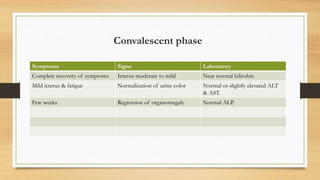
• 3.Convalescent phase.
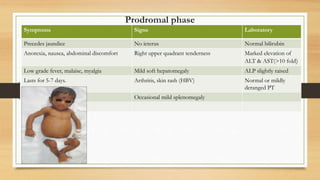
Prodromal phase
Symptoms Signs Laboratory
Precedes jaundice No icterus Normal bilirubin
Anorexia, nausea, abdominal discomfort Right upper quadrant tenderness Marked elevation of
ALT & AST(>10 fold)
Low grade fever, malaise, myalgia Mild soft hepatomegaly ALP slightly raised
Lasts for 5-7 days. Arthritis, skin rash (HBV) Normal or mildly
deranged PT
Occasional mild splenomegaly
Icteric phase
Symptoms Signs Laboratory
Yellow discoloration of eyes &
urine.
Jaundice of variable severity High serum bilirubin-conjugated
Improvement of appetite. Mildly ,soft hepatomegaly Moderately elevated ALT & AST.
Feeling well & active. Occasional mild, soft, splenomegaly
Lasts for 6 weeks. Scratch marks, if itching
Convalescent phase
Symptoms Signs Laboratory
Complete recovery of symptoms Icterus-moderate to mild Near normal bilirubin
Mild icterus & fatigue Normalization of urine color Normal or slightly elevated ALT
& AST.
Few weeks Regression of organomegaly Normal ALP.
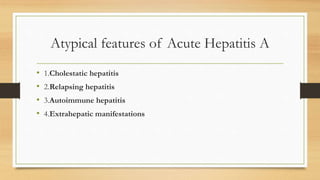
Atypical features of Acute Hepatitis A
• 1.Cholestatic hepatitis
• 2.Relapsing hepatitis
• 3.Autoimmune hepatitis
• 4.Extrahepatic manifestations
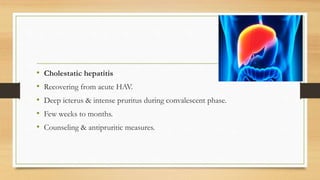
• Cholestatic hepatitis
• Recovering from acute HAV.
• Deep icterus & intense pruritus during convalescent phase.
• Few weeks to months.
• Counseling & antipruritic measures.
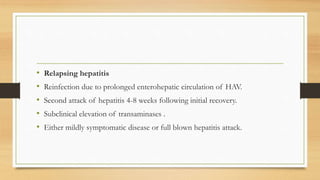
• Relapsing hepatitis
• Reinfection due to prolonged enterohepatic circulation of HAV.
• Second attack of hepatitis 4-8 weeks following initial recovery.
• Subclinical elevation of transaminases .
• Either mildly symptomatic disease or full blown hepatitis attack.
• Extra hepatic manifestations
• Renal- proteinuria, AGN, nephrotic syndrome, ARF.
• Nervous system- aseptic meningitis, encephalitis, seizures.
• Pancreatobiliary system- acalculous cholecystitis, acute pancreatitis.
• Hematological- autoimmune hemolytic anemia, aplastic anemia
Differential diagnosis
• Malaria
• Dengue hepatitis
• Enteric hepatitis
• Chronic liver disease
• Liver abscess
• Cholangitis
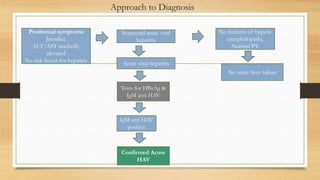
Approach to Diagnosis
Prodromal symptoms
Jaundice
ALT/AST markedly
elevated
No risk factor for hepatitis
Suspected acute viral
hepatitis
No features of hepatic
encephalopathy.
Normal PT.
Acute viral hepatitis
Tests for HBsAg &
IgM anti HAV
IgM anti HAV
positive
Confirmed Acute
HAV
No acute liver failure
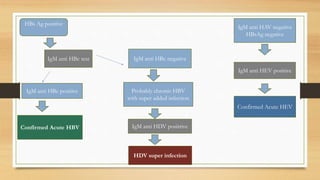
HBs Ag positive
IgM anti HBc test
IgM anti HBc positive
Confirmed Acute HBV
IgM anti HBc negative
Probably chronic HBV
with super added infection
IgM anti HDV positrive
HDV super infection
IgM anti HAV negative
HBsAg negative
IgM anti HEV positive
Confirmed Acute HEV
Management
• Supportive therapy
• Antipyretics, analgesics & antiemetics
• Light physical activity. no role for bed rest.
• Hygienic measures prevent spread to other family members.
• No role for vitamin k, appetizers, antibiotics & hepatoprotective medications
• ( Liv-52, Ursodeoxycholic acid ).
• Dietary restrictions of fat, milk, turmeric, pickles, spices offer no benefit.
Counselling
• Parents counseled about :
• 1. benign nature of illness.
• 2. likelihood of complete natural recovery.
• 3. avoidance of restrictions on physical activity & diet.
• 4. lack of role for drugs.
• 5. for hepatitis B & C follow up for chronicity.
• Monitoring
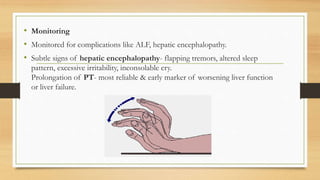
• Monitored for complications like ALF, hepatic encephalopathy.
• Subtle signs of hepatic encephalopathy- flapping tremors, altered sleep
pattern, excessive irritability, inconsolable cry.
Prolongation of PT- most reliable & early marker of worsening liver function
or liver failure.
Vaccines
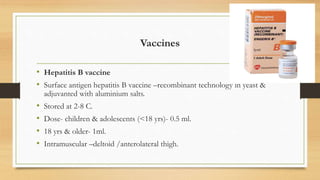
• Hepatitis B vaccine
• Surface antigen hepatitis B vaccine –recombinant technology in yeast &
adjuvanted with aluminium salts.
• Stored at 2-8 C.
• Dose- children & adolescents (<18 yrs)- 0.5 ml.
• 18 yrs & older- 1ml.
• Intramuscular –deltoid /anterolateral thigh.
Hepatitis B vaccine schedules
• 1. Birth, 6 wks, 14 wks- preferred one.
• 2. 6 wks, 10 wks, 14 wks.
• 3. Birth, 6 wks, 6 months.
• 4. Birth, 6 wks, 10 wks, 14 wks.
Hepatitis B immunoglobulin
• Passive immunity
• Indicated along with hepatitis B vaccine in perinatal, occupational, sexual
exposures.
• Neonates/infant dose-0.5 ml, Adult dose- 0.06 ml/kg.
• Stored at 2-8 C.
• Immunocompromised/Nonresponders- 2 doses of HBIG 1 month apart.
Management of infant born to hepatitis B positive
mother
• Pregnant women counselled for HBsAg screening.
• 1. Mother is HBsAg negative, Hepatitis B vaccine given at 0, 6 wks, 6 months.
• 2. Mothers HBsAg status not known- hepatitis B vaccine given within few hours of
birth.
• 3. Mother HBsAg positive- baby given HBIG (0.5ml) & hepatitis B vaccine (0.5
ml) within 12 hrs of birth.
• Hepatitis B vaccine -2 more doses given at 6 wks & 6 months.
• If HBIG not available- Hepatitis B vaccine given at birth, 1month, 2 month &
additional dose between 9 months-1 year.
Hepatitis A vaccine
• Liposomal adjuvanted inactivated hepatitis A vaccine, derived from RG-SB
strain.
• First dose at 12 mon, second dose at 18 mon. intramuscular route. 0.5 ml.
• Live attenuated vaccine from human diploid cell also available.
• Live vaccine given subcutaneously.
Prognosis
• Most cases with AVH - spontaneous & complete recovery.
• ALF cases- high risk of mortality & needs ICU care & liver transplantation.
• Some cases of HBV & HCV develops chronic hepatitis & liver cirrhosis.
• High risk for chronic HBV- infancy & early childhood (<5 yrs).
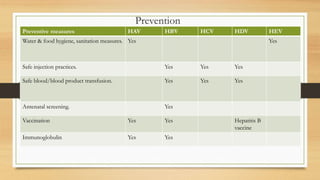
Prevention
Preventive measures HAV HBV HCV HDV HEV
Water & food hygiene, sanitation measures. Yes Yes
Safe injection practices. Yes Yes Yes
Safe blood/blood product transfusion. Yes Yes Yes
Antenatal screening. Yes
Vaccination Yes Yes Hepatitis B
vaccine
Immunoglobulin Yes Yes
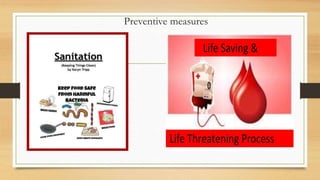
Preventive measures
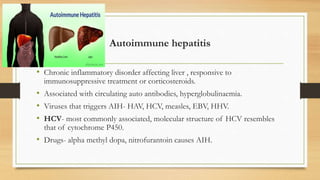
Autoimmune hepatitis
• Chronic inflammatory disorder affecting liver , responsive to
immunosuppressive treatment or corticosteroids.
• Associated with circulating auto antibodies, hyperglobulinaemia.
• Viruses that triggers AIH- HAV, HCV, measles, EBV, HHV.
• HCV- most commonly associated, molecular structure of HCV resembles
that of cytochrome P450.
• Drugs- alpha methyl dopa, nitrofurantoin causes AIH.
• Classification of AIH- Type 1- ANA (Antinuclear antibody), Anti smooth muscle
antibody.
• Type 2- Anti liver-kidney-microsomal antibody.
• Type 3- Anti soluble liver antigen.
• Diagnostic criteria for AIH
• Periportal hepatitis
• Hyper gammaglobulinaemia
• Autoantibodies & female sex.
• Liver biopsy
• Piece meal necrosis- characteristic histological feature.
• Lympho plasmacytic infiltrate- portal tract with lymphocytes & plasma cells.
• Bridging necrosis
• Treatment- AIH
• Corticosteroid therapy- Prednisolone- 1-2 mg/kg/day.
• Immunosuppressants- Azathioprine- ( 2 mg/kg/day ) & Cyclosporine.
• Liver transplantation.
Summary
• Five hepatotrophic viruses A to E, cause majority of acute viral hepatitis
episodes.
• Hepatitis A virus followed by hepatitis B virus are the common viral
agents for hepatitis in children in India.
• Most patients with AVH improve spontaneously.
• Degree of ALT/AST elevation has no relation with disease severity.
• Prolongation of PT- reliable lab. marker of severity.
• Few children progress to liver failure.
• HBV or HCV infection may progress to chronic hepatitis.
Viral hepatitis

Viral hepatitis

  • 1.
    HEPATITIS By Dr RobinThomas Resident in Pediatrics JJMMC, Davangere
  • 2.
    Introduction • Acute hepatitis-Inflammatory disorder of liver, usually associated with complete clinical & histological recovery within 4 to 6 weeks. • Children most commonly caused by hepatotrophic viruses, followed by drugs & metabolic liver diseases. • Acute viral hepatitis- self limited mild disease, does not require any active treatment. • Sometimes leads to fulminant hepatitis & may need liver transplantation. • Infection with Hepatotropic viruses [HAV, HBV, HCV, HDV, HEV]. • Non Hepatotropic viruses- mumps, measles, rubella, CMV, HSV, VZV, Dengue virus. • Salmonella typhi, Plasmodium. • Drugs- ATT, Antiepileptics, Halothane. • Autoimmune Hepatitis.
  • 3.
    • Acute viralhepatitis- HAV, HEV. • Chronic viral hepatitis- [>6months]- HBV,HCV,HDV.
  • 4.
    Epidemiology • Viral hepatitisoccurs in all parts of world, higher in resource poor countries of Asia &Africa. • High population density, poor water quality & sanitation, financial constraints, lack of education. • India- HAV & HEV infection common. • 1-3%- chronic HBV infection. • 0.5-1.5%- chronic HCV infection. • 10-20% of chronic HBV infection carries HDV infection.
  • 5.
    Various hepatotrophic viruses FeatureHAV HBV HCV HDV HEV Virus size (nm) 28 42 50 35-37 32-34 Nucleic acid RNA DNA RNA RNA RNA Disease frequency Most common Second most common Uncommon Uncommon in india Uncommon Routes of transmission Fecal oral Parenteral, mother to child, sexual. Parenteral, mother to child, sexual. Parenteral, sexual. Fecal oral. Incubation period 14-28 45-180 15-150 30-180 15-60 Clinical AVH, ALF AVH, ALF, chronic hepatitis Chronic hepatitis, AVH. HBV-HDV coinfection. AVH, ALF, chronic hepatitis. Chronicity No Yes, cirrhosis & HCC. Yes, cirrhosis & HCC. Yes with chronic HBV infection. Rare, in transplant recipients & immunosuppressed.
  • 6.
    Feature HAV HBVHCV HDV HEV Diagnostic tests IgM anti HAV antibody. HbsAg (acute/chronic), IgM anti HBc antibody(acute infection). Anti HCV, HCV RNA. IgM anti HDV antibody, HDV RNA. IgM anti HEV antibody. Treatment Supportive Oral nucleotide analogs, interferons. Pegylated interferon & Ribavirin. Pegylated interferon. Supportive for acute hepatitis & Ribavirin for chronic infection. Vaccine Yes Yes None Yes (HBV vaccine) Developed , not yet available.
  • 7.
    Etiology • Hepatotropic virusesA,B,C,D,E. • Hepatitis A virus • Most common cause of AVH- 60 % • HAV infected children below 2 yrs- asymptomatic & above 5 yrs- symptomatic. • Fecal oral route
  • 8.
    • Hepatitis Bvirus • Acute & chronic hepatitis, acute liver failure. • Second most common cause of AVH. • Liver cirrhosis & hepatocellular carcinoma. • Parenteral, mother to infant, sexual transmission.
  • 9.
    • Hepatitis Cvirus • Hepatitis D virus • Hepatitis E virus
  • 10.
    Pathogenesis • Hepatitis Avirus • Enter body by feco-oral route. • Multiply in hepatocytes & excretion in stools. • No cytopathic effect on hepatocyte ie does not cause much hepatocyte damage.
  • 11.
    • Hepatitis Bvirus • HBV[ DNA virus ], enters into hepatocyte nucleus . • Integrates with host DNA- forms covalently closed circular DNA (cccDNA). • cccDNA remains inside the body for rest of life- Chronic HBV infection.
  • 12.
    • Hepatitis Cvirus • 70% leads to chronic infection. • High degree of genetic variability & mutations.
  • 13.
    • Histopathology- chronicviral hepatitis • Inflammatory cells (lymphocytes). • Necro inflammation. • Liver fibrosis. • Regenerating nodules. • Cirrhosis.
  • 14.
    Clinical features • Hepatotropicviruses- 3 possible courses- • 1.Acute viral hepatitis • 2.Chronic viral hepatitis. • 3.Acute liver failure.
  • 15.
    • Acute viralhepatitis- runs a triphasic course- • 1.Prodromal phase. • 2.Icteric phase. • 3.Convalescent phase.
  • 16.
    Prodromal phase Symptoms SignsLaboratory Precedes jaundice No icterus Normal bilirubin Anorexia, nausea, abdominal discomfort Right upper quadrant tenderness Marked elevation of ALT & AST(>10 fold) Low grade fever, malaise, myalgia Mild soft hepatomegaly ALP slightly raised Lasts for 5-7 days. Arthritis, skin rash (HBV) Normal or mildly deranged PT Occasional mild splenomegaly
  • 17.
    Icteric phase Symptoms SignsLaboratory Yellow discoloration of eyes & urine. Jaundice of variable severity High serum bilirubin-conjugated Improvement of appetite. Mildly ,soft hepatomegaly Moderately elevated ALT & AST. Feeling well & active. Occasional mild, soft, splenomegaly Lasts for 6 weeks. Scratch marks, if itching
  • 18.
    Convalescent phase Symptoms SignsLaboratory Complete recovery of symptoms Icterus-moderate to mild Near normal bilirubin Mild icterus & fatigue Normalization of urine color Normal or slightly elevated ALT & AST. Few weeks Regression of organomegaly Normal ALP.
  • 19.
    Atypical features ofAcute Hepatitis A • 1.Cholestatic hepatitis • 2.Relapsing hepatitis • 3.Autoimmune hepatitis • 4.Extrahepatic manifestations
  • 20.
    • Cholestatic hepatitis •Recovering from acute HAV. • Deep icterus & intense pruritus during convalescent phase. • Few weeks to months. • Counseling & antipruritic measures.
  • 21.
    • Relapsing hepatitis •Reinfection due to prolonged enterohepatic circulation of HAV. • Second attack of hepatitis 4-8 weeks following initial recovery. • Subclinical elevation of transaminases . • Either mildly symptomatic disease or full blown hepatitis attack.
  • 22.
    • Extra hepaticmanifestations • Renal- proteinuria, AGN, nephrotic syndrome, ARF. • Nervous system- aseptic meningitis, encephalitis, seizures. • Pancreatobiliary system- acalculous cholecystitis, acute pancreatitis. • Hematological- autoimmune hemolytic anemia, aplastic anemia
  • 23.
    Differential diagnosis • Malaria •Dengue hepatitis • Enteric hepatitis • Chronic liver disease • Liver abscess • Cholangitis
  • 24.
    Approach to Diagnosis Prodromalsymptoms Jaundice ALT/AST markedly elevated No risk factor for hepatitis Suspected acute viral hepatitis No features of hepatic encephalopathy. Normal PT. Acute viral hepatitis Tests for HBsAg & IgM anti HAV IgM anti HAV positive Confirmed Acute HAV No acute liver failure
  • 25.
    HBs Ag positive IgManti HBc test IgM anti HBc positive Confirmed Acute HBV IgM anti HBc negative Probably chronic HBV with super added infection IgM anti HDV positrive HDV super infection IgM anti HAV negative HBsAg negative IgM anti HEV positive Confirmed Acute HEV
  • 28.
    Management • Supportive therapy •Antipyretics, analgesics & antiemetics • Light physical activity. no role for bed rest. • Hygienic measures prevent spread to other family members.
  • 29.
    • No rolefor vitamin k, appetizers, antibiotics & hepatoprotective medications • ( Liv-52, Ursodeoxycholic acid ). • Dietary restrictions of fat, milk, turmeric, pickles, spices offer no benefit.
  • 30.
    Counselling • Parents counseledabout : • 1. benign nature of illness. • 2. likelihood of complete natural recovery. • 3. avoidance of restrictions on physical activity & diet. • 4. lack of role for drugs. • 5. for hepatitis B & C follow up for chronicity.
  • 31.
    • Monitoring • Monitoredfor complications like ALF, hepatic encephalopathy. • Subtle signs of hepatic encephalopathy- flapping tremors, altered sleep pattern, excessive irritability, inconsolable cry. Prolongation of PT- most reliable & early marker of worsening liver function or liver failure.
  • 32.
    Vaccines • Hepatitis Bvaccine • Surface antigen hepatitis B vaccine –recombinant technology in yeast & adjuvanted with aluminium salts. • Stored at 2-8 C. • Dose- children & adolescents (<18 yrs)- 0.5 ml. • 18 yrs & older- 1ml. • Intramuscular –deltoid /anterolateral thigh.
  • 33.
    Hepatitis B vaccineschedules • 1. Birth, 6 wks, 14 wks- preferred one. • 2. 6 wks, 10 wks, 14 wks. • 3. Birth, 6 wks, 6 months. • 4. Birth, 6 wks, 10 wks, 14 wks.
  • 34.
    Hepatitis B immunoglobulin •Passive immunity • Indicated along with hepatitis B vaccine in perinatal, occupational, sexual exposures. • Neonates/infant dose-0.5 ml, Adult dose- 0.06 ml/kg. • Stored at 2-8 C. • Immunocompromised/Nonresponders- 2 doses of HBIG 1 month apart.
  • 35.
    Management of infantborn to hepatitis B positive mother • Pregnant women counselled for HBsAg screening. • 1. Mother is HBsAg negative, Hepatitis B vaccine given at 0, 6 wks, 6 months. • 2. Mothers HBsAg status not known- hepatitis B vaccine given within few hours of birth. • 3. Mother HBsAg positive- baby given HBIG (0.5ml) & hepatitis B vaccine (0.5 ml) within 12 hrs of birth. • Hepatitis B vaccine -2 more doses given at 6 wks & 6 months. • If HBIG not available- Hepatitis B vaccine given at birth, 1month, 2 month & additional dose between 9 months-1 year.
  • 36.
    Hepatitis A vaccine •Liposomal adjuvanted inactivated hepatitis A vaccine, derived from RG-SB strain. • First dose at 12 mon, second dose at 18 mon. intramuscular route. 0.5 ml. • Live attenuated vaccine from human diploid cell also available. • Live vaccine given subcutaneously.
  • 37.
    Prognosis • Most caseswith AVH - spontaneous & complete recovery. • ALF cases- high risk of mortality & needs ICU care & liver transplantation. • Some cases of HBV & HCV develops chronic hepatitis & liver cirrhosis. • High risk for chronic HBV- infancy & early childhood (<5 yrs).
  • 38.
    Prevention Preventive measures HAVHBV HCV HDV HEV Water & food hygiene, sanitation measures. Yes Yes Safe injection practices. Yes Yes Yes Safe blood/blood product transfusion. Yes Yes Yes Antenatal screening. Yes Vaccination Yes Yes Hepatitis B vaccine Immunoglobulin Yes Yes
  • 39.
  • 41.
    Autoimmune hepatitis • Chronicinflammatory disorder affecting liver , responsive to immunosuppressive treatment or corticosteroids. • Associated with circulating auto antibodies, hyperglobulinaemia. • Viruses that triggers AIH- HAV, HCV, measles, EBV, HHV. • HCV- most commonly associated, molecular structure of HCV resembles that of cytochrome P450. • Drugs- alpha methyl dopa, nitrofurantoin causes AIH.
  • 42.
    • Classification ofAIH- Type 1- ANA (Antinuclear antibody), Anti smooth muscle antibody. • Type 2- Anti liver-kidney-microsomal antibody. • Type 3- Anti soluble liver antigen. • Diagnostic criteria for AIH • Periportal hepatitis • Hyper gammaglobulinaemia • Autoantibodies & female sex. • Liver biopsy • Piece meal necrosis- characteristic histological feature. • Lympho plasmacytic infiltrate- portal tract with lymphocytes & plasma cells. • Bridging necrosis
  • 44.
    • Treatment- AIH •Corticosteroid therapy- Prednisolone- 1-2 mg/kg/day. • Immunosuppressants- Azathioprine- ( 2 mg/kg/day ) & Cyclosporine. • Liver transplantation.
  • 45.
    Summary • Five hepatotrophicviruses A to E, cause majority of acute viral hepatitis episodes. • Hepatitis A virus followed by hepatitis B virus are the common viral agents for hepatitis in children in India. • Most patients with AVH improve spontaneously. • Degree of ALT/AST elevation has no relation with disease severity. • Prolongation of PT- reliable lab. marker of severity.
  • 46.
    • Few childrenprogress to liver failure. • HBV or HCV infection may progress to chronic hepatitis.