PROJECT REPORT
ON
GSM ARCHITECTURE
PRATIK KUMAR
ECE (E)
01896302811
SUBMITTED BY:
GSM (Global System for Mobile Communications) , is a standard set
developed by the European Telecommunications Standards Institute (ETSI) to
describe protocols for second generation (2G) digital cellular networks used
by mobile phones . It became the global standard for mobile communications
with over 80% market share.
The GSM standard was developed as a replacement for first generation (1G)
analog cellular networks, and originally described a digital, circuit-switched
network optimized for full duplex voice telephony
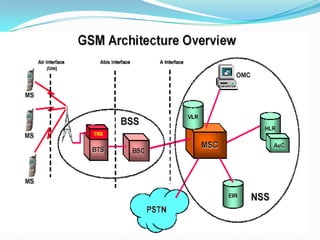
GSM Architecture Overview
This includes a brief explanation of the different network
subsystems and a description of the functionality of the elements
within each of the subsystems. Topics include:
 General architecture overview
 The Mobile Station (MS) Subsystem and Elements
 The Base Station Subsystem (BSS) and Elements
 The Network Subsystem (NSS) and Elements
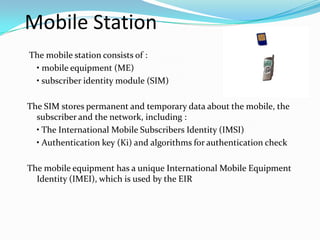
The mobile station consists of :
• mobile equipment (ME)
• subscriber identity module (SIM)
The SIM stores permanent and temporary data about the mobile, the
subscriber and the network, including :
• The International Mobile Subscribers Identity (IMSI)
• Authentication key (Ki) and algorithms for authentication check
The mobile equipment has a unique International Mobile Equipment
Identity (IMEI), which is used by the EIR
Mobile Station
 The BSS comprises:
 Base Station Controller (BSC)
• One or more Base Transceiver Stations (BTSs)
 BTS contains:
 Radio Transmitter/Receiver (TRX)
• Signal processing and control equipment
 Antennas and feeder cables
 The BSC:
 allocates a channel for the duration of a call
 maintains the call:
• controls the power transmitted by the BTS or MS
• generates a handover to another cell when required
Base Station Subsystem (BSS)
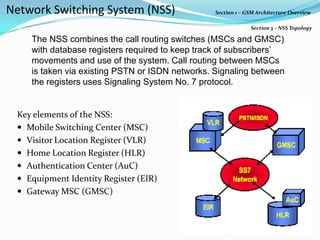
Network Switching System (NSS)
The NSS combines the call routing switches (MSCs and GMSC)
with database registers required to keep track of subscribers’
movements and use of the system. Call routing between MSCs
is taken via existing PSTN or ISDN networks. Signaling between
the registers uses Signaling System No. 7 protocol.
Section 1 – GSM Architecture Overview
Key elements of the NSS:
 Mobile Switching Center (MSC)
 Visitor Location Register (VLR)
 Home Location Register (HLR)
 Authentication Center (AuC)
 Equipment Identity Register (EIR)
 Gateway MSC (GMSC)
Section 3 – NSS Topology
Mobile Switching Center (MSC)
The following are typical MSC functions in a cellular system:
 Provide switched connections with PSTN
 Provide switched connections between mobile subscribers
 Coordinate the location and handover process
 Provide custom services to mobile users
 Collect billing data
Home Location Register
HLR is a database that stores subscription and set of functions needed to
manage subscriber data in one PLMN area. Any administrative action by
the service provider or changes made by subscriber is first carried out on
the HLR and then update the VLR.
Section 3 – NSS Topology
Visitor Location Register
It is a subscriber database containing the information about all the MS
currently located in the MSC service area. VLR can be considered as a
distributed HLR in the case of a roaming subscriber. If MS moves into a
new service area (MSC), VLR requests the HLR to provide the relevant
data and store it, for making the calls for that MS.
It can also be viewed as a subset of a HLR.
Section 3 – NSS Topology
Authentication Center (AUC)
AUC is always integrated with HLR for the purpose of the
authentication. At subscription time, the Subscriber
Authentication Key (Ki) is allocated to the subscriber, together
with the IMSI.
AUC stores the following information for each subscriber
1. The IMSI number,
2. The individual authentication key Ki,
Section 3 – NSS Topology
Equipment Identification Register (EIR)
Purpose of this feature is to make sure that no stolen or unauthorized mobile
equipment is used in the network.
EIR is a database that stores a unique International Mobile Equipment Identity
(IMEI) number for each item of mobile equipment.
Procedure:
 The MSC/VLR requests the IMEI from the MS and sends it to a
EIR.
 On request of IMEI, the EIR makes use of three possible defined
lists:
- A white list: containing all number of all equipment identities
that have been allocated in the different participating countries.
- A black list: containing all equipment identities that are
considered to be barred.
- A grey list: containing (operator’s decision) faulty or non-
approved mobile equipment.
 Result is sent to MSC/VLR and influences the decision about
access to the system.
Operation And Maintenance Center (OMC)
The OMC centralizes all operations and maintenance activities for the MSCs and
BSSs using remote software control. It provides remote testing, operations, and
maintenance capabilities for the entire system from one central location. Each
BSS, MSC, HLR, VLR, EIR, and AUC can be monitored and controlled from the
OMC.
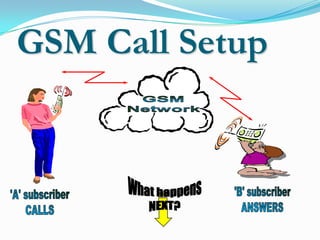
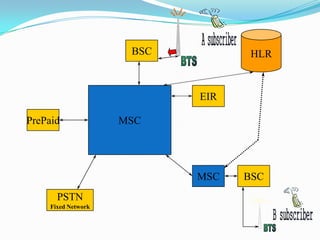
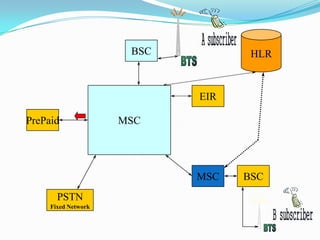
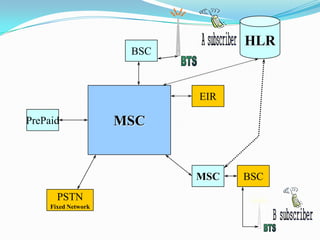
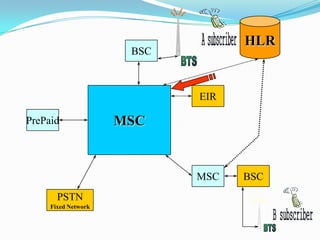
GSM Call Setup
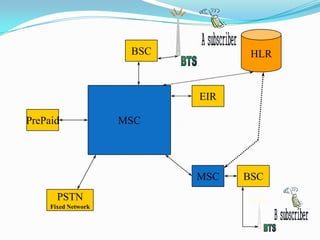
MSC
EIR
PSTN
Fixed Network
BSC
PrePaid
HLR
MSC BSC
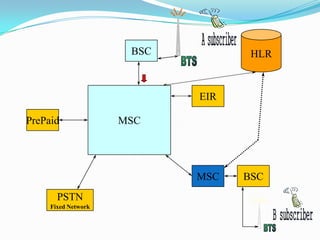
MSC
EIR
BSC
PrePaid
HLR
MSC BSC
PSTN
Fixed Network
BSC
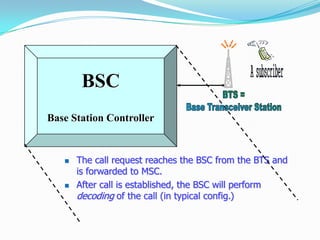
Base Station Controller
 The call request reaches the BSC from the BTS and
is forwarded to MSC.
 After call is established, the BSC will perform
decoding of the call (in typical config.)
BSC HLR
MSC
EIR
PrePaid
MSC BSC
PSTN
Fixed Network
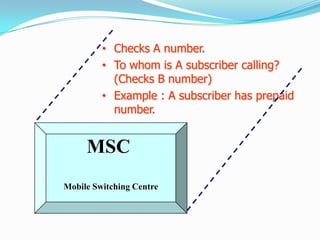
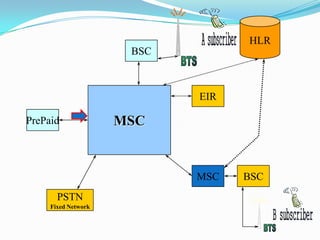
• Checks A number.
• To whom is A subscriber calling?
(Checks B number)
• Example : A subscriber has prepaid
number.
MSC
Mobile Switching Centre
BSC HLR
MSC
EIR
PrePaid
MSC BSC
PSTN
Fixed Network
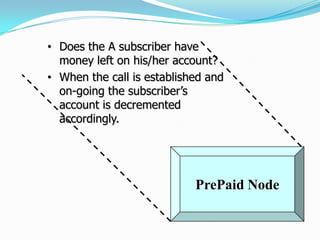
• Does the A subscriber have
money left on his/her account?
• When the call is established and
on-going the subscriber’s
account is decremented
accordingly.
PrePaid Node
BSC
HLR
MSC
EIR
PrePaid
MSC BSC
PSTN
Fixed Network
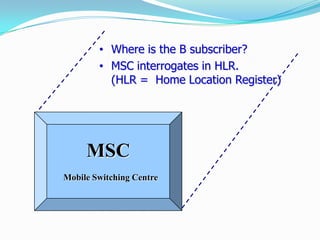
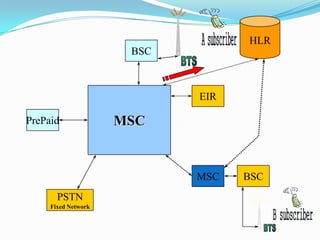
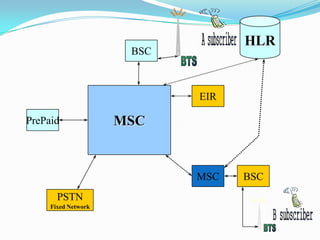
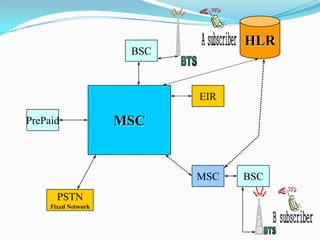
• Where is the B subscriber?
• MSC interrogates in HLR.
(HLR = Home Location Register)
MSC
Mobile Switching Centre
BSC
HLR
MSCPrePaid
MSC BSC
PSTN
Fixed Network
EIR
BSC
HLR
MSC
MSC BSC
PSTN
Fixed Network
PrePaid
EIR
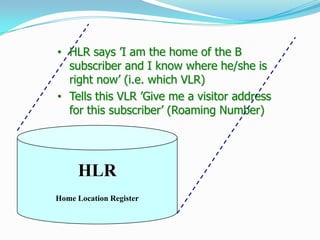
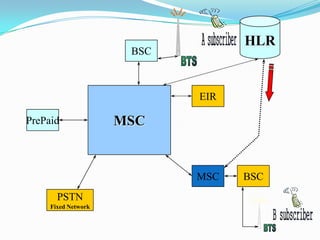
• HLR says ’I am the home of the B
subscriber and I know where he/she is
right now’ (i.e. which VLR)
• Tells this VLR ’Give me a visitor address
for this subscriber’ (Roaming Number)
HLR
Home Location Register
BSC
HLR
MSC
MSC BSC
PSTN
Fixed Network
PrePaid
EIR
BSC
HLR
MSC
MSC BSC
PSTN
Fixed Network
PrePaid
EIR
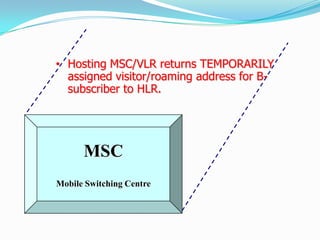
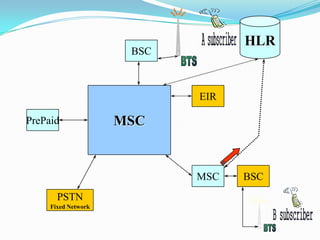
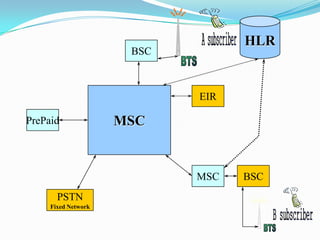
• Hosting MSC/VLR returns TEMPORARILY
assigned visitor/roaming address for B-
subscriber to HLR.
MSC
Mobile Switching Centre
BSC
HLR
MSC
MSC BSC
PSTN
Fixed Network
PrePaid
EIR
BSC
HLR
MSC
MSC BSC
PSTN
Fixed Network
PrePaid
EIR
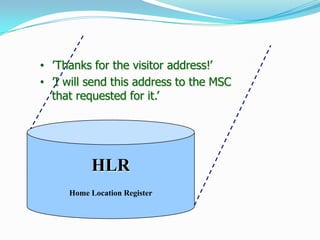
• ’Thanks for the visitor address!’
• ’I will send this address to the MSC
that requested for it.’
HLR
Home Location Register
BSC
HLR
MSC
MSC BSC
PSTN
Fixed Network
PrePaid
EIR
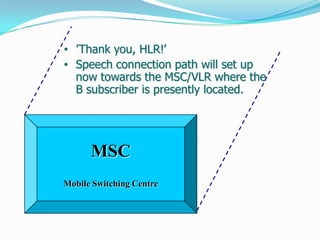
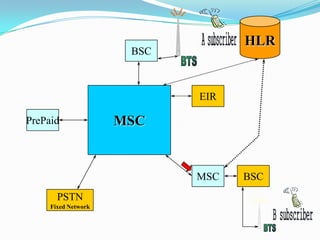
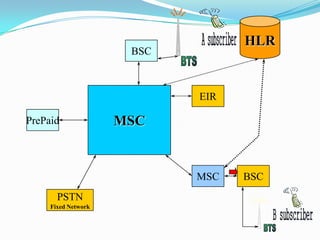
• ’Thank you, HLR!’
• Speech connection path will set up
now towards the MSC/VLR where the
B subscriber is presently located.
MSC
Mobile Switching Centre
BSC
HLR
MSC
MSC BSC
PSTN
Fixed Network
PrePaid
EIR
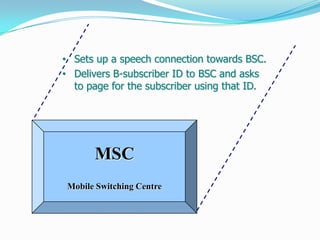
• Sets up a speech connection towards BSC.
• Delivers B-subscriber ID to BSC and asks
to page for the subscriber using that ID.
MSC
Mobile Switching Centre
BSC
HLR
MSC
MSC BSC
PSTN
Fixed Network
PrePaid
EIR
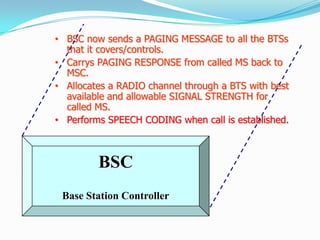
• BSC now sends a PAGING MESSAGE to all the BTSs
that it covers/controls.
• Carrys PAGING RESPONSE from called MS back to
MSC.
• Allocates a RADIO channel through a BTS with best
available and allowable SIGNAL STRENGTH for
called MS.
• Performs SPEECH CODING when call is established.
BSC
Base Station Controller
BSC
HLR
MSC
MSC BSC
PSTN
Fixed Network
PrePaid
EIR
GSM Architecture

GSM Architecture

  • 1.
    PROJECT REPORT ON GSM ARCHITECTURE PRATIKKUMAR ECE (E) 01896302811 SUBMITTED BY:
  • 2.
    GSM (Global Systemfor Mobile Communications) , is a standard set developed by the European Telecommunications Standards Institute (ETSI) to describe protocols for second generation (2G) digital cellular networks used by mobile phones . It became the global standard for mobile communications with over 80% market share. The GSM standard was developed as a replacement for first generation (1G) analog cellular networks, and originally described a digital, circuit-switched network optimized for full duplex voice telephony
  • 3.
    GSM Architecture Overview Thisincludes a brief explanation of the different network subsystems and a description of the functionality of the elements within each of the subsystems. Topics include:  General architecture overview  The Mobile Station (MS) Subsystem and Elements  The Base Station Subsystem (BSS) and Elements  The Network Subsystem (NSS) and Elements
  • 5.
    The mobile stationconsists of : • mobile equipment (ME) • subscriber identity module (SIM) The SIM stores permanent and temporary data about the mobile, the subscriber and the network, including : • The International Mobile Subscribers Identity (IMSI) • Authentication key (Ki) and algorithms for authentication check The mobile equipment has a unique International Mobile Equipment Identity (IMEI), which is used by the EIR Mobile Station
  • 6.
     The BSScomprises:  Base Station Controller (BSC) • One or more Base Transceiver Stations (BTSs)  BTS contains:  Radio Transmitter/Receiver (TRX) • Signal processing and control equipment  Antennas and feeder cables  The BSC:  allocates a channel for the duration of a call  maintains the call: • controls the power transmitted by the BTS or MS • generates a handover to another cell when required Base Station Subsystem (BSS)
  • 7.
    Network Switching System(NSS) The NSS combines the call routing switches (MSCs and GMSC) with database registers required to keep track of subscribers’ movements and use of the system. Call routing between MSCs is taken via existing PSTN or ISDN networks. Signaling between the registers uses Signaling System No. 7 protocol. Section 1 – GSM Architecture Overview Key elements of the NSS:  Mobile Switching Center (MSC)  Visitor Location Register (VLR)  Home Location Register (HLR)  Authentication Center (AuC)  Equipment Identity Register (EIR)  Gateway MSC (GMSC) Section 3 – NSS Topology
  • 8.
    Mobile Switching Center(MSC) The following are typical MSC functions in a cellular system:  Provide switched connections with PSTN  Provide switched connections between mobile subscribers  Coordinate the location and handover process  Provide custom services to mobile users  Collect billing data
  • 9.
    Home Location Register HLRis a database that stores subscription and set of functions needed to manage subscriber data in one PLMN area. Any administrative action by the service provider or changes made by subscriber is first carried out on the HLR and then update the VLR. Section 3 – NSS Topology
  • 10.
    Visitor Location Register Itis a subscriber database containing the information about all the MS currently located in the MSC service area. VLR can be considered as a distributed HLR in the case of a roaming subscriber. If MS moves into a new service area (MSC), VLR requests the HLR to provide the relevant data and store it, for making the calls for that MS. It can also be viewed as a subset of a HLR. Section 3 – NSS Topology
  • 11.
    Authentication Center (AUC) AUCis always integrated with HLR for the purpose of the authentication. At subscription time, the Subscriber Authentication Key (Ki) is allocated to the subscriber, together with the IMSI. AUC stores the following information for each subscriber 1. The IMSI number, 2. The individual authentication key Ki, Section 3 – NSS Topology
  • 12.
    Equipment Identification Register(EIR) Purpose of this feature is to make sure that no stolen or unauthorized mobile equipment is used in the network. EIR is a database that stores a unique International Mobile Equipment Identity (IMEI) number for each item of mobile equipment. Procedure:  The MSC/VLR requests the IMEI from the MS and sends it to a EIR.  On request of IMEI, the EIR makes use of three possible defined lists: - A white list: containing all number of all equipment identities that have been allocated in the different participating countries. - A black list: containing all equipment identities that are considered to be barred. - A grey list: containing (operator’s decision) faulty or non- approved mobile equipment.  Result is sent to MSC/VLR and influences the decision about access to the system.
  • 13.
    Operation And MaintenanceCenter (OMC) The OMC centralizes all operations and maintenance activities for the MSCs and BSSs using remote software control. It provides remote testing, operations, and maintenance capabilities for the entire system from one central location. Each BSS, MSC, HLR, VLR, EIR, and AUC can be monitored and controlled from the OMC.
  • 14.
  • 15.
  • 16.
  • 17.
    BSC Base Station Controller The call request reaches the BSC from the BTS and is forwarded to MSC.  After call is established, the BSC will perform decoding of the call (in typical config.)
  • 18.
  • 19.
    • Checks Anumber. • To whom is A subscriber calling? (Checks B number) • Example : A subscriber has prepaid number. MSC Mobile Switching Centre
  • 20.
  • 21.
    • Does theA subscriber have money left on his/her account? • When the call is established and on-going the subscriber’s account is decremented accordingly. PrePaid Node
  • 22.
  • 23.
    • Where isthe B subscriber? • MSC interrogates in HLR. (HLR = Home Location Register) MSC Mobile Switching Centre
  • 24.
  • 25.
  • 26.
    • HLR says’I am the home of the B subscriber and I know where he/she is right now’ (i.e. which VLR) • Tells this VLR ’Give me a visitor address for this subscriber’ (Roaming Number) HLR Home Location Register
  • 27.
  • 28.
  • 29.
    • Hosting MSC/VLRreturns TEMPORARILY assigned visitor/roaming address for B- subscriber to HLR. MSC Mobile Switching Centre
  • 30.
  • 31.
  • 32.
    • ’Thanks forthe visitor address!’ • ’I will send this address to the MSC that requested for it.’ HLR Home Location Register
  • 33.
  • 34.
    • ’Thank you,HLR!’ • Speech connection path will set up now towards the MSC/VLR where the B subscriber is presently located. MSC Mobile Switching Centre
  • 35.
  • 36.
    • Sets upa speech connection towards BSC. • Delivers B-subscriber ID to BSC and asks to page for the subscriber using that ID. MSC Mobile Switching Centre
  • 37.
  • 38.
    • BSC nowsends a PAGING MESSAGE to all the BTSs that it covers/controls. • Carrys PAGING RESPONSE from called MS back to MSC. • Allocates a RADIO channel through a BTS with best available and allowable SIGNAL STRENGTH for called MS. • Performs SPEECH CODING when call is established. BSC Base Station Controller
  • 39.