© 2012 Cisco Systems, Inc. All rights reserved. Cisco Public 1
OSI Physical Layer
Network Fundamentals – Chapter 8
2© 2012 Cisco Systems, Inc. All rights reserved. Cisco Public
Objectives
 Explain the role of Physical layer protocols and
services in supporting communication across data
networks.
- Describe the role of signals used to represent bits as a frame
as the frame is transported across the local media
 Describe the purpose of Physical layer signaling and
encoding as they are used in networks
 Identify the basic characteristics of copper, fiber and
wireless network media
 Describe common uses of copper, fiber and wireless
network media
3© 2012 Cisco Systems, Inc. All rights reserved. Cisco Public
Physical Layer Protocols & Services
 Describe the purpose of the Physical layer in the
network and identify the basic elements that enable this
layer to fulfill its function
4© 2012 Cisco Systems, Inc. All rights reserved. Cisco Public
Physical Layer Protocols & Services
 Describe the role of bits in representing a frame as it is
transported across the local media.
5© 2012 Cisco Systems, Inc. All rights reserved. Cisco Public
Physical Layer Protocols & Services
 Describe the role of signaling in the physical media.
6© 2012 Cisco Systems, Inc. All rights reserved. Cisco Public
Physical Layer Protocols & Services
 Distinguish who establishes and maintains standards
for the Physical layers compared to those for the other
layers of the network
7© 2012 Cisco Systems, Inc. All rights reserved. Cisco Public
Physical Layer Protocols & Services
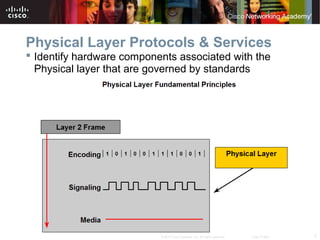
 Identify hardware components associated with the
Physical layer that are governed by standards
8© 2012 Cisco Systems, Inc. All rights reserved. Cisco Public
Physical Layer Signaling and Encoding
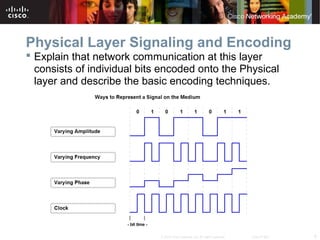
 Explain that network communication at this layer
consists of individual bits encoded onto the Physical
layer and describe the basic encoding techniques.
9© 2012 Cisco Systems, Inc. All rights reserved. Cisco Public
Physical Layer Signaling and Encoding
 Describe the role of encoding as it applies to the
transmission of bits and explain the value of treating a
collection of bits as a code.
10© 2012 Cisco Systems, Inc. All rights reserved. Cisco Public
Physical Layer Signaling and Encoding
 Define the terms bandwidth, throughput, and goodput
11© 2012 Cisco Systems, Inc. All rights reserved. Cisco Public
Characteristics & Uses of Network Media
 Identify several media characteristics defined by
Physical layer standards.
12© 2012 Cisco Systems, Inc. All rights reserved. Cisco Public
Characteristics & Uses of Network Media
 Describe the impact interference has on throughput and
the role of proper cabling in reducing interference
13© 2012 Cisco Systems, Inc. All rights reserved. Cisco Public
Characteristics & Uses of Network Media
 Identify the basic characteristics of UTP cable
14© 2012 Cisco Systems, Inc. All rights reserved. Cisco Public
Characteristics & Uses of Network Media
 Identify the basic characteristics of STP and Coaxial
cable
15© 2012 Cisco Systems, Inc. All rights reserved. Cisco Public
Characteristics & Uses of Network Media
 Identify types of safety issues when working with
copper cabling
16© 2012 Cisco Systems, Inc. All rights reserved. Cisco Public
Characteristics & Uses of Network Media
 Identify several primary characteristics of fiber cabling
and its main advantages over other media
17© 2012 Cisco Systems, Inc. All rights reserved. Cisco Public
Characteristics & Uses of Network Media
 Describe the role of radio waves when using air as the
media and the increased need for security in wireless
communications
18© 2012 Cisco Systems, Inc. All rights reserved. Cisco Public
Characteristics & Uses of Network Media
 Identify the characteristics used to categorize
connectors, describe some common uses for the same
connectors, and identify the consequences for
misapplying a connector in a given situation
19© 2012 Cisco Systems, Inc. All rights reserved. Cisco Public
Summary
20© 2012 Cisco Systems, Inc. All rights reserved. Cisco Public

CCNA Exploration 1 - Chapter 8

  • 1.
    © 2012 CiscoSystems, Inc. All rights reserved. Cisco Public 1 OSI Physical Layer Network Fundamentals – Chapter 8
  • 2.
    2© 2012 CiscoSystems, Inc. All rights reserved. Cisco Public Objectives  Explain the role of Physical layer protocols and services in supporting communication across data networks. - Describe the role of signals used to represent bits as a frame as the frame is transported across the local media  Describe the purpose of Physical layer signaling and encoding as they are used in networks  Identify the basic characteristics of copper, fiber and wireless network media  Describe common uses of copper, fiber and wireless network media
  • 3.
    3© 2012 CiscoSystems, Inc. All rights reserved. Cisco Public Physical Layer Protocols & Services  Describe the purpose of the Physical layer in the network and identify the basic elements that enable this layer to fulfill its function
  • 4.
    4© 2012 CiscoSystems, Inc. All rights reserved. Cisco Public Physical Layer Protocols & Services  Describe the role of bits in representing a frame as it is transported across the local media.
  • 5.
    5© 2012 CiscoSystems, Inc. All rights reserved. Cisco Public Physical Layer Protocols & Services  Describe the role of signaling in the physical media.
  • 6.
    6© 2012 CiscoSystems, Inc. All rights reserved. Cisco Public Physical Layer Protocols & Services  Distinguish who establishes and maintains standards for the Physical layers compared to those for the other layers of the network
  • 7.
    7© 2012 CiscoSystems, Inc. All rights reserved. Cisco Public Physical Layer Protocols & Services  Identify hardware components associated with the Physical layer that are governed by standards
  • 8.
    8© 2012 CiscoSystems, Inc. All rights reserved. Cisco Public Physical Layer Signaling and Encoding  Explain that network communication at this layer consists of individual bits encoded onto the Physical layer and describe the basic encoding techniques.
  • 9.
    9© 2012 CiscoSystems, Inc. All rights reserved. Cisco Public Physical Layer Signaling and Encoding  Describe the role of encoding as it applies to the transmission of bits and explain the value of treating a collection of bits as a code.
  • 10.
    10© 2012 CiscoSystems, Inc. All rights reserved. Cisco Public Physical Layer Signaling and Encoding  Define the terms bandwidth, throughput, and goodput
  • 11.
    11© 2012 CiscoSystems, Inc. All rights reserved. Cisco Public Characteristics & Uses of Network Media  Identify several media characteristics defined by Physical layer standards.
  • 12.
    12© 2012 CiscoSystems, Inc. All rights reserved. Cisco Public Characteristics & Uses of Network Media  Describe the impact interference has on throughput and the role of proper cabling in reducing interference
  • 13.
    13© 2012 CiscoSystems, Inc. All rights reserved. Cisco Public Characteristics & Uses of Network Media  Identify the basic characteristics of UTP cable
  • 14.
    14© 2012 CiscoSystems, Inc. All rights reserved. Cisco Public Characteristics & Uses of Network Media  Identify the basic characteristics of STP and Coaxial cable
  • 15.
    15© 2012 CiscoSystems, Inc. All rights reserved. Cisco Public Characteristics & Uses of Network Media  Identify types of safety issues when working with copper cabling
  • 16.
    16© 2012 CiscoSystems, Inc. All rights reserved. Cisco Public Characteristics & Uses of Network Media  Identify several primary characteristics of fiber cabling and its main advantages over other media
  • 17.
    17© 2012 CiscoSystems, Inc. All rights reserved. Cisco Public Characteristics & Uses of Network Media  Describe the role of radio waves when using air as the media and the increased need for security in wireless communications
  • 18.
    18© 2012 CiscoSystems, Inc. All rights reserved. Cisco Public Characteristics & Uses of Network Media  Identify the characteristics used to categorize connectors, describe some common uses for the same connectors, and identify the consequences for misapplying a connector in a given situation
  • 19.
    19© 2012 CiscoSystems, Inc. All rights reserved. Cisco Public Summary
  • 20.
    20© 2012 CiscoSystems, Inc. All rights reserved. Cisco Public