EDUCATIONAL MEASUREMENT IN
Physical Education
PROF. DR. Pervez A. Shami
Izaz-e-Fazeelat
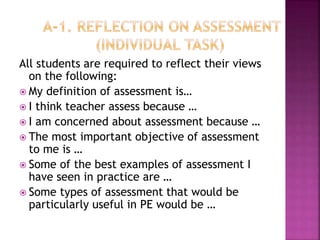
All students are required to reflect their views
on the following:
 My definition of assessment is…
 I think teacher assess because …
 I am concerned about assessment because …
 The most important objective of assessment
to me is …
 Some of the best examples of assessment I
have seen in practice are …
 Some types of assessment that would be
particularly useful in PE would be …
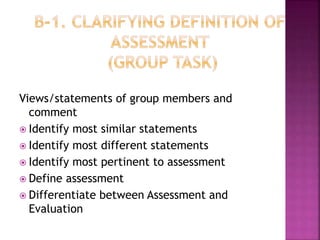
Views/statements of group members and
comment
 Identify most similar statements
 Identify most different statements
 Identify most pertinent to assessment
 Define assessment
 Differentiate between Assessment and
Evaluation
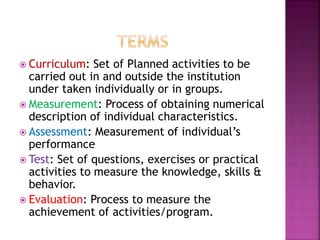
 Curriculum: Set of Planned activities to be
carried out in and outside the institution
under taken individually or in groups.
 Measurement: Process of obtaining numerical
description of individual characteristics.
 Assessment: Measurement of individual’s
performance
 Test: Set of questions, exercises or practical
activities to measure the knowledge, skills &
behavior.
 Evaluation: Process to measure the
achievement of activities/program.
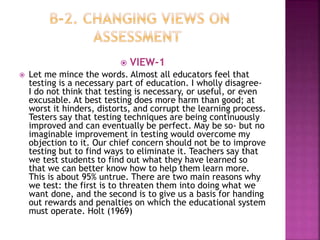
 VIEW-1
 Let me mince the words. Almost all educators feel that
testing is a necessary part of education. I wholly disagree-
I do not think that testing is necessary, or useful, or even
excusable. At best testing does more harm than good; at
worst it hinders, distorts, and corrupt the learning process.
Testers say that testing techniques are being continuously
improved and can eventually be perfect. May be so- but no
imaginable improvement in testing would overcome my
objection to it. Our chief concern should not be to improve
testing but to find ways to eliminate it. Teachers say that
we test students to find out what they have learned so
that we can better know how to help them learn more.
This is about 95% untrue. There are two main reasons why
we test: the first is to threaten them into doing what we
want done, and the second is to give us a basis for handing
out rewards and penalties on which the educational system
must operate. Holt (1969)
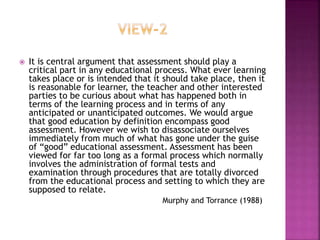
 It is central argument that assessment should play a
critical part in any educational process. What ever learning
takes place or is intended that it should take place, then it
is reasonable for learner, the teacher and other interested
parties to be curious about what has happened both in
terms of the learning process and in terms of any
anticipated or unanticipated outcomes. We would argue
that good education by definition encompass good
assessment. However we wish to disassociate ourselves
immediately from much of what has gone under the guise
of “good” educational assessment. Assessment has been
viewed for far too long as a formal process which normally
involves the administration of formal tests and
examination through procedures that are totally divorced
from the educational process and setting to which they are
supposed to relate.
Murphy and Torrance (1988)
 What are the views of John Holt and reasons
behind his views?
 In what way his views have relevance to our
situation?
 What are the views of Murphy and Torrance
and associated reasons?
 What implication does this have on Physical
education?
Reflect on:
 What is assessment for?
 Why should we assess learning? (List as many
reasons as you can)
 How could you classify the various purposes
of assessment? Consider certification,
selection, feedback, etc.
 Formative assessment- collection of
ongoing information
 Summative assessment- at the end of a
study course
 Informal and formal assessment- day to day
classroom activity and examination
 Terminal and Semester system
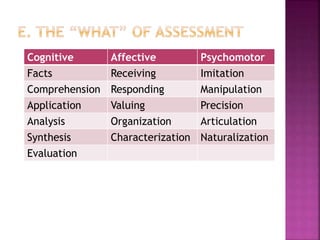
Cognitive Affective Psychomotor
Facts Receiving Imitation
Comprehension Responding Manipulation
Application Valuing Precision
Analysis Organization Articulation
Synthesis Characterization Naturalization
Evaluation
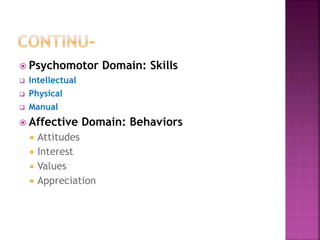
 Psychomotor Domain: Skills
 Intellectual
 Physical
 Manual
 Affective Domain: Behaviors
 Attitudes
 Interest
 Values
 Appreciation
The students are required to:
 List available methods of assessment?
 List the methods of assessment you are
following in PE and their suitability in the
system?
 Why do you think that you are on right path?
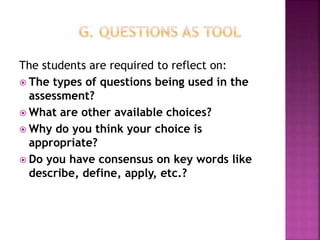
The students are required to reflect on:
 The types of questions being used in the
assessment?
 What are other available choices?
 Why do you think your choice is
appropriate?
 Do you have consensus on key words like
describe, define, apply, etc.?
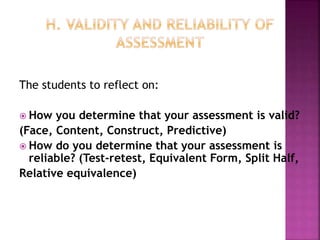
The students to reflect on:
 How you determine that your assessment is valid?
(Face, Content, Construct, Predictive)
 How do you determine that your assessment is
reliable? (Test-retest, Equivalent Form, Split Half,
Relative equivalence)

edu: measurement in P.E

  • 1.
    EDUCATIONAL MEASUREMENT IN PhysicalEducation PROF. DR. Pervez A. Shami Izaz-e-Fazeelat
  • 2.
    All students arerequired to reflect their views on the following:  My definition of assessment is…  I think teacher assess because …  I am concerned about assessment because …  The most important objective of assessment to me is …  Some of the best examples of assessment I have seen in practice are …  Some types of assessment that would be particularly useful in PE would be …
  • 3.
    Views/statements of groupmembers and comment  Identify most similar statements  Identify most different statements  Identify most pertinent to assessment  Define assessment  Differentiate between Assessment and Evaluation
  • 4.
     Curriculum: Setof Planned activities to be carried out in and outside the institution under taken individually or in groups.  Measurement: Process of obtaining numerical description of individual characteristics.  Assessment: Measurement of individual’s performance  Test: Set of questions, exercises or practical activities to measure the knowledge, skills & behavior.  Evaluation: Process to measure the achievement of activities/program.
  • 5.
     VIEW-1  Letme mince the words. Almost all educators feel that testing is a necessary part of education. I wholly disagree- I do not think that testing is necessary, or useful, or even excusable. At best testing does more harm than good; at worst it hinders, distorts, and corrupt the learning process. Testers say that testing techniques are being continuously improved and can eventually be perfect. May be so- but no imaginable improvement in testing would overcome my objection to it. Our chief concern should not be to improve testing but to find ways to eliminate it. Teachers say that we test students to find out what they have learned so that we can better know how to help them learn more. This is about 95% untrue. There are two main reasons why we test: the first is to threaten them into doing what we want done, and the second is to give us a basis for handing out rewards and penalties on which the educational system must operate. Holt (1969)
  • 6.
     It iscentral argument that assessment should play a critical part in any educational process. What ever learning takes place or is intended that it should take place, then it is reasonable for learner, the teacher and other interested parties to be curious about what has happened both in terms of the learning process and in terms of any anticipated or unanticipated outcomes. We would argue that good education by definition encompass good assessment. However we wish to disassociate ourselves immediately from much of what has gone under the guise of “good” educational assessment. Assessment has been viewed for far too long as a formal process which normally involves the administration of formal tests and examination through procedures that are totally divorced from the educational process and setting to which they are supposed to relate. Murphy and Torrance (1988)
  • 7.
     What arethe views of John Holt and reasons behind his views?  In what way his views have relevance to our situation?  What are the views of Murphy and Torrance and associated reasons?  What implication does this have on Physical education?
  • 8.
    Reflect on:  Whatis assessment for?  Why should we assess learning? (List as many reasons as you can)  How could you classify the various purposes of assessment? Consider certification, selection, feedback, etc.
  • 9.
     Formative assessment-collection of ongoing information  Summative assessment- at the end of a study course  Informal and formal assessment- day to day classroom activity and examination  Terminal and Semester system
  • 10.
    Cognitive Affective Psychomotor FactsReceiving Imitation Comprehension Responding Manipulation Application Valuing Precision Analysis Organization Articulation Synthesis Characterization Naturalization Evaluation
  • 11.
     Psychomotor Domain:Skills  Intellectual  Physical  Manual  Affective Domain: Behaviors  Attitudes  Interest  Values  Appreciation
  • 12.
    The students arerequired to:  List available methods of assessment?  List the methods of assessment you are following in PE and their suitability in the system?  Why do you think that you are on right path?
  • 13.
    The students arerequired to reflect on:  The types of questions being used in the assessment?  What are other available choices?  Why do you think your choice is appropriate?  Do you have consensus on key words like describe, define, apply, etc.?
  • 14.
    The students toreflect on:  How you determine that your assessment is valid? (Face, Content, Construct, Predictive)  How do you determine that your assessment is reliable? (Test-retest, Equivalent Form, Split Half, Relative equivalence)