Lecture 8: Introduction to
Narrative therapy
Systemic Comparative
Kevin Standish
Newham College University Centre
Learning Outcomes
1. Identify the background influences
2. Describe the core concepts of Narrative Therapy
3. Conceptualisation of problems in Narrative
Therapy
4. Therapeutic goals in Narrative Therapy
5. Therapist role in Narrative Therapy
6. Narrative Therapy interventions
7. Evaluation of Narrative Therapy
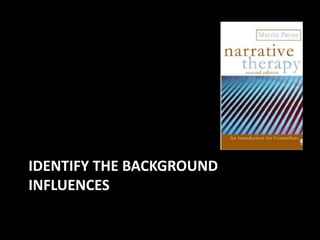
IDENTIFY THE BACKGROUND
INFLUENCES
The limits of language ….
mean the limits of my world
Ludwig Wittgenstein

4
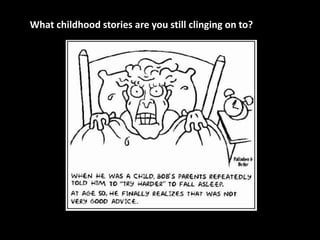
What childhood stories are you still clinging on to?
“Narrative Means to Therapeutic Ends”

Michael
White

David
Epston
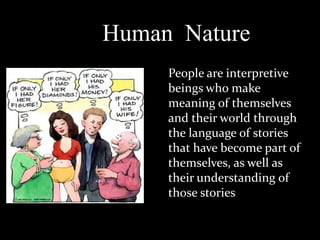
Human Nature
People are interpretive
beings who make
meaning of themselves
and their world through
the language of stories
that have become part of
themselves, as well as
their understanding of
those stories
Narrative Family Therapy
1. Based on “liberation philosophy” (postmodern, social
constructionist) which avoids objectification of
people/families—belief that problems arise because of
culturally-induced subscription to narrow and self-defeating
views of self and world
2. No normative pattern to be achieved (meaning,
purposefulness, health determined by each
family/culture/situation)
3. Focuses on narrative reasoning (versus logico-scientific)—
asserts that people live their lives by stories, and these can
be re-written (re-authoring in creative ways)
4. Families encouraged to externalize their problems (problem
becomes separate entity, avoids blaming traps)
DESCRIBE THE CORE CONCEPTS OF
NARRATIVE THERAPY
PRIMARY THEMES IN NARRATIVE
THERAPY
Realities are socially constructed
Realities are constituted through language
Narrative organizes and maintains reality
There are no essential truths

10
PRIMARY THEMES IN NARRATIVE
THERAPY
Our lives are storied
Identity generated through stories
People are not problems
Problems are to be externalized
Deconstruct problems

11
REALITIES ARE SOCIALLY
CONSTRUCTED
We become who we are through relationship—
through how others perceive us and interact
with us and how we make meaning of the
social interaction

(Combs and Friedman, 1999)

12
REALITIES ARE SOCIALLY
CONSTRUCTED
Identity=definition of the author generated in the
text of one’s story
– Self dwells within the story

– Confirmed and modified through interaction
– Basis for identity rests in the group fiction
– Fiction can either heal or cripple the person who
possesses it
(Hillman, 1983, cited in Nagel, 1988)
13
REALITIES ARE CONSTITUTED THROUGH
LANGUAGE

Internal reality differs from external reality
Combination of values, experience and filters
Postmodernists state that words and language
create reality
(Combs and Freedman, 1998)
14
REALITIES ARE CONSTITUTED THROUGH
LANGUAGE

[Three umpires] are sitting around over a beer,
and one says, “There’s balls and there’s
strikes and I call ‘em the way they are.”
Another says, “There’s balls and strikes and I
call ‘em the way I see ‘em.” The third says,
“There’s balls and there’s strikes, and they
ain’t nothin’ until I call ‘em.”
(Combs and Freedman, 1998)
15
OUR LIVES ARE “STORIED”
Dominant identity story
– Solution or problem oriented?

Life story=sufficient and self-contained fiction
Differs from biography, oral history or life history

16
Theoretical Concepts

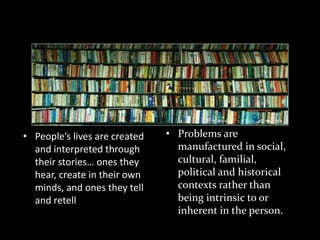
• People’s lives are created
and interpreted through
their stories… ones they
hear, create in their own
minds, and ones they tell
and retell

• Problems are
manufactured in social,
cultural, familial,
political and historical
contexts rather than
being intrinsic to or
inherent in the person.
Theoretical Concepts
• Drawing people’s attention to
subtle changes in their lives
can foster new insights,
promote empowerment and
help people develop better
ways to resolve difficulties…
through this knowledge people
can truly become authors of
their own lives…
• Client is an expert on his own
life and counselor is an expert
of narrative therapy
Theoretical Concepts
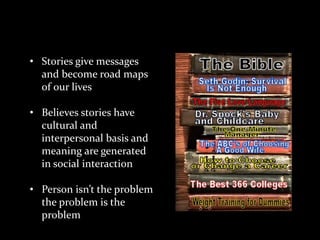
• Stories give messages
and become road maps
of our lives
• Believes stories have
cultural and
interpersonal basis and
meaning are generated
in social interaction
• Person isn’t the problem
the problem is the
problem
CONCEPTUALISATION OF PROBLEMS IN
NARRATIVE THERAPY
IDENTITY GENERATED THROUGH
STORIES
Represents the key to meaning and significance
(Fisher, 1984)
Stories provide
– Significant events and appropriate meanings for
listeners
– Identify and affiliation for those who tell them

Healing for both listener and storyteller
Emphasis on “listening, accepting, making nonjudgmental, non-confrontational comments.”
(Hennings, 1987)
21
PROBLEMS ARE TO BE EXTERNALIZED
Hidden problems cannot be changed
– “only as sick as your secrets”

Externalization allows re-authoring
May need to externalize solution as well as
problem

22
DECONSTRUCTING THE PROBLEM
Erase object of text as well as author
“I’m not much, but I’m all I think about.”
Can ask multiple forms of same question
Therapist becomes linguistic detective
Intricate and delicate process
23
EXAMPLE OF DECONSTRUCTION
“A tear in the hand of a Western man
He’ll tell you about salt, carbon and water
But a tear to an Oriental man
He’ll tell you about sadness, sorrow, the love of
a man and a woman.”
“Ride the Tiger,” Jefferson Starship (1974)
Dragon Fly
24
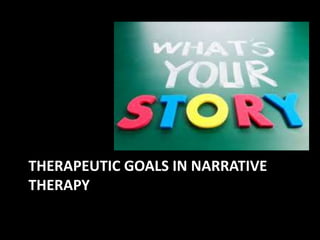
THERAPEUTIC GOALS IN NARRATIVE
THERAPY
Therapeutic Goals
• Therapists invite clients to describe
their experience in new language and
facilitate the discovery or creation of
new options that are unique to them
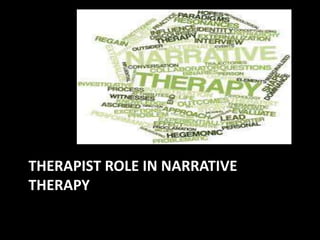
THERAPIST ROLE IN NARRATIVE
THERAPY
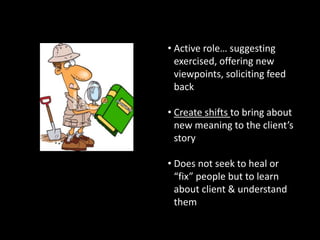
Counselors’ Roles
• Active role… suggesting
exercised, offering new
viewpoints, soliciting feed
back

• Create shifts to bring about
new meaning to the client’s
story
• Therapeutic Anthropologists
• Supportive, facilitator,
encourager… not an expert
• Never Judges

• Does not seek to heal or
“fix” people but to learn
about client & understand
them
Therapist Role
• Suggest alternative
viewpoints and elicit stories
• Mirroring- reflect
themselves as well as the
client
• Emphasis on being
respective & encouraging of
client’s strengths and
resources

• Participatory witness
and interpersonal
relationship based on
collaboration not just
reflection (personcentered) but interactive
• Careful listening,
empathetic,
summarization and
paraphrasing to give
people ownership
The Therapeutic Process in
Narrative Therapy
• Collaborate with the client in identifying (naming)
the problem
• Separate the person from his or her problem
• Investigate how the problem has been disrupting
or dominating the person
• Search for exceptions to the problem
• Ask clients to speculate about what kind of future
they could expect from the competent person
that is emerging
• Create an audience to support the new story
Narrative Therapist’s function and role
• To become active facilitators
• To demonstrate care, interest, respectful curiosity, openness,
empathy, contact, and fascination
• To adopt a not-knowing position that allows being guided by
the client’s story
• To help clients construct a preferred alternative story
• To separate the problem from the people (instead of person
own the problem)

• To create a collaborative relationship --- with the client being
the senior partner
Therapeutic Relationship
• Emphasize the quality of therapeutic
relationship, in particular therapists’ attitudes
• Client-as-expert, clients are the primary
interpreters of their own experiences
• Therapists seek to understand client's lived
experience and avoid effort to predict,
interpret, and pathologies.
NARRATIVE THERAPY INTERVENTIONS
Therapeutic Techniques
• No recipe, no set agenda, and no formula
• This approach is grounded in a philosophical
framework
• Questions—and more questions:
– Questions are used as a way to generate experience
rather than to gather information
– Asking questions can lead to separating “person”
from “problem”, identifying preferred directions, and
creating alternative stories to support these
directions.
Therapeutic Techniques
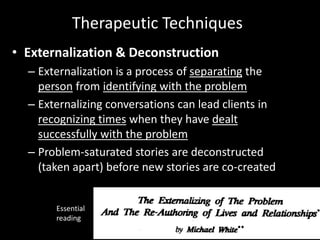
• Externalization & Deconstruction
– Externalization is a process of separating the
person from identifying with the problem
– Externalizing conversations can lead clients in
recognizing times when they have dealt
successfully with the problem
– Problem-saturated stories are deconstructed
(taken apart) before new stories are co-created

Essential
reading
Therapeutic Techniques

• Search for unique outcomes

– Successful stories regarding the problem

• Creating Alternative Stories
– The assumption is that people can continually and
actively re-author their lives
– Invite clients to author alternative stories through
“unique outcomes”
– An appreciative audience helps new stories to
take root
Read
Therapeutic Techniques
• Documenting the evidence
– Therapists write and send a letter to clients
between sessions regarding their strengths and
accomplishments, alternative story, and unique
outcomes or exceptions to the problems.

http://www.youtube.com/watch?v=XMst5HoO
S6c
Narrative Treatment Techniques
1. Externalization of problem—the problem is the
problem, and is given a name. Family and members
not defined by problem
2. Influence of the Problem on each Person
3. Influence of the Person on the Problem
4. Raising Dilemmas—examine aspects of problem
before need arises
5. Predicting Setbacks—they almost inevitable, best
dealt with when anticipated
Narrative Treatment Techniques
6. Using Questions
• Exceptions-oriented
• Significance of exceptions
7. Letters to client families—a form of case note to
family, put in transparent/congruent statements
8. Celebrations/certificates—festive, signify
victory/achievement, tailored to circumstances by
wording, printed and include logo (For
achievements in conquest of “Apathy”)
EVALUATION OF NARRATIVE THERAPY
Summary and Evaluation
• Contributions
– Client-as-expert (not knowing position)
– View people are competent and able to create
solutions and alternative stories
– Do not support the DSM-IV-TR labeling system
– A brief approach, is good for managed care.
– In general, studies provided preliminary support
for the efficacy
Summary and Evaluation
• Limitations
– No set of formulas or recipes to follow
– Inexperienced therapist may view narrative as techniques.
However, the attitude of the therapist is critical to the
success of outcomes.
– Therapists need to be able to make quick assessments,
assist clients in setting up the goals, and effectively use
appropriate interventions
READINGS ETC
http://www.theinstituteofnarrativethe
rapy.com/papersandresources.html
Popular articles about narrative
therapy and community work
• http://www.dulwichcentre.com.au/articlesabout-narrative-therapy.html
2 free chapters
• http://www.dulwichcentre.com.au/what-isnarrative-therapy.html
http://www.delrayrecoverycenter.com
/ebooks/narrative-therapy/download/

Narrative Therapy Exerpt from Dr. Bitter
http://www.youtube.com/watch?v=gYaDrVp_
DyI
• Dallos, R. & Draper, R. (2010) chap 3
• Metcalf, L. (2011) chapter 13
• White, M & Epston, D. (1990) Narrative means to therapeutic ends. New
York: W. W. Norton
• Kaslow (2010) Family therapy Narrative
• Moreira, et al (2011) CLIENTS’ NARRATIVES IN PSYCHOTHERAPY
• Von Sydow (2002) Systemic Attachment theory and therapeutic practice
• Wallis et al (2011) What Is Narrative Therapy and What Is It Not
• Dallos (2004) Attachment narrative therapy integrating ideas from
narrative attachment theory
• Advanced reading
• Chang & Nylund (2013) Narrative and Solution-Focused therapies a 20
year retrospective
• Payne, Martin (2006) Narrative Therapy : An Introduction for
Counsellors 2nd ed. SAGE Publications London. Full Text available as
an eBook on EBSCO Host via your Athens login.
• Meier, Scott T (2012) Language and Narratives in Counseling
and Psychotherapy Springer Pub. Co New York, N.Y. Full Text available as
an eBook on EBSCO Host via your Athens login
Lecture 8 narrative therapy

Lecture 8 narrative therapy

  • 1.
    Lecture 8: Introductionto Narrative therapy Systemic Comparative Kevin Standish Newham College University Centre
  • 2.
    Learning Outcomes 1. Identifythe background influences 2. Describe the core concepts of Narrative Therapy 3. Conceptualisation of problems in Narrative Therapy 4. Therapeutic goals in Narrative Therapy 5. Therapist role in Narrative Therapy 6. Narrative Therapy interventions 7. Evaluation of Narrative Therapy
  • 3.
  • 4.
    The limits oflanguage …. mean the limits of my world Ludwig Wittgenstein 4
  • 5.
    What childhood storiesare you still clinging on to?
  • 6.
    “Narrative Means toTherapeutic Ends” Michael White David Epston
  • 7.
    Human Nature People areinterpretive beings who make meaning of themselves and their world through the language of stories that have become part of themselves, as well as their understanding of those stories
  • 8.
    Narrative Family Therapy 1.Based on “liberation philosophy” (postmodern, social constructionist) which avoids objectification of people/families—belief that problems arise because of culturally-induced subscription to narrow and self-defeating views of self and world 2. No normative pattern to be achieved (meaning, purposefulness, health determined by each family/culture/situation) 3. Focuses on narrative reasoning (versus logico-scientific)— asserts that people live their lives by stories, and these can be re-written (re-authoring in creative ways) 4. Families encouraged to externalize their problems (problem becomes separate entity, avoids blaming traps)
  • 9.
    DESCRIBE THE CORECONCEPTS OF NARRATIVE THERAPY
  • 10.
    PRIMARY THEMES INNARRATIVE THERAPY Realities are socially constructed Realities are constituted through language Narrative organizes and maintains reality There are no essential truths 10
  • 11.
    PRIMARY THEMES INNARRATIVE THERAPY Our lives are storied Identity generated through stories People are not problems Problems are to be externalized Deconstruct problems 11
  • 12.
    REALITIES ARE SOCIALLY CONSTRUCTED Webecome who we are through relationship— through how others perceive us and interact with us and how we make meaning of the social interaction (Combs and Friedman, 1999) 12
  • 13.
    REALITIES ARE SOCIALLY CONSTRUCTED Identity=definitionof the author generated in the text of one’s story – Self dwells within the story – Confirmed and modified through interaction – Basis for identity rests in the group fiction – Fiction can either heal or cripple the person who possesses it (Hillman, 1983, cited in Nagel, 1988) 13
  • 14.
    REALITIES ARE CONSTITUTEDTHROUGH LANGUAGE Internal reality differs from external reality Combination of values, experience and filters Postmodernists state that words and language create reality (Combs and Freedman, 1998) 14
  • 15.
    REALITIES ARE CONSTITUTEDTHROUGH LANGUAGE [Three umpires] are sitting around over a beer, and one says, “There’s balls and there’s strikes and I call ‘em the way they are.” Another says, “There’s balls and strikes and I call ‘em the way I see ‘em.” The third says, “There’s balls and there’s strikes, and they ain’t nothin’ until I call ‘em.” (Combs and Freedman, 1998) 15
  • 16.
    OUR LIVES ARE“STORIED” Dominant identity story – Solution or problem oriented? Life story=sufficient and self-contained fiction Differs from biography, oral history or life history 16
  • 17.
    Theoretical Concepts • People’slives are created and interpreted through their stories… ones they hear, create in their own minds, and ones they tell and retell • Problems are manufactured in social, cultural, familial, political and historical contexts rather than being intrinsic to or inherent in the person.
  • 18.
    Theoretical Concepts • Drawingpeople’s attention to subtle changes in their lives can foster new insights, promote empowerment and help people develop better ways to resolve difficulties… through this knowledge people can truly become authors of their own lives… • Client is an expert on his own life and counselor is an expert of narrative therapy
  • 19.
    Theoretical Concepts • Storiesgive messages and become road maps of our lives • Believes stories have cultural and interpersonal basis and meaning are generated in social interaction • Person isn’t the problem the problem is the problem
  • 20.
    CONCEPTUALISATION OF PROBLEMSIN NARRATIVE THERAPY
  • 21.
    IDENTITY GENERATED THROUGH STORIES Representsthe key to meaning and significance (Fisher, 1984) Stories provide – Significant events and appropriate meanings for listeners – Identify and affiliation for those who tell them Healing for both listener and storyteller Emphasis on “listening, accepting, making nonjudgmental, non-confrontational comments.” (Hennings, 1987) 21
  • 22.
    PROBLEMS ARE TOBE EXTERNALIZED Hidden problems cannot be changed – “only as sick as your secrets” Externalization allows re-authoring May need to externalize solution as well as problem 22
  • 23.
    DECONSTRUCTING THE PROBLEM Eraseobject of text as well as author “I’m not much, but I’m all I think about.” Can ask multiple forms of same question Therapist becomes linguistic detective Intricate and delicate process 23
  • 24.
    EXAMPLE OF DECONSTRUCTION “Atear in the hand of a Western man He’ll tell you about salt, carbon and water But a tear to an Oriental man He’ll tell you about sadness, sorrow, the love of a man and a woman.” “Ride the Tiger,” Jefferson Starship (1974) Dragon Fly 24
  • 25.
    THERAPEUTIC GOALS INNARRATIVE THERAPY
  • 26.
    Therapeutic Goals • Therapistsinvite clients to describe their experience in new language and facilitate the discovery or creation of new options that are unique to them
  • 27.
    THERAPIST ROLE INNARRATIVE THERAPY
  • 28.
    Counselors’ Roles • Activerole… suggesting exercised, offering new viewpoints, soliciting feed back • Create shifts to bring about new meaning to the client’s story • Therapeutic Anthropologists • Supportive, facilitator, encourager… not an expert • Never Judges • Does not seek to heal or “fix” people but to learn about client & understand them
  • 29.
    Therapist Role • Suggestalternative viewpoints and elicit stories • Mirroring- reflect themselves as well as the client • Emphasis on being respective & encouraging of client’s strengths and resources • Participatory witness and interpersonal relationship based on collaboration not just reflection (personcentered) but interactive • Careful listening, empathetic, summarization and paraphrasing to give people ownership
  • 30.
    The Therapeutic Processin Narrative Therapy • Collaborate with the client in identifying (naming) the problem • Separate the person from his or her problem • Investigate how the problem has been disrupting or dominating the person • Search for exceptions to the problem • Ask clients to speculate about what kind of future they could expect from the competent person that is emerging • Create an audience to support the new story
  • 31.
    Narrative Therapist’s functionand role • To become active facilitators • To demonstrate care, interest, respectful curiosity, openness, empathy, contact, and fascination • To adopt a not-knowing position that allows being guided by the client’s story • To help clients construct a preferred alternative story • To separate the problem from the people (instead of person own the problem) • To create a collaborative relationship --- with the client being the senior partner
  • 32.
    Therapeutic Relationship • Emphasizethe quality of therapeutic relationship, in particular therapists’ attitudes • Client-as-expert, clients are the primary interpreters of their own experiences • Therapists seek to understand client's lived experience and avoid effort to predict, interpret, and pathologies.
  • 33.
  • 34.
    Therapeutic Techniques • Norecipe, no set agenda, and no formula • This approach is grounded in a philosophical framework • Questions—and more questions: – Questions are used as a way to generate experience rather than to gather information – Asking questions can lead to separating “person” from “problem”, identifying preferred directions, and creating alternative stories to support these directions.
  • 35.
    Therapeutic Techniques • Externalization& Deconstruction – Externalization is a process of separating the person from identifying with the problem – Externalizing conversations can lead clients in recognizing times when they have dealt successfully with the problem – Problem-saturated stories are deconstructed (taken apart) before new stories are co-created Essential reading
  • 36.
    Therapeutic Techniques • Searchfor unique outcomes – Successful stories regarding the problem • Creating Alternative Stories – The assumption is that people can continually and actively re-author their lives – Invite clients to author alternative stories through “unique outcomes” – An appreciative audience helps new stories to take root Read
  • 37.
    Therapeutic Techniques • Documentingthe evidence – Therapists write and send a letter to clients between sessions regarding their strengths and accomplishments, alternative story, and unique outcomes or exceptions to the problems. http://www.youtube.com/watch?v=XMst5HoO S6c
  • 38.
    Narrative Treatment Techniques 1.Externalization of problem—the problem is the problem, and is given a name. Family and members not defined by problem 2. Influence of the Problem on each Person 3. Influence of the Person on the Problem 4. Raising Dilemmas—examine aspects of problem before need arises 5. Predicting Setbacks—they almost inevitable, best dealt with when anticipated
  • 39.
    Narrative Treatment Techniques 6.Using Questions • Exceptions-oriented • Significance of exceptions 7. Letters to client families—a form of case note to family, put in transparent/congruent statements 8. Celebrations/certificates—festive, signify victory/achievement, tailored to circumstances by wording, printed and include logo (For achievements in conquest of “Apathy”)
  • 40.
  • 41.
    Summary and Evaluation •Contributions – Client-as-expert (not knowing position) – View people are competent and able to create solutions and alternative stories – Do not support the DSM-IV-TR labeling system – A brief approach, is good for managed care. – In general, studies provided preliminary support for the efficacy
  • 42.
    Summary and Evaluation •Limitations – No set of formulas or recipes to follow – Inexperienced therapist may view narrative as techniques. However, the attitude of the therapist is critical to the success of outcomes. – Therapists need to be able to make quick assessments, assist clients in setting up the goals, and effectively use appropriate interventions
  • 43.
  • 44.
  • 45.
    Popular articles aboutnarrative therapy and community work • http://www.dulwichcentre.com.au/articlesabout-narrative-therapy.html
  • 46.
    2 free chapters •http://www.dulwichcentre.com.au/what-isnarrative-therapy.html
  • 47.
  • 48.
    • Dallos, R.& Draper, R. (2010) chap 3 • Metcalf, L. (2011) chapter 13 • White, M & Epston, D. (1990) Narrative means to therapeutic ends. New York: W. W. Norton • Kaslow (2010) Family therapy Narrative • Moreira, et al (2011) CLIENTS’ NARRATIVES IN PSYCHOTHERAPY • Von Sydow (2002) Systemic Attachment theory and therapeutic practice • Wallis et al (2011) What Is Narrative Therapy and What Is It Not • Dallos (2004) Attachment narrative therapy integrating ideas from narrative attachment theory • Advanced reading • Chang & Nylund (2013) Narrative and Solution-Focused therapies a 20 year retrospective • Payne, Martin (2006) Narrative Therapy : An Introduction for Counsellors 2nd ed. SAGE Publications London. Full Text available as an eBook on EBSCO Host via your Athens login. • Meier, Scott T (2012) Language and Narratives in Counseling and Psychotherapy Springer Pub. Co New York, N.Y. Full Text available as an eBook on EBSCO Host via your Athens login