







SATHISH Rajamani M.Sc (N) Lecturer Annai Meenakshi College of Nursing Coimbatore ELECTROCONVULSIVE THERAPY
Somatic Therapies are treatment approaches that uses physiological or physical interventions to effect behavior change.  The most common form of somatic therapy is ECT. It was first used as a treatment modality in 1934, to “cure” psychotic disorders by inducing convulsions. INTRODUCTION
HISTORY 1500 – Parcelsus induces seizures by administering camphor by mouth to treat psychotic illness. 1934 – Ladislaus Meduna begins the modern era of convulsive therapy by using IM injection of camphor for catatonic schizophrenia 1938 – Lucio Cerletti and Ugo Bini conduct the first electrical induction of a series of seizures in a catatonic patient and produce a sucessful treatment response.
DEFINITION ECT are also known as Electroshock or Shock Therapy. Electroconvulsive Therapy is a type of somatic treatment in which electric  current is applied to the brain through electrodes placed on the temples of the patient
INDICATIONS The main indications of ECT include Depressive Illness ECT is effective in treating depression especially with somatic features, and psychotic symptoms. Severe Depression with suicidal risk Depressive Stupor Severe Pureperal Depression Depressive illness with nihilistic or paranoid illness
INDICATIONS Cont… Failure to respond to an adequate course of antidepressant In elderly where the ECT is safer than drugs Inability to take drugs e.g. Depression in First trimester of Pregnancy or Physical illness
INDICATION Cont… 2.  Schizophrenia ECT produces greater early symptomatic relief than the neuroleptics. The main indications of ECT in Schizophrenia are, Excitement Stupor Purperal Schizophrenia Schizophrenia episodes in first trimester of pregnancy
INDICATIONS Cont… 3. MANIA The main indication of ECT in mania are Excited or Uncooperative behavior Bipolar Mood disorder with mixed features 4. POST PARTUM PSYCHOSIS 5. SCHIZOAFFECTIVE DISORDERS 6. PSYCHOSIS IN 1 st  TRIMESTER OF PREGNANCY
CONTRAINDICATIONS ABSOLUTE  The only absolute CI is the presence of raised ICP RELATIVE These includes Recent MI Severe Hypertension Cerebero vascular Accident Severe Pulmonary Disease Retinal Detachment Pheochromocytoma
MODE OF ACTION The exact MoA of ECT is unknown, various hypotheses suggest different MoA. The passage of current results in production of generalized tonic – clonic seizures lasting at least 25 – 30 sec. ECT affects the catecholamine pathways between Diencephalon and limbic system also involving hypothalamus. As ECT increases threshold for further seizures, it may paradoxically act as an anticonvulsant.
CLINICAL GUIDELINES FOR ECT Pre treatment Evaluation Pre Medications Electrodes Placements Electrical Stimulus Induced Seizures Monitoring Seizures Failure to Induce Seizures Number and spacing of Treatment
PRE TREATMENT EVALUATION Pre Treatment evaluation should includes Standard Physical Examination Neurological Evaluation Complete Medical History Chest X – Ray Electrocardiogram Dental Examination CT & MRI ( Seizure Disorder) X – Ray of the Spine (Spinal Disorder) Blood and Urine Chemistries
PRE MEDICATIONS Patients should be kept in NPO for 6 Hrs. IV line should be established A Bite block is inserted into the mouth just before administering ECT. 100 % Oxygen is administered at a rate of 5 Liters per minute Emergency equipments for establishing airway should be kept near for immediate access if need arise
Pre Medications Cont… Muscarinic Anticholinergic Drugs Anesthesia Muscle Relaxants
They are administered before administering ECT  to minimize oral and respiratory secretions. The most commonly used Muscarinic Anticholinergic agent is Atrphine  0.3 to 0.6 mg administered IM or Subcutaneously 30 to 60 minutes before the anesthetic or 0.4 to 1.0 mg IV 2 or 3 minutes before anesthetic. An option to atrophine was Glycopyrrolate (Robinoul) 0.2 to 0.4 mg IM / IV / SC. Which is less likely to cross Blood Brain Barrier. MUSCARINIC ANTICHOLINERGIC AGENTS
Administeration of ECT requires general anesthesia and oxygenation. Methohexital 0.75 to 1.0 mg /kg IV Bolus is commonly used.  Other anesthetic agent is Thiopental ( Pentothal) ANESTHESIA
After the onset of the anesthetic effect, usually within a minute a muscle relaxant is administered, to minimize the risk of bone fractures and joints dislocations, resulting from motor activity during the seizure.  Succinyl Choline is the choice of muscle relaxants which is administered in a dose of 0.5 to 1.0 mg/kg as an IV bolus. MUSCLE RELAXANTS
ELECTORDES PLACEMENT Bilateral Placement It yields a more rapid therapeutic response. It is the standard form of ECT and most commonly used. Electrodes are placed on each side one inch above the mid point of an imaginery line connecting the outer canthus of the eye and tragus of the ear. Unilateral Placement Here the electrodes are placed only on one side of head, usually non – dominant side. (Right side of head in a right – handed individual) . Unilateral ECT is safer, with much fewer side effects particularly those of memory impairment
ELECTRICAL STIMULUS The electrical stimulus must be strong  enough to reach the seizure threshold. The electrical stimulus is given in cycles. Each cycles contains a positive and negative wave. Old machines use Sine wave: However the modern machines uses brief pulse waveform.
INDUCED SEIZURES Plantar extension is the first sign of the occurrence of seizure. Plantar extension lasts for 10 – 20 seconds which marks tonic phase. Rhythmic contraction (Clonic) follows the tonic phase, that decreases in frequency and finally disappears.
MONITORING SEIZURES Observe the tonic – clonic phase movements or EEG readings to know the onset of seizure.
FAILURE TO INDUCE SEIZURE Up to four attempts of seizure induction can be tried in a single course of time. Onset of seizure activity is sometimes delayed as long as 20 to 40 seconds after administration of stimulus. If stimulus fails to induce seizure check the electrodes placement and increase the stimulus by 25 to 100%.
Failure to induce seizure Change in anesthetic agent can be used to minimize the seizure threshold. Additional procedure to induce seizure are Inducing hyperventilation Administering 500 – 2000 mg IV caffeine sodium benzoate 5 to 10 minutes before the administration of stimulus
NUMBER AND SPACING OF TREATMENT ECT are usually administered two or three times a week. 6 – 12 treatments for Major Depression. Mania treatment needs up to 20 seating's. Schizophrenia needs 15+. Catatonia and delirium requires 1 to 4 ECT’s.
SIDE EFFECTS Amnesia Confusion Memory impairment Palpitation Nausea and vomiting Anxiety & Restlessness Sweating Tongue Bite Dizziness Dryness of mouth Headache Weakness & Fatigue Muscle pain Poor Concentration Incontinence
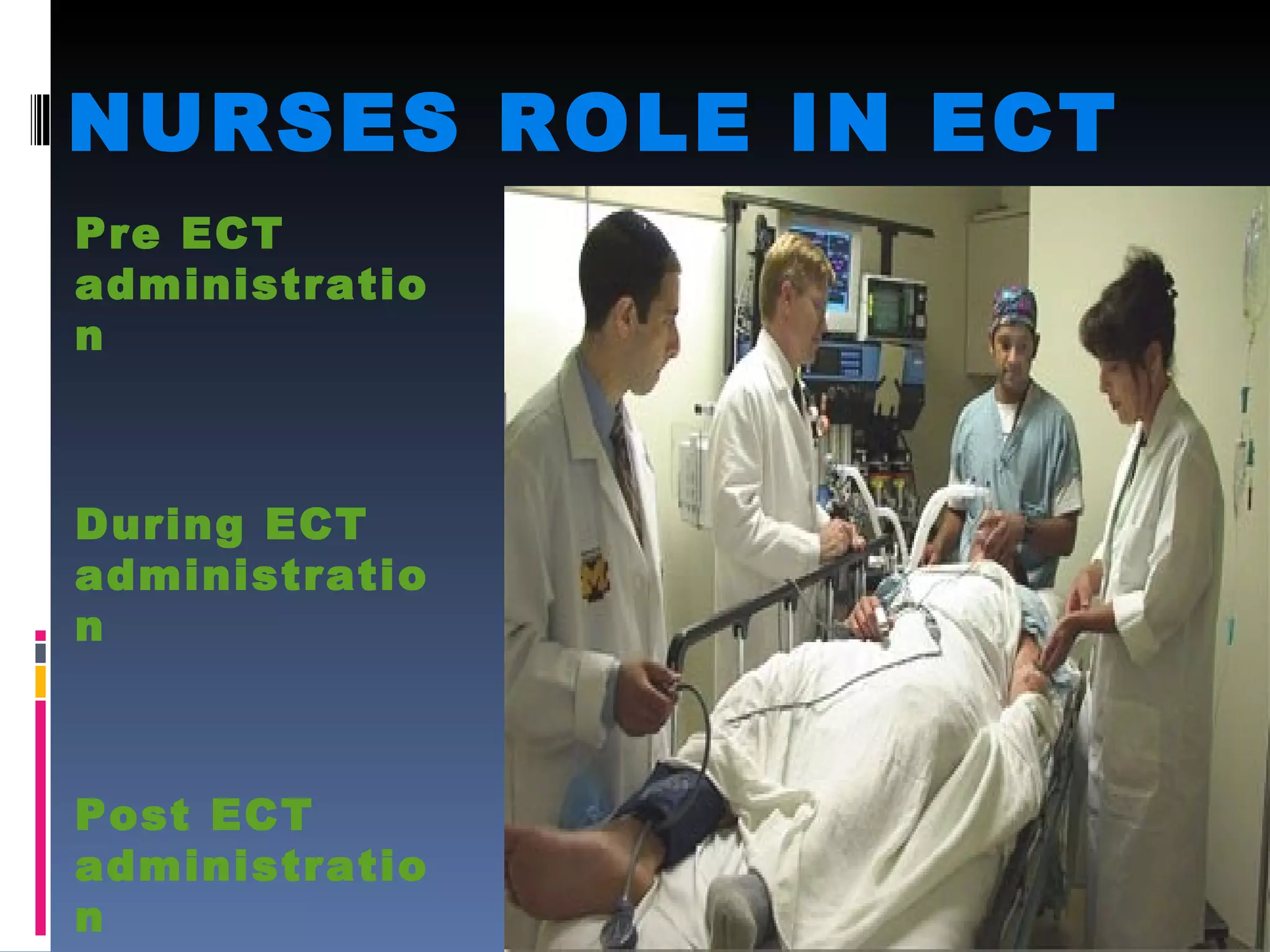
NURSES ROLE IN ECT Pre ECT administration During ECT administration Post ECT administration
 

Ect

  • 1.
    SATHISH Rajamani M.Sc(N) Lecturer Annai Meenakshi College of Nursing Coimbatore ELECTROCONVULSIVE THERAPY
  • 2.
    Somatic Therapies aretreatment approaches that uses physiological or physical interventions to effect behavior change. The most common form of somatic therapy is ECT. It was first used as a treatment modality in 1934, to “cure” psychotic disorders by inducing convulsions. INTRODUCTION
  • 3.
    HISTORY 1500 –Parcelsus induces seizures by administering camphor by mouth to treat psychotic illness. 1934 – Ladislaus Meduna begins the modern era of convulsive therapy by using IM injection of camphor for catatonic schizophrenia 1938 – Lucio Cerletti and Ugo Bini conduct the first electrical induction of a series of seizures in a catatonic patient and produce a sucessful treatment response.
  • 4.
    DEFINITION ECT arealso known as Electroshock or Shock Therapy. Electroconvulsive Therapy is a type of somatic treatment in which electric current is applied to the brain through electrodes placed on the temples of the patient
  • 5.
    INDICATIONS The mainindications of ECT include Depressive Illness ECT is effective in treating depression especially with somatic features, and psychotic symptoms. Severe Depression with suicidal risk Depressive Stupor Severe Pureperal Depression Depressive illness with nihilistic or paranoid illness
  • 6.
    INDICATIONS Cont… Failureto respond to an adequate course of antidepressant In elderly where the ECT is safer than drugs Inability to take drugs e.g. Depression in First trimester of Pregnancy or Physical illness
  • 7.
    INDICATION Cont… 2. Schizophrenia ECT produces greater early symptomatic relief than the neuroleptics. The main indications of ECT in Schizophrenia are, Excitement Stupor Purperal Schizophrenia Schizophrenia episodes in first trimester of pregnancy
  • 8.
    INDICATIONS Cont… 3.MANIA The main indication of ECT in mania are Excited or Uncooperative behavior Bipolar Mood disorder with mixed features 4. POST PARTUM PSYCHOSIS 5. SCHIZOAFFECTIVE DISORDERS 6. PSYCHOSIS IN 1 st TRIMESTER OF PREGNANCY
  • 9.
    CONTRAINDICATIONS ABSOLUTE The only absolute CI is the presence of raised ICP RELATIVE These includes Recent MI Severe Hypertension Cerebero vascular Accident Severe Pulmonary Disease Retinal Detachment Pheochromocytoma
  • 10.
    MODE OF ACTIONThe exact MoA of ECT is unknown, various hypotheses suggest different MoA. The passage of current results in production of generalized tonic – clonic seizures lasting at least 25 – 30 sec. ECT affects the catecholamine pathways between Diencephalon and limbic system also involving hypothalamus. As ECT increases threshold for further seizures, it may paradoxically act as an anticonvulsant.
  • 11.
    CLINICAL GUIDELINES FORECT Pre treatment Evaluation Pre Medications Electrodes Placements Electrical Stimulus Induced Seizures Monitoring Seizures Failure to Induce Seizures Number and spacing of Treatment
  • 12.
    PRE TREATMENT EVALUATIONPre Treatment evaluation should includes Standard Physical Examination Neurological Evaluation Complete Medical History Chest X – Ray Electrocardiogram Dental Examination CT & MRI ( Seizure Disorder) X – Ray of the Spine (Spinal Disorder) Blood and Urine Chemistries
  • 13.
    PRE MEDICATIONS Patientsshould be kept in NPO for 6 Hrs. IV line should be established A Bite block is inserted into the mouth just before administering ECT. 100 % Oxygen is administered at a rate of 5 Liters per minute Emergency equipments for establishing airway should be kept near for immediate access if need arise
  • 14.
    Pre Medications Cont…Muscarinic Anticholinergic Drugs Anesthesia Muscle Relaxants
  • 15.
    They are administeredbefore administering ECT to minimize oral and respiratory secretions. The most commonly used Muscarinic Anticholinergic agent is Atrphine 0.3 to 0.6 mg administered IM or Subcutaneously 30 to 60 minutes before the anesthetic or 0.4 to 1.0 mg IV 2 or 3 minutes before anesthetic. An option to atrophine was Glycopyrrolate (Robinoul) 0.2 to 0.4 mg IM / IV / SC. Which is less likely to cross Blood Brain Barrier. MUSCARINIC ANTICHOLINERGIC AGENTS
  • 16.
    Administeration of ECTrequires general anesthesia and oxygenation. Methohexital 0.75 to 1.0 mg /kg IV Bolus is commonly used. Other anesthetic agent is Thiopental ( Pentothal) ANESTHESIA
  • 17.
    After the onsetof the anesthetic effect, usually within a minute a muscle relaxant is administered, to minimize the risk of bone fractures and joints dislocations, resulting from motor activity during the seizure. Succinyl Choline is the choice of muscle relaxants which is administered in a dose of 0.5 to 1.0 mg/kg as an IV bolus. MUSCLE RELAXANTS
  • 18.
    ELECTORDES PLACEMENT BilateralPlacement It yields a more rapid therapeutic response. It is the standard form of ECT and most commonly used. Electrodes are placed on each side one inch above the mid point of an imaginery line connecting the outer canthus of the eye and tragus of the ear. Unilateral Placement Here the electrodes are placed only on one side of head, usually non – dominant side. (Right side of head in a right – handed individual) . Unilateral ECT is safer, with much fewer side effects particularly those of memory impairment
  • 19.
    ELECTRICAL STIMULUS Theelectrical stimulus must be strong enough to reach the seizure threshold. The electrical stimulus is given in cycles. Each cycles contains a positive and negative wave. Old machines use Sine wave: However the modern machines uses brief pulse waveform.
  • 20.
    INDUCED SEIZURES Plantarextension is the first sign of the occurrence of seizure. Plantar extension lasts for 10 – 20 seconds which marks tonic phase. Rhythmic contraction (Clonic) follows the tonic phase, that decreases in frequency and finally disappears.
  • 21.
    MONITORING SEIZURES Observethe tonic – clonic phase movements or EEG readings to know the onset of seizure.
  • 22.
    FAILURE TO INDUCESEIZURE Up to four attempts of seizure induction can be tried in a single course of time. Onset of seizure activity is sometimes delayed as long as 20 to 40 seconds after administration of stimulus. If stimulus fails to induce seizure check the electrodes placement and increase the stimulus by 25 to 100%.
  • 23.
    Failure to induceseizure Change in anesthetic agent can be used to minimize the seizure threshold. Additional procedure to induce seizure are Inducing hyperventilation Administering 500 – 2000 mg IV caffeine sodium benzoate 5 to 10 minutes before the administration of stimulus
  • 24.
    NUMBER AND SPACINGOF TREATMENT ECT are usually administered two or three times a week. 6 – 12 treatments for Major Depression. Mania treatment needs up to 20 seating's. Schizophrenia needs 15+. Catatonia and delirium requires 1 to 4 ECT’s.
  • 25.
    SIDE EFFECTS AmnesiaConfusion Memory impairment Palpitation Nausea and vomiting Anxiety & Restlessness Sweating Tongue Bite Dizziness Dryness of mouth Headache Weakness & Fatigue Muscle pain Poor Concentration Incontinence
  • 26.
    NURSES ROLE INECT Pre ECT administration During ECT administration Post ECT administration
  • 27.