SCHIZOPHRENIA Mr. Sathish Rajamani M.Sc (N), Lecturer, BKIN – Daudhar.
Definition The schizophrenic disorders are characterized in general by fundamental and characteristic  distortions of thinking and perception, and affects  that are inappropriate or blunted. Clear consciousness and intellectual capacity are usually maintained although certain cognitive deficits may evolve in the course of time.  The most important psychopathological phenomena include thought echo thought insertion or withdrawal thought broadcasting delusional perception and delusions of control influence or passivity hallucinatory voices commenting or discussing the patient in the third person thought disorders and negative symptoms.
Schizophrenia Schizophrenia occurs with regular frequency nearly everywhere in the world in 1 % of population and begins mainly in young age (mostly around 16 to 25 years). Schizophrenia is defined by  a group of characteristic positive and negative symptoms deterioration in social, occupational, or interpersonal relationships continuous signs of the disturbance for at least 6 months
History Emil Kraepelin : This illness develops relatively early in life, and its course is likely deteriorating and chronic; deterioration reminded dementia  („Dementia praecox“ ), but was not followed by any organic changes of the brain, detectable at that time. Eugen Bleuler : He renamed Kraepelin’s dementia praecox as  schizophrenia  (1911); he recognized the cognitive impairment in this illness, which he named as a „splitting “  of mind. Kurt Schneider : He emphasized the role of psychotic symptoms, as hallucinations, delusions and gave them the privilege of  „the first rank symptoms”  even in the concept of the diagnosis of schizophrenia.
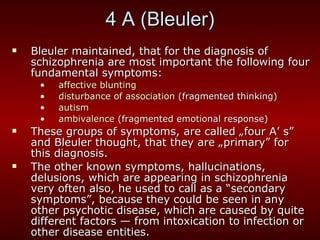
4 A (Bleuler) Bleuler maintained, that for the diagnosis of schizophrenia are most important the following four fundamental symptoms: affective blunting disturbance of association  (fragmented thinking) autism ambivalence  (fragmented emotional response) These groups of symptoms, are called „four A’ s” and Bleuler thought, that they are „primary” for this diagnosis. The other known symptoms, hallucinations, delusions, which are appearing in schizophrenia very often also, he used to call as a “secondary symptoms”, because they could be seen in any other psychotic disease, which are caused by quite different factors — from intoxication to infection or other disease entities.
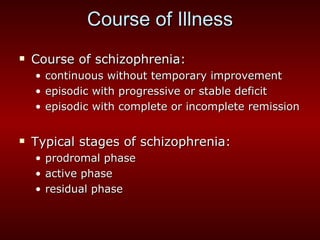
Course of Illness Course of schizophrenia: continuous without temporary improvement episodic with progressive or stable deficit episodic with complete or incomplete remission  Typical stages of schizophrenia: prodromal phase active phase residual phase
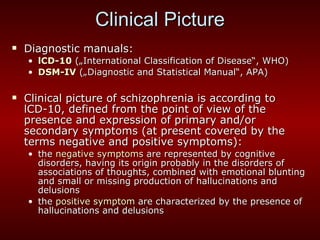
Clinical Picture Diagnostic manuals:  lCD-10  („International Classification of Disease“, WHO) DSM-IV  („Diagnostic and Statistical Manual“, APA) Clinical picture of schizophrenia is according to lCD-10, defined from the point of view of the presence and expression of primary and/or secondary symptoms (at present covered by the terms negative and positive symptoms) : t he  negative symptoms  are represented by cognitive disorders, having its origin probably in the disorders of associations of thoughts, combined with emotional blunting and small or missing production of hallucinations and delusions t he  positive  symptom  are characterized by the presence of hallucinations and delusions
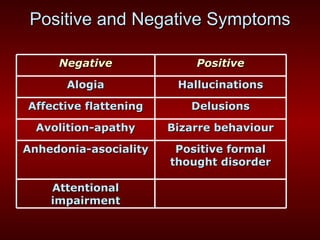
Positive and Negative Symptoms Negative Positive Alogia Hallucinations Affective flattening Delusions Avolition-apathy Bizarre behaviour Anhedonia-asociality Positive formal thought disorder Attentional impairment
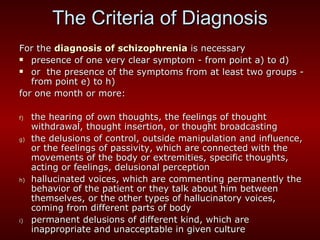
The Criteria of Diagnosis For the  diagnosis of schizophrenia  is necessary  presence of one very clear symptom  -  from point a) to d) or  the presence of the symptoms from at least two groups  -  from point e) to h) for one month or more: the hearing of own thoughts, the feelings of thought withdrawal, thought insertion, or thought broadcasting the delusions of control, outside manipulation and influence, or the feelings of passivity, which are connected with the movements of the body or extremities, specific thoughts, acting or feelings, delusional perception hallucinated voices, which are commenting permanently the behavior of the patient or they talk about him between themselves, or the other types of hallucinatory voices, coming from different parts of body permanent delusions of different kind, which are inappropriate and unacceptable in given culture
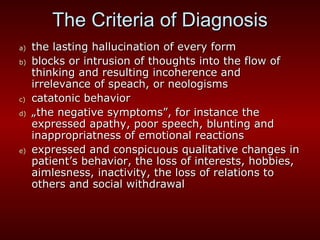
The Criteria of Diagnosis the lasting hallucination of every form blocks or intrusion of thoughts into the flow of thinking and resulting incoherence and irrelevance of speach, or neologisms catatonic behavior „ the negative symptoms”, for instance the expressed apathy, poor speech, blunting and inappropriatness of emotional reactions expressed and conspicuous qualitative changes in patient’s behavior, the loss of interests, hobbies, aimlesness, inactivity, the loss of relations to others and social withdrawal
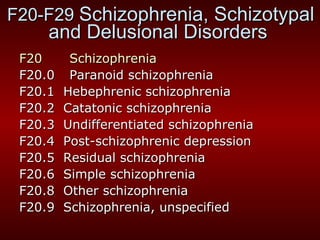
F20-F29  Schizophrenia, Schizotypal and Delusional Disorders  F20  Schizophrenia   F20.0  Paranoid schizophrenia  F20.1  Hebephrenic schizophrenia  F20.2  Catatonic schizophrenia  F20.3  Undifferentiated schizophrenia  F20.4  Post-schizophrenic depression  F20.5  Residual schizophrenia  F20.6  Simple schizophrenia  F20.8  Other schizophrenia  F20.9  Schizophrenia, unspecified
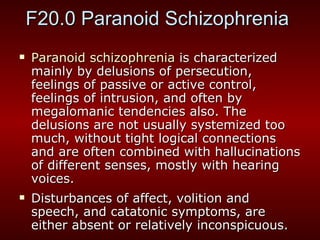
F20.0 Paranoid Schizophrenia  Paranoid schizophrenia  is characterized mainly by delusions of persecution, feelings of passive or active control, feelings of intrusion, and often by megalomanic tendencies also. The delusions are not usually systemized too much, without tight logical connections and are often combined with hallucinations of different senses, mostly with hearing voices.  Disturbances of affect, volition and speech, and catatonic symptoms, are either absent or relatively inconspicuous.
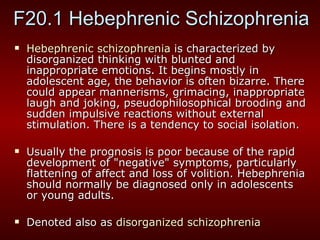
F20.1 Hebephrenic Schizophrenia Hebephrenic schizophrenia  is characterized by disorganized thinking with blunted and inappropriate emotions. It begins mostly in adolescent age, the behavior is often bizarre. There could appear mannerisms, grimacing, inappropriate laugh and joking, pseudophilosophical brooding and sudden impulsive reactions without external stimulation. There is a tendency to social isolation. Usually the prognosis is poor because of the rapid development of "negative" symptoms, particularly flattening of affect and loss of volition. Hebephrenia should normally be diagnosed only in adolescents or young adults . Denoted also as  disorganized schizophrenia
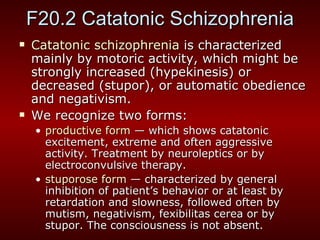
F20.2 Catatonic Schizophrenia Catatonic schizophrenia  is characterized mainly by motoric activity, which might be strongly increased (hypekinesis) or decreased (stupor), or automatic obedience and negativism.  We recognize two forms: productive form  — which shows catatonic excitement, extreme and often aggressive activity.  Treatment  by neuroleptics or by electroconvulsive therapy. stuporose form  — characterized by general inhibition of patient’s behavior or at least by retardation and slowness, followed often by mutism, negativism, fexibilitas cerea or by stupor. The consciousness is not absent.
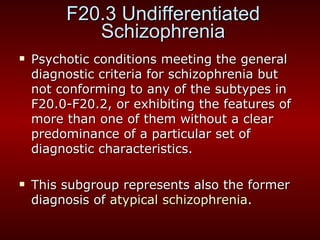
F20.3 Undifferentiated Schizophrenia Psychotic conditions meeting the general diagnostic criteria for schizophrenia but not conforming to any of the subtypes in F20.0-F20.2, or exhibiting the features of more than one of them without a clear predominance of a particular set of diagnostic characteristics. This subgroup represents also the former diagnosis of  atypical schizophrenia .
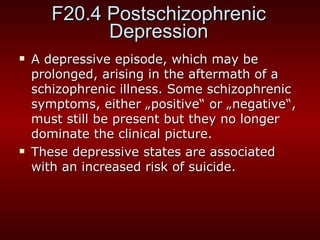
F20.4 Postschizophrenic Depression A depressive episode, which may be prolonged, arising in the aftermath of a schizophrenic illness. Some schizophrenic symptoms, either  „ positive “  or  „ negative “ , must still be present but they no longer dominate the clinical picture.  These depressive states are associated with an increased risk of suicide.
F20.5 Residual Schizophrenia A  chronic stage in the development of schizophrenia with clear succession from the initial stage with one or more episodes characterized by general criteria of schizophrenia to the late stage with long-lasting negative symptoms and deterioration (not necessarily irreversible).
F20.6 Simple Schizophrenia Simple schizophrenia is characterized by early and slowly developing initial stage with growing social isolation, withdrawal, small activity, passivity, avolition and dependence on the others. The patients are indifferent, without any initiative and volition. There is not expressed the presence of hallucinations and delusions.
Genetics of Schizophrenia Many psychiatric disorders are multifactorial (caused by the interaction of external and genetic factors) and from the genetic point of view very often polygenically determined. Relative risk for schizophrenia is around: 1% for normal population 5.6% for parents 10.1% for siblings 12.8% for children
Etiology of Schizophrenia The etiology and pathogenesis of schizophrenia is not known It is accepted, that schizophrenia is „the group of schizophrenias“ which origin is multifactorial: internal factors – genetic, inborn, biochemical external factors – trauma, infection of CNS, stress
Etiology of Schizophrenia - Dopamine Hypothesis The most influential and plausible are the hypotheses, based on the supposed disorder of neurotransmission in the brain, derived mainly from the effects of antipsychotic drugs that have in common the ability to inhibit the dopaminergic system by blocking action of dopamine in the brain dopamine-releasing drugs (amphetamine, mescaline, diethyl amide of lysergic acid - LSD) that can induce state closely resembling paranoid schizophrenia Classical dopamine hypothesis of schizophrenia : Psychotic symptoms are related to dopaminergic hyperactivity in the brain. Hyperactivity of dopaminergic systems during schizophrenia is result of increased sensitivity and density of dopamine D2 receptors in the different parts of the brain.
Etiology of Schizophrenia - Neurodevelopmental Model Neurodevelopmental model  supposes in schizophrenia the presence of “silent lesion” in the brain, mostly in the parts, important for the development of integration (frontal, parietal and temporal), which is caused by different factors (genetic, inborn, infection, trauma...) during very early development of the brain in prenatal or early postnatal period of life.  It does not interfere too much with the basic brain functioning in early years, but expresses itself in the time, when the subject is stressed by demands of growing needs for integration, during formative years in adolescence and young adulthood.
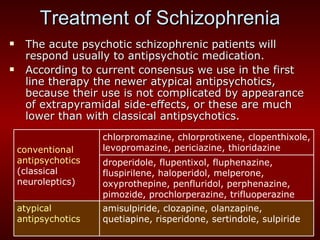
Treatment of Schizophrenia The acute psychotic schizophrenic patients will respond usually to antipsychotic medication. According to current consensus we use in the first line therapy the newer atypical antipsychotics, because their use is not complicated by appearance of extrapyramidal side-effects, or these are much lower than with classical antipsychotics. conventional antipsychotics (classical neuroleptics) chlorpromazine, chlorprotixene, clopenthixole, levopromazine, periciazine, thioridazine droperidole, flupentixol, fluphenazine, fluspirilene, haloperidol, melperone, oxyprothepine, penfluridol, perphenazine, pimozide, prochlorperazine, trifluoperazine atypical antipsychotics amisulpiride, clozapine, olanzapine, quetiapine, risperidone, sertindole, sulpiride
"It's extremely rare for patients with schizophrenia to be offered ECT,“. Most people are given ECT every two to five days for a total of 6 to 12 sessions. After the sessions are complete, a course of medication can help maintain remission of symptoms. ECT
Psychotherapy is not the treatment of choice for someone with schizophrenia. Used as an adjunct to a good medication plan, however, psychotherapy can help maintain the individual on their medication, learn needed social skills, and support the person's weekly goals and activities in their community. PSYCHOLOGICAL THERAPIES
This may include advice, reassurance, education, modeling, limit setting, and reality testing with the therapist. Encouragement in setting small goals and reaching them can often be helpful. PSYCHO SOCIAL THERAPIES
  This supportive group therapy can be especially helpful in decreasing social isolation and increasing reality testing. Group therapy focuses on real-life plans, problems, and relationships; on social and work roles and interaction; GROUP THERAPY
  This therapy encourages the family to convene a family meeting whenever an issue arises, FAMILY THERAPY

Schizophrenia (1)

  • 1.
    SCHIZOPHRENIA Mr. SathishRajamani M.Sc (N), Lecturer, BKIN – Daudhar.
  • 2.
    Definition The schizophrenicdisorders are characterized in general by fundamental and characteristic distortions of thinking and perception, and affects that are inappropriate or blunted. Clear consciousness and intellectual capacity are usually maintained although certain cognitive deficits may evolve in the course of time. The most important psychopathological phenomena include thought echo thought insertion or withdrawal thought broadcasting delusional perception and delusions of control influence or passivity hallucinatory voices commenting or discussing the patient in the third person thought disorders and negative symptoms.
  • 3.
    Schizophrenia Schizophrenia occurswith regular frequency nearly everywhere in the world in 1 % of population and begins mainly in young age (mostly around 16 to 25 years). Schizophrenia is defined by a group of characteristic positive and negative symptoms deterioration in social, occupational, or interpersonal relationships continuous signs of the disturbance for at least 6 months
  • 4.
    History Emil Kraepelin: This illness develops relatively early in life, and its course is likely deteriorating and chronic; deterioration reminded dementia („Dementia praecox“ ), but was not followed by any organic changes of the brain, detectable at that time. Eugen Bleuler : He renamed Kraepelin’s dementia praecox as schizophrenia (1911); he recognized the cognitive impairment in this illness, which he named as a „splitting “ of mind. Kurt Schneider : He emphasized the role of psychotic symptoms, as hallucinations, delusions and gave them the privilege of „the first rank symptoms” even in the concept of the diagnosis of schizophrenia.
  • 5.
    4 A (Bleuler)Bleuler maintained, that for the diagnosis of schizophrenia are most important the following four fundamental symptoms: affective blunting disturbance of association (fragmented thinking) autism ambivalence (fragmented emotional response) These groups of symptoms, are called „four A’ s” and Bleuler thought, that they are „primary” for this diagnosis. The other known symptoms, hallucinations, delusions, which are appearing in schizophrenia very often also, he used to call as a “secondary symptoms”, because they could be seen in any other psychotic disease, which are caused by quite different factors — from intoxication to infection or other disease entities.
  • 6.
    Course of IllnessCourse of schizophrenia: continuous without temporary improvement episodic with progressive or stable deficit episodic with complete or incomplete remission Typical stages of schizophrenia: prodromal phase active phase residual phase
  • 7.
    Clinical Picture Diagnosticmanuals: lCD-10 („International Classification of Disease“, WHO) DSM-IV („Diagnostic and Statistical Manual“, APA) Clinical picture of schizophrenia is according to lCD-10, defined from the point of view of the presence and expression of primary and/or secondary symptoms (at present covered by the terms negative and positive symptoms) : t he negative symptoms are represented by cognitive disorders, having its origin probably in the disorders of associations of thoughts, combined with emotional blunting and small or missing production of hallucinations and delusions t he positive symptom are characterized by the presence of hallucinations and delusions
  • 8.
    Positive and NegativeSymptoms Negative Positive Alogia Hallucinations Affective flattening Delusions Avolition-apathy Bizarre behaviour Anhedonia-asociality Positive formal thought disorder Attentional impairment
  • 9.
    The Criteria ofDiagnosis For the diagnosis of schizophrenia is necessary presence of one very clear symptom - from point a) to d) or the presence of the symptoms from at least two groups - from point e) to h) for one month or more: the hearing of own thoughts, the feelings of thought withdrawal, thought insertion, or thought broadcasting the delusions of control, outside manipulation and influence, or the feelings of passivity, which are connected with the movements of the body or extremities, specific thoughts, acting or feelings, delusional perception hallucinated voices, which are commenting permanently the behavior of the patient or they talk about him between themselves, or the other types of hallucinatory voices, coming from different parts of body permanent delusions of different kind, which are inappropriate and unacceptable in given culture
  • 10.
    The Criteria ofDiagnosis the lasting hallucination of every form blocks or intrusion of thoughts into the flow of thinking and resulting incoherence and irrelevance of speach, or neologisms catatonic behavior „ the negative symptoms”, for instance the expressed apathy, poor speech, blunting and inappropriatness of emotional reactions expressed and conspicuous qualitative changes in patient’s behavior, the loss of interests, hobbies, aimlesness, inactivity, the loss of relations to others and social withdrawal
  • 11.
    F20-F29 Schizophrenia,Schizotypal and Delusional Disorders F20 Schizophrenia F20.0 Paranoid schizophrenia F20.1 Hebephrenic schizophrenia F20.2 Catatonic schizophrenia F20.3 Undifferentiated schizophrenia F20.4 Post-schizophrenic depression F20.5 Residual schizophrenia F20.6 Simple schizophrenia F20.8 Other schizophrenia F20.9 Schizophrenia, unspecified
  • 12.
    F20.0 Paranoid Schizophrenia Paranoid schizophrenia is characterized mainly by delusions of persecution, feelings of passive or active control, feelings of intrusion, and often by megalomanic tendencies also. The delusions are not usually systemized too much, without tight logical connections and are often combined with hallucinations of different senses, mostly with hearing voices. Disturbances of affect, volition and speech, and catatonic symptoms, are either absent or relatively inconspicuous.
  • 13.
    F20.1 Hebephrenic SchizophreniaHebephrenic schizophrenia is characterized by disorganized thinking with blunted and inappropriate emotions. It begins mostly in adolescent age, the behavior is often bizarre. There could appear mannerisms, grimacing, inappropriate laugh and joking, pseudophilosophical brooding and sudden impulsive reactions without external stimulation. There is a tendency to social isolation. Usually the prognosis is poor because of the rapid development of "negative" symptoms, particularly flattening of affect and loss of volition. Hebephrenia should normally be diagnosed only in adolescents or young adults . Denoted also as disorganized schizophrenia
  • 14.
    F20.2 Catatonic SchizophreniaCatatonic schizophrenia is characterized mainly by motoric activity, which might be strongly increased (hypekinesis) or decreased (stupor), or automatic obedience and negativism. We recognize two forms: productive form — which shows catatonic excitement, extreme and often aggressive activity. Treatment by neuroleptics or by electroconvulsive therapy. stuporose form — characterized by general inhibition of patient’s behavior or at least by retardation and slowness, followed often by mutism, negativism, fexibilitas cerea or by stupor. The consciousness is not absent.
  • 15.
    F20.3 Undifferentiated SchizophreniaPsychotic conditions meeting the general diagnostic criteria for schizophrenia but not conforming to any of the subtypes in F20.0-F20.2, or exhibiting the features of more than one of them without a clear predominance of a particular set of diagnostic characteristics. This subgroup represents also the former diagnosis of atypical schizophrenia .
  • 16.
    F20.4 Postschizophrenic DepressionA depressive episode, which may be prolonged, arising in the aftermath of a schizophrenic illness. Some schizophrenic symptoms, either „ positive “ or „ negative “ , must still be present but they no longer dominate the clinical picture. These depressive states are associated with an increased risk of suicide.
  • 17.
    F20.5 Residual SchizophreniaA chronic stage in the development of schizophrenia with clear succession from the initial stage with one or more episodes characterized by general criteria of schizophrenia to the late stage with long-lasting negative symptoms and deterioration (not necessarily irreversible).
  • 18.
    F20.6 Simple SchizophreniaSimple schizophrenia is characterized by early and slowly developing initial stage with growing social isolation, withdrawal, small activity, passivity, avolition and dependence on the others. The patients are indifferent, without any initiative and volition. There is not expressed the presence of hallucinations and delusions.
  • 19.
    Genetics of SchizophreniaMany psychiatric disorders are multifactorial (caused by the interaction of external and genetic factors) and from the genetic point of view very often polygenically determined. Relative risk for schizophrenia is around: 1% for normal population 5.6% for parents 10.1% for siblings 12.8% for children
  • 20.
    Etiology of SchizophreniaThe etiology and pathogenesis of schizophrenia is not known It is accepted, that schizophrenia is „the group of schizophrenias“ which origin is multifactorial: internal factors – genetic, inborn, biochemical external factors – trauma, infection of CNS, stress
  • 21.
    Etiology of Schizophrenia- Dopamine Hypothesis The most influential and plausible are the hypotheses, based on the supposed disorder of neurotransmission in the brain, derived mainly from the effects of antipsychotic drugs that have in common the ability to inhibit the dopaminergic system by blocking action of dopamine in the brain dopamine-releasing drugs (amphetamine, mescaline, diethyl amide of lysergic acid - LSD) that can induce state closely resembling paranoid schizophrenia Classical dopamine hypothesis of schizophrenia : Psychotic symptoms are related to dopaminergic hyperactivity in the brain. Hyperactivity of dopaminergic systems during schizophrenia is result of increased sensitivity and density of dopamine D2 receptors in the different parts of the brain.
  • 22.
    Etiology of Schizophrenia- Neurodevelopmental Model Neurodevelopmental model supposes in schizophrenia the presence of “silent lesion” in the brain, mostly in the parts, important for the development of integration (frontal, parietal and temporal), which is caused by different factors (genetic, inborn, infection, trauma...) during very early development of the brain in prenatal or early postnatal period of life. It does not interfere too much with the basic brain functioning in early years, but expresses itself in the time, when the subject is stressed by demands of growing needs for integration, during formative years in adolescence and young adulthood.
  • 23.
    Treatment of SchizophreniaThe acute psychotic schizophrenic patients will respond usually to antipsychotic medication. According to current consensus we use in the first line therapy the newer atypical antipsychotics, because their use is not complicated by appearance of extrapyramidal side-effects, or these are much lower than with classical antipsychotics. conventional antipsychotics (classical neuroleptics) chlorpromazine, chlorprotixene, clopenthixole, levopromazine, periciazine, thioridazine droperidole, flupentixol, fluphenazine, fluspirilene, haloperidol, melperone, oxyprothepine, penfluridol, perphenazine, pimozide, prochlorperazine, trifluoperazine atypical antipsychotics amisulpiride, clozapine, olanzapine, quetiapine, risperidone, sertindole, sulpiride
  • 24.
    "It's extremely rarefor patients with schizophrenia to be offered ECT,“. Most people are given ECT every two to five days for a total of 6 to 12 sessions. After the sessions are complete, a course of medication can help maintain remission of symptoms. ECT
  • 25.
    Psychotherapy is notthe treatment of choice for someone with schizophrenia. Used as an adjunct to a good medication plan, however, psychotherapy can help maintain the individual on their medication, learn needed social skills, and support the person's weekly goals and activities in their community. PSYCHOLOGICAL THERAPIES
  • 26.
    This may includeadvice, reassurance, education, modeling, limit setting, and reality testing with the therapist. Encouragement in setting small goals and reaching them can often be helpful. PSYCHO SOCIAL THERAPIES
  • 27.
      This supportivegroup therapy can be especially helpful in decreasing social isolation and increasing reality testing. Group therapy focuses on real-life plans, problems, and relationships; on social and work roles and interaction; GROUP THERAPY
  • 28.
      This therapyencourages the family to convene a family meeting whenever an issue arises, FAMILY THERAPY