










September 27, 2015
Music Recommendations
@
Spotify
Vidhya Murali
@vid052
Vidhya Murali
Areas of Interest: Machine Learning & Big Data
Data Science Engineer @ Spotify
Grad Student from the University of Wisconsin Madison
aka Happy Badger for life!
Who Am I?
2
Spotify’s Big Data
Started in 2006, now available in 58 countries
70+ million active users, 20+ million paid subscribers
30+ million songs in our catalog, ~20K added every day
1.5 billion playlists so far and counting
1 TB of user data logged every day
Hadoop cluster with 1500 nodes
~20,000 Hadoop jobs per day
3
Music Recommendations at Spotify
Features:
Discover
Discover Weekly
Right Now
Radio
Related Artists
4
30 million tracks…
What to recommend?
5
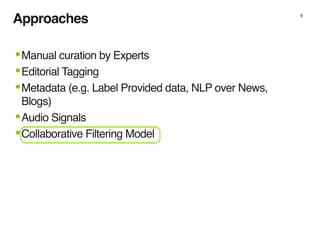
Approaches 6
•Manual curation by Experts
•Editorial Tagging
•Metadata (e.g. Label Provided data, NLP over News,
Blogs)
•Audio Signals
•Collaborative Filtering Model
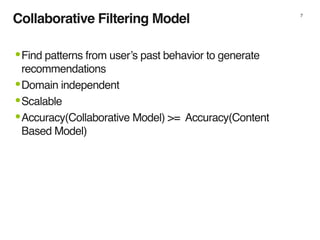
Collaborative Filtering Model 7
•Find patterns from user’s past behavior to generate
recommendations
•Domain independent
•Scalable
•Accuracy(Collaborative Model) >= Accuracy(Content
Based Model)
Definition of CF
8
Hey,
I like tracks P, Q, R, S!
Well,
I like tracks Q, R, S, T!
Then you should check out
track P!
Nice! Btw try track T!
Legacy Slide of Erik Bernhardsson
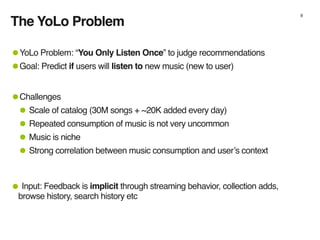
The YoLo Problem
9
•YoLo Problem: “You Only Listen Once” to judge recommendations
•Goal: Predict if users will listen to new music (new to user)
•Challenges
•Scale of catalog (30M songs + ~20K added every day)
•Repeated consumption of music is not very uncommon
•Music is niche
•Strong correlation between music consumption and user’s context
•Input: Feedback is implicit through streaming behavior, collection adds,
browse history, search history etc
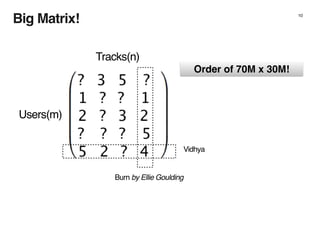
Big Matrix! 10
Tracks(n)
Users(m)
Vidhya
Burn by Ellie Goulding
Order of 70M x 30M!
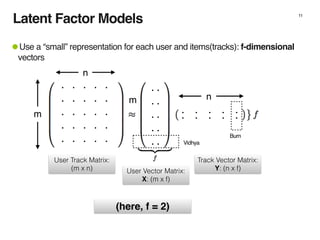
Latent Factor Models 11
Vidhya
Burn
.. . . . .
.. . . . .
.. . . . .
.. . . . .
.. . . . .
•Use a “small” representation for each user and items(tracks): f-dimensional
vectors
.. .
.. .
.. .
.. .
. .
...
...
...
...
..
(here, f = 2)
m m
n
m n
User Vector Matrix:
X: (m x f)
Track Vector Matrix:
Y: (n x f)
User Track Matrix:
(m x n)
Equation(s) Alert!
12
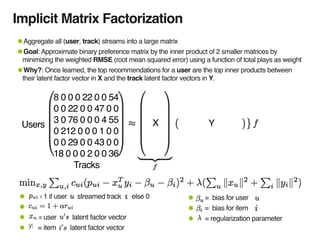
Implicit Matrix Factorization
8 0 0 0 22 0 0 54
0 0 22 0 0 47 0 0
3 0 76 0 0 0 4 55
0 212 0 0 0 1 0 0
0 0 29 0 0 43 0 0
18 0 0 0 2 0 0 36
•Aggregate all (user, track) streams into a large matrix
•Goal: Approximate binary preference matrix by the inner product of 2 smaller matrices by
minimizing the weighted RMSE (root mean squared error) using a function of total plays as weight
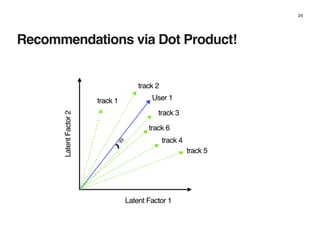
•Why?: Once learned, the top recommendations for a user are the top inner products between
their latent factor vector in X and the track latent factor vectors in Y.
X YUsers
Tracks
• = bias for user
• = bias for item
• = regularization parameter
• = 1 if user streamed track else 0
•
• = user latent factor vector
• = item latent factor vectoryi
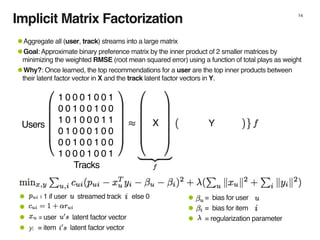
Implicit Matrix Factorization 14
1 0 0 0 1 0 0 1
0 0 1 0 0 1 0 0
1 0 1 0 0 0 1 1
0 1 0 0 0 1 0 0
0 0 1 0 0 1 0 0
1 0 0 0 1 0 0 1
•Aggregate all (user, track) streams into a large matrix
•Goal: Approximate binary preference matrix by the inner product of 2 smaller matrices by
minimizing the weighted RMSE (root mean squared error) using a function of total plays as weight
•Why?: Once learned, the top recommendations for a user are the top inner products between
their latent factor vector in X and the track latent factor vectors in Y.
X YUsers
Tracks
• = bias for user
• = bias for item
• = regularization parameter
• = 1 if user streamed track else 0
•
• = user latent factor vector
• = item latent factor vectoryi
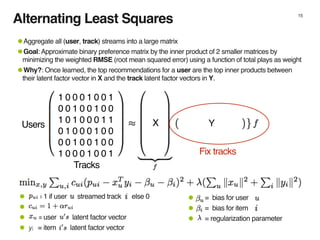
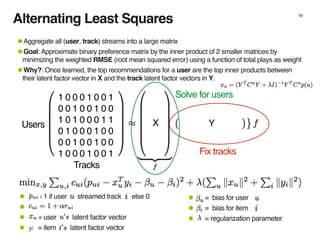
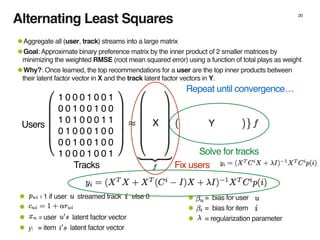
Alternating Least Squares 15
1 0 0 0 1 0 0 1
0 0 1 0 0 1 0 0
1 0 1 0 0 0 1 1
0 1 0 0 0 1 0 0
0 0 1 0 0 1 0 0
1 0 0 0 1 0 0 1
X YUsers
Tracks
• = bias for user
• = bias for item
• = regularization parameter
• = 1 if user streamed track else 0
•
• = user latent factor vector
• = item latent factor vector
Fix tracks
•Aggregate all (user, track) streams into a large matrix
•Goal: Approximate binary preference matrix by the inner product of 2 smaller matrices by
minimizing the weighted RMSE (root mean squared error) using a function of total plays as weight
•Why?: Once learned, the top recommendations for a user are the top inner products between
their latent factor vector in X and the track latent factor vectors in Y.
yi
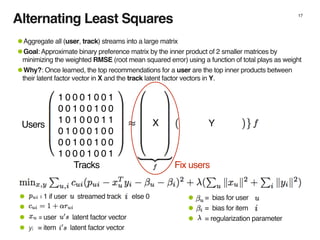
16
1 0 0 0 1 0 0 1
0 0 1 0 0 1 0 0
1 0 1 0 0 0 1 1
0 1 0 0 0 1 0 0
0 0 1 0 0 1 0 0
1 0 0 0 1 0 0 1
X YUsers
• = bias for user
• = bias for item
• = regularization parameter
• = 1 if user streamed track else 0
•
• = user latent factor vector
• = item latent factor vector
Fix tracks
Solve for users
•Aggregate all (user, track) streams into a large matrix
•Goal: Approximate binary preference matrix by the inner product of 2 smaller matrices by
minimizing the weighted RMSE (root mean squared error) using a function of total plays as weight
•Why?: Once learned, the top recommendations for a user are the top inner products between
their latent factor vector in X and the track latent factor vectors in Y.
Alternating Least Squares
yi
Tracks
17
1 0 0 0 1 0 0 1
0 0 1 0 0 1 0 0
1 0 1 0 0 0 1 1
0 1 0 0 0 1 0 0
0 0 1 0 0 1 0 0
1 0 0 0 1 0 0 1
X YUsers
• = bias for user
• = bias for item
• = regularization parameter
• = 1 if user streamed track else 0
•
• = user latent factor vector
• = item latent factor vector
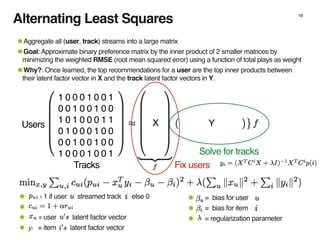
Fix users
•Aggregate all (user, track) streams into a large matrix
•Goal: Approximate binary preference matrix by the inner product of 2 smaller matrices by
minimizing the weighted RMSE (root mean squared error) using a function of total plays as weight
•Why?: Once learned, the top recommendations for a user are the top inner products between
their latent factor vector in X and the track latent factor vectors in Y.
Alternating Least Squares
yi
Tracks
18
1 0 0 0 1 0 0 1
0 0 1 0 0 1 0 0
1 0 1 0 0 0 1 1
0 1 0 0 0 1 0 0
0 0 1 0 0 1 0 0
1 0 0 0 1 0 0 1
X YUsers
• = bias for user
• = bias for item
• = regularization parameter
• = 1 if user streamed track else 0
•
• = user latent factor vector
• = item latent factor vector
Fix users
Solve for tracks
•Aggregate all (user, track) streams into a large matrix
•Goal: Approximate binary preference matrix by the inner product of 2 smaller matrices by
minimizing the weighted RMSE (root mean squared error) using a function of total plays as weight
•Why?: Once learned, the top recommendations for a user are the top inner products between
their latent factor vector in X and the track latent factor vectors in Y.
Alternating Least Squares
yi
Tracks
19
1 0 0 0 1 0 0 1
0 0 1 0 0 1 0 0
1 0 1 0 0 0 1 1
0 1 0 0 0 1 0 0
0 0 1 0 0 1 0 0
1 0 0 0 1 0 0 1
X YUsers
• = bias for user
• = bias for item
• = regularization parameter
• = 1 if user streamed track else 0
•
• = user latent factor vector
• = item latent factor vector
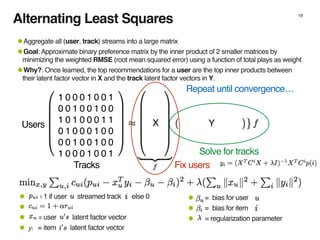
Fix users
Solve for tracks
Repeat until convergence…
•Aggregate all (user, track) streams into a large matrix
•Goal: Approximate binary preference matrix by the inner product of 2 smaller matrices by
minimizing the weighted RMSE (root mean squared error) using a function of total plays as weight
•Why?: Once learned, the top recommendations for a user are the top inner products between
their latent factor vector in X and the track latent factor vectors in Y.
Alternating Least Squares
yi
Tracks
20
1 0 0 0 1 0 0 1
0 0 1 0 0 1 0 0
1 0 1 0 0 0 1 1
0 1 0 0 0 1 0 0
0 0 1 0 0 1 0 0
1 0 0 0 1 0 0 1
X YUsers
• = bias for user
• = bias for item
• = regularization parameter
• = 1 if user streamed track else 0
•
• = user latent factor vector
• = item latent factor vector
Fix users
Solve for tracks
Repeat until convergence…
•Aggregate all (user, track) streams into a large matrix
•Goal: Approximate binary preference matrix by the inner product of 2 smaller matrices by
minimizing the weighted RMSE (root mean squared error) using a function of total plays as weight
•Why?: Once learned, the top recommendations for a user are the top inner products between
their latent factor vector in X and the track latent factor vectors in Y.
Alternating Least Squares
yi
Tracks
21
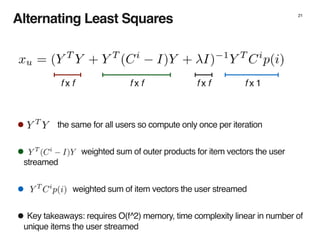
Alternating Least Squares
• the same for all users so compute only once per iteration
• weighted sum of outer products for item vectors the user
streamed
• weighted sum of item vectors the user streamed
•Key takeaways: requires O(f^2) memory, time complexity linear in number of
unique items the user streamed
f x f f x f f x 1f x f
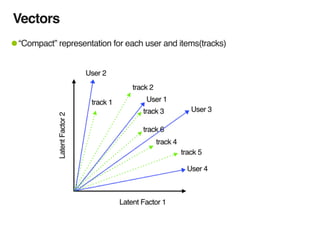
Vectors
•“Compact” representation for users and items(tracks)
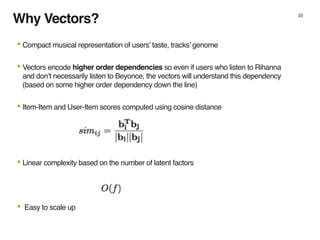
Why Vectors? 23
•Compact musical representation of users’ taste, tracks’ genome
•Vectors encode higher order dependencies so even if users who listen to Rihanna
and don’t necessarily listen to Beyonce, the vectors will understand this dependency
(based on some higher order dependency down the line)
•Item-Item and User-Item scores computed using cosine distance
•Linear complexity based on the number of latent factors
• Easy to scale up
Recommendations via Dot Product!
24
70 Million users x 30
Million tracks. How to
scale?
25
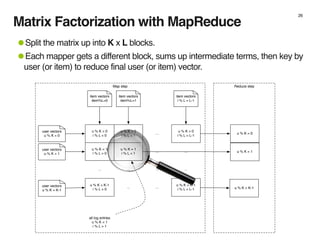
Matrix Factorization with MapReduce
26
Reduce stepMap step
u % K = 0
i % L = 0
u % K = 0
i % L = 1
...
u % K = 0
i % L = L-1
u % K = 1
i % L = 0
u % K = 1
i % L = 1
... ...
... ... ... ...
u % K = K-1
i % L = 0
... ...
u % K = K-1
i % L = L-1
item vectors
item%L=0
item vectors
item%L=1
item vectors
i % L = L-1
user vectors
u % K = 0
user vectors
u % K = 1
user vectors
u % K = K-1
all log entries
u % K = 1
i % L = 1
u % K = 0
u % K = 1
u % K = K-1
•Split the matrix up into K x L blocks.
•Each mapper gets a different block, sums up intermediate terms, then key by
user (or item) to reduce final user (or item) vector.
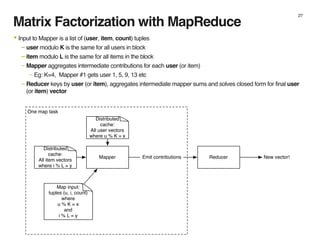
Matrix Factorization with MapReduce
27
One map task
Distributed
cache:
All user vectors
where u % K = x
Distributed
cache:
All item vectors
where i % L = y
Mapper Emit contributions
Map input:
tuples (u, i, count)
where
u % K = x
and
i % L = y
Reducer New vector!
•Input to Mapper is a list of (user, item, count) tuples
– user modulo K is the same for all users in block
– item modulo L is the same for all items in the block
– Mapper aggregates intermediate contributions for each user (or item)
– Eg: K=4, Mapper #1 gets user 1, 5, 9, 13 etc
– Reducer keys by user (or item), aggregates intermediate mapper sums and solves closed form for final user
(or item) vector
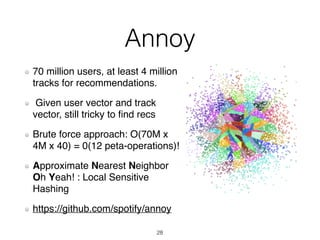
Annoy
70 million users, at least 4 million
tracks for recommendations.
Given user vector and track
vector, still tricky to find recs
Brute force approach: O(70M x
4M x 40) = 0(12 peta-operations)!
Approximate Nearest Neighbor
Oh Yeah! : Local Sensitive
Hashing
https://github.com/spotify/annoy
28
29
Thank You!
You can reach me @
Email: vidhya@spotify.com
Twitter: @vid052

CF Models for Music Recommendations At Spotify

  • 1.
    September 27, 2015 MusicRecommendations @ Spotify Vidhya Murali @vid052
  • 2.
    Vidhya Murali Areas ofInterest: Machine Learning & Big Data Data Science Engineer @ Spotify Grad Student from the University of Wisconsin Madison aka Happy Badger for life! Who Am I? 2
  • 3.
    Spotify’s Big Data Startedin 2006, now available in 58 countries 70+ million active users, 20+ million paid subscribers 30+ million songs in our catalog, ~20K added every day 1.5 billion playlists so far and counting 1 TB of user data logged every day Hadoop cluster with 1500 nodes ~20,000 Hadoop jobs per day 3
  • 4.
    Music Recommendations atSpotify Features: Discover Discover Weekly Right Now Radio Related Artists 4
  • 5.
  • 6.
    Approaches 6 •Manual curationby Experts •Editorial Tagging •Metadata (e.g. Label Provided data, NLP over News, Blogs) •Audio Signals •Collaborative Filtering Model
  • 7.
    Collaborative Filtering Model7 •Find patterns from user’s past behavior to generate recommendations •Domain independent •Scalable •Accuracy(Collaborative Model) >= Accuracy(Content Based Model)
  • 8.
    Definition of CF 8 Hey, Ilike tracks P, Q, R, S! Well, I like tracks Q, R, S, T! Then you should check out track P! Nice! Btw try track T! Legacy Slide of Erik Bernhardsson
  • 9.
    The YoLo Problem 9 •YoLoProblem: “You Only Listen Once” to judge recommendations •Goal: Predict if users will listen to new music (new to user) •Challenges •Scale of catalog (30M songs + ~20K added every day) •Repeated consumption of music is not very uncommon •Music is niche •Strong correlation between music consumption and user’s context •Input: Feedback is implicit through streaming behavior, collection adds, browse history, search history etc
  • 10.
    Big Matrix! 10 Tracks(n) Users(m) Vidhya Burnby Ellie Goulding Order of 70M x 30M!
  • 11.
    Latent Factor Models11 Vidhya Burn .. . . . . .. . . . . .. . . . . .. . . . . .. . . . . •Use a “small” representation for each user and items(tracks): f-dimensional vectors .. . .. . .. . .. . . . ... ... ... ... .. (here, f = 2) m m n m n User Vector Matrix: X: (m x f) Track Vector Matrix: Y: (n x f) User Track Matrix: (m x n)
  • 12.
  • 13.
    Implicit Matrix Factorization 80 0 0 22 0 0 54 0 0 22 0 0 47 0 0 3 0 76 0 0 0 4 55 0 212 0 0 0 1 0 0 0 0 29 0 0 43 0 0 18 0 0 0 2 0 0 36 •Aggregate all (user, track) streams into a large matrix •Goal: Approximate binary preference matrix by the inner product of 2 smaller matrices by minimizing the weighted RMSE (root mean squared error) using a function of total plays as weight •Why?: Once learned, the top recommendations for a user are the top inner products between their latent factor vector in X and the track latent factor vectors in Y. X YUsers Tracks • = bias for user • = bias for item • = regularization parameter • = 1 if user streamed track else 0 • • = user latent factor vector • = item latent factor vectoryi
  • 14.
    Implicit Matrix Factorization14 1 0 0 0 1 0 0 1 0 0 1 0 0 1 0 0 1 0 1 0 0 0 1 1 0 1 0 0 0 1 0 0 0 0 1 0 0 1 0 0 1 0 0 0 1 0 0 1 •Aggregate all (user, track) streams into a large matrix •Goal: Approximate binary preference matrix by the inner product of 2 smaller matrices by minimizing the weighted RMSE (root mean squared error) using a function of total plays as weight •Why?: Once learned, the top recommendations for a user are the top inner products between their latent factor vector in X and the track latent factor vectors in Y. X YUsers Tracks • = bias for user • = bias for item • = regularization parameter • = 1 if user streamed track else 0 • • = user latent factor vector • = item latent factor vectoryi
  • 15.
    Alternating Least Squares15 1 0 0 0 1 0 0 1 0 0 1 0 0 1 0 0 1 0 1 0 0 0 1 1 0 1 0 0 0 1 0 0 0 0 1 0 0 1 0 0 1 0 0 0 1 0 0 1 X YUsers Tracks • = bias for user • = bias for item • = regularization parameter • = 1 if user streamed track else 0 • • = user latent factor vector • = item latent factor vector Fix tracks •Aggregate all (user, track) streams into a large matrix •Goal: Approximate binary preference matrix by the inner product of 2 smaller matrices by minimizing the weighted RMSE (root mean squared error) using a function of total plays as weight •Why?: Once learned, the top recommendations for a user are the top inner products between their latent factor vector in X and the track latent factor vectors in Y. yi
  • 16.
    16 1 0 00 1 0 0 1 0 0 1 0 0 1 0 0 1 0 1 0 0 0 1 1 0 1 0 0 0 1 0 0 0 0 1 0 0 1 0 0 1 0 0 0 1 0 0 1 X YUsers • = bias for user • = bias for item • = regularization parameter • = 1 if user streamed track else 0 • • = user latent factor vector • = item latent factor vector Fix tracks Solve for users •Aggregate all (user, track) streams into a large matrix •Goal: Approximate binary preference matrix by the inner product of 2 smaller matrices by minimizing the weighted RMSE (root mean squared error) using a function of total plays as weight •Why?: Once learned, the top recommendations for a user are the top inner products between their latent factor vector in X and the track latent factor vectors in Y. Alternating Least Squares yi Tracks
  • 17.
    17 1 0 00 1 0 0 1 0 0 1 0 0 1 0 0 1 0 1 0 0 0 1 1 0 1 0 0 0 1 0 0 0 0 1 0 0 1 0 0 1 0 0 0 1 0 0 1 X YUsers • = bias for user • = bias for item • = regularization parameter • = 1 if user streamed track else 0 • • = user latent factor vector • = item latent factor vector Fix users •Aggregate all (user, track) streams into a large matrix •Goal: Approximate binary preference matrix by the inner product of 2 smaller matrices by minimizing the weighted RMSE (root mean squared error) using a function of total plays as weight •Why?: Once learned, the top recommendations for a user are the top inner products between their latent factor vector in X and the track latent factor vectors in Y. Alternating Least Squares yi Tracks
  • 18.
    18 1 0 00 1 0 0 1 0 0 1 0 0 1 0 0 1 0 1 0 0 0 1 1 0 1 0 0 0 1 0 0 0 0 1 0 0 1 0 0 1 0 0 0 1 0 0 1 X YUsers • = bias for user • = bias for item • = regularization parameter • = 1 if user streamed track else 0 • • = user latent factor vector • = item latent factor vector Fix users Solve for tracks •Aggregate all (user, track) streams into a large matrix •Goal: Approximate binary preference matrix by the inner product of 2 smaller matrices by minimizing the weighted RMSE (root mean squared error) using a function of total plays as weight •Why?: Once learned, the top recommendations for a user are the top inner products between their latent factor vector in X and the track latent factor vectors in Y. Alternating Least Squares yi Tracks
  • 19.
    19 1 0 00 1 0 0 1 0 0 1 0 0 1 0 0 1 0 1 0 0 0 1 1 0 1 0 0 0 1 0 0 0 0 1 0 0 1 0 0 1 0 0 0 1 0 0 1 X YUsers • = bias for user • = bias for item • = regularization parameter • = 1 if user streamed track else 0 • • = user latent factor vector • = item latent factor vector Fix users Solve for tracks Repeat until convergence… •Aggregate all (user, track) streams into a large matrix •Goal: Approximate binary preference matrix by the inner product of 2 smaller matrices by minimizing the weighted RMSE (root mean squared error) using a function of total plays as weight •Why?: Once learned, the top recommendations for a user are the top inner products between their latent factor vector in X and the track latent factor vectors in Y. Alternating Least Squares yi Tracks
  • 20.
    20 1 0 00 1 0 0 1 0 0 1 0 0 1 0 0 1 0 1 0 0 0 1 1 0 1 0 0 0 1 0 0 0 0 1 0 0 1 0 0 1 0 0 0 1 0 0 1 X YUsers • = bias for user • = bias for item • = regularization parameter • = 1 if user streamed track else 0 • • = user latent factor vector • = item latent factor vector Fix users Solve for tracks Repeat until convergence… •Aggregate all (user, track) streams into a large matrix •Goal: Approximate binary preference matrix by the inner product of 2 smaller matrices by minimizing the weighted RMSE (root mean squared error) using a function of total plays as weight •Why?: Once learned, the top recommendations for a user are the top inner products between their latent factor vector in X and the track latent factor vectors in Y. Alternating Least Squares yi Tracks
  • 21.
    21 Alternating Least Squares •the same for all users so compute only once per iteration • weighted sum of outer products for item vectors the user streamed • weighted sum of item vectors the user streamed •Key takeaways: requires O(f^2) memory, time complexity linear in number of unique items the user streamed f x f f x f f x 1f x f
  • 22.
  • 23.
    Why Vectors? 23 •Compactmusical representation of users’ taste, tracks’ genome •Vectors encode higher order dependencies so even if users who listen to Rihanna and don’t necessarily listen to Beyonce, the vectors will understand this dependency (based on some higher order dependency down the line) •Item-Item and User-Item scores computed using cosine distance •Linear complexity based on the number of latent factors • Easy to scale up
  • 24.
  • 25.
    70 Million usersx 30 Million tracks. How to scale? 25
  • 26.
    Matrix Factorization withMapReduce 26 Reduce stepMap step u % K = 0 i % L = 0 u % K = 0 i % L = 1 ... u % K = 0 i % L = L-1 u % K = 1 i % L = 0 u % K = 1 i % L = 1 ... ... ... ... ... ... u % K = K-1 i % L = 0 ... ... u % K = K-1 i % L = L-1 item vectors item%L=0 item vectors item%L=1 item vectors i % L = L-1 user vectors u % K = 0 user vectors u % K = 1 user vectors u % K = K-1 all log entries u % K = 1 i % L = 1 u % K = 0 u % K = 1 u % K = K-1 •Split the matrix up into K x L blocks. •Each mapper gets a different block, sums up intermediate terms, then key by user (or item) to reduce final user (or item) vector.
  • 27.
    Matrix Factorization withMapReduce 27 One map task Distributed cache: All user vectors where u % K = x Distributed cache: All item vectors where i % L = y Mapper Emit contributions Map input: tuples (u, i, count) where u % K = x and i % L = y Reducer New vector! •Input to Mapper is a list of (user, item, count) tuples – user modulo K is the same for all users in block – item modulo L is the same for all items in the block – Mapper aggregates intermediate contributions for each user (or item) – Eg: K=4, Mapper #1 gets user 1, 5, 9, 13 etc – Reducer keys by user (or item), aggregates intermediate mapper sums and solves closed form for final user (or item) vector
  • 28.
    Annoy 70 million users,at least 4 million tracks for recommendations. Given user vector and track vector, still tricky to find recs Brute force approach: O(70M x 4M x 40) = 0(12 peta-operations)! Approximate Nearest Neighbor Oh Yeah! : Local Sensitive Hashing https://github.com/spotify/annoy 28
  • 29.
  • 30.
    Thank You! You canreach me @ Email: vidhya@spotify.com Twitter: @vid052