CAVITY DESIGN
PRIYA AHUJA
DENTAL ( INTERN)
DEFINATION -
CAVITY DESIGN IS ESSENTIALLY A BOX IN FORM OF
FLOOR [PULPAL] AND FOUR WALLS.
THREE TYPES OF CAVITIES-
 smooth surface cavities
 root cavities
 pit and fissure cavities
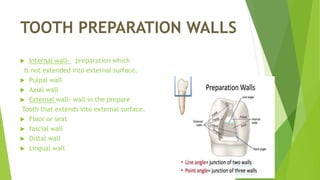
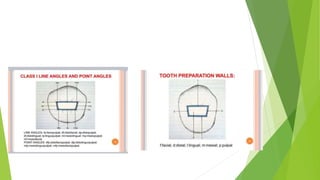
TOOTH PREPARATION WALLS
 Internal wall- preparation which
Is not extended into external surface.
 Pulpal wall
 Axial wall
 External wall- wall in the prepare
Tooth that extends into external surface.
 Floor or seat
 fascial wall
 Distal wall
 Lingual wall
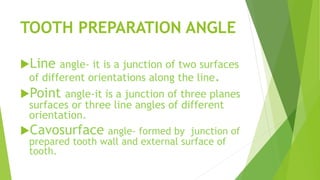
TOOTH PREPARATION ANGLE
Line angle- it is a junction of two surfaces
of different orientations along the line.
Point angle-it is a junction of three planes
surfaces or three line angles of different
orientation.
Cavosurface angle- formed by junction of
prepared tooth wall and external surface of
tooth.
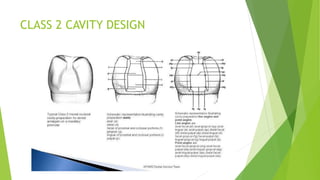
CLASS 2 CAVITY DESIGN
SIMPLE COMPOUND AND COMPLEX
TOOTH PREPARATIONS
 SIMPLE- if only one surface is involve
example occlusal preparations.
COMPOUND- if two surfaces are involved
example mesio-occlusal preparations.
COMPLEX-if preparation involve more than
two surface example MOD preparations.
G.V BLACK CLASSIFICATION OF CAVITY
[THE GRAND OLD MAN OF DENTISTRY]
 CLASS 1 CAVITY
 CLASS 2 CAVITY
 CLASS 3 CAVITY
 CLASS 4 CAVITY
 CLASS 5 CAVITY
G .V BLACK CLASSIFICATION OF CAVITY
CLASS 1 RESTORATIONS
 All pit and fissure restorations are class 1 and are
assigned to three groups as follows-
 restorations on occlusal surface of premolars and molars.
 Restorations on occlusal two third of the facial and
lingual surfaces of molars.
 restorations on lingual surface of maxillary incisor.
CLASS 2 RESTORATIONS
 restorations on proximal surfaces of posterior teeth are
class 2.
CLASS 3 RESTORATIONS
 Restorations on the proximal surfaces of anterior teeth that do
not involve the incisal edge are class 3.
CLASS 4 RESTORATIONS
 restorations on the proximal surfaces of anterior teeth that do
involve the incisal edge are class 4.
CLASS 5 RESTORATIONS
 Restorations on gingival third of the facial or lingual surfaces of
all the teeth except pit and fissure lesions are class 5.
CLASS 6 RESTORATIONS
 Restorations on the incisal edge of anterior teeth or the
occlusal cusp heights of posterior teeth are class 6
CLASS 1 CAVITY PREPARATION
 Need to provide increased resistance – resistance to fracture of
teeth.
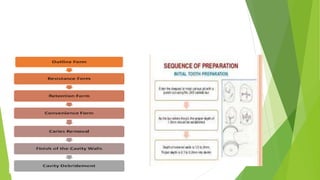
 Enter the bur in distal pit area [ inverted cone diamond bur –
parallel with the long axis of crown] –permits better vision.
 The mesio-distal length will be prepared.
 Pulpal floor initial depth 1.5mm -0.2mm inside DEJ.
 Lingual facial depth could be greater 1.75mm.
 Cuspal and marginal ridge area preservation as much as
possible.
 Outline form should be conservative as possible.
 Extension toward cusp tip should be as minimal as
possible.
 Fascial and lingual extension and width are directed
by the caries ,old restorative material or fault.
 1.6 mm thickness of marginal ridge for premolars and
2mm for molars.
 Extending the outline form to sound tooth structure,
remaining caries should be removed.
CLASS 2 CAVITY CONVENTIONAL DESIGN
OCCLUSAL STEP-
-similarly like class 1
-conservative connection between occlusal and proximal
portion.
-1.5 mm initial occlusal depth
-Initial extension toward the proximal area
-Go through the marginal ridge, initial pulpal floor depth
exposing the DEG
-DEG serve as a guide for preparation.
-Inverted cone diamond, parallel with long axis of teeth
crown – occlusal convergence.
PROXIMAL BOX
 Faciolingual width as narrow as possible.
 Initial depth 1.5mm than follows the rise and fall of the
underlying DEG.
 Pulpal floor relatively flat.
 Preservation of cuspal area.
 Not to cut the adjacent tooth.
 Ideally there is no preparation beyond the proximal
contact.
 Bur always parallel with the long axis of teeth.
 Axial wall 0.2mm inside DEG.
 Inverted cone diamond resulted occlusal convergency.
 Remove gingivally any unsupported enamel margins.
 PREPARATION ON THE ROOT-
90 degree cavosurface margin
Depth is 0.75-1mm
CAVITY DESIGN
CAVITY DESIGN

CAVITY DESIGN

  • 1.
  • 2.
    DEFINATION - CAVITY DESIGNIS ESSENTIALLY A BOX IN FORM OF FLOOR [PULPAL] AND FOUR WALLS. THREE TYPES OF CAVITIES-  smooth surface cavities  root cavities  pit and fissure cavities
  • 3.
    TOOTH PREPARATION WALLS Internal wall- preparation which Is not extended into external surface.  Pulpal wall  Axial wall  External wall- wall in the prepare Tooth that extends into external surface.  Floor or seat  fascial wall  Distal wall  Lingual wall
  • 4.
    TOOTH PREPARATION ANGLE Lineangle- it is a junction of two surfaces of different orientations along the line. Point angle-it is a junction of three planes surfaces or three line angles of different orientation. Cavosurface angle- formed by junction of prepared tooth wall and external surface of tooth.
  • 6.
  • 7.
    SIMPLE COMPOUND ANDCOMPLEX TOOTH PREPARATIONS  SIMPLE- if only one surface is involve example occlusal preparations. COMPOUND- if two surfaces are involved example mesio-occlusal preparations. COMPLEX-if preparation involve more than two surface example MOD preparations.
  • 8.
    G.V BLACK CLASSIFICATIONOF CAVITY [THE GRAND OLD MAN OF DENTISTRY]  CLASS 1 CAVITY  CLASS 2 CAVITY  CLASS 3 CAVITY  CLASS 4 CAVITY  CLASS 5 CAVITY
  • 9.
    G .V BLACKCLASSIFICATION OF CAVITY CLASS 1 RESTORATIONS  All pit and fissure restorations are class 1 and are assigned to three groups as follows-  restorations on occlusal surface of premolars and molars.  Restorations on occlusal two third of the facial and lingual surfaces of molars.  restorations on lingual surface of maxillary incisor. CLASS 2 RESTORATIONS  restorations on proximal surfaces of posterior teeth are class 2.
  • 10.
    CLASS 3 RESTORATIONS Restorations on the proximal surfaces of anterior teeth that do not involve the incisal edge are class 3. CLASS 4 RESTORATIONS  restorations on the proximal surfaces of anterior teeth that do involve the incisal edge are class 4. CLASS 5 RESTORATIONS  Restorations on gingival third of the facial or lingual surfaces of all the teeth except pit and fissure lesions are class 5. CLASS 6 RESTORATIONS  Restorations on the incisal edge of anterior teeth or the occlusal cusp heights of posterior teeth are class 6
  • 11.
    CLASS 1 CAVITYPREPARATION  Need to provide increased resistance – resistance to fracture of teeth.  Enter the bur in distal pit area [ inverted cone diamond bur – parallel with the long axis of crown] –permits better vision.  The mesio-distal length will be prepared.  Pulpal floor initial depth 1.5mm -0.2mm inside DEJ.  Lingual facial depth could be greater 1.75mm.  Cuspal and marginal ridge area preservation as much as possible.  Outline form should be conservative as possible.
  • 12.
     Extension towardcusp tip should be as minimal as possible.  Fascial and lingual extension and width are directed by the caries ,old restorative material or fault.  1.6 mm thickness of marginal ridge for premolars and 2mm for molars.  Extending the outline form to sound tooth structure, remaining caries should be removed.
  • 14.
    CLASS 2 CAVITYCONVENTIONAL DESIGN OCCLUSAL STEP- -similarly like class 1 -conservative connection between occlusal and proximal portion. -1.5 mm initial occlusal depth -Initial extension toward the proximal area -Go through the marginal ridge, initial pulpal floor depth exposing the DEG -DEG serve as a guide for preparation. -Inverted cone diamond, parallel with long axis of teeth crown – occlusal convergence.
  • 15.
    PROXIMAL BOX  Faciolingualwidth as narrow as possible.  Initial depth 1.5mm than follows the rise and fall of the underlying DEG.  Pulpal floor relatively flat.  Preservation of cuspal area.  Not to cut the adjacent tooth.  Ideally there is no preparation beyond the proximal contact.  Bur always parallel with the long axis of teeth.  Axial wall 0.2mm inside DEG.
  • 16.
     Inverted conediamond resulted occlusal convergency.  Remove gingivally any unsupported enamel margins.  PREPARATION ON THE ROOT- 90 degree cavosurface margin Depth is 0.75-1mm