Operative lecture 10
1
Class I Cavity Preparation for amalgam
Definition of class I cavity preparation :
(Acc to black’s classification): Pits and fissures cavities which occur in:
1. the occlusal surfaces of molars and premolars
2. occlusal 2/3 of the buccal, lingual or palatal surfaces of molars only (premolars not
involved)
3. Palatal surfaces of the upper incisors commonly.
(Acc to si/sta classification): Class one cavity preparation according to GV black is considered site 1
o Pits and fissures cavities which occur in the occlusal surfaces of molars and premolars,
occlusal 2/3 of the buccal, lingual or palatal surfaces of molars only
Characters of class I cavity preparation or carious lesions
1- pits and fissure cavities which present in the occlusal surfaces of bicuspid (premolars), molars,
and upper incisors
2- Histologically, lesion spreads as triangular Cone shape in Enamel; with apex occlusal & base
towards the DEJ. & in dentin; with base at the DEJ and apex towards the pulp.
3- Class I cavity may be:
• Simple: include occlusal surface of posterior teeth molar or premolar, isolated buccal or
palatal or lingual pit of molars only.
• Compound: include two surfaces of molars, occlusal one and buccal or lingual surface.
• Complex: include three surfaces e.g. occlusal, buccal and lingual/palatal surfaces of molars.
Because of the extension of caries in this case[complex], this lead to weakening to the tooth
structure so we should use restorative filling material reinforce the tooth structure as amalgam
with amalgam bond but we better use composite or resin based filling material as we use with the
composite bonding agent which reinforce tooth structure
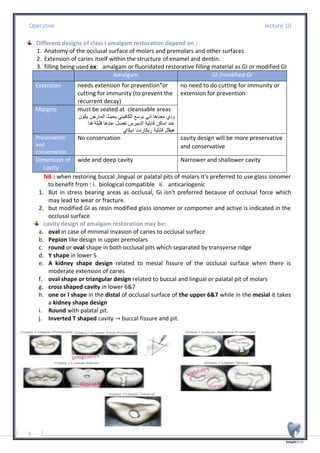
NB :( Base of cone wider in dentin than
enamel (why)→ lateral spread of caries
at D.E.J due to lateral branches tubules
is higher than spread of caries in enamel
Operative lecture 10
2
Different designs of class I amalgam restoration depend on :
1. Anatomy of the occlusal surface of molars and premolars and other surfaces .
2. Extension of caries itself within the structure of enamel and dentin.
3. filling being used ex: amalgam or fluoridated restorative filling material as GI or modified GI
Amalgam GI /modified GI
Extension needs extension for prevention*or
cutting for immunity (to prevent the
recurrent decay)
no need to do cutting for immunity or
extension for prevention
Margins must be seated at cleansable areas
‫ب‬ ‫الكافيتي‬ ‫بوسع‬ ‫اني‬ ‫معناها‬ ‫ودي‬
‫ح‬
‫يكون‬ ‫المارجن‬ ‫يث‬
‫فدا‬ ‫قليلة‬ ‫عندها‬ ‫تفضل‬ ‫الديبرس‬ ‫قابلية‬ ‫اماكن‬ ‫عند‬
‫ديكاي‬ ‫ريكارنت‬ ‫قابلية‬ ‫هيقلل‬
Preservation
and
conservation
No conservation cavity design will be more preservative
and conservative
Dimension of
cavity
wide and deep cavity Narrower and shallower cavity
NB : when restoring buccal ,lingual or palatal pits of molars it's preferred to use glass ionomer
to benefit from : i. biological compatible ii. anticariogenic
1. But in stress bearing areas as occlusal, GI isn't preferred because of occlusal force which
may lead to wear or fracture.
2. but modified GI as resin modified glass ionomer or compomer and active is indicated in the
occlusal surface
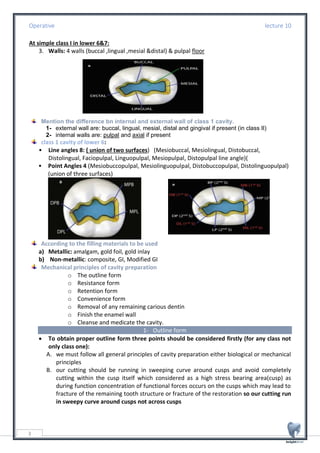
cavity design of amalgam restoration may be:
a. oval in case of minimal invasion of caries to occlusal surface
b. Pepion like design in upper premolars
c. round or oval shape in both occlusal pits which separated by transverse ridge
d. Y shape in lower 5
e. A kidney shape design related to mesial fissure of the occlusal surface when there is
moderate extension of caries
f. oval shape or triangular design related to buccal and lingual or palatal pit of molars
g. cross shaped cavity in lower 6&7
h. one or l shape in the distal of occlusal surface of the upper 6&7 while in the mesial it takes
a kidney shape design
i. Round with palatal pit.
j. Inverted T shaped cavity → buccal fissure and pit.
Operative lecture 10
3
At simple class I in lower 6&7:
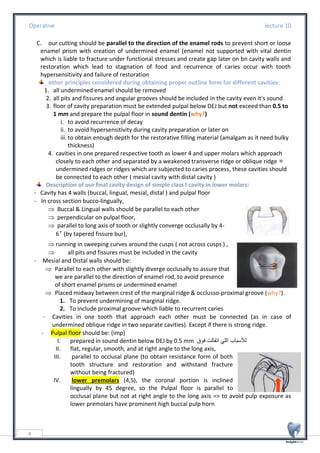
3. Walls: 4 walls (buccal ,lingual ,mesial &distal) & pulpal floor
Mention the difference bn internal and external wall of class 1 cavity.
1- external wall are: buccal, lingual, mesial, distal and gingival if present (in class II)
2- internal walls are: pulpal and axial if present
class 1 cavity of lower 6:
• Line angles 8: ( union of two surfaces) (Mesiobuccal, Mesiolingual, Distobuccal,
Distolingual, Faciopulpal, Linguopulpal, Mesiopulpal, Distopulpal line angle)(
• Point Angles 4 (Mesiobuccopulpal, Mesiolinguopulpal, Distobuccopulpal, Distolinguopulpal)
(union of three surfaces)
According to the filling materials to be used
a) Metallic: amalgam, gold foil, gold inlay
b) Non-metallic: composite, GI, Modified GI
Mechanical principles of cavity preparation
o The outline form
o Resistance form
o Retention form
o Convenience form
o Removal of any remaining carious dentin
o Finish the enamel wall
o Cleanse and medicate the cavity.
1- Outline form
• To obtain proper outline form three points should be considered firstly (for any class not
only class one):
A. we must follow all general principles of cavity preparation either biological or mechanical
principles
B. our cutting should be running in sweeping curve around cusps and avoid completely
cutting within the cusp itself which considered as a high stress bearing area(cusp) as
during function concentration of functional forces occurs on the cusps which may lead to
fracture of the remaining tooth structure or fracture of the restoration so our cutting run
in sweepy curve around cusps not across cusps
Operative lecture 10
4
C. our cutting should be parallel to the direction of the enamel rods to prevent short or loose
enamel prism with creation of undermined enamel (enamel not supported with vital dentin
which is liable to fracture under functional stresses and create gap later on bn cavity walls and
restoration which lead to stagnation of food and recurrence of caries occur with tooth
hypersensitivity and failure of restoration
other principles considered during obtaining proper outline form for different cavities:
1. all undermined enamel should be removed
2. all pits and fissures and angular grooves should be included in the cavity even it's sound
3. floor of cavity preparation must be extended pulpal below DEJ but not exceed than 0.5 to
1 mm and prepare the pulpal floor in sound dentin (why?)
i. to avoid recurrence of decay
ii. to avoid hypersensitivity during cavity preparation or later on
iii. to obtain enough depth for the restorative filling material (amalgam as it need bulky
thickness)
4. cavities in one prepared respective tooth as lower 4 and upper molars which approach
closely to each other and separated by a weakened transverse ridge or oblique ridge =
undermined ridges or ridges which are subjected to caries process, these cavities should
be connected to each other ( mesial cavity with distal cavity )
Description of our final cavity design of simple class I cavity in lower molars:
- Cavity has 4 walls (buccal, lingual, mesial, distal ) and pulpal floor
- In cross section bucco-lingually,
 Buccal & Lingual walls should be parallel to each other
 perpendicular on pulpal floor,
 parallel to long axis of tooth or slightly converge occlusally by 4-
6˚ (by tapered fissure bur),
 running in sweeping curves around the cusps ( not across cusps ) ,
 all pits and fissures must be included in the cavity
- Mesial and Distal walls should be:
 Parallel to each other with slightly diverge occlusally to assure that
we are parallel to the direction of enamel rod, to avoid presence
of short enamel prisms or undermined enamel
 Placed midway between crest of the marginal ridge & occlusso-proximal groove (why?).
1. To prevent undermining of marginal ridge.
2. To include proximal groove which liable to recurrent caries
- Cavities in one tooth that approach each other must be connected (as in case of
undermined oblique ridge in two separate cavities). Except if there is strong ridge.
- Pulpal floor should be: (imp)
I. prepared in sound dentin below DEJ by 0.5 mm ‫فوق‬ ‫اتقالت‬ ‫اللي‬ ‫لألسباب‬
II. flat, regular, smooth, and at right angle to the long axis,
III. parallel to occlusal plane (to obtain resistance form of both
tooth structure and restoration and withstand fracture
without being fractured)
IV. lower premolars (4,5), the coronal portion is inclined
lingually by 45 degree, so the Pulpal floor is parallel to
occlusal plane but not at right angle to the long axis => to avoid pulp exposure as
lower premolars have prominent high buccal pulp horn
Operative lecture 10
5
 Gripping Action: condensation
of amalgam on dentin (visco-
elastic) which being compressed
& after condensation, stress
relief in dentin layer pushing
amalgam slightly out giving
better retention & seal.
:Resistance form: design of the cavity which result in integrity & Durability of the tooth structures
& restorative materials from fracture during mastication forces.
Retention form: design of cavity which result in secure and retention of restoration material in its
position during function.
Resistance form Retention form
Avoid fracture of the tooth and the
restorative filling material
Avoid displacement of the restoration
Related with the restorative material and
tooth
Related to the restoration only
Retention are achieved either by:
1. Box shape cavity with slight converge occlusally . Which give us a good retention and
resistance form
2. Dove-tails→ prevent displacement (move in its position) & dislodgement (completely
removed) in horizontal direction
3. Undercuts→ prevent displacement and dislodgement in vertical direction
4. Parallelism of walls →cause’s friction and gripping action of
dentin
5. Viscoelasticity of dentin => cause gripping action for
retention.
6. Slot and grooves → extra-means of retention (groove within
line angles and pinholes within point angles) → Macro-
retentive means) related to marginal ridge mainly in class II by
inverted cone bur.
7. Commonly composite depend on micromechanical retentive means.
- Enamel: etching giving micro pores for mechanical interlocking and using of adhesive
systems which create micropores in enamel
- open dentinal tubules → hybrid layer with resin tags ready for mechanical interlocking.
- If the remaining tooth structure is decreased…to preserve the tooth structure & increase
fraction resistance, we used the resin based material (composite)
Factors affect resistance:
1. Box shape cavity
2. All undermined enamel and loose enamel prisms should be removed
3. All pits and fissures and and angular grooves should be removed
4. Pulpal floor must be below D.E.J by .5 mm
5. Pulpal floor should be flat, regular, smooth, & at right angle to the long axis, parallel to occlusal
plane.
6. Roundation of line and point angles to prevent stress concentration.
7. The shape design of cavity has direct relation for resistance form , ex: inverted truncated cone
shape will have a higher resistance to functional loading than box shape
8. Proper Cavo-surface angle should be:
- Butt joint. (90 degrees), Butt joint in amalgam as it has low edge strength resulting in fracture &ditches
N. B- Resistance and retention form
have scientific definition but when
prepared one the other is obtained.
Function of convergence shape of cavity: ‫للفهم‬
• Decrease force which applied in occlusal surface.
• More retention and secure for amalgam restoration (undercut).
- Convergence of cavity not exceed 6˚to prevent weakening of amalgam at point angles of the cavity
which may lead to fracture of amalgam.

Class1 part1 R MSA UNIVERSITY1111111.pdf

  • 1.
    Operative lecture 10 1 ClassI Cavity Preparation for amalgam Definition of class I cavity preparation : (Acc to black’s classification): Pits and fissures cavities which occur in: 1. the occlusal surfaces of molars and premolars 2. occlusal 2/3 of the buccal, lingual or palatal surfaces of molars only (premolars not involved) 3. Palatal surfaces of the upper incisors commonly. (Acc to si/sta classification): Class one cavity preparation according to GV black is considered site 1 o Pits and fissures cavities which occur in the occlusal surfaces of molars and premolars, occlusal 2/3 of the buccal, lingual or palatal surfaces of molars only Characters of class I cavity preparation or carious lesions 1- pits and fissure cavities which present in the occlusal surfaces of bicuspid (premolars), molars, and upper incisors 2- Histologically, lesion spreads as triangular Cone shape in Enamel; with apex occlusal & base towards the DEJ. & in dentin; with base at the DEJ and apex towards the pulp. 3- Class I cavity may be: • Simple: include occlusal surface of posterior teeth molar or premolar, isolated buccal or palatal or lingual pit of molars only. • Compound: include two surfaces of molars, occlusal one and buccal or lingual surface. • Complex: include three surfaces e.g. occlusal, buccal and lingual/palatal surfaces of molars. Because of the extension of caries in this case[complex], this lead to weakening to the tooth structure so we should use restorative filling material reinforce the tooth structure as amalgam with amalgam bond but we better use composite or resin based filling material as we use with the composite bonding agent which reinforce tooth structure NB :( Base of cone wider in dentin than enamel (why)→ lateral spread of caries at D.E.J due to lateral branches tubules is higher than spread of caries in enamel
  • 2.
    Operative lecture 10 2 Differentdesigns of class I amalgam restoration depend on : 1. Anatomy of the occlusal surface of molars and premolars and other surfaces . 2. Extension of caries itself within the structure of enamel and dentin. 3. filling being used ex: amalgam or fluoridated restorative filling material as GI or modified GI Amalgam GI /modified GI Extension needs extension for prevention*or cutting for immunity (to prevent the recurrent decay) no need to do cutting for immunity or extension for prevention Margins must be seated at cleansable areas ‫ب‬ ‫الكافيتي‬ ‫بوسع‬ ‫اني‬ ‫معناها‬ ‫ودي‬ ‫ح‬ ‫يكون‬ ‫المارجن‬ ‫يث‬ ‫فدا‬ ‫قليلة‬ ‫عندها‬ ‫تفضل‬ ‫الديبرس‬ ‫قابلية‬ ‫اماكن‬ ‫عند‬ ‫ديكاي‬ ‫ريكارنت‬ ‫قابلية‬ ‫هيقلل‬ Preservation and conservation No conservation cavity design will be more preservative and conservative Dimension of cavity wide and deep cavity Narrower and shallower cavity NB : when restoring buccal ,lingual or palatal pits of molars it's preferred to use glass ionomer to benefit from : i. biological compatible ii. anticariogenic 1. But in stress bearing areas as occlusal, GI isn't preferred because of occlusal force which may lead to wear or fracture. 2. but modified GI as resin modified glass ionomer or compomer and active is indicated in the occlusal surface cavity design of amalgam restoration may be: a. oval in case of minimal invasion of caries to occlusal surface b. Pepion like design in upper premolars c. round or oval shape in both occlusal pits which separated by transverse ridge d. Y shape in lower 5 e. A kidney shape design related to mesial fissure of the occlusal surface when there is moderate extension of caries f. oval shape or triangular design related to buccal and lingual or palatal pit of molars g. cross shaped cavity in lower 6&7 h. one or l shape in the distal of occlusal surface of the upper 6&7 while in the mesial it takes a kidney shape design i. Round with palatal pit. j. Inverted T shaped cavity → buccal fissure and pit.
  • 3.
    Operative lecture 10 3 Atsimple class I in lower 6&7: 3. Walls: 4 walls (buccal ,lingual ,mesial &distal) & pulpal floor Mention the difference bn internal and external wall of class 1 cavity. 1- external wall are: buccal, lingual, mesial, distal and gingival if present (in class II) 2- internal walls are: pulpal and axial if present class 1 cavity of lower 6: • Line angles 8: ( union of two surfaces) (Mesiobuccal, Mesiolingual, Distobuccal, Distolingual, Faciopulpal, Linguopulpal, Mesiopulpal, Distopulpal line angle)( • Point Angles 4 (Mesiobuccopulpal, Mesiolinguopulpal, Distobuccopulpal, Distolinguopulpal) (union of three surfaces) According to the filling materials to be used a) Metallic: amalgam, gold foil, gold inlay b) Non-metallic: composite, GI, Modified GI Mechanical principles of cavity preparation o The outline form o Resistance form o Retention form o Convenience form o Removal of any remaining carious dentin o Finish the enamel wall o Cleanse and medicate the cavity. 1- Outline form • To obtain proper outline form three points should be considered firstly (for any class not only class one): A. we must follow all general principles of cavity preparation either biological or mechanical principles B. our cutting should be running in sweeping curve around cusps and avoid completely cutting within the cusp itself which considered as a high stress bearing area(cusp) as during function concentration of functional forces occurs on the cusps which may lead to fracture of the remaining tooth structure or fracture of the restoration so our cutting run in sweepy curve around cusps not across cusps
  • 4.
    Operative lecture 10 4 C.our cutting should be parallel to the direction of the enamel rods to prevent short or loose enamel prism with creation of undermined enamel (enamel not supported with vital dentin which is liable to fracture under functional stresses and create gap later on bn cavity walls and restoration which lead to stagnation of food and recurrence of caries occur with tooth hypersensitivity and failure of restoration other principles considered during obtaining proper outline form for different cavities: 1. all undermined enamel should be removed 2. all pits and fissures and angular grooves should be included in the cavity even it's sound 3. floor of cavity preparation must be extended pulpal below DEJ but not exceed than 0.5 to 1 mm and prepare the pulpal floor in sound dentin (why?) i. to avoid recurrence of decay ii. to avoid hypersensitivity during cavity preparation or later on iii. to obtain enough depth for the restorative filling material (amalgam as it need bulky thickness) 4. cavities in one prepared respective tooth as lower 4 and upper molars which approach closely to each other and separated by a weakened transverse ridge or oblique ridge = undermined ridges or ridges which are subjected to caries process, these cavities should be connected to each other ( mesial cavity with distal cavity ) Description of our final cavity design of simple class I cavity in lower molars: - Cavity has 4 walls (buccal, lingual, mesial, distal ) and pulpal floor - In cross section bucco-lingually,  Buccal & Lingual walls should be parallel to each other  perpendicular on pulpal floor,  parallel to long axis of tooth or slightly converge occlusally by 4- 6˚ (by tapered fissure bur),  running in sweeping curves around the cusps ( not across cusps ) ,  all pits and fissures must be included in the cavity - Mesial and Distal walls should be:  Parallel to each other with slightly diverge occlusally to assure that we are parallel to the direction of enamel rod, to avoid presence of short enamel prisms or undermined enamel  Placed midway between crest of the marginal ridge & occlusso-proximal groove (why?). 1. To prevent undermining of marginal ridge. 2. To include proximal groove which liable to recurrent caries - Cavities in one tooth that approach each other must be connected (as in case of undermined oblique ridge in two separate cavities). Except if there is strong ridge. - Pulpal floor should be: (imp) I. prepared in sound dentin below DEJ by 0.5 mm ‫فوق‬ ‫اتقالت‬ ‫اللي‬ ‫لألسباب‬ II. flat, regular, smooth, and at right angle to the long axis, III. parallel to occlusal plane (to obtain resistance form of both tooth structure and restoration and withstand fracture without being fractured) IV. lower premolars (4,5), the coronal portion is inclined lingually by 45 degree, so the Pulpal floor is parallel to occlusal plane but not at right angle to the long axis => to avoid pulp exposure as lower premolars have prominent high buccal pulp horn
  • 5.
    Operative lecture 10 5 Gripping Action: condensation of amalgam on dentin (visco- elastic) which being compressed & after condensation, stress relief in dentin layer pushing amalgam slightly out giving better retention & seal. :Resistance form: design of the cavity which result in integrity & Durability of the tooth structures & restorative materials from fracture during mastication forces. Retention form: design of cavity which result in secure and retention of restoration material in its position during function. Resistance form Retention form Avoid fracture of the tooth and the restorative filling material Avoid displacement of the restoration Related with the restorative material and tooth Related to the restoration only Retention are achieved either by: 1. Box shape cavity with slight converge occlusally . Which give us a good retention and resistance form 2. Dove-tails→ prevent displacement (move in its position) & dislodgement (completely removed) in horizontal direction 3. Undercuts→ prevent displacement and dislodgement in vertical direction 4. Parallelism of walls →cause’s friction and gripping action of dentin 5. Viscoelasticity of dentin => cause gripping action for retention. 6. Slot and grooves → extra-means of retention (groove within line angles and pinholes within point angles) → Macro- retentive means) related to marginal ridge mainly in class II by inverted cone bur. 7. Commonly composite depend on micromechanical retentive means. - Enamel: etching giving micro pores for mechanical interlocking and using of adhesive systems which create micropores in enamel - open dentinal tubules → hybrid layer with resin tags ready for mechanical interlocking. - If the remaining tooth structure is decreased…to preserve the tooth structure & increase fraction resistance, we used the resin based material (composite) Factors affect resistance: 1. Box shape cavity 2. All undermined enamel and loose enamel prisms should be removed 3. All pits and fissures and and angular grooves should be removed 4. Pulpal floor must be below D.E.J by .5 mm 5. Pulpal floor should be flat, regular, smooth, & at right angle to the long axis, parallel to occlusal plane. 6. Roundation of line and point angles to prevent stress concentration. 7. The shape design of cavity has direct relation for resistance form , ex: inverted truncated cone shape will have a higher resistance to functional loading than box shape 8. Proper Cavo-surface angle should be: - Butt joint. (90 degrees), Butt joint in amalgam as it has low edge strength resulting in fracture &ditches N. B- Resistance and retention form have scientific definition but when prepared one the other is obtained. Function of convergence shape of cavity: ‫للفهم‬ • Decrease force which applied in occlusal surface. • More retention and secure for amalgam restoration (undercut). - Convergence of cavity not exceed 6˚to prevent weakening of amalgam at point angles of the cavity which may lead to fracture of amalgam.