Name:
Muhammad sheraz shabbir
Muhammad Ibad ur rehman
Shehzada furqan
Ansar
What is conflict. Write down its causes and effect and also 5 basic
conflict.
INTRODUCTION
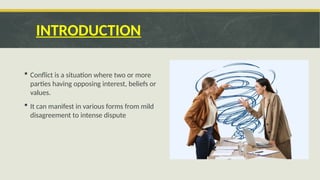
 Conflict is a situation where two or more
parties having opposing interest, beliefs or
values.
 It can manifest in various forms from mild
disagreement to intense dispute
DEFINITON OF CONFLICT
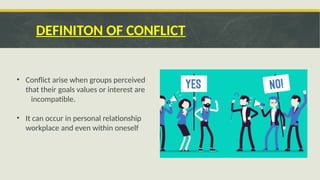
• Conflict arise when groups perceived
that their goals values or interest are
incompatible.
• It can occur in personal relationship
workplace and even within oneself
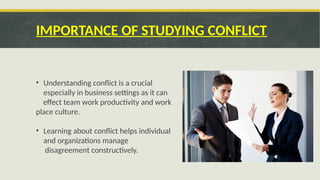
IMPORTANCE OF STUDYING CONFLICT
• Understanding conflict is a crucial
especially in business settings as it can
effect team work productivity and work
place culture.
• Learning about conflict helps individual
and organizations manage
disagreement constructively.
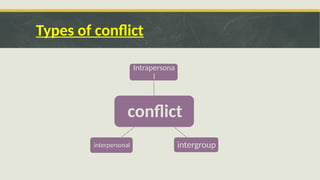
Types of conflict
conflict
Intrapersona
l
intergroup
interpersonal
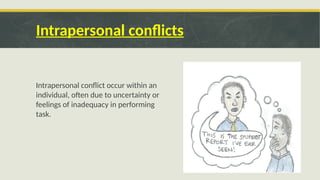
Intrapersonal conflicts
Intrapersonal conflict occur within an
individual, often due to uncertainty or
feelings of inadequacy in performing
task.
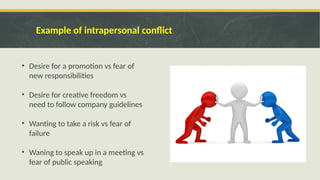
Example of intrapersonal conflict
• Desire for a promotion vs fear of
new responsibilities
• Desire for creative freedom vs
need to follow company guidelines
• Wanting to take a risk vs fear of
failure
• Waning to speak up in a meeting vs
fear of public speaking
Types of intrapersonal conflict
Role conflict: When you feel torn between
different roles or responsibilities in your life.
For example: Work vs family time
Role ambiguity: Role ambiguity is when you
are not sure what your job is or what you
are supposed to do.
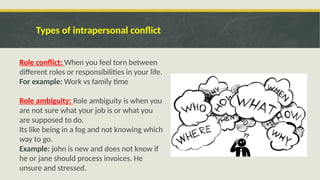
Its like being in a fog and not knowing which
way to go.
Example: john is new and does not know if
he or jane should process invoices. He
unsure and stressed.
Key takeaway:
Intrapersonal conflicts can
stem from differing roles
and unclear guidelines,
leading to internal struggles
in decision making.
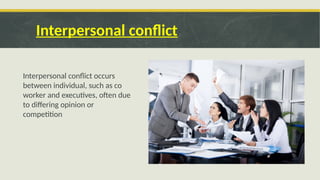
Interpersonal conflict
Interpersonal conflict occurs
between individual, such as co
worker and executives, often due
to differing opinion or
competition
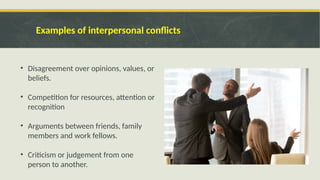
Examples of interpersonal conflicts
• Disagreement over opinions, values, or
beliefs.
• Competition for resources, attention or
recognition
• Arguments between friends, family
members and work fellows.
• Criticism or judgement from one
person to another.
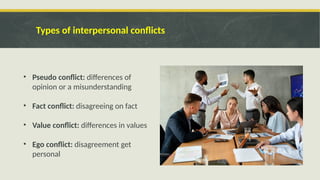
Types of interpersonal conflicts
• Pseudo conflict: differences of
opinion or a misunderstanding
• Fact conflict: disagreeing on fact
• Value conflict: differences in values
• Ego conflict: disagreement get
personal
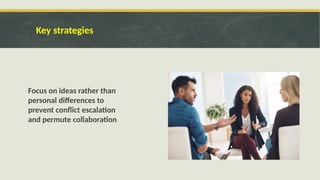
Key strategies
Focus on ideas rather than
personal differences to
prevent conflict escalation
and permute collaboration
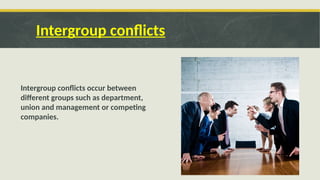
Intergroup conflicts
Intergroup conflicts occur between
different groups such as department,
union and management or competing
companies.
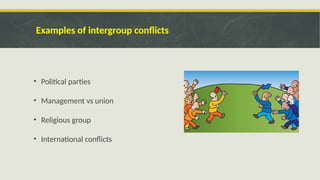
Examples of intergroup conflicts
• Political parties
• Management vs union
• Religious group
• International conflicts
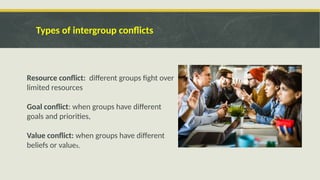
Types of intergroup conflicts
Resource conflict: different groups fight over
limited resources
Goal conflict: when groups have different
goals and priorities,
Value conflict: when groups have different
beliefs or values,
Key strategies for intergroup conflicts
• Encourage open dialogue
• Use a mediator
• Recognize and reward
• Establish a conflict resolution process
Is conflict always bad?
conflict in teams
Task conflict: can be beneficial in early stages
of decision making, stimulating creativity, but
ca hinder complex task in the long run.
Personal conflict: never healthy causing stress
and distress and can lead to workplace bullying
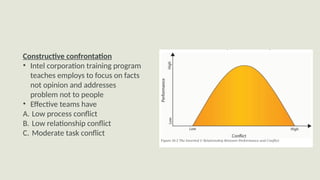
Constructive confrontation
• Intel corporation training program
teaches employs to focus on facts
not opinion and addresses
problem not to people
• Effective teams have
A. Low process conflict
B. Low relationship conflict
C. Moderate task conflict
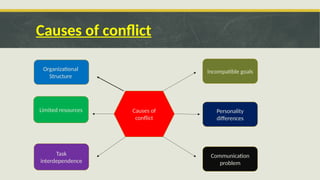
Causes of conflict
Causes of
conflict
Organizational
Structure
Limited resources
Task
interdependence
Incompatible goals
Communication
problem
Personality
differences
Organizational structure
• Conflicts types varies based on
organizational structure
• A matrix structure like that ABB Inc.
create inherited decisional conflict due
to dual reporting lines
• This leads to confusion with the
organization as it operates through
numerous geographic and industry units.
Limited resources
• Scarcity of resources like money time
and equipment
• The completion of high demand
resources e.g. laptop ,phone
• Limited availability of important
resources
• Different role e.g. technical employs vs
sale representative.
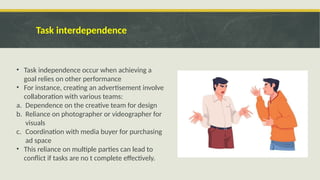
Task interdependence
• Task independence occur when achieving a
goal relies on other performance
• For instance, creating an advertisement involve
collaboration with various teams:
a. Dependence on the creative team for design
b. Reliance on photographer or videographer for
visuals
c. Coordination with media buyer for purchasing
ad space
• This reliance on multiple parties can lead to
conflict if tasks are no t complete effectively.
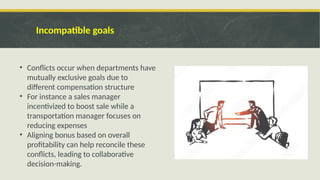
Incompatible goals
• Conflicts occur when departments have
mutually exclusive goals due to
different compensation structure
• For instance a sales manager
incentivized to boost sale while a
transportation manager focuses on
reducing expenses
• Aligning bonus based on overall
profitability can help reconcile these
conflicts, leading to collaborative
decision-making.
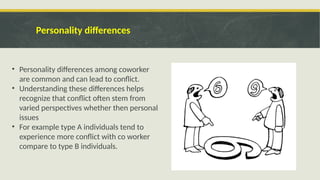
Personality differences
• Personality differences among coworker
are common and can lead to conflict.
• Understanding these differences helps
recognize that conflict often stem from
varied perspectives whether then personal
issues
• For example type A individuals tend to
experience more conflict with co worker
compare to type B individuals.
Communication problem
• Conflicts can arise from small, unintentional
communication problems such as lost
emails or unreturned calls
• For example instead of labelling Jeff's
tardiness as a bad attitude one might say
when you arrive late, I feel my time is
wasted
• This approach emphasizes the impact of
behavior allowing for a constructive
discussion about the issues without
personal attack.
OUTCOMES OF CONFLICTS
Positive outcomes
• consideration of a broader range of idea
resulting in a better stronger idea.
• Surfacing of assumptions that maybe
inaccurate
• Increase participation and creativity
• Clarification of individual views that
build learning.
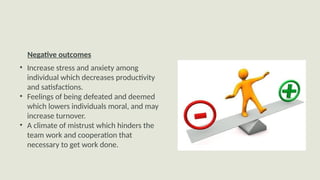
Negative outcomes
• Increase stress and anxiety among
individual which decreases productivity
and satisfactions.
• Feelings of being defeated and deemed
which lowers individuals moral, and may
increase turnover.
• A climate of mistrust which hinders the
team work and cooperation that
necessary to get work done.
Negative outcomes
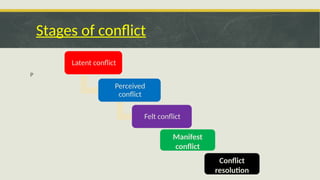
Stages of conflict
P
Latent conflict
Perceived
conflict
Felt conflict
Manifest
conflict
Conflict
resolution
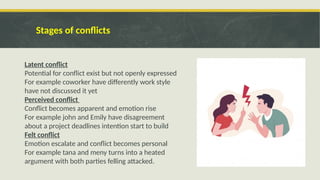
Stages of conflicts
Latent conflict
Potential for conflict exist but not openly expressed
For example coworker have differently work style
have not discussed it yet
Perceived conflict
Conflict becomes apparent and emotion rise
For example john and Emily have disagreement
about a project deadlines intention start to build
Felt conflict
Emotion escalate and conflict becomes personal
For example tana and meny turns into a heated
argument with both parties felling attacked.
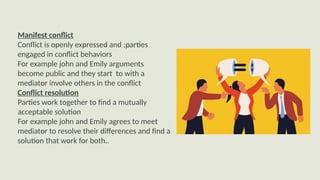
Manifest conflict
Conflict is openly expressed and ;parties
engaged in conflict behaviors
For example john and Emily arguments
become public and they start to with a
mediator involve others in the conflict
Conflict resolution
Parties work together to find a mutually
acceptable solution
For example john and Emily agrees to meet
mediator to resolve their differences and find a
solution that work for both..
Case study
Conflict between Marketing and Sales Teams
Background:
A mid-sized software company, TechCorp, has two teams: Marketing and Sales. The
Marketing team, led by Rachel, is responsible for creating promotional materials and
campaigns. The Sales team, led by Michael, is responsible for meeting sales targets.
Stage 1: Latent Conflict
The Marketing and Sales teams have different work styles and priorities. The Marketing
team focuses on creating creative campaigns, while the Sales team focuses on meeting
sales targets. Although there are no open conflicts, tensions and disagreements exist
beneath the surface.
Incident:
Rachel and Michael have a disagreement about the marketing budget. Rachel wants to
allocate more funds to social media campaigns, while Michael wants to allocate more
funds to sales promotions.
Stage 2: Perceived Conflict
Rachel and Michael start to perceive the budget disagreement as a conflict. They begin
to take sides, and their communication becomes strained. Rachel feels that Michael is
not understanding the importance of social media campaigns, while Michael feels that
Rachel is not considering the sales team's needs.
Stage 3: Felt Conflict
The conflict escalates, and emotions rise. Rachel and Michael start to involve their team
members, creating a divide between the Marketing and Sales teams. The conflict
becomes personal, with each side feeling attacked and misunderstood.
Stage 4: Manifest Conflict
The conflict becomes openly expressed, and the teams start to engage in
conflict behaviors. Rachel and Michael have heated arguments, and their team
members start to take sides. The conflict affects the entire organization, causing
delays and impacting productivity.
Stage 5: Conflict Resolution
The CEO intervenes and facilitates a meeting between Rachel and Michael. They
are able to discuss their differences and find a mutually acceptable solution. The
marketing budget is allocated in a way that meets both teams' needs. The
conflict is resolved, and the teams are able to work together effectively.
Conflict management
There are number of different ways of
managing organizational conflict which are
highlighted in this section. Conflict
management refer to resolving disagreement
effectively
Ways of managing conflict
Change a structure
Vanessa, the lead engineer, and Tom, the procurement officer, are having a
disagreement because Tom is not approving some important parts that Vanessa
wants to buy for a new product. Vanessa is upset because she feels Tom doesn't
trust her choices. On the other hand, Tom is trying to keep costs low and stick to
the budget. To solve this problem, their boss, Sharon, suggests a new way to
evaluate both of them. From now on, they will be judged based on how well they
manage costs and how well the product performs. This will encourage them to
work together to find a balance between keeping costs down and ensuring quality.
This situation shows how changing the way people are evaluated can help fix
conflicts that arise between teams or departments.
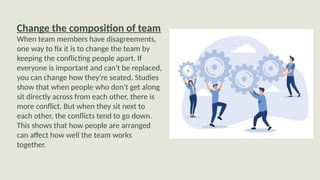
Change the composition of team
When team members have disagreements,
one way to fix it is to change the team by
keeping the conflicting people apart. If
everyone is important and can't be replaced,
you can change how they're seated. Studies
show that when people who don't get along
sit directly across from each other, there is
more conflict. But when they sit next to
each other, the conflicts tend to go down.
This shows that how people are arranged
can affect how well the team works
together.
Create a common opposing force
When groups within a company have conflicts,
one way to reduce the tension is to focus on a
common opponent, like a competitor. For
example, if two software teams are fighting for
marketing money, they can choose to work
together against the competition to improve
marketing for the whole company. This
"enemy" doesn't have to be another business;
it could also be a challenge like an economic
downturn that encourages different
departments to join forces to save jobs during
hard times.
Consider majority rule
Group conflicts can be solved by using
majority rule, which means members vote on
an idea, and the one with the most votes is
chosen. This works well if everyone thinks the
process is fair. However, it may not work if
the same people keep winning or if it's used
too often. It's important to use this method
only after having good discussions about the
issues, not as a way to skip those discussions.
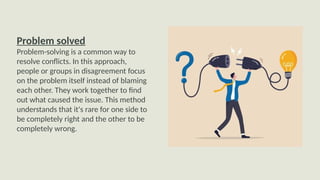
Problem solved
Problem-solving is a common way to
resolve conflicts. In this approach,
people or groups in disagreement focus
on the problem itself instead of blaming
each other. They work together to find
out what caused the issue. This method
understands that it's rare for one side to
be completely right and the other to be
completely wrong.
Conflict resolution
Conflict-Handling Styles
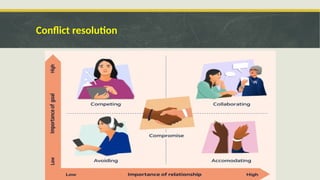
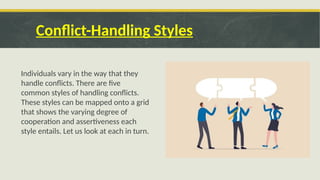
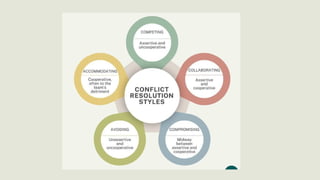
Individuals vary in the way that they
handle conflicts. There are five
common styles of handling conflicts.
These styles can be mapped onto a grid
that shows the varying degree of
cooperation and assertiveness each
style entails. Let us look at each in turn.
Avoidance
The avoiding style of conflict resolution
is uncooperative and non-assertive.
People who use this style try to avoid
conflict by ignoring it and postponing
decisions that might lead to
disagreements. They might say things
like, "I don't care if we work this out," or
"I feel fine about things." While this
approach may be acceptable for minor
issues, it becomes problematic when
important matters are ignored due to a
dislike of conflict or fear of how others
will react.
Accommodation
The accommodating style of conflict
resolution is cooperative but not assertive. In
this style, a person agrees with what the
other side wants, even if it means giving up
their own goals. They might be afraid to
speak up for themselves or think that
disagreeing could hurt the other person. They
often say things like, "Let’s do it your way" or
"If it’s important to you, I can go along with
it." This approach can work well when the
issue matters more to others than to oneself.
However, if someone always uses this style,
they may start to ignore their own needs and
feelings.
compromise
The compromising style is a middle-ground
approach where people want to express their
own concerns but also respect the other
person's goals. A compromiser might say
things like, "Maybe I should rethink my
position" or "We can both give in a little." In
this style, both sides give up something
important to reach an agreement. For
example, when the Lanes borough Hotel in
London mistakenly advertised rooms for £35
instead of £350, they faced a potential crisis.
Instead of canceling bookings, they decided to
honor the lower price for up to three nights,
which helped protect their reputation and
finances.
competition
People who use a competing style in conflicts
want to achieve their own goals, no matter
what others think or feel. They care more
about getting what they want than keeping
good relationships with others, which can hurt
those connections over time. This approach
can work well if someone believes strongly
that the other options are wrong or harmful.
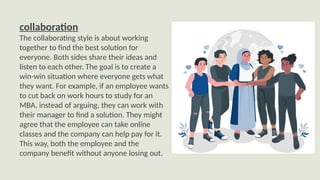
collaboration
The collaborating style is about working
together to find the best solution for
everyone. Both sides share their ideas and
listen to each other. The goal is to create a
win-win situation where everyone gets what
they want. For example, if an employee wants
to cut back on work hours to study for an
MBA, instead of arguing, they can work with
their manager to find a solution. They might
agree that the employee can take online
classes and the company can help pay for it.
This way, both the employee and the
company benefit without anyone losing out.
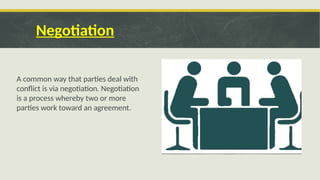
Negotiation
A common way that parties deal with
conflict is via negotiation. Negotiation
is a process whereby two or more
parties work toward an agreement.
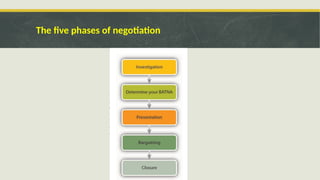
The five phases of negotiation
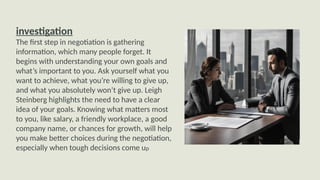
investigation
The first step in negotiation is gathering
information, which many people forget. It
begins with understanding your own goals and
what’s important to you. Ask yourself what you
want to achieve, what you’re willing to give up,
and what you absolutely won’t give up. Leigh
Steinberg highlights the need to have a clear
idea of your goals. Knowing what matters most
to you, like salary, a friendly workplace, a good
company name, or chances for growth, will help
you make better choices during the negotiation,
especially when tough decisions come up
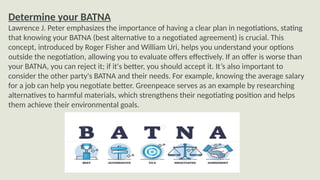
Determine your BATNA
Lawrence J. Peter emphasizes the importance of having a clear plan in negotiations, stating
that knowing your BATNA (best alternative to a negotiated agreement) is crucial. This
concept, introduced by Roger Fisher and William Uri, helps you understand your options
outside the negotiation, allowing you to evaluate offers effectively. If an offer is worse than
your BATNA, you can reject it; if it's better, you should accept it. It’s also important to
consider the other party's BATNA and their needs. For example, knowing the average salary
for a job can help you negotiate better. Greenpeace serves as an example by researching
alternatives to harmful materials, which strengthens their negotiating position and helps
them achieve their environmental goals.
Presentation
The third phase of negotiation is presentation,
where you organize the information you've
collected to back up your position. For example,
in a job or salary negotiation, you can share facts
about your past contributions to show your value.
This might include things like creating a blog that
helped the company gain attention, securing
donations for a charity, or being a supportive
team member who helps others succeed.
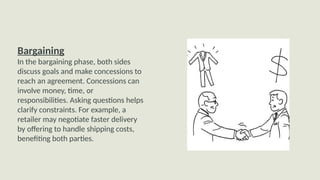
Bargaining
In the bargaining phase, both sides
discuss goals and make concessions to
reach an agreement. Concessions can
involve money, time, or
responsibilities. Asking questions helps
clarify constraints. For example, a
retailer may negotiate faster delivery
by offering to handle shipping costs,
benefiting both parties.
Closure
Closure is key in negotiations, where you
either reach an agreement or walk away. If
your best offer is rejected, view it as a
chance to learn. For instance, a CEO asked
a customer why they chose a competitor
and learned that after-sales service was
more important than price. With this
information, the CEO made a better offer,
which the customer accepted. If a deal
falls through, consider following up to
understand why. You may gain useful
insights for future negotiations.
When all else fails third party negotiation
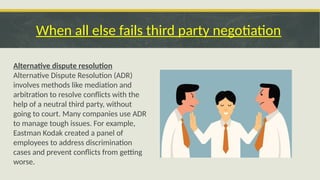
Alternative dispute resolution
Alternative Dispute Resolution (ADR)
involves methods like mediation and
arbitration to resolve conflicts with the
help of a neutral third party, without
going to court. Many companies use ADR
to manage tough issues. For example,
Eastman Kodak created a panel of
employees to address discrimination
cases and prevent conflicts from getting
worse.
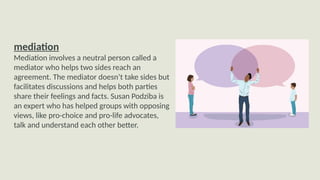
mediation
Mediation involves a neutral person called a
mediator who helps two sides reach an
agreement. The mediator doesn’t take sides but
facilitates discussions and helps both parties
share their feelings and facts. Susan Podziba is
an expert who has helped groups with opposing
views, like pro-choice and pro-life advocates,
talk and understand each other better.
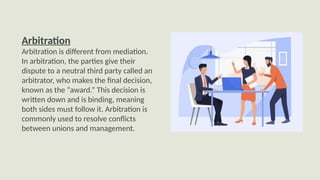
Arbitration
Arbitration is different from mediation.
In arbitration, the parties give their
dispute to a neutral third party called an
arbitrator, who makes the final decision,
known as the “award.” This decision is
written down and is binding, meaning
both sides must follow it. Arbitration is
commonly used to resolve conflicts
between unions and management.
conclusion
Conflict can be minor or serious and can either boost creativity or disrupt
work. It often arises from unclear roles, limited resources, personality
clashes, or communication issues. To resolve conflict, different methods can
be used, depending on the situation. Negotiation is important and involves
knowing your BATNA, or "best alternative." The process includes five steps:
investigation, determining BATNA, presentation, bargaining, and closure.
Avoid mistakes like accepting the first offer or letting emotions interfere.
Understanding cultural differences can also help in resolving conflicts.
M.sheraz...Conflict topic presentation .pptx

M.sheraz...Conflict topic presentation .pptx

  • 1.
    Name: Muhammad sheraz shabbir MuhammadIbad ur rehman Shehzada furqan Ansar What is conflict. Write down its causes and effect and also 5 basic conflict.
  • 3.
    INTRODUCTION  Conflict isa situation where two or more parties having opposing interest, beliefs or values.  It can manifest in various forms from mild disagreement to intense dispute
  • 4.
    DEFINITON OF CONFLICT •Conflict arise when groups perceived that their goals values or interest are incompatible. • It can occur in personal relationship workplace and even within oneself
  • 5.
    IMPORTANCE OF STUDYINGCONFLICT • Understanding conflict is a crucial especially in business settings as it can effect team work productivity and work place culture. • Learning about conflict helps individual and organizations manage disagreement constructively.
  • 6.
  • 7.
    Intrapersonal conflicts Intrapersonal conflictoccur within an individual, often due to uncertainty or feelings of inadequacy in performing task.
  • 8.
    Example of intrapersonalconflict • Desire for a promotion vs fear of new responsibilities • Desire for creative freedom vs need to follow company guidelines • Wanting to take a risk vs fear of failure • Waning to speak up in a meeting vs fear of public speaking
  • 9.
    Types of intrapersonalconflict Role conflict: When you feel torn between different roles or responsibilities in your life. For example: Work vs family time Role ambiguity: Role ambiguity is when you are not sure what your job is or what you are supposed to do. Its like being in a fog and not knowing which way to go. Example: john is new and does not know if he or jane should process invoices. He unsure and stressed.
  • 10.
    Key takeaway: Intrapersonal conflictscan stem from differing roles and unclear guidelines, leading to internal struggles in decision making.
  • 11.
    Interpersonal conflict Interpersonal conflictoccurs between individual, such as co worker and executives, often due to differing opinion or competition
  • 12.
    Examples of interpersonalconflicts • Disagreement over opinions, values, or beliefs. • Competition for resources, attention or recognition • Arguments between friends, family members and work fellows. • Criticism or judgement from one person to another.
  • 13.
    Types of interpersonalconflicts • Pseudo conflict: differences of opinion or a misunderstanding • Fact conflict: disagreeing on fact • Value conflict: differences in values • Ego conflict: disagreement get personal
  • 14.
    Key strategies Focus onideas rather than personal differences to prevent conflict escalation and permute collaboration
  • 15.
    Intergroup conflicts Intergroup conflictsoccur between different groups such as department, union and management or competing companies.
  • 16.
    Examples of intergroupconflicts • Political parties • Management vs union • Religious group • International conflicts
  • 17.
    Types of intergroupconflicts Resource conflict: different groups fight over limited resources Goal conflict: when groups have different goals and priorities, Value conflict: when groups have different beliefs or values,
  • 18.
    Key strategies forintergroup conflicts • Encourage open dialogue • Use a mediator • Recognize and reward • Establish a conflict resolution process
  • 20.
    Is conflict alwaysbad? conflict in teams Task conflict: can be beneficial in early stages of decision making, stimulating creativity, but ca hinder complex task in the long run. Personal conflict: never healthy causing stress and distress and can lead to workplace bullying
  • 21.
    Constructive confrontation • Intelcorporation training program teaches employs to focus on facts not opinion and addresses problem not to people • Effective teams have A. Low process conflict B. Low relationship conflict C. Moderate task conflict
  • 22.
    Causes of conflict Causesof conflict Organizational Structure Limited resources Task interdependence Incompatible goals Communication problem Personality differences
  • 23.
    Organizational structure • Conflictstypes varies based on organizational structure • A matrix structure like that ABB Inc. create inherited decisional conflict due to dual reporting lines • This leads to confusion with the organization as it operates through numerous geographic and industry units.
  • 24.
    Limited resources • Scarcityof resources like money time and equipment • The completion of high demand resources e.g. laptop ,phone • Limited availability of important resources • Different role e.g. technical employs vs sale representative.
  • 25.
    Task interdependence • Taskindependence occur when achieving a goal relies on other performance • For instance, creating an advertisement involve collaboration with various teams: a. Dependence on the creative team for design b. Reliance on photographer or videographer for visuals c. Coordination with media buyer for purchasing ad space • This reliance on multiple parties can lead to conflict if tasks are no t complete effectively.
  • 26.
    Incompatible goals • Conflictsoccur when departments have mutually exclusive goals due to different compensation structure • For instance a sales manager incentivized to boost sale while a transportation manager focuses on reducing expenses • Aligning bonus based on overall profitability can help reconcile these conflicts, leading to collaborative decision-making.
  • 27.
    Personality differences • Personalitydifferences among coworker are common and can lead to conflict. • Understanding these differences helps recognize that conflict often stem from varied perspectives whether then personal issues • For example type A individuals tend to experience more conflict with co worker compare to type B individuals.
  • 28.
    Communication problem • Conflictscan arise from small, unintentional communication problems such as lost emails or unreturned calls • For example instead of labelling Jeff's tardiness as a bad attitude one might say when you arrive late, I feel my time is wasted • This approach emphasizes the impact of behavior allowing for a constructive discussion about the issues without personal attack.
  • 29.
    OUTCOMES OF CONFLICTS Positiveoutcomes • consideration of a broader range of idea resulting in a better stronger idea. • Surfacing of assumptions that maybe inaccurate • Increase participation and creativity • Clarification of individual views that build learning.
  • 30.
    Negative outcomes • Increasestress and anxiety among individual which decreases productivity and satisfactions. • Feelings of being defeated and deemed which lowers individuals moral, and may increase turnover. • A climate of mistrust which hinders the team work and cooperation that necessary to get work done. Negative outcomes
  • 31.
    Stages of conflict P Latentconflict Perceived conflict Felt conflict Manifest conflict Conflict resolution
  • 32.
    Stages of conflicts Latentconflict Potential for conflict exist but not openly expressed For example coworker have differently work style have not discussed it yet Perceived conflict Conflict becomes apparent and emotion rise For example john and Emily have disagreement about a project deadlines intention start to build Felt conflict Emotion escalate and conflict becomes personal For example tana and meny turns into a heated argument with both parties felling attacked.
  • 33.
    Manifest conflict Conflict isopenly expressed and ;parties engaged in conflict behaviors For example john and Emily arguments become public and they start to with a mediator involve others in the conflict Conflict resolution Parties work together to find a mutually acceptable solution For example john and Emily agrees to meet mediator to resolve their differences and find a solution that work for both..
  • 34.
    Case study Conflict betweenMarketing and Sales Teams Background: A mid-sized software company, TechCorp, has two teams: Marketing and Sales. The Marketing team, led by Rachel, is responsible for creating promotional materials and campaigns. The Sales team, led by Michael, is responsible for meeting sales targets. Stage 1: Latent Conflict The Marketing and Sales teams have different work styles and priorities. The Marketing team focuses on creating creative campaigns, while the Sales team focuses on meeting sales targets. Although there are no open conflicts, tensions and disagreements exist beneath the surface.
  • 35.
    Incident: Rachel and Michaelhave a disagreement about the marketing budget. Rachel wants to allocate more funds to social media campaigns, while Michael wants to allocate more funds to sales promotions. Stage 2: Perceived Conflict Rachel and Michael start to perceive the budget disagreement as a conflict. They begin to take sides, and their communication becomes strained. Rachel feels that Michael is not understanding the importance of social media campaigns, while Michael feels that Rachel is not considering the sales team's needs. Stage 3: Felt Conflict The conflict escalates, and emotions rise. Rachel and Michael start to involve their team members, creating a divide between the Marketing and Sales teams. The conflict becomes personal, with each side feeling attacked and misunderstood.
  • 36.
    Stage 4: ManifestConflict The conflict becomes openly expressed, and the teams start to engage in conflict behaviors. Rachel and Michael have heated arguments, and their team members start to take sides. The conflict affects the entire organization, causing delays and impacting productivity. Stage 5: Conflict Resolution The CEO intervenes and facilitates a meeting between Rachel and Michael. They are able to discuss their differences and find a mutually acceptable solution. The marketing budget is allocated in a way that meets both teams' needs. The conflict is resolved, and the teams are able to work together effectively.
  • 37.
    Conflict management There arenumber of different ways of managing organizational conflict which are highlighted in this section. Conflict management refer to resolving disagreement effectively
  • 38.
    Ways of managingconflict Change a structure Vanessa, the lead engineer, and Tom, the procurement officer, are having a disagreement because Tom is not approving some important parts that Vanessa wants to buy for a new product. Vanessa is upset because she feels Tom doesn't trust her choices. On the other hand, Tom is trying to keep costs low and stick to the budget. To solve this problem, their boss, Sharon, suggests a new way to evaluate both of them. From now on, they will be judged based on how well they manage costs and how well the product performs. This will encourage them to work together to find a balance between keeping costs down and ensuring quality. This situation shows how changing the way people are evaluated can help fix conflicts that arise between teams or departments.
  • 39.
    Change the compositionof team When team members have disagreements, one way to fix it is to change the team by keeping the conflicting people apart. If everyone is important and can't be replaced, you can change how they're seated. Studies show that when people who don't get along sit directly across from each other, there is more conflict. But when they sit next to each other, the conflicts tend to go down. This shows that how people are arranged can affect how well the team works together.
  • 40.
    Create a commonopposing force When groups within a company have conflicts, one way to reduce the tension is to focus on a common opponent, like a competitor. For example, if two software teams are fighting for marketing money, they can choose to work together against the competition to improve marketing for the whole company. This "enemy" doesn't have to be another business; it could also be a challenge like an economic downturn that encourages different departments to join forces to save jobs during hard times.
  • 41.
    Consider majority rule Groupconflicts can be solved by using majority rule, which means members vote on an idea, and the one with the most votes is chosen. This works well if everyone thinks the process is fair. However, it may not work if the same people keep winning or if it's used too often. It's important to use this method only after having good discussions about the issues, not as a way to skip those discussions.
  • 42.
    Problem solved Problem-solving isa common way to resolve conflicts. In this approach, people or groups in disagreement focus on the problem itself instead of blaming each other. They work together to find out what caused the issue. This method understands that it's rare for one side to be completely right and the other to be completely wrong.
  • 43.
  • 44.
    Conflict-Handling Styles Individuals varyin the way that they handle conflicts. There are five common styles of handling conflicts. These styles can be mapped onto a grid that shows the varying degree of cooperation and assertiveness each style entails. Let us look at each in turn.
  • 46.
    Avoidance The avoiding styleof conflict resolution is uncooperative and non-assertive. People who use this style try to avoid conflict by ignoring it and postponing decisions that might lead to disagreements. They might say things like, "I don't care if we work this out," or "I feel fine about things." While this approach may be acceptable for minor issues, it becomes problematic when important matters are ignored due to a dislike of conflict or fear of how others will react.
  • 47.
    Accommodation The accommodating styleof conflict resolution is cooperative but not assertive. In this style, a person agrees with what the other side wants, even if it means giving up their own goals. They might be afraid to speak up for themselves or think that disagreeing could hurt the other person. They often say things like, "Let’s do it your way" or "If it’s important to you, I can go along with it." This approach can work well when the issue matters more to others than to oneself. However, if someone always uses this style, they may start to ignore their own needs and feelings.
  • 48.
    compromise The compromising styleis a middle-ground approach where people want to express their own concerns but also respect the other person's goals. A compromiser might say things like, "Maybe I should rethink my position" or "We can both give in a little." In this style, both sides give up something important to reach an agreement. For example, when the Lanes borough Hotel in London mistakenly advertised rooms for £35 instead of £350, they faced a potential crisis. Instead of canceling bookings, they decided to honor the lower price for up to three nights, which helped protect their reputation and finances.
  • 49.
    competition People who usea competing style in conflicts want to achieve their own goals, no matter what others think or feel. They care more about getting what they want than keeping good relationships with others, which can hurt those connections over time. This approach can work well if someone believes strongly that the other options are wrong or harmful.
  • 50.
    collaboration The collaborating styleis about working together to find the best solution for everyone. Both sides share their ideas and listen to each other. The goal is to create a win-win situation where everyone gets what they want. For example, if an employee wants to cut back on work hours to study for an MBA, instead of arguing, they can work with their manager to find a solution. They might agree that the employee can take online classes and the company can help pay for it. This way, both the employee and the company benefit without anyone losing out.
  • 51.
    Negotiation A common waythat parties deal with conflict is via negotiation. Negotiation is a process whereby two or more parties work toward an agreement.
  • 52.
    The five phasesof negotiation
  • 53.
    investigation The first stepin negotiation is gathering information, which many people forget. It begins with understanding your own goals and what’s important to you. Ask yourself what you want to achieve, what you’re willing to give up, and what you absolutely won’t give up. Leigh Steinberg highlights the need to have a clear idea of your goals. Knowing what matters most to you, like salary, a friendly workplace, a good company name, or chances for growth, will help you make better choices during the negotiation, especially when tough decisions come up
  • 54.
    Determine your BATNA LawrenceJ. Peter emphasizes the importance of having a clear plan in negotiations, stating that knowing your BATNA (best alternative to a negotiated agreement) is crucial. This concept, introduced by Roger Fisher and William Uri, helps you understand your options outside the negotiation, allowing you to evaluate offers effectively. If an offer is worse than your BATNA, you can reject it; if it's better, you should accept it. It’s also important to consider the other party's BATNA and their needs. For example, knowing the average salary for a job can help you negotiate better. Greenpeace serves as an example by researching alternatives to harmful materials, which strengthens their negotiating position and helps them achieve their environmental goals.
  • 55.
    Presentation The third phaseof negotiation is presentation, where you organize the information you've collected to back up your position. For example, in a job or salary negotiation, you can share facts about your past contributions to show your value. This might include things like creating a blog that helped the company gain attention, securing donations for a charity, or being a supportive team member who helps others succeed.
  • 56.
    Bargaining In the bargainingphase, both sides discuss goals and make concessions to reach an agreement. Concessions can involve money, time, or responsibilities. Asking questions helps clarify constraints. For example, a retailer may negotiate faster delivery by offering to handle shipping costs, benefiting both parties.
  • 57.
    Closure Closure is keyin negotiations, where you either reach an agreement or walk away. If your best offer is rejected, view it as a chance to learn. For instance, a CEO asked a customer why they chose a competitor and learned that after-sales service was more important than price. With this information, the CEO made a better offer, which the customer accepted. If a deal falls through, consider following up to understand why. You may gain useful insights for future negotiations.
  • 58.
    When all elsefails third party negotiation Alternative dispute resolution Alternative Dispute Resolution (ADR) involves methods like mediation and arbitration to resolve conflicts with the help of a neutral third party, without going to court. Many companies use ADR to manage tough issues. For example, Eastman Kodak created a panel of employees to address discrimination cases and prevent conflicts from getting worse.
  • 59.
    mediation Mediation involves aneutral person called a mediator who helps two sides reach an agreement. The mediator doesn’t take sides but facilitates discussions and helps both parties share their feelings and facts. Susan Podziba is an expert who has helped groups with opposing views, like pro-choice and pro-life advocates, talk and understand each other better.
  • 60.
    Arbitration Arbitration is differentfrom mediation. In arbitration, the parties give their dispute to a neutral third party called an arbitrator, who makes the final decision, known as the “award.” This decision is written down and is binding, meaning both sides must follow it. Arbitration is commonly used to resolve conflicts between unions and management.
  • 61.
    conclusion Conflict can beminor or serious and can either boost creativity or disrupt work. It often arises from unclear roles, limited resources, personality clashes, or communication issues. To resolve conflict, different methods can be used, depending on the situation. Negotiation is important and involves knowing your BATNA, or "best alternative." The process includes five steps: investigation, determining BATNA, presentation, bargaining, and closure. Avoid mistakes like accepting the first offer or letting emotions interfere. Understanding cultural differences can also help in resolving conflicts.