UniT Vi
Logical
Reasoning
Presented by
Logic and Logical Reasoning:
Why should we study logic?
• Critical thinking and analysis
• To make strong and valid arguments
• One of the bases of research
LOGICAL REASONING - "A scientific way of
thinking about ideas". (Cambridge dictionary)
LOGIC - Set of principles governing correct/reliable
reasoning.
It creates coherence.
An Introduction
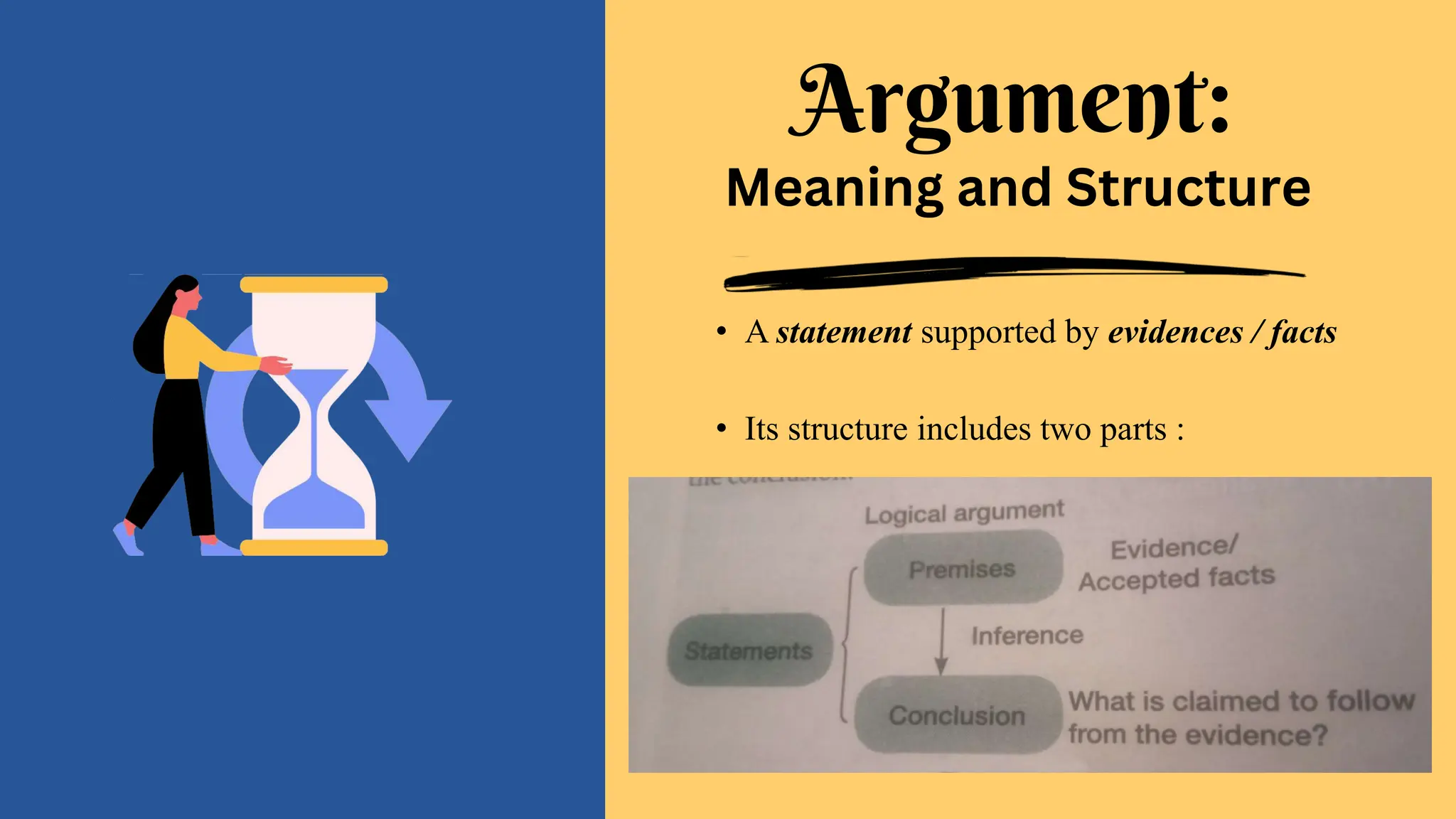
• A statement supported by evidences / facts
• Its structure includes two parts :
Argument:
Meaning and Structure
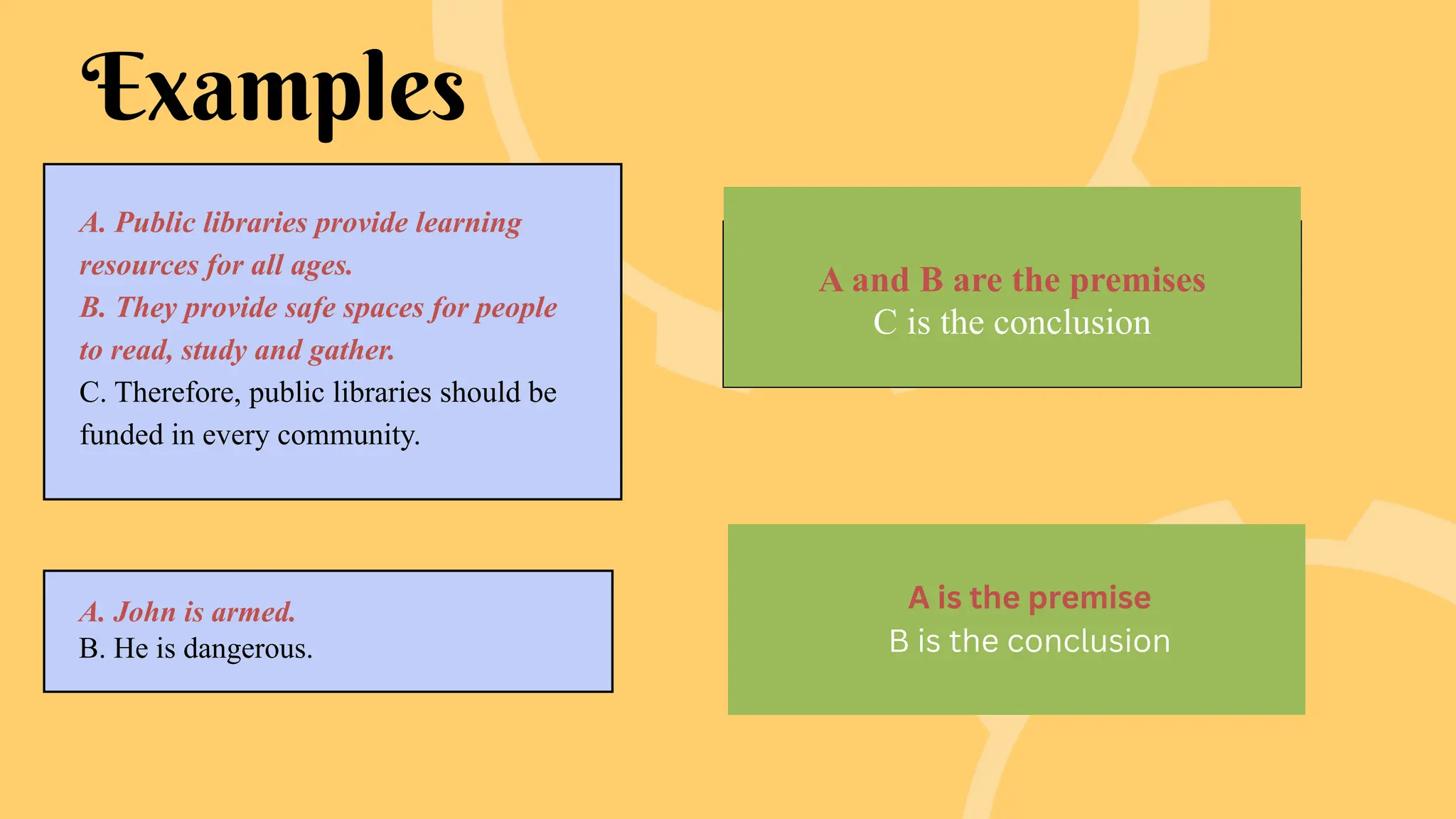
A and B are the premises
C is the conclusion
A. Public libraries provide learning
resources for all ages.
B. They provide safe spaces for people
to read, study and gather.
C. Therefore, public libraries should be
funded in every community.
A. John is armed.
B. He is dangerous.
Examples
A is the premise
B is the conclusion
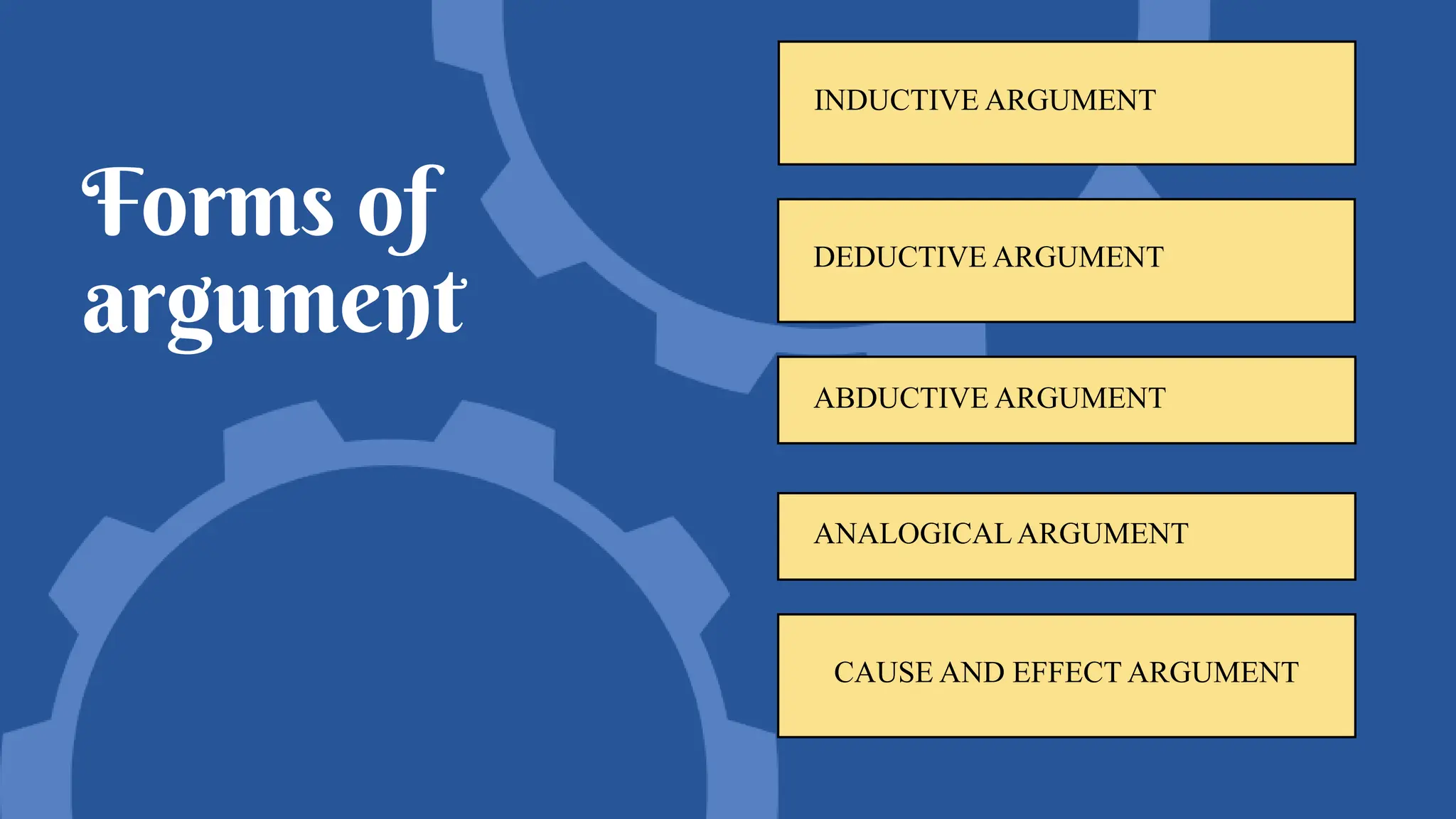
Forms of
argument
CAUSE AND EFFECT ARGUMENT
INDUCTIVE ARGUMENT
DEDUCTIVE ARGUMENT
ABDUCTIVE ARGUMENT
ANALOGICAL ARGUMENT
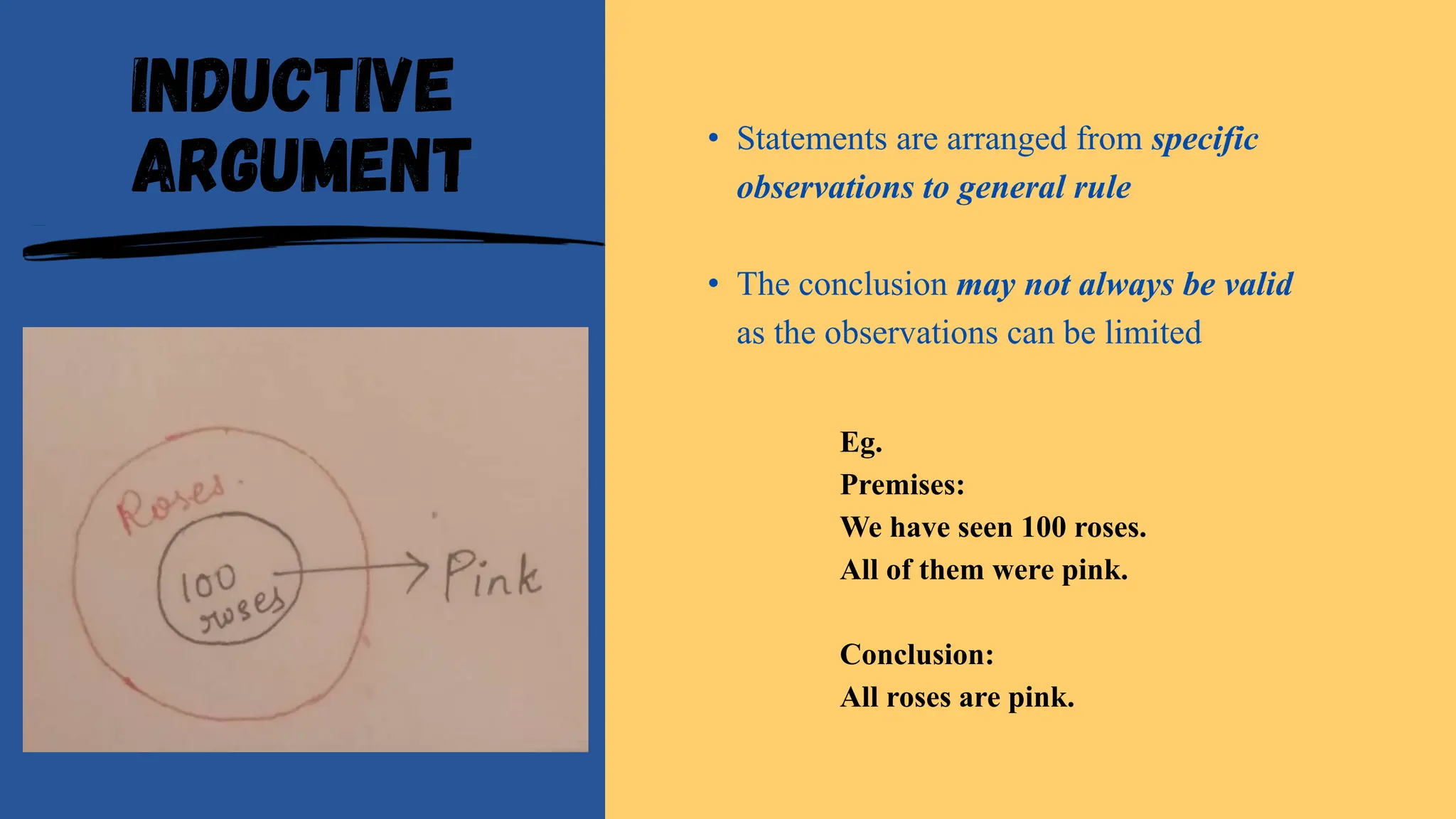
• Statements are arranged from specific
observations to general rule
• The conclusion may not always be valid
as the observations can be limited
Inductive
Argument
Eg.
Premises:
We have seen 100 roses.
All of them were pink.
Conclusion:
All roses are pink.
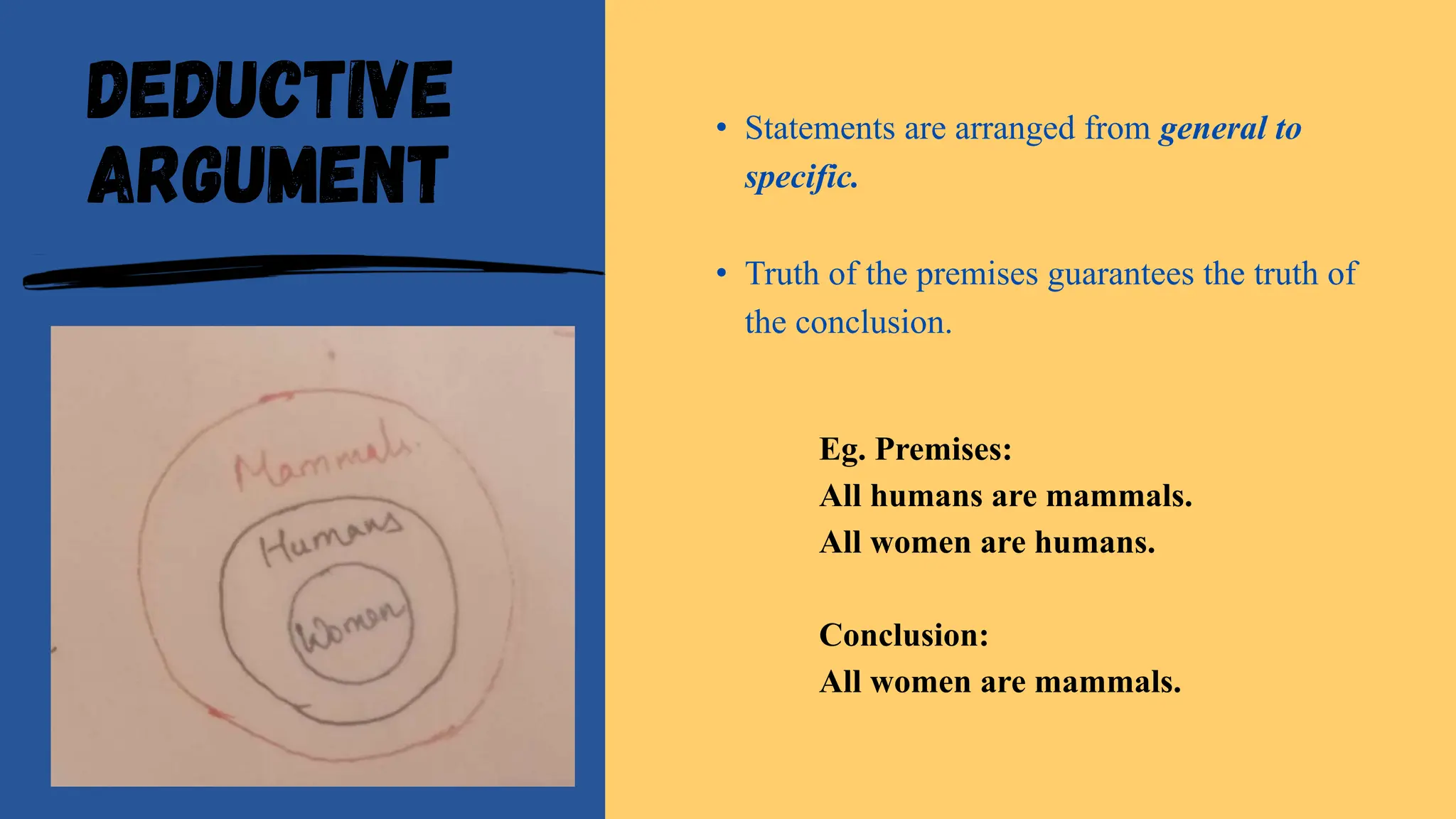
• Statements are arranged from general to
specific.
• Truth of the premises guarantees the truth of
the conclusion.
Deductive
argument
Eg. Premises:
All humans are mammals.
All women are humans.
Conclusion:
All women are mammals.
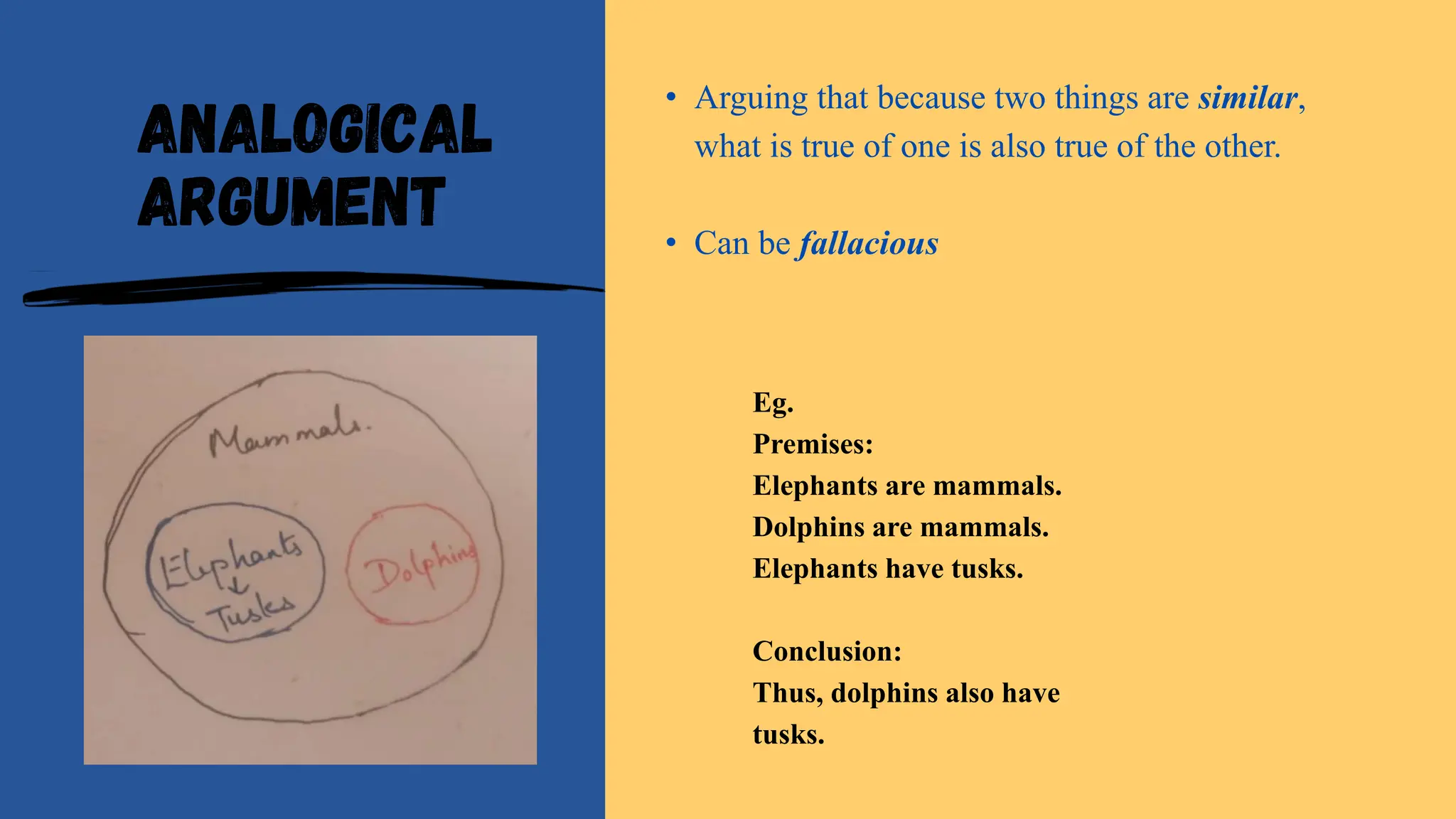
• Arguing that because two things are similar,
what is true of one is also true of the other.
• Can be fallacious
Analogical
argument
Eg.
Premises:
Elephants are mammals.
Dolphins are mammals.
Elephants have tusks.
Conclusion:
Thus, dolphins also have
tusks.
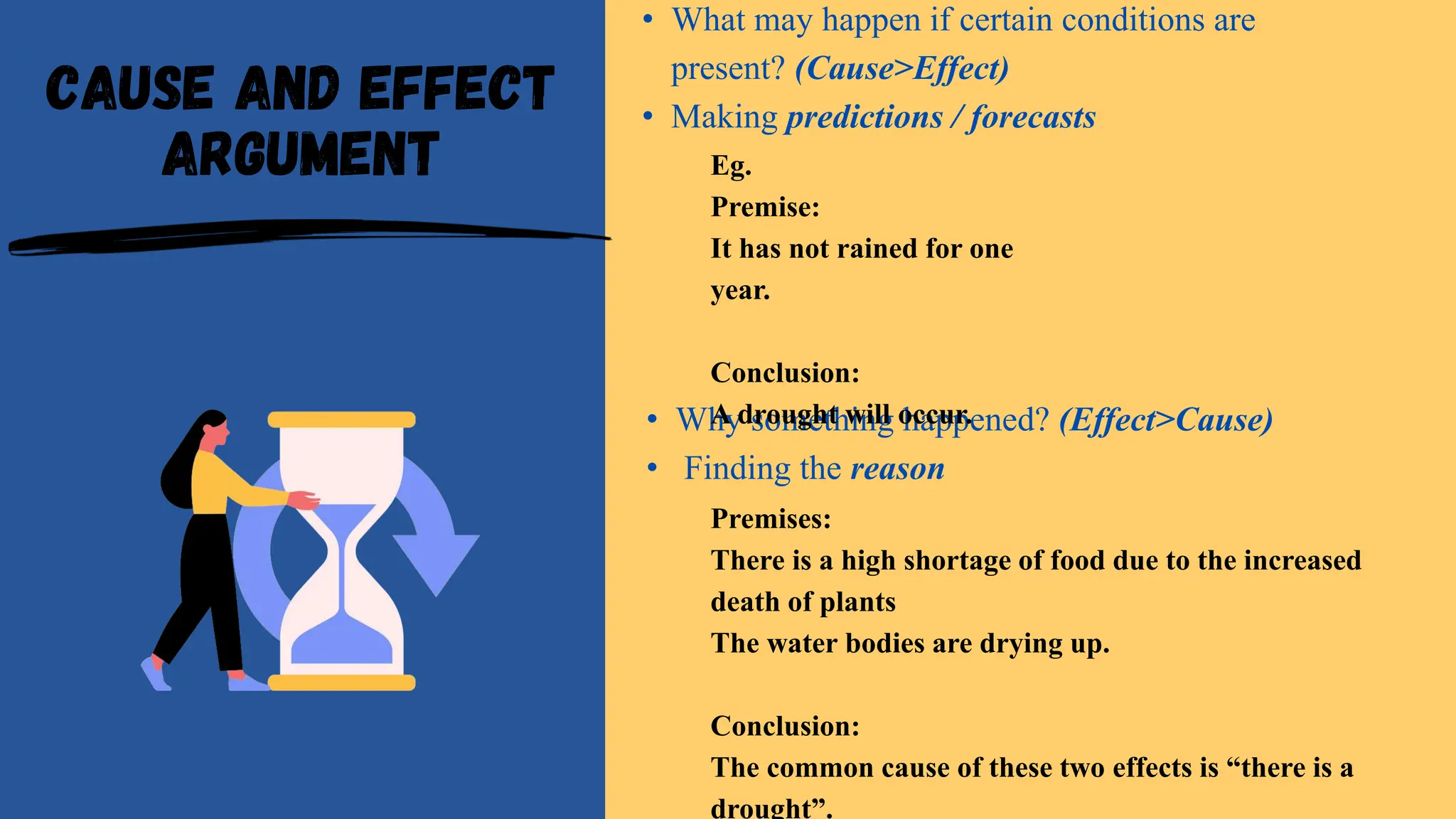
• What may happen if certain conditions are
present? (Cause>Effect)
• Making predictions / forecasts
CAUSE AND EFFECT
argument
Premises:
There is a high shortage of food due to the increased
death of plants
The water bodies are drying up.
Conclusion:
The common cause of these two effects is “there is a
drought”.
• Why something happened? (Effect>Cause)
• Finding the reason
Eg.
Premise:
It has not rained for one
year.
Conclusion:
A drought will occur.
A statement in an argument, consisting of:
Categorical Proposition
A quantifier
A word that represents the quantity
(All, some, no)
Subject term
The first category
Predicate term
The second category
Copula
Link word that connects the subject
and the predicate
(is, is not, are, are not)
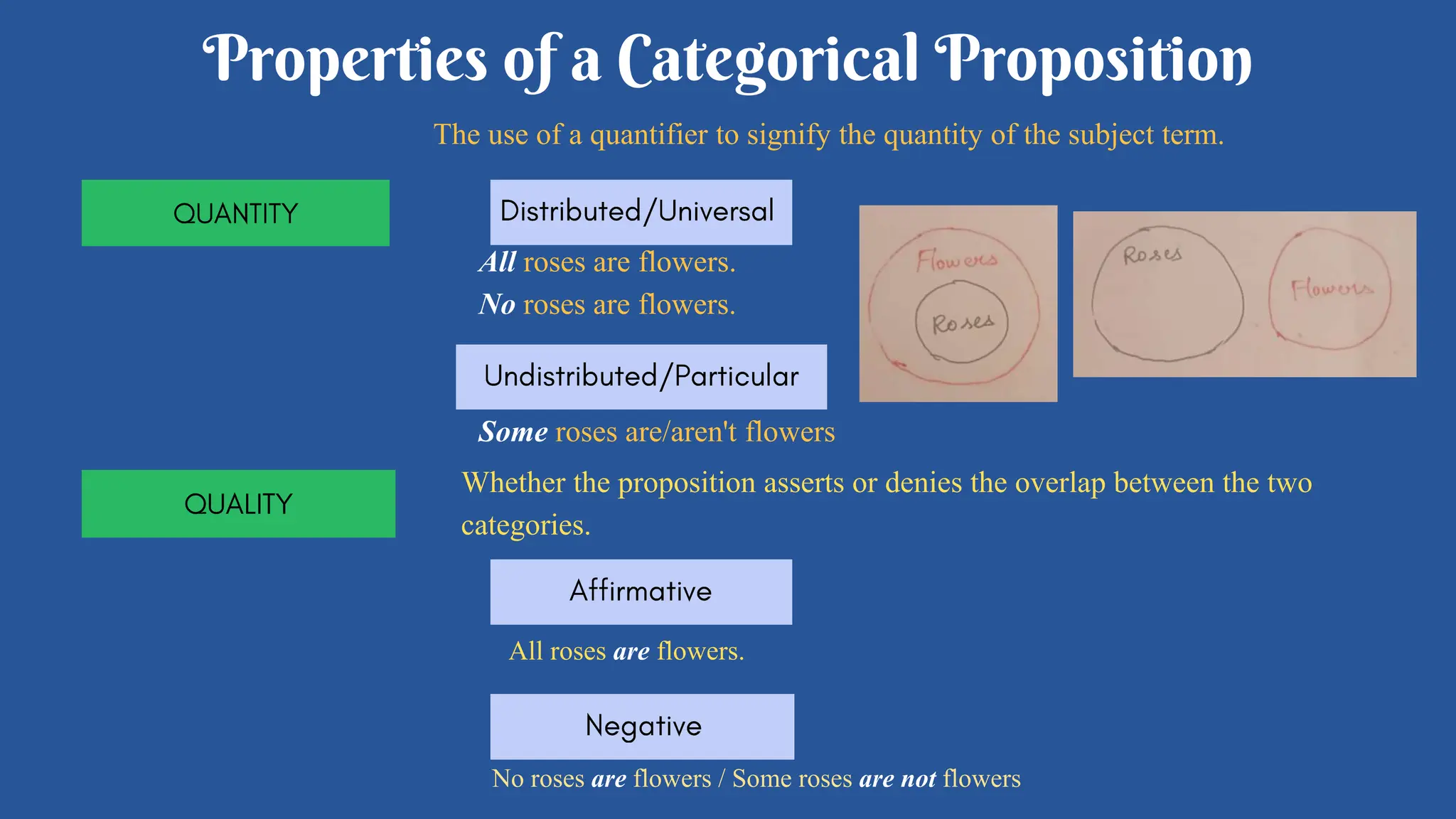
Properties of a Categorical Proposition
The use of a quantifier to signify the quantity of the subject term.
All roses are flowers.
No roses are flowers.
Some roses are/aren't flowers
Whether the proposition asserts or denies the overlap between the two
categories.
All roses are flowers.
No roses are flowers / Some roses are not flowers
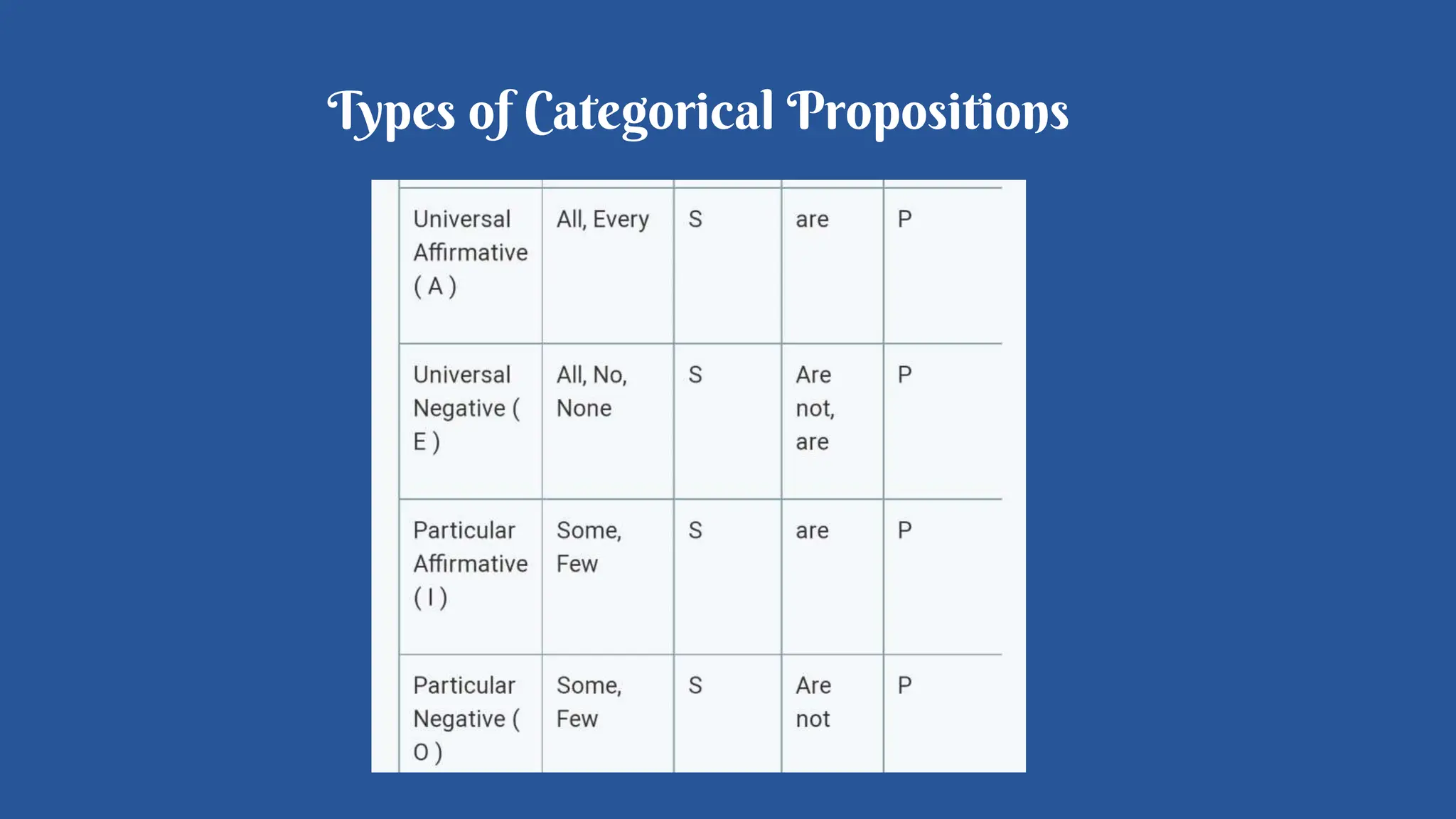
Types of Categorical Propositions
An argument consisting of
3 categorical propositions.
Categorical
Syllogism
Premises:
All mammals have tails.
All dogs are mammals.
Conclusion:
All dogs have tails.
MAJOR TERM : Predicate term of the
conclusion
MINOR TERM : Subject term of the
conclusion
MIDDLE TERM : Present in both the
premises
All the three terms occur
twice in the syllogism
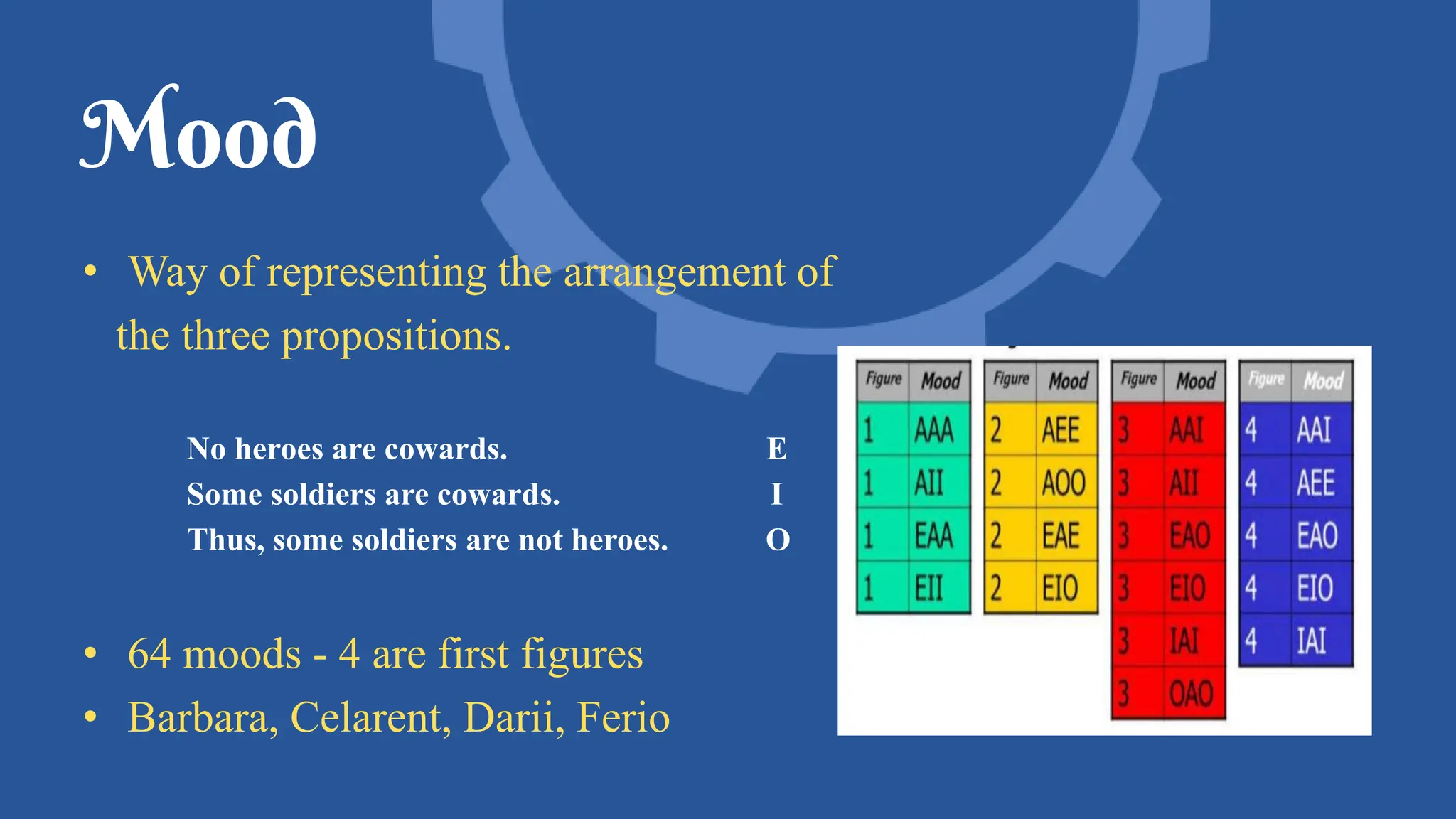
• Way of representing the arrangement of
the three propositions.
• 64 moods - 4 are first figures
• Barbara, Celarent, Darii, Ferio
Mood
No heroes are cowards. E
Some soldiers are cowards. I
Thus, some soldiers are not heroes. O
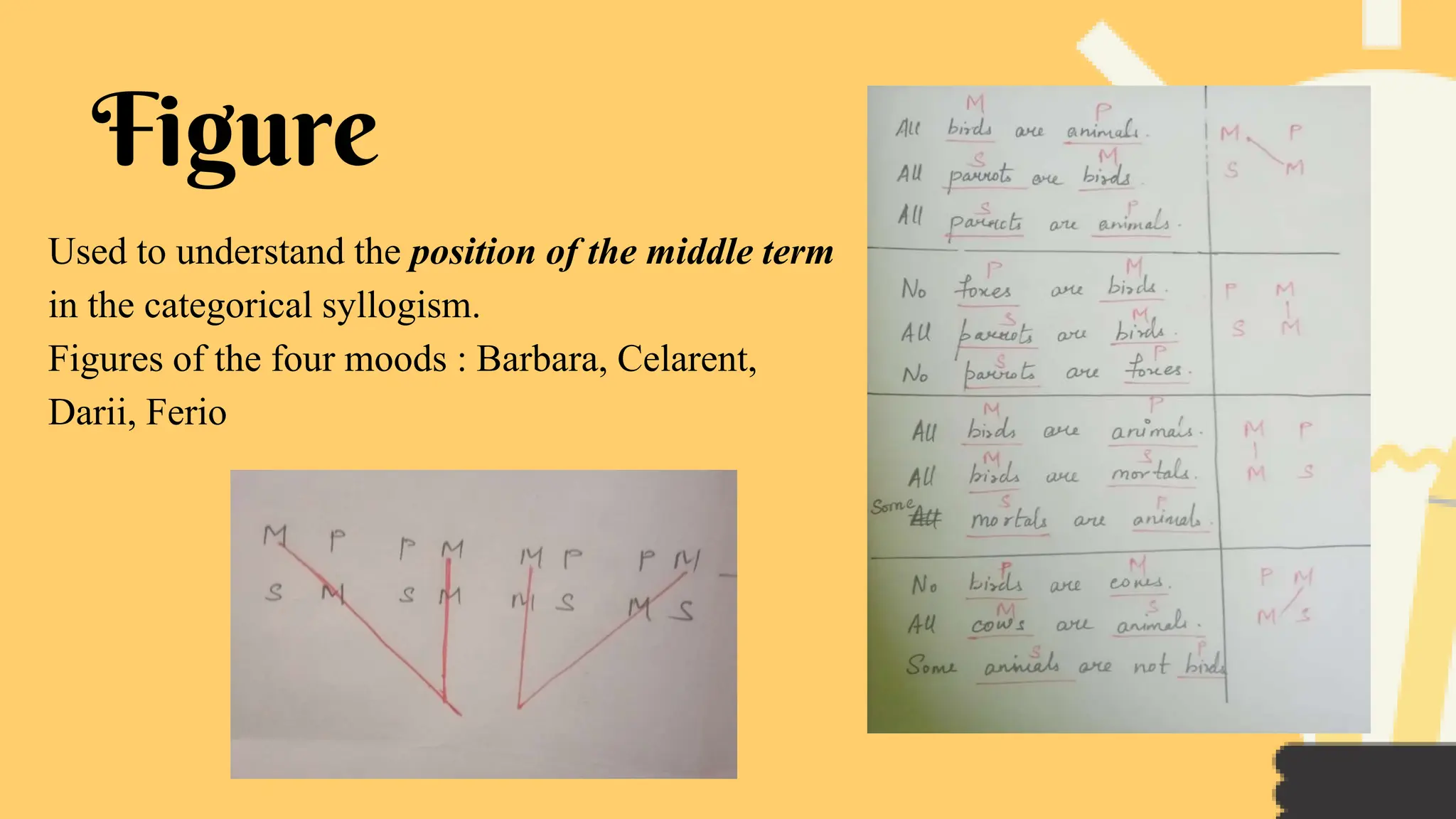
Figure
Used to understand the position of the middle term
in the categorical syllogism.
Figures of the four moods : Barbara, Celarent,
Darii, Ferio
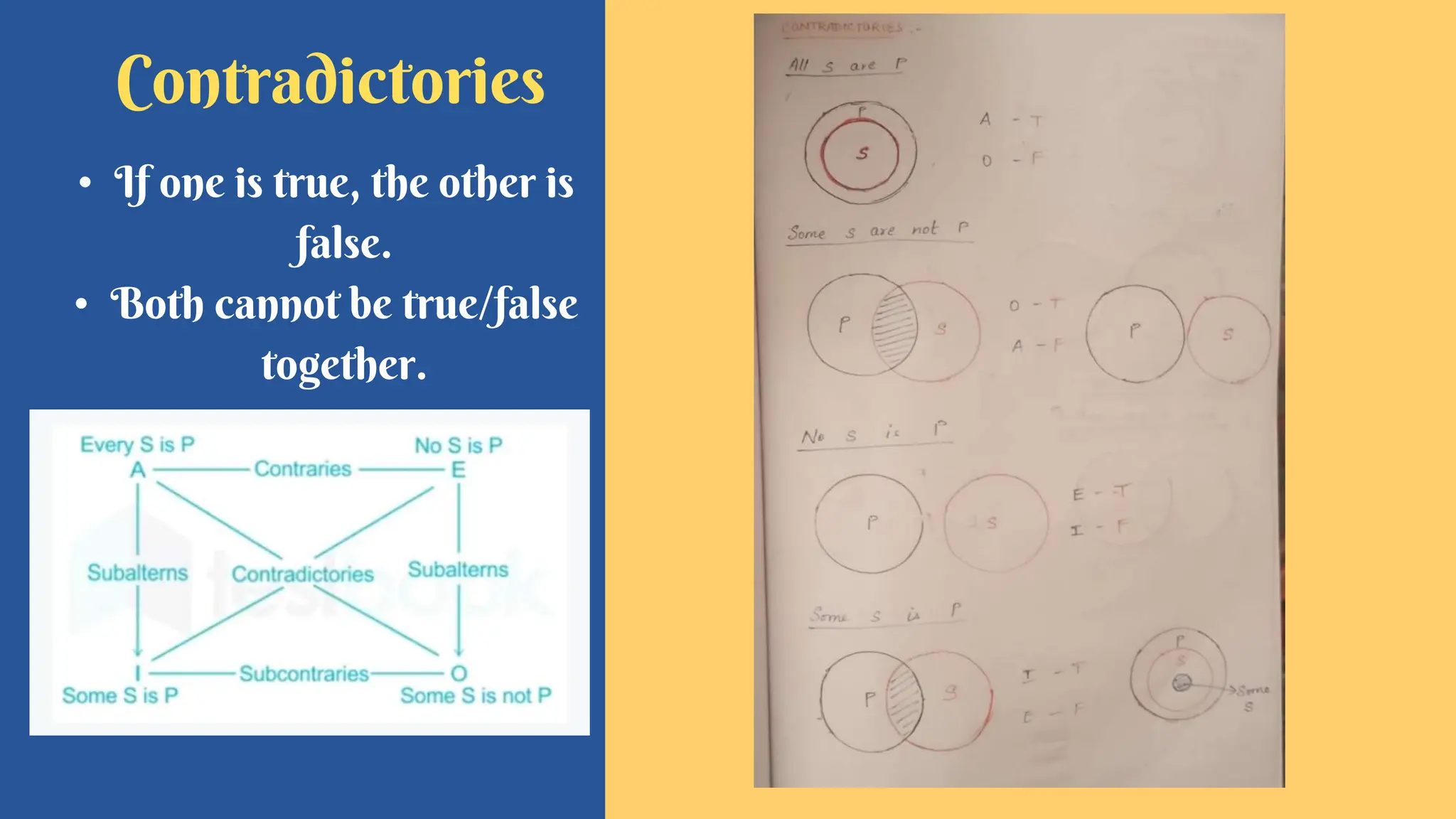
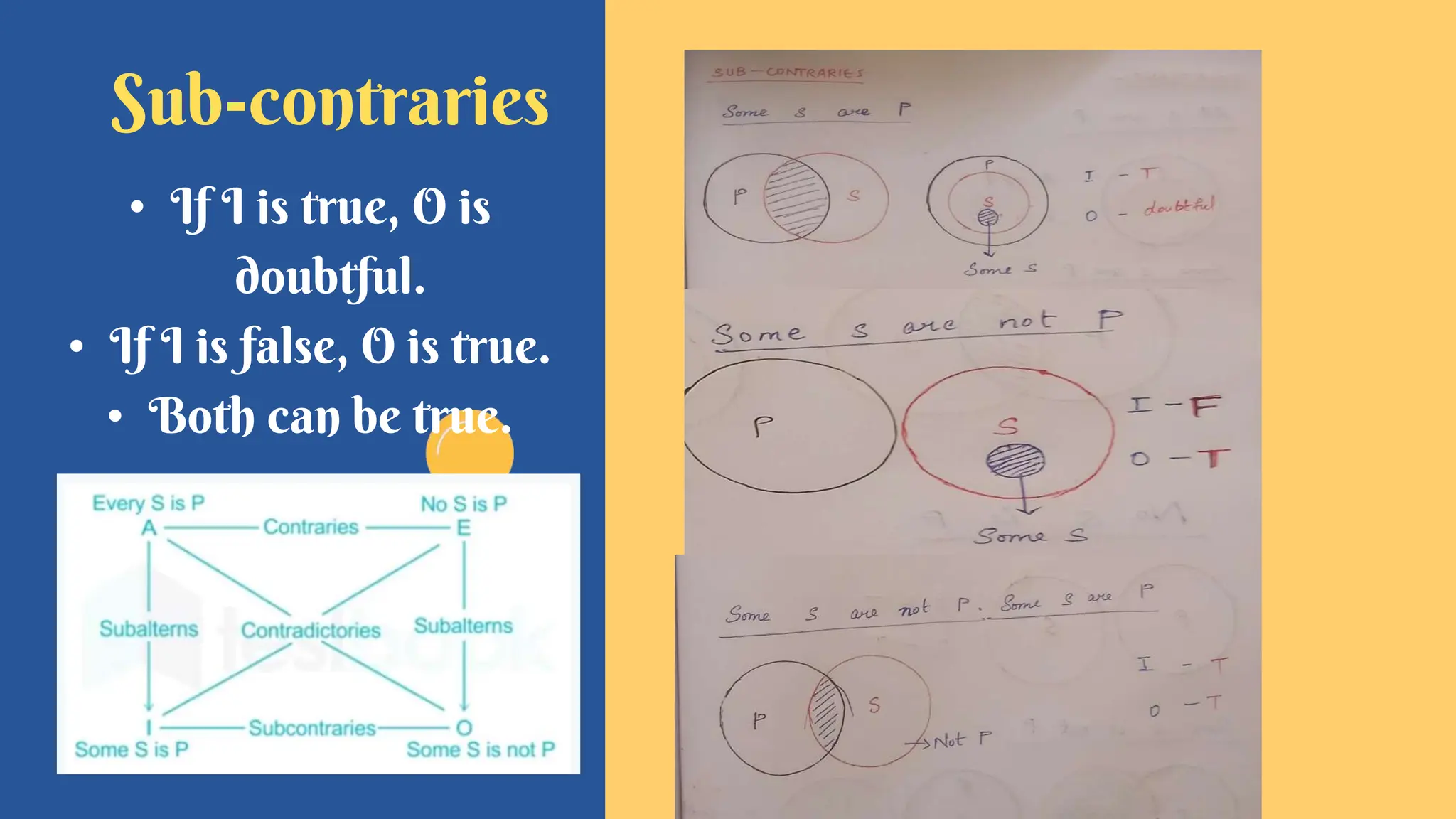
Contradictories
• If one is true, the other is
false.
• Both cannot be true/false
together.
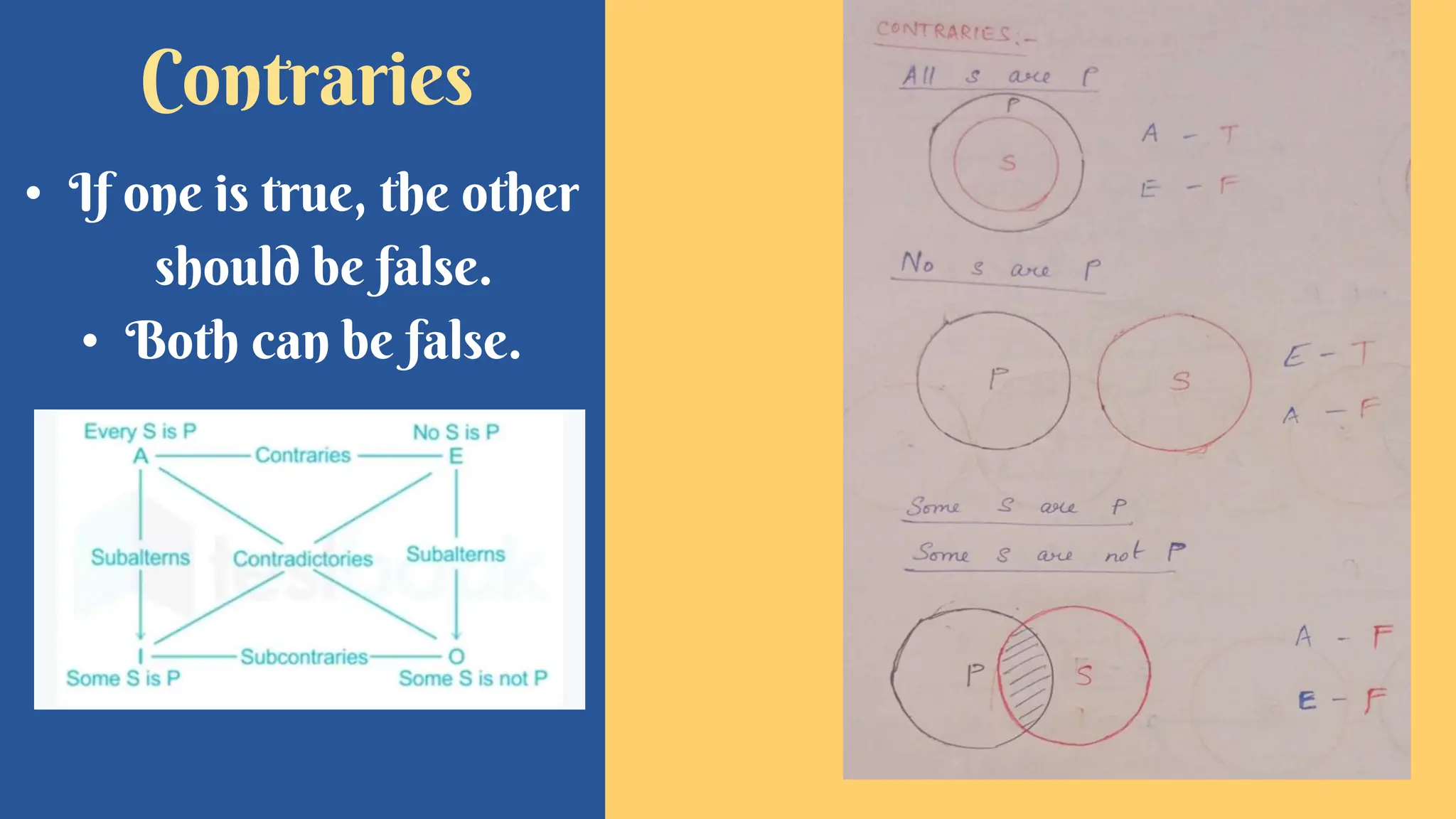
Contraries
• If one is true, the other
should be false.
• Both can be false.
Sub-contraries
• If I is true, O is
doubtful.
• If I is false, O is true.
• Both can be true.
Subalterns
• If A/E is true, I/O is true
• If I/O is true, A/E
may or may not be true.
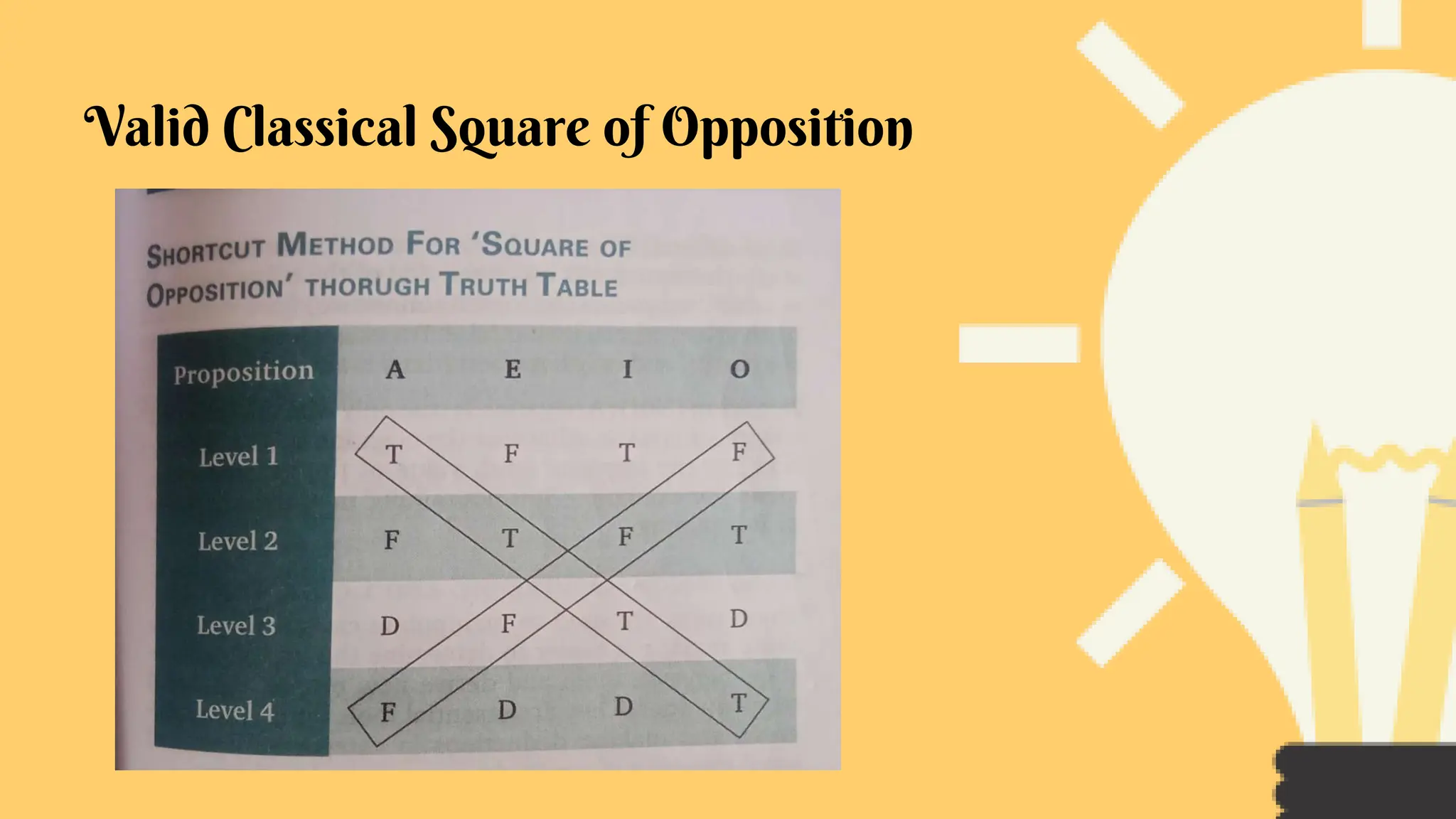
Valid Classical Square of Opposition
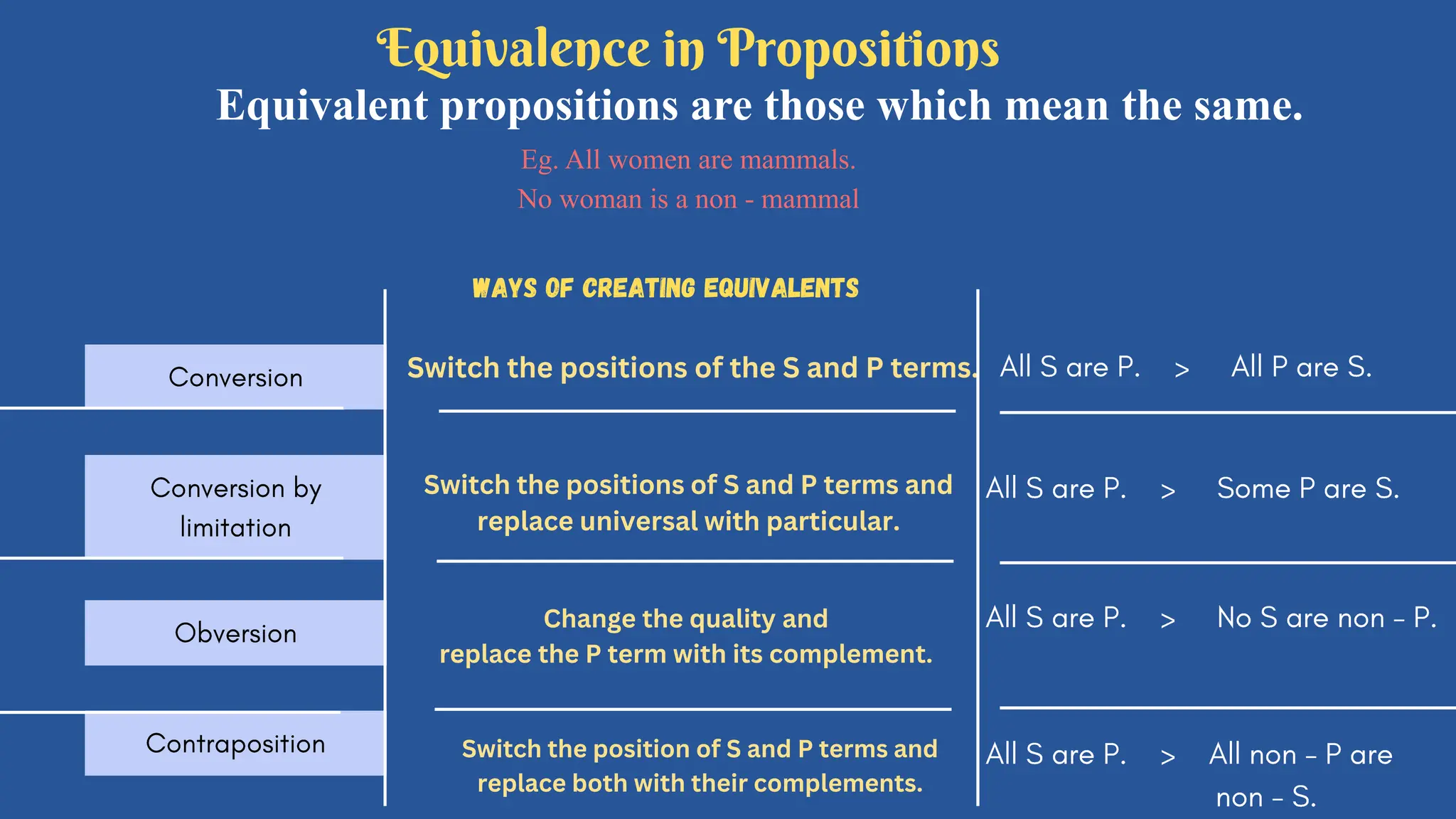
Equivalence in Propositions
Ways of creating equivalents
Equivalent propositions are those which mean the same.
Eg. All women are mammals.
No woman is a non - mammal
Switch the positions of the S and P terms.
Switch the positions of S and P terms and
replace universal with particular.
Change the quality and
replace the P term with its complement.
Switch the position of S and P terms and
replace both with their complements.
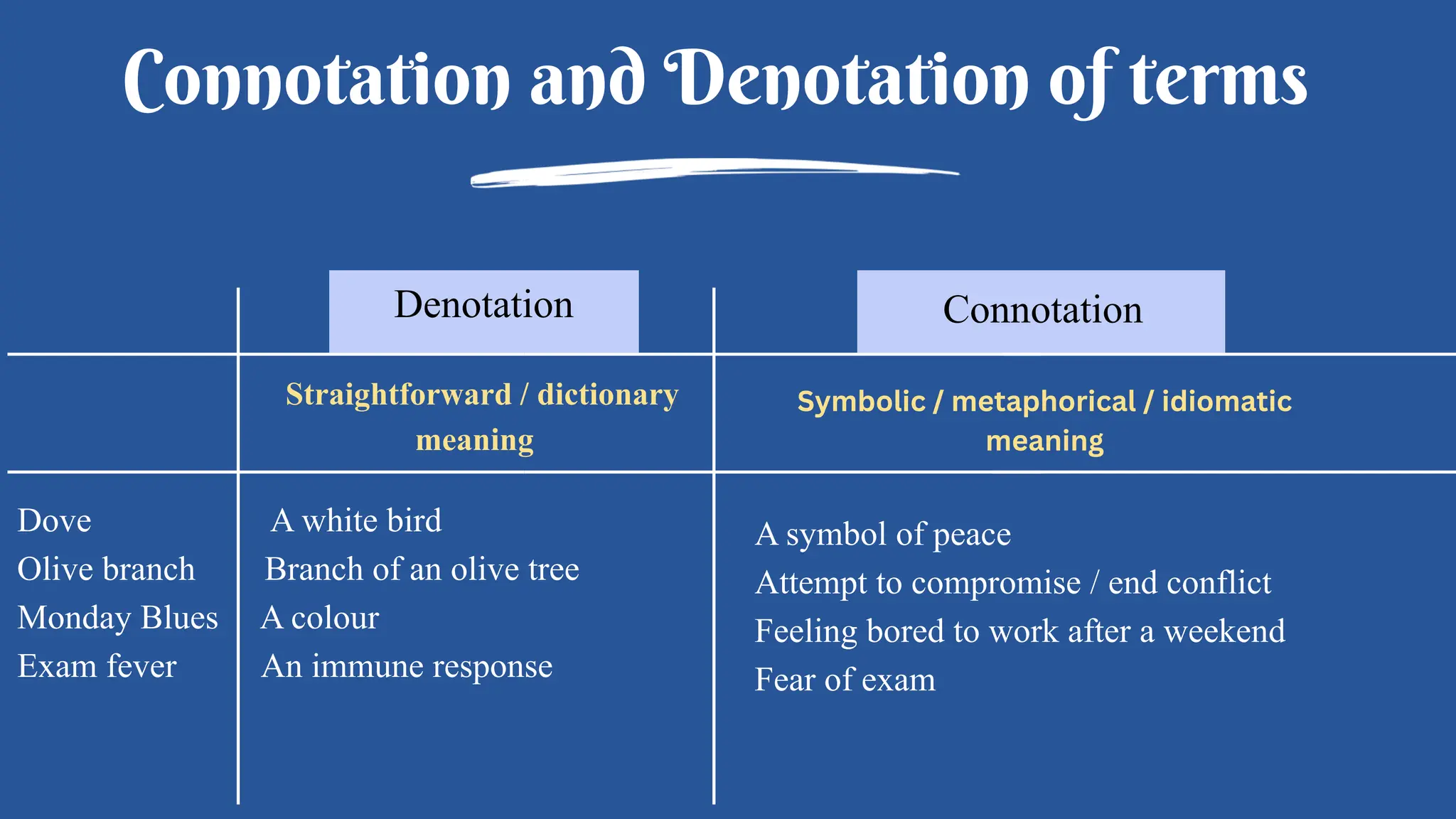
Connotation and Denotation of terms
Denotation Connotation
Dove A white bird
Olive branch Branch of an olive tree
Monday Blues A colour
Exam fever An immune response
A symbol of peace
Attempt to compromise / end conflict
Feeling bored to work after a weekend
Fear of exam
Straightforward / dictionary
meaning
Symbolic / metaphorical / idiomatic
meaning

Understanding the Structure of Arguments(LR).pptx

  • 1.
  • 2.
    Logic and LogicalReasoning: Why should we study logic? • Critical thinking and analysis • To make strong and valid arguments • One of the bases of research LOGICAL REASONING - "A scientific way of thinking about ideas". (Cambridge dictionary) LOGIC - Set of principles governing correct/reliable reasoning. It creates coherence. An Introduction
  • 3.
    • A statementsupported by evidences / facts • Its structure includes two parts : Argument: Meaning and Structure
  • 4.
    A and Bare the premises C is the conclusion A. Public libraries provide learning resources for all ages. B. They provide safe spaces for people to read, study and gather. C. Therefore, public libraries should be funded in every community. A. John is armed. B. He is dangerous. Examples A is the premise B is the conclusion
  • 5.
    Forms of argument CAUSE ANDEFFECT ARGUMENT INDUCTIVE ARGUMENT DEDUCTIVE ARGUMENT ABDUCTIVE ARGUMENT ANALOGICAL ARGUMENT
  • 6.
    • Statements arearranged from specific observations to general rule • The conclusion may not always be valid as the observations can be limited Inductive Argument Eg. Premises: We have seen 100 roses. All of them were pink. Conclusion: All roses are pink.
  • 7.
    • Statements arearranged from general to specific. • Truth of the premises guarantees the truth of the conclusion. Deductive argument Eg. Premises: All humans are mammals. All women are humans. Conclusion: All women are mammals.
  • 8.
    • Arguing thatbecause two things are similar, what is true of one is also true of the other. • Can be fallacious Analogical argument Eg. Premises: Elephants are mammals. Dolphins are mammals. Elephants have tusks. Conclusion: Thus, dolphins also have tusks.
  • 9.
    • What mayhappen if certain conditions are present? (Cause>Effect) • Making predictions / forecasts CAUSE AND EFFECT argument Premises: There is a high shortage of food due to the increased death of plants The water bodies are drying up. Conclusion: The common cause of these two effects is “there is a drought”. • Why something happened? (Effect>Cause) • Finding the reason Eg. Premise: It has not rained for one year. Conclusion: A drought will occur.
  • 10.
    A statement inan argument, consisting of: Categorical Proposition A quantifier A word that represents the quantity (All, some, no) Subject term The first category Predicate term The second category Copula Link word that connects the subject and the predicate (is, is not, are, are not)
  • 11.
    Properties of aCategorical Proposition The use of a quantifier to signify the quantity of the subject term. All roses are flowers. No roses are flowers. Some roses are/aren't flowers Whether the proposition asserts or denies the overlap between the two categories. All roses are flowers. No roses are flowers / Some roses are not flowers
  • 12.
  • 13.
    An argument consistingof 3 categorical propositions. Categorical Syllogism Premises: All mammals have tails. All dogs are mammals. Conclusion: All dogs have tails. MAJOR TERM : Predicate term of the conclusion MINOR TERM : Subject term of the conclusion MIDDLE TERM : Present in both the premises All the three terms occur twice in the syllogism
  • 14.
    • Way ofrepresenting the arrangement of the three propositions. • 64 moods - 4 are first figures • Barbara, Celarent, Darii, Ferio Mood No heroes are cowards. E Some soldiers are cowards. I Thus, some soldiers are not heroes. O
  • 15.
    Figure Used to understandthe position of the middle term in the categorical syllogism. Figures of the four moods : Barbara, Celarent, Darii, Ferio
  • 16.
    Contradictories • If oneis true, the other is false. • Both cannot be true/false together.
  • 17.
    Contraries • If oneis true, the other should be false. • Both can be false.
  • 18.
    Sub-contraries • If Iis true, O is doubtful. • If I is false, O is true. • Both can be true.
  • 19.
    Subalterns • If A/Eis true, I/O is true • If I/O is true, A/E may or may not be true.
  • 20.
  • 21.
    Equivalence in Propositions Waysof creating equivalents Equivalent propositions are those which mean the same. Eg. All women are mammals. No woman is a non - mammal Switch the positions of the S and P terms. Switch the positions of S and P terms and replace universal with particular. Change the quality and replace the P term with its complement. Switch the position of S and P terms and replace both with their complements.
  • 22.
    Connotation and Denotationof terms Denotation Connotation Dove A white bird Olive branch Branch of an olive tree Monday Blues A colour Exam fever An immune response A symbol of peace Attempt to compromise / end conflict Feeling bored to work after a weekend Fear of exam Straightforward / dictionary meaning Symbolic / metaphorical / idiomatic meaning