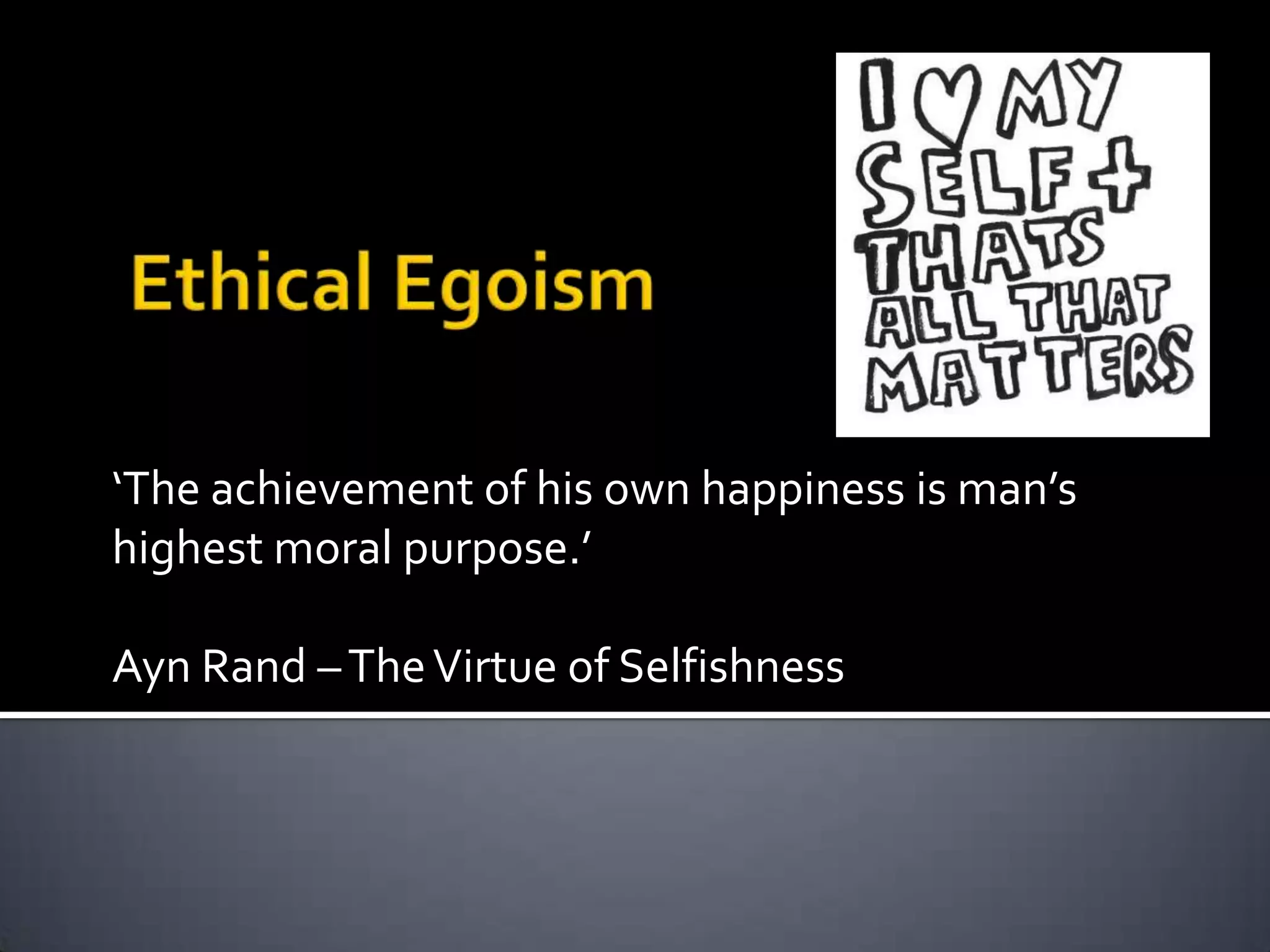
Ethical Egoism‘The achievement of his own happiness is man’s highest moral purpose.’Ayn Rand – The Virtue of Selfishness
Read Handouts Read through the handouts and discuss the questions and ideas presented on HedonismPsychological Egoism Egoistic Hedonism
Background – Is there a duty to contribute to famine relief?Watch video – Starvation in Ethiopia (6mins)15,000 children every day die of malnutrition5,500,000 every year
Whilst in wealthy countriesMaterialism rules supreme Watch video
Moral ProblemWe could forego luxury spending and give money to famine relief to help assist starving children The fact that we don’t implies our luxuries are more important than feeding/keeping alive the hungryWhy do we behave like this? - Discuss
Reasons asideWhat is our duty?What should we do?Morality requires that we balance our own interests against the interests of othersEg $100 dollars to go and watch a movie or donate that money to relieve famine/provide medicine and so help dying childrenCommon sense – leads to famine relief
Moral dutiesThe previous example leads to an assumption of moral duties‘we have ‘natural’ duties to others simply because they are people who could be helped or harmed by our actions’However, not everyone agrees with this
Ethical EgoismThe idea that each person ought to pursue his/her own self-interest exclusivelyIt differs from Psychological Egoism which is a theory of human nature concerned with how people do behaveEthical Egoism by contrast is a normative theory (a theory about how we ought to behave)It argues we have no duty except to do what is best for ourselvesThere is only one ultimate principle of conduct – the principle of self-interestAll duties and obligations are subject to self-interestIs this a self evident theory?
ImportantEthical Egoism does not say that you should avoid actions that help othersIt could be that by helping others you help yourself‘You scratch my back and I’ll scratch yours’Or your interests coincide with the interests of others and by helping yourself you inadvertently help othersThe important point is that in such cases the benefit to others is not what makes the action right
Selfishness not foolishness It is also important to realise it doesn’t endorse the idea that we ought always to do what we want to Short term pleasures may be harmful in the long runIt doesn’t lead to a debauched hedonistic lifestyle It says that a person really ought to do what really is in his/her own best advantage over the long run – It endorses selfishness not foolishness
Two arguments in support of Ethical Egoisma) Each of us is intimately familiar with our own individual needs and wants but we cannot know the desires and needs of other peopleb) The policy of looking out for others is an offensive intrusion into other people’s privacyc) Making other people the object of one’s ‘charity’ is degrading to them it robs them of their dignity and self-respectDiscuss these claims
BasicallyThe previous arguments amount to the idea that a policy of ‘looking out for others’ is self defeating
Ayn Rand2. The second argument was put forward by Ayn RandShe argues the ethics of altruism is a totally destructive idea both in terms of society and individuals taken in by itAltruism leads to a denial of the value of the individual‘ If a man accepts the ethics of altruism…his first concern is not how to live his life but how to sacrifice it’Discuss the quote – watch video (9)
Value of the human individualRand is arguing along these linesA person has only one life to live. If we value the individual – that is, if the individual has moral worth – then we must agree that this life is of supreme importanceIf your willing to sacrifice for the good of others (altruism) you are not truly valuing the human individualTherefore Ethical Egoism is the philosophy that ought to be accepted
James Rachels - Two Arguments against Ethical Egoism1. Rachels argues that …Ethical Egoism cannot provide solutions for conflicts of interestWe need moral rules because our interests some times come into conflictRead pg 91 – Booklet and summarise in your own words this argument
Differences between people are not arbitrary2. Ethical Egoism advocates that each of us divides the world into two categories of people – ourselves and the rest – and we regard the interests of the first group as more important than the interests of the second groupBut what is the difference between myself and others that justifies placing myself in this special categoryAm I more intelligent?Do I enjoy my life more?Are my achievements greater?What makes me so special?Failing an answer Ethical Egoism is an arbitrary doctrine
In deductive form Any moral doctrine that assigns greater importance to interests of one group than to those of another is unacceptably arbitrary unless there is some difference between the members of the groups that justifies treating them differentlyThereforeEthical Egoism would have each person assign greater importance to his or her own interests than to the interests of others. But there is no general difference between oneself and others, to which each person can appeal, that justifies this difference in treatmentThereforeEthical Egoism is unacceptably arbitrary and not a valid theory
Finally We should care about the interests of others for the same reason we care about our own interests – because their needs and desires are the same as our ownConsider again – the starving people we could help to feed by giving up some of our luxuries Why should we care about them?Because there is no difference between us and them – we would go to any lengths to feed ourselves if we were starvingTheir needs are the same as oursThey are no less deserving than us – If our needs should be met then so should theirsThis realization that we are equal to one another is the deepest reason why our morality must include some recognition of the needs of others and why Ethical Egoism fails as a moral theory
Peter Singer What arguments does Peter Singer put forward to contribute to this debateRead the short chapter in the booklet to summarise his ideas
Summary of debateRead the main points given in the bookletEssay/DebateIs it unreasonable to ask people to sacrifice their own pleasures/luxuries for those in poverty in other areas of the world?

Ethical egoism

  • 1.
    Ethical Egoism‘The achievementof his own happiness is man’s highest moral purpose.’Ayn Rand – The Virtue of Selfishness
  • 2.
    Read Handouts Readthrough the handouts and discuss the questions and ideas presented on HedonismPsychological Egoism Egoistic Hedonism
  • 3.
    Background – Isthere a duty to contribute to famine relief?Watch video – Starvation in Ethiopia (6mins)15,000 children every day die of malnutrition5,500,000 every year
  • 4.
    Whilst in wealthycountriesMaterialism rules supreme Watch video
  • 5.
    Moral ProblemWe couldforego luxury spending and give money to famine relief to help assist starving children The fact that we don’t implies our luxuries are more important than feeding/keeping alive the hungryWhy do we behave like this? - Discuss
  • 6.
    Reasons asideWhat isour duty?What should we do?Morality requires that we balance our own interests against the interests of othersEg $100 dollars to go and watch a movie or donate that money to relieve famine/provide medicine and so help dying childrenCommon sense – leads to famine relief
  • 7.
    Moral dutiesThe previousexample leads to an assumption of moral duties‘we have ‘natural’ duties to others simply because they are people who could be helped or harmed by our actions’However, not everyone agrees with this
  • 8.
    Ethical EgoismThe ideathat each person ought to pursue his/her own self-interest exclusivelyIt differs from Psychological Egoism which is a theory of human nature concerned with how people do behaveEthical Egoism by contrast is a normative theory (a theory about how we ought to behave)It argues we have no duty except to do what is best for ourselvesThere is only one ultimate principle of conduct – the principle of self-interestAll duties and obligations are subject to self-interestIs this a self evident theory?
  • 9.
    ImportantEthical Egoism doesnot say that you should avoid actions that help othersIt could be that by helping others you help yourself‘You scratch my back and I’ll scratch yours’Or your interests coincide with the interests of others and by helping yourself you inadvertently help othersThe important point is that in such cases the benefit to others is not what makes the action right
  • 10.
    Selfishness not foolishnessIt is also important to realise it doesn’t endorse the idea that we ought always to do what we want to Short term pleasures may be harmful in the long runIt doesn’t lead to a debauched hedonistic lifestyle It says that a person really ought to do what really is in his/her own best advantage over the long run – It endorses selfishness not foolishness
  • 11.
    Two arguments insupport of Ethical Egoisma) Each of us is intimately familiar with our own individual needs and wants but we cannot know the desires and needs of other peopleb) The policy of looking out for others is an offensive intrusion into other people’s privacyc) Making other people the object of one’s ‘charity’ is degrading to them it robs them of their dignity and self-respectDiscuss these claims
  • 12.
    BasicallyThe previous argumentsamount to the idea that a policy of ‘looking out for others’ is self defeating
  • 13.
    Ayn Rand2. Thesecond argument was put forward by Ayn RandShe argues the ethics of altruism is a totally destructive idea both in terms of society and individuals taken in by itAltruism leads to a denial of the value of the individual‘ If a man accepts the ethics of altruism…his first concern is not how to live his life but how to sacrifice it’Discuss the quote – watch video (9)
  • 14.
    Value of thehuman individualRand is arguing along these linesA person has only one life to live. If we value the individual – that is, if the individual has moral worth – then we must agree that this life is of supreme importanceIf your willing to sacrifice for the good of others (altruism) you are not truly valuing the human individualTherefore Ethical Egoism is the philosophy that ought to be accepted
  • 15.
    James Rachels -Two Arguments against Ethical Egoism1. Rachels argues that …Ethical Egoism cannot provide solutions for conflicts of interestWe need moral rules because our interests some times come into conflictRead pg 91 – Booklet and summarise in your own words this argument
  • 16.
    Differences between peopleare not arbitrary2. Ethical Egoism advocates that each of us divides the world into two categories of people – ourselves and the rest – and we regard the interests of the first group as more important than the interests of the second groupBut what is the difference between myself and others that justifies placing myself in this special categoryAm I more intelligent?Do I enjoy my life more?Are my achievements greater?What makes me so special?Failing an answer Ethical Egoism is an arbitrary doctrine
  • 17.
    In deductive formAny moral doctrine that assigns greater importance to interests of one group than to those of another is unacceptably arbitrary unless there is some difference between the members of the groups that justifies treating them differentlyThereforeEthical Egoism would have each person assign greater importance to his or her own interests than to the interests of others. But there is no general difference between oneself and others, to which each person can appeal, that justifies this difference in treatmentThereforeEthical Egoism is unacceptably arbitrary and not a valid theory
  • 18.
    Finally We shouldcare about the interests of others for the same reason we care about our own interests – because their needs and desires are the same as our ownConsider again – the starving people we could help to feed by giving up some of our luxuries Why should we care about them?Because there is no difference between us and them – we would go to any lengths to feed ourselves if we were starvingTheir needs are the same as oursThey are no less deserving than us – If our needs should be met then so should theirsThis realization that we are equal to one another is the deepest reason why our morality must include some recognition of the needs of others and why Ethical Egoism fails as a moral theory
  • 19.
    Peter Singer Whatarguments does Peter Singer put forward to contribute to this debateRead the short chapter in the booklet to summarise his ideas
  • 20.
    Summary of debateReadthe main points given in the bookletEssay/DebateIs it unreasonable to ask people to sacrifice their own pleasures/luxuries for those in poverty in other areas of the world?